
Introduction to Probability and Statistics from a Bayesian Viewpoint, Part 2, Inference
The two parts of this book treat probability and statistics as mathematical disciplines and with the same degree of rigour as is adopted for other branches of applied mathematics at the level of a British honours degree. They contain the minimum information about these subjects that any honours graduate in mathematics ought to know. They are written primarily for general mathematicians, rather than for statistical specialists or for natural scientists who need to use statistics in their work. No previous knowledge of probability or statistics is assumed, though familiarity with calculus and linear algebra is required. The first volume takes the theory of probability sufficiently far to be able to discuss the simpler random processes, for example, queueing theory and random walks. The second volume deals with statistics, the theory of making valid inferences from experimental data, and includes an account of the methods of least squares and maximum likelihood; it uses the results of the first volume.
1014818754
Introduction to Probability and Statistics from a Bayesian Viewpoint, Part 2, Inference
The two parts of this book treat probability and statistics as mathematical disciplines and with the same degree of rigour as is adopted for other branches of applied mathematics at the level of a British honours degree. They contain the minimum information about these subjects that any honours graduate in mathematics ought to know. They are written primarily for general mathematicians, rather than for statistical specialists or for natural scientists who need to use statistics in their work. No previous knowledge of probability or statistics is assumed, though familiarity with calculus and linear algebra is required. The first volume takes the theory of probability sufficiently far to be able to discuss the simpler random processes, for example, queueing theory and random walks. The second volume deals with statistics, the theory of making valid inferences from experimental data, and includes an account of the methods of least squares and maximum likelihood; it uses the results of the first volume.
50.0
In Stock
5
1
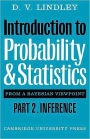

Introduction to Probability and Statistics from a Bayesian Viewpoint, Part 2, Inference
308
Introduction to Probability and Statistics from a Bayesian Viewpoint, Part 2, Inference
308Paperback(Revised ed.)
$50.00
50.0
In Stock

Product Details
| ISBN-13: | 9780521298667 |
|---|---|
| Publisher: | Cambridge University Press |
| Publication date: | 03/20/1980 |
| Edition description: | Revised ed. |
| Pages: | 308 |
| Product dimensions: | 5.51(w) x 8.46(h) x 0.79(d) |
From the B&N Reads Blog