
This edition includes contemporary reviews, other writings by Haggard on Africa and romance, and documents focusing on imperialism and diamond mining in late nineteenth-century South Africa.
This edition includes contemporary reviews, other writings by Haggard on Africa and romance, and documents focusing on imperialism and diamond mining in late nineteenth-century South Africa.

King Solomon's Mines
306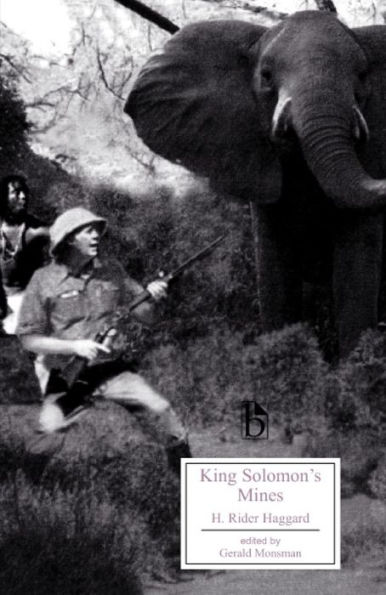
King Solomon's Mines
306Paperback(New Edition)
-
SHIP THIS ITEMIn stock. Ships in 1-2 days.PICK UP IN STORE
Your local store may have stock of this item.
Available within 2 business hours
Related collections and offers
Overview
This edition includes contemporary reviews, other writings by Haggard on Africa and romance, and documents focusing on imperialism and diamond mining in late nineteenth-century South Africa.

Product Details
| ISBN-13: | 9781551114392 |
|---|---|
| Publisher: | Broadview Press |
| Publication date: | 08/12/2002 |
| Series: | Broadview Literary Texts Series |
| Edition description: | New Edition |
| Pages: | 306 |
| Product dimensions: | 5.50(w) x 8.50(h) x 0.62(d) |
About the Author

Gerald Monsman is a Professor of English at the University of Arizona. He is the author of Olive Schreiner's Fiction: Landscape and Power (1991).
Read an Excerpt
CHAPTER I
I Meet Sir Henry Curtis
It is a curious thing that at my age-fifty-five last birthday- I should find myself taking up a pen to try to write a history. I wonder what sort of a history it will be when I have finished it, if ever I come to the end of the trip! I have done a good many things in my life, which seems a long one to me, owing to my having begun work so young, perhaps. At an age when other boys are at school I was earning my living as a trader in the old Colony. I have been trading, hunting, fighting, or mining ever since. And yet it is only eight months ago that I made my pile. It is a big pile now that I have got it-I don't yet know how big-but I do not think I would go through the last fifteen or sixteen months again for it; no, not if I knew that I should come out safe at the end, pile and all. But then I am a timid man, and dislike violence, and, moreover, I am fairly sick of adventure. I wonder why I am going to write this book: it is not in my line. I am not a literary man, though very devoted to the Old Testament and also to the "Ingoldsby Legends." Let me try to set down my reasons, just to see if I have any.
First reason: Because Sir Henry Curtis and Captain John Good asked me to.
Second reason: Because I am laid up here at Durban with the pain in my left leg. Ever since that confounded lion got hold of me I have been liable to this trouble, and its being rather bad just now makes me limp more than ever. There must be some poison in a lion's teeth, otherwise how is it that when your wounds are healed they break out again, generally, mark you, at the same time of year that you got your mauling? It is ahard thing when one has shot sixty-five lions and more, as I have in the course of my life, that the sixty-sixth should chew your leg like a quid of tobacco. It breaks the routine of the thing, and putting other considerations aside, I am an orderly man and don't like that. This is by the way.
Third reason: Because I want my boy Harry, who is over there at the hospital in London studying to become a doctor, to have something to amuse him and keep him out of mischief for a week or so. Hospital work must sometimes pall and grow rather dull, for even of cutting up dead bodies there may come satiety, and as this history will not be dull, whatever else it may be, it will put a little life into things for a day or two while Harry is reading it.
Fourth reason and last: Because I am going to tell the strangest story that I know of. It may seem a queer thing to say, especially considering that there is no woman in it-except Foulata. Stop, though! there is Gagaoola, if she was a woman and not a fiend. But she was a hundred at least, and therefore not marriageable, so I don't count her. At any rate, I can safely say that there is not a petticoat in the whole history. Well, I had better come to the yoke. It is a stiff place, and I feel as though I were bogged up to the axle. But "sutjes, sutjes," as the Boers say-I am sure I don't know how they spell it-softly does it. A strong team will come through at last, that is, if they are not too poor. You can never do anything with poor oxen. Now to begin.
I, Allan Quatermain, of Durban, Natal, Gentleman, make oath and say-That's how I began my deposition before the magistrate about poor Khiva's and Ventvögel's sad deaths; but somehow it doesn't seem quite the right way to begin a book. And, besides, am I a gentleman? What is a gentleman? I don't quite know, and yet I have had to do with niggers-no, I will scratch out that word "niggers," for I do not like it. I've known natives who are, and so you will say, Harry, my boy, before you have done with this tale, and I have known mean whites with lots of money and fresh out from home, too, who are not. Well, at any rate, I was born a gentleman, though I have been nothing but a poor travelling trader and hunter all my life. Whether I have remained so I know not, you must judge of that. Heaven knows I've tried. I have killed many men in my time, yet I have never slain wantonly or stained my hand in innocent blood, but only in self-defence. The Almighty gave us our lives, and I suppose He meant us to defend them, at least I have always acted on that, and I hope it will not be brought up against me when my clock strikes. There, there, it is a cruel and a wicked world, and for a timid man I have been mixed up in a deal of slaughter. I cannot tell the rights of it, but at any rate I have never stolen, though once I cheated a Kafir out of a herd of cattle. But then he had done me a dirty turn, and it has troubled me ever since into the bargain.
Well, it is eighteen months or so ago since first I met Sir Henry Curtis and Captain Good, and it was in this way. I had been up elephant hunting beyond Bamangwato, and had met with bad luck. Everything went wrong that trip, and to top up with I got the fever badly. So soon as I was well enough I trekked down to the Diamond Fields, sold such ivory as I had, together with my wagon and oxen, discharged my hunters, and took the post-cart to the Cape. After spending a week in Cape Town, finding that they overcharged me at the hotel, and having seen everything there was to see, including the botanical gardens, which seem to me likely to confer a great benefit on the country, and the new Houses of Parliament, which I expect will do nothing of the sort, I determined to go back to Natal by the Dunkeld, then lying at the docks waiting for the Edinburgh Castle due in from England. I took my berth and went aboard, and that afternoon the Natal passengers from the Edinburgh Castle transhipped, and we weighed and put out to sea.
Among the passengers who came on board there were two who excited my curiosity. One, a gentleman of about thirty, was per- haps the biggest-chested and longest-armed man I ever saw. He had yellow hair, a thick yellow beard, clear-cut features, and large grey eyes set deep into his head. I never saw a finer-looking man, and somehow he reminded me of an ancient Dane. Not that I know much of ancient Danes, though I knew a modern Dane who did me out of ten pounds; but I remember once seeing a picture of some of those gentry, who, I take it, were a kind of white Zulus. They were drinking out of big horns, and their long hair hung down their backs, and as I looked at my friend standing there by the companion-ladder, I thought that if he only let his hair grow a little, put one of those chain shirts on to his great shoulders, and took hold of a battle-axe and a horn mug, he might have sat as a model for that picture. And by the way it is a curious thing, and just shows how the blood will out, I discovered afterwards that Sir Henry Curtis, for that was the big man's name, is of Danish blood.* He also reminded me strongly of somebody else, but at the time I could not remember who it was.
The other man who stood talking to Sir Henry was short, stout, and dark, and of quite a different cut. I suspected at once that he was a naval officer; I don't know why, but it is difficult to mistake a navy man. I have gone on shooting trips with several of them in the course of my life, and they have always proved themselves the best and bravest and nicest fellows I ever met, though given to the use of profane language.
I asked a page or two back, what is a gentleman? I'll answer it now: a Royal Naval officer is, in a general sort of a way, though of course there may be a black sheep among them here and there. I fancy it is just the wide seas and the breath of God's winds that wash their hearts and blow the bitterness out of their minds and make them what men ought to be. Well, to return, I was right again; I ascertained that he was a naval officer, a lieutenant of thirty-one, who, after seventeen years' service, had been turned out of her Majesty's employ with the barren honour of a commander's rank, because it was impossible that he should be promoted. This is what people who serve the Queen have to expect: to be shot out into the
* Mr. Quatermain's ideas about ancient Danes seem to be rather confused; we have always understood that they were dark-haired people. Probably he was thinking of Saxons. -Editor.
cold world to find a living just when they are beginning to really understand their work, and to reach the prime of life. Well, I suppose they don't mind it, but for my part I had rather earn my bread as a hunter. One's halfpence are as scarce perhaps, but you do not get so many kicks. His name I found out-by referring to the passengers' list-was Good-Captain John Good. He was broad, of medium height, dark, stout, and rather a curious man to look at. He was so very neat and so very clean shaved, and he always wore an eye-glass in his right eye. It seemed to grow there, for it had no string, and he never took it out except to wipe it. At first I thought he used to sleep in it, but I afterwards found that this was a mistake. He put it in his trousers pocket when he went to bed, together with his false teeth, of which he had two beautiful sets that, my own being none of the best, have often caused me to break the tenth commandment. But I am anticipating.
Soon after we had got under weigh evening closed in, and brought with it very dirty weather. A keen breeze sprang up off land, and a kind of aggravated Scotch mist soon drove everybody from the deck. As for the Dunkeld, she is a flat-bottomed punt, and going up light as she was, she rolled very heavily. It almost seemed as though she would go right over, but she never did. It was quite impossible to walk about, so I stood near the engines where it was warm, and amused myself with watching the pendulum, which was fixed opposite to me, swinging slowly backwards and forwards as the vessel rolled, and marking the angle she touched at each lurch.
"That pendulum's wrong; it is not properly weighted," suddenly said a voice at my shoulder somewhat testily. Looking round I saw the naval officer whom I had noticed when the passengers came aboard.
"Indeed, now what makes you think so?" I asked.
"Think so. I don't think at all. Why there"-as she righted herself after a roll-"if the ship had really rolled to the degree that thing pointed to then she would never have rolled again, that's all. But it is just like these merchant skippers, they always are so confoundedly careless."
Just then the dinner-bell rang, and I was not sorry, for it is a dreadful thing to have to listen to an officer of the Royal Navy when he gets on to that subject. I only know one worse thing, and it is to hear a merchant skipper express his candid opinion of officers of the Royal Navy.
Captain Good and I went down to dinner together, and there we found Sir Henry Curtis already seated. He and Captain Good were placed together, and I sat opposite to them. The captain and I soon fell into talk about shooting and what not; he asking me many questions, and I answering them as well as I could. Presently he got on to elephants.
"Ah, sir," called out somebody who was sitting near me, "you've reached the right man for that; Hunter Quatermain should be able to tell you about elephants if anybody can."
Sir Henry, who had been sitting quite quiet listening to our talk, started visibly.
"Excuse me, sir," he said, leaning forward across the table, and speaking in a low deep voice, a very suitable voice, it seemed to me, to come out of those great lungs. "Excuse me, sir, but is your name Allan Quatermain?"
I said that it was.
The big man made no further remark, but I heard him mutter "fortunate" into his beard.
Presently dinner came to an end, and as we were leaving the saloon Sir Henry strolled up and asked me if I would come into his cabin to smoke a pipe. I accepted, and he led the way to the Dunkeld deck cabin, and a very good cabin it is. It had been two cabins, but when Sir Garnet or one of those big swells went down the coast in the Dunkeld, they knocked away the partition and have never put it up again. There was a sofa in the cabin, and a little table in front of it. Sir Henry sent the steward for a bottle of whisky, and the three of us sat down and lit our pipes.
"Mr. Quatermain," said Sir Henry Curtis, when the steward had brought the whisky and lit the lamp, "the year before last about this time you were, I believe, at a place called Bamangwato, to the north of the Transvaal."
"I was," I answered, rather surprised that this gentleman should be so well acquainted with my movements, which were not, so far as I was aware, considered of general interest.
"You were trading there, were you not?" put in Captain Good, in his quick way.
"I was. I took up a wagon-load of goods, made a camp outside the settlement, and stopped till I had sold them."
Table of Contents
PrefaceIntroduction
H. Rider Haggard: A Brief Chronology
A Note on the Text
King Solomon’s Mines
Appendix A: Victorian Critical Reaction
- The Saturday Review, 10 October 1885
- Robert Louis Stevenson, 1885
- The Spectator, 7 November 1885
- The Literary World, 23 January 1886
- Gerard Manley Hopkins, 28 October 1886
- The Dial, May 1887
- The Book Buyer, August 1887
- The Church Quarterly Review, January 1888
- Fortnightly Review, 1 September 1888
- Forum, May 1889
Appendix B: Haggard on Africa and Romance
- “Notes on King Solomon’s Mines” (1906)
- “Anecdote” (c. 1876)
- “A Zulu War-Dance” (1877)
- “About Fiction” (1877)
Appendix C: Historical Documents: Natives and Imperialists in South Africa
- Fred Fynney, Zululand and the Zulus (1880)
- John Ruskin, Lectures on Art (1873)
- Cecil Rhodes,“Confession of Faith” (1877)
- Cecil Rhodes, Speeches (1881-1900)
- Olive Schreiner, Trooper Peter Halket of Mashonaland (1897)
- Olive Schreiner, Thoughts on South Africa (1890-92)
Appendix D: Historical Documents: Spoils of Imperialism: Gold, Diamonds, and Ivory
- The Bible, I Kings 10: 1-13
- Kebra Negast (c. 14th Century)
- “The Ophir of Scripture,” The Illustrated London News, 11 January 1873
- Hugh Mulleneux Walmsley, The Ruined Cities of Zulu Land (1869)
- Olive Schreiner, “Diamond Fields” (c. 1880)
- Frederick Courteney Selous, A Hunter’s Wanderings in Africa (1890)
Works Cited and Recommended Reading
Reading Group Guide
Touted by its 1885 publisher as “the most amazing story ever written,” King Solomon’s Mines was one of the bestselling novels of the nineteenth century. H. Rider Haggard’s thrilling saga of elephant hunter Allan Quatermain and his search for fabled treasure is more than just an adventure story, though: As Alexandra Fuller explains in her Introduction, in its vivid portrayal of the alliances and battles of white colonials and African tribesmen, King Solomon’s Mines “brings us the world of extremes, of the absurdly tall tales and of the illogical loyalty between disparate people that still informs this part of the world.”