The Known World

( 140 )

Pick Up in Store

Reserve and pick up in 60 minutes at your local store

Paperback (Reprint)
$10.98
BN.com price
$14.95 List Price (Save 27%)
Marketplace (New and Used)
from
$0.01
$14.95 List Price (Save 100%)
All (544)  
Used (509)  
New (35)  
Close
Sort by
Page 1 of 55
Showing 1 – 10 of 544 (55 pages)
$0.01
(Save 100%)
Seller since 2008

Feedback rating:

(2944)

Condition:

New — never opened or used in original packaging.

Like New — packaging may have been opened. A "Like New" item is suitable to give as a gift.

Very Good — may have minor signs of wear on packaging but item works perfectly and has no damage.

Good — item is in good condition but packaging may have signs of shelf wear/aging or torn packaging. All specific defects should be noted in the Comments section associated with each item.

Acceptable — item is in working order but may show signs of wear such as scratches or torn packaging. All specific defects should be noted in the Comments section associated with each item.

Used — An item that has been opened and may show signs of wear. All specific defects should be noted in the Comments section associated with each item.

Refurbished — A used item that has been renewed or updated and verified to be in proper working condition. Not necessarily completed by the original manufacturer.

Very Good
VG Nice copy with light cover wear. Pages clean with tight binding.

Ships from: San Jose, CA

Usually ships in 1-2 business days

  • Canadian
  • International
  • Standard, 48 States
  • Standard (AK, HI)
  • Express, 48 States
  • Express (AK, HI)
$0.01
(Save 100%)
Seller since 2009

Feedback rating:

(22569)

Condition: Good
Giving great service since 2004: Buy from the Best! 4,000,000 items shipped to delighted customers. We have 1,000,000 unique items ready to ship! Find your Great Buy today!

Ships from: Lakewood, WA

Usually ships in 1-2 business days

  • Canadian
  • International
  • Standard, 48 States
  • Standard (AK, HI)
  • Express, 48 States
  • Express (AK, HI)
$0.01
(Save 100%)
Seller since 2009

Feedback rating:

(22569)

Condition: Good
Giving great service since 2004: Buy from the Best! 4,000,000 items shipped to delighted customers. We have 1,000,000 unique items ready to ship! Find your Great Buy today!

Ships from: Lakewood, WA

Usually ships in 1-2 business days

  • Canadian
  • International
  • Standard, 48 States
  • Standard (AK, HI)
  • Express, 48 States
  • Express (AK, HI)
$0.01
(Save 100%)
Seller since 2009

Feedback rating:

(22569)

Condition: Very Good
Giving great service since 2004: Buy from the Best! 4,000,000 items shipped to delighted customers. We have 1,000,000 unique items ready to ship! Find your Great Buy today!

Ships from: Lakewood, WA

Usually ships in 1-2 business days

  • Canadian
  • International
  • Standard, 48 States
  • Standard (AK, HI)
  • Express, 48 States
  • Express (AK, HI)
$0.01
(Save 100%)
Seller since 2009

Feedback rating:

(22569)

Condition: Good
Giving great service since 2004: Buy from the Best! 4,000,000 items shipped to delighted customers. We have 1,000,000 unique items ready to ship! Find your Great Buy today!

Ships from: Lakewood, WA

Usually ships in 1-2 business days

  • Canadian
  • International
  • Standard, 48 States
  • Standard (AK, HI)
  • Express, 48 States
  • Express (AK, HI)
$0.01
(Save 100%)
Seller since 2009

Feedback rating:

(22569)

Condition: Good
Giving great service since 2004: Buy from the Best! 4,000,000 items shipped to delighted customers. We have 1,000,000 unique items ready to ship! Find your Great Buy today!

Ships from: Lakewood, WA

Usually ships in 1-2 business days

  • Canadian
  • International
  • Standard, 48 States
  • Standard (AK, HI)
  • Express, 48 States
  • Express (AK, HI)
$0.01
(Save 100%)
Seller since 2009

Feedback rating:

(22569)

Condition: Good
Giving great service since 2004: Buy from the Best! 4,000,000 items shipped to delighted customers. We have 1,000,000 unique items ready to ship! Find your Great Buy today!

Ships from: Lakewood, WA

Usually ships in 1-2 business days

  • Canadian
  • International
  • Standard, 48 States
  • Standard (AK, HI)
  • Express, 48 States
  • Express (AK, HI)
$0.01
(Save 100%)
Seller since 2009

Feedback rating:

(22569)

Condition: Good
Giving great service since 2004: Buy from the Best! 4,000,000 items shipped to delighted customers. We have 1,000,000 unique items ready to ship! Find your Great Buy today!

Ships from: Lakewood, WA

Usually ships in 1-2 business days

  • Canadian
  • International
  • Standard, 48 States
  • Standard (AK, HI)
  • Express, 48 States
  • Express (AK, HI)
$0.01
(Save 100%)
Seller since 2009

Feedback rating:

(22569)

Condition: Good
Giving great service since 2004: Buy from the Best! 4,000,000 items shipped to delighted customers. We have 1,000,000 unique items ready to ship! Find your Great Buy today!

Ships from: Lakewood, WA

Usually ships in 1-2 business days

  • Canadian
  • International
  • Standard, 48 States
  • Standard (AK, HI)
  • Express, 48 States
  • Express (AK, HI)
$0.01
(Save 100%)
Seller since 2009

Feedback rating:

(22569)

Condition: Good
Giving great service since 2004: Buy from the Best! 4,000,000 items shipped to delighted customers. We have 1,000,000 unique items ready to ship! Find your Great Buy today!

Ships from: Lakewood, WA

Usually ships in 1-2 business days

  • Canadian
  • International
  • Standard, 48 States
  • Standard (AK, HI)
  • Express, 48 States
  • Express (AK, HI)
Page 1 of 55
Showing 1 – 10 of 544 (55 pages)
Close
Sort by
NOOK Book (eBook)
$9.99
BN.com price

Available on NOOK devices and apps

  • Nook Devices
  • NOOK
  • NOOK Color
  • NOOK Tablet
  • Tablet/Phone
  • NOOK for iPad
  • NOOK for iPhone
  • NOOK for Android
  • NOOK for Android (Tablet)
  • NOOK Kids for iPad
  • PC/Mac
  • NOOK Study
  • NOOK for PC
  • NOOK for Mac

Want a NOOK? Explore Now

Overview

One of the most acclaimed novels in recent memory, The Known World is a daring and ambitious work by Pulitzer Prize winner Edward P. Jones.

The Known World tells the story of Henry Townsend, a black farmer and former slave who falls under the tutelage of William Robbins, the most powerful man in Manchester County, Virginia. Making certain he never circumvents the law, Townsend runs his affairs with unusual discipline. But when death takes him unexpectedly, his widow, Caldonia, can't uphold the estate's order, and chaos ensues. Jones has woven a footnote of history into an epic that takes an unflinching look at slavery in all its moral complexities.

Winner of the 2004 Pulitzer Prize for Fiction.

Winner of the 2003 National Book Critics Circle Award for Fiction.

Finalist for the 2003 National Book Award for Fiction.

Editorial Reviews

QBR-The Black Book Review
“Complex, beautifully written, and breathtaking...the book will knock the wind out of you with the depth of its compassion.”
The New York Times
At the end of Edward P. Jones's stunning new antebellum novel, an artist recreates the book's plantation setting as "a map of life made with every kind of life man has ever thought to represent himself." One of the characters says, "It is what God sees when He looks down."

The author's viewpoint has the same effect in this book about slavery, property, freedom and family, all in a most unusual setting. With hard-won wisdom and hugely effective understatement, Mr. Jones explores the unsettling, contradiction-prone world of a Virginia slaveholder who happens to be black. — Janet Maslin

The New Yorker
On a small plantation in Manchester County, Virginia, in the eighteen-fifties, a freed black man named Henry Townsend lives with his wife and the thirty-three slaves he has bought, some with the help of his former owner. This kaleidoscopic first novel depicts daily life for Henry and his friends (“members of a free Negro class that, while not having the power of some whites, had been brought up to believe that they were rulers waiting in the wings”); for the plantation’s slaves, one of whom believes that he, too, will be transformed into an owner after Henry’s death; and for the county’s white inhabitants, who coexist uneasily with their slaves and their emancipated black neighbors. Jones has written a book of tremendous moral intricacy: no relationship here is left unaltered by the bonds of ownership, and liberty eludes most of Manchester County’s residents, not just its slaves.
The Washington Post
The bizarre world of American slavery has been the subject of much fiction, some of it uncommonly good, from Harriet Beecher Stowe to William Faulkner to Toni Morrison. This extraordinary novel -- the best new work of American fiction to cross my desk in years -- takes as its subject one of the most peculiar anomalies of that endlessly provocative and troubling subject: In the antebellum South, where whites systematically enslaved blacks, there were free blacks who themselves owned black slaves. — Jonathan Yardley
Publishers Weekly
In a crabbed, powerful follow-up to his National Book Award-nominated short story collection (Lost in the City), Jones explores an oft-neglected chapter of American history, the world of blacks who owned blacks in the antebellum South. His fictional examination of this unusual phenomenon starts with the dying 31-year-old Henry Townsend, a former slave-now master of 33 slaves of his own and more than 50 acres of land in Manchester County, Va.-worried about the fate of his holdings upon his early death. As a slave in his youth, Henry makes himself indispensable to his master, William Robbins. Even after Henry's parents purchase the family's freedom, Henry retains his allegiance to Robbins, who patronizes him when he sets up shop as a shoemaker and helps him buy his first slaves and his plantation. Jones's thorough knowledge of the legal and social intricacies of slaveholding allows him to paint a complex, often startling picture of life in the region. His richest characterizations-of Robbins and Henry-are particularly revealing. Though he is a cruel master to his slaves, Robbins is desperately in love with a black woman and feels as much fondness for Henry as for his own children; Henry, meanwhile, reads Milton, but beats his slaves as readily as Robbins does. Henry's wife, Caldonia, is not as disciplined as her husband, and when he dies, his worst fears are realized: the plantation falls into chaos. Jones's prose can be rather static and his phrasings ponderous, but his narrative achieves crushing momentum through sheer accumulation of detail, unusual historical insight and generous character writing. Agent, Eric Simonoff. (Sept.) Forecast: This is a new tack for Jones, whose collection Lost in the City was set in Washington, D.C., in the 1960s and '70s. Amistad is sending the novel off with a bang-a 10-city author tour, a 20-city national radio campaign-and it should attract considerable review attention. Copyright 2003 Reed Business Information.
Library Journal
This ambitious first novel by National Book Award nominee Jones (Lost in the City: Stories) looks at slavery from an unusual angle. Henry Townsend is a former slave who was purchased and freed by his own father. Through hard work, he has acquired 50 acres of farmland in Virginia. Given the slave-based agricultural economy, Townsend believes that the logical (and legal) way to work the land is with slaves, and, eventually, he owns more than 30. Although he is less brutal than his neighbors, most of his slaves dream of escaping north. When they try, Townsend must pay the white patrollers to return them or be seen as irresponsible. But as rumors of bloody slave rebellions spread through the South, unscrupulous bounty hunters begin to round up free blacks, Native Americans, and white orphans along with the escapees. By focusing on an African American slaveholder, Jones forcefully demonstrates how institutionalized slavery jeopardized all levels of civilized society so that no one was really free. A fascinating look at a painful theme, this book is an ideal choice for book clubs. Highly recommended. [Previewed in Prepub Alert, LJ 5/15/03.]-Edward B. St. John, Loyola Law Sch. Lib., Los Angeles Copyright 2003 Reed Business Information.
Kirkus Reviews
Slave-owning by free blacks in antebellum America is the astonishingly rich subject of this impressively researched, challenging novel debut by Faulkner Award-winning Jones (stories: Lost in the City, 1992). Set mostly in the period 1830-50, many nested and interrelated stories revolve around the death of black Virginia farmer and slaveholder Henry Townsend, himself a former slave who had purchased his own freedom, as was-and did-his father Augustus, a gifted woodcarver. Jones's flexible narrative moves from the travail of Augustus and his wife Mildred through Henry's conflicted life as both servant and master, to survey as well the lives of Armstrong slaves, from their early years on to many decades after Henry's passing. The first hundred pages are daunting, as the reader struggles to sort out initially quickly glimpsed characters and absorb Jones's handling of historical background information (which virtually never feels obtrusive or oppressive, thanks to his eloquent prose and palpable high seriousness). The story steadily gathers overpowering momentum, as we learn more about such vibrant figures as Henry's introspective spouse Caldonia, his wily overseer Moses, the long-suffering mutilated slave Elias and his crippled wife Celeste, the brutal "patrollers" charged with hunting down runaways (one of whom, duplicitous Harvey Travis, is a villain for the ages), and county sheriff John Skiffington, a decent man who nevertheless cannot shrug off "responsibilities" with which his culture has provisioned, and burdened, him. The particulars and consequences of the "right" of humans to own other humans are dramatized with unprecedented ingenuity and intensity, in a harrowing tale thatscarcely ever raises its voice-even during a prolonged climax when two searches produce bitter results and presage the vanishing of a "known world" unable to isolate itself from the shaping power of time and change. This will mean a great deal to a great many people. It should be a major prize contender, and it won't be forgotten. Author tour. Agent: Eric Simonoff/Janklow & Nesbit
Seattle Times
“Extraordinary.....Nothing...quite prepares readers for the imaginative leaps and technical prowess of ‘The Known World.’”
Atlanta Journal-Constitution
“Brilliant....Glorious....[The Known World] belongs on the shelf with other classics of slavery, like Toni Morrison’s “Beloved.”
Baltimore Sun
“Fascinating...poignant....[A] complex and fine novel.”
Book Magazine
“Vivid....[An] epic novel.”
Booklist (starred)
“A profoundly beautiful and insightful look at American slavery and human nature.”
Boston Globe
“Destined for a permanent spot on the...shelf of great American novels about slavery, next to Morrison...and Faulkner.”
Chicago Tribune Books
“A grand and inspired work of historical fiction. . .[It] deserves every word of praise that comes its way.”
Dallas Morning News
“Heartrending....[The Known World] walks with the pace and solemnity of the Bible.”
Entertainment Weekly
“Breathtaking....A fascinating counterweight to Toni Morrison’s Beloved....It is essential reading.”
Essence
“An incredible saga.”
Fort Worth Star-Telegram
“Once you start the book you are hooked....Consider this novel necessary reading.”
New York Times
“Stunning....His first novel is...likely to win acclaim.”
Newsday
” An exemplar of historical fiction. . . [it] will subdue your preconceptions, enrich your perceptions and trouble your sleep.. . .The way Jones tells this story. . .recalls Cormac McCarthy, William Faulkner and Gabriel Garcia Marquez.”
Newsweek
“Heartbreaking....fascinating.”
O Magazine
“One of those rare works of fiction that both wound and heal.”
People (4-Starred Critic's Choice)
“This...magical novel will touch you in a profound way.”
Philadelphia Inquirer
“Fascinating . . .There is grief and fear, genuine affection an envy in this complex and fine novel.”
QBR: The Black Book Review
“Complex, beautifully written, and breathtaking...the book will knock the wind out of you with the depth of its compassion.”
QBR: The Black Book Review
“Complex, beautifully written, and breathtaking...the book will knock the wind out of you with the depth of its compassion.”
San Diego Union-Tribune
“’The Known World’ is a great novel, one that may eventually be placed with the best of American Literature.”
Speakeasy
“If Jones. . .keeps up this level of work, he’ll equal the best fiction Toni Morrison has written about being black in America.”
St. Louis Post-Dispatch
“Brilliant...Jones’ novel movingly evokes one small landscape of a larger map that so stubbornly yields up its truths today”
Starred Library Journal
” An exemplar of historical fiction. . . [it] will subdue your preconceptions, enrich your perceptions and trouble your sleep.. . .The way Jones tells this story. . .recalls Cormac McCarthy, William Faulkner and Gabriel Garcia Marquez.”
The New Yorker
“Jones has written a book of tremendous moral intricacy.”
The Washington Times
“Stunning....Pitch-perfect....Too much cannot be said about Mr. Jones gifts as a storyteller and a stylist.”
Time
“A masterpiece that deserves a place in the American literary canon.”
Time magazine
“A masterpiece that deserves a place in the American literary canon.”
Time Out New York
“A major achievement.”
USA Today
“Beautifully written . . .[it] ought to enjoy the massive readership that Charles Frazier’s runaway hit, Cold Mountain did.”

Product Details

  • ISBN-13: 9780060557553
  • Publisher: HarperCollins Publishers
  • Publication date: 5/25/2004
  • Edition description: Reprint
  • Pages: 432
  • Sales rank: 83,787
  • Product dimensions: 5.31 (w) x 8.00 (h) x 0.97 (d)

Meet the Author

Edward P. Jones
Edward P. Jones

Edward P. Jones, the New York Times bestselling author, has been awarded the Pulitzer Prize, for fiction, the National Book Critics Circle award, the International IMPAC Dublin Literary Award, and the Lannan Literary Award for The Known World; he also received a MacArthur Fellowship in 2004. His first collection of stories, Lost in the City, won the PEN/Hemingway Award and was short listed for the National Book Award. His second collection, All Aunt Hagar's Children, was a finalist for the Pen/Faulkner Award. He has been an instructor of fiction writing at a range of universities, including Princeton. He lives in Washington, D.C.

Biography

Edward P. Jones grew up in Washington, D.C., where his mother worked as a dishwasher and hotel maid to support Jones and his brother and sister. Though she couldn't read or write herself, Jones's mother encouraged her son to study, and eventually a Jesuit priest who knew Jones suggested he apply for a scholarship at the College of the Holy Cross in Massachusetts. There, Jones discovered the odd fact that in the antebellum South, there had been free black people who owned black slaves.

"It was a shock that there were black people who would take part in a system like that," he later told a Boston Globe interviewer. "Why didn't they know better?" That question stayed with Jones for more than 20 years and would eventually inspire his first novel, The Known World.

After graduating from Holy Cross with a degree in English, Jones moved back to Washington, D.C., and began writing short stories, aiming to create a portrait of his city in the mode of James Joyce's Dubliners. He attended writing seminars, then earned an M.F.A. in creative writing from the University of Virginia, but he felt that neither writing nor teaching was a reliable enough source of income. He took a day job as a business writer for an Arlington, Virgina, nonprofit, and held it for almost 19 years -- during which he published his first short-story collection, Lost in the City, which was nominated for a National Book Award. He also began planning his first novel, composing and revising chapters entirely in his head. Jones had just taken a five-week vacation to start writing the book when he found out he was being laid off, so he lived on severance pay and unemployment during the few months it took him to finish his first draft.

The Known World was published in 2003, 11 years after Lost in the City. "With hard-won wisdom and hugely effective understatement, Mr. Jones explores the unsettling, contradiction-prone world of a Virginia slaveholder who happens to be black," wrote Janet Maslin in The New York Times Book Review. Jonathan Yardley of the Washington Post Book World called the book "the best new work of American fiction to cross my desk in years."

Though some reviewers have praised the author's impressive research, Jones insists he made almost everything up. During the 10 years he spent thinking about his novel, he accumulated shelves full of books about slavery, but ultimately he read none of them, choosing instead to write the book that had already taken shape in his mind. The depth and detail of Jones's fictional Manchester County has been compared with William Faulkner's Yoknapatawpha County; Martha Woodroof of National Public Radio also noted similarities to Dickens, in that Jones spins "a densely populated, sprawling story built around a morally bankrupt institution."

Despite all the attention he's earned, Jones seems unwilling to assume the role of celebrity writer. "If you write a story today, and you get up tomorrow and start another story, all the expertise that you put into the first story doesn't transfer over automatically to the second story," he explained in an online chat on Washingtonpost.com . "You're always starting at the bottom of the mountain. So you're always becoming a writer. You're never really arriving."

Good To Know

Unable to find a full-time job after college, Jones was on the verge of borrowing $15 from his sister for a bus ticket to Brooklyn, where she lived, when he got word that Essence magazine was publishing his first story for $400. A job at the American Association for the Advancement of Science enabled him to stay in Washington, D.C., where he continued writing the stories for his collection Lost in the City.

Jones has never owned a car, commuting instead by public transportation. "I don't want to own something that you can't take into your apartment at night," he explained in an interview with The Washington Post.

    1. Hometown:
      Washington, D.C.
    1. Date of Birth:
      October 5, 1950
    2. Place of Birth:
      Washington, D.C.
    1. Education:
      B.A., College of the Holy Cross, 1972; M.F.A., University of Virginia, 1981

Read an Excerpt

The Known World


By Edward P. Jones

Harper Collins Publishers

Copyright © 2003 Edward P. Jones All right reserved. ISBN: 0060557540

Chapter One

Liaison. The Warmth of Family.

Stormy Weather.


The evening his master died he worked again well after he ended the day for the other adults, his own wife among them, and sent them back with hunger and tiredness to their cabins. The young ones, his son among them, had been sent out of the fields an hour or so before the adults, to prepare the late supper and, if there was time enough, to play in the few minutes of sun that were left. When he, Moses, finally freed himself of the ancient and brittle harness that connected him to the oldest mule his master owned, all that was left of the sun was a five-inch-long memory of red orange laid out in still waves across the horizon between two mountains on the left and one on the right. He had been in the fields for all of fourteen hours. He paused before leaving the fields as the evening quiet wrapped itself about him. The mule quivered, wanting home and rest. Moses closed his eyes and bent down and took a pinch of the soil and ate it with no more thought than if it were a spot of cornbread. He worked the dirt around in his mouth and swallowed, leaning his head back and opening his eyes in time to see the strip of sun fade to dark blue and then to nothing. He was the only man in the realm, slave or free, whoate dirt, but while the bondage women, particularly the pregnant ones, ate it for some incomprehensible need, for that something that ash cakes and apples and fatback did not give their bodies, he ate it not only to discover the strengths and weaknesses of the field, but because the eating of it tied him to the only thing in his small world that meant almost as much as his own life.

This was July, and July dirt tasted even more like sweetened metal than the dirt of June or May. Something in the growing crops unleashed a metallic life that only began to dissipate in mid-August, and by harvest time that life would be gone altogether, replaced by a sour moldiness he associated with the coming of fall and winter, the end of a relationship he had begun with the first taste of dirt back in March, before the first hard spring rain. Now, with the sun gone and no moon and the darkness having taken a nice hold of him, he walked to the end of the row, holding the mule by the tail. In the clearing he dropped the tail and moved around the mule toward the barn.

The mule followed him, and after he had prepared the animal for the night and came out, Moses smelled the coming of rain. He breathed deeply, feeling it surge through him. Believing he was alone, he smiled. He knelt down to be closer to the earth and breathed deeply some more. Finally, when the effect began to dwindle, he stood and turned away, for the third time that week, from the path that led to the narrow lane of the quarters with its people and his own cabin, his woman and his boy. His wife knew enough now not to wait for him to come and eat with them. On a night with the moon he could see some of the smoke rising from the world that was the lane - home and food and rest and what passed in many cabins for the life of family. He turned his head slightly to the right and made out what he thought was the sound of playing children, but when he turned his head back, he could hear far more clearly the last bird of the day as it evening-chirped in the small forest far off to the left.

He went straight ahead, to the farthest edge of the cornfields to a patch of woods that had yielded nothing of value since the day his master bought it from a white man who had gone broke and returned to Ireland. "I did well over there," that man lied to his people back in Ireland, his dying wife standing hunched over beside him, "but I longed for all of you and for the wealth of my homeland." The patch of woods of no more than three acres did yield some soft, blue grass that no animal would touch and many trees that no one could identify. Just before Moses stepped into the woods, the rain began, and as he walked on the rain became heavier. Well into the forest the rain came in torrents through the trees and the mighty summer leaves and after a bit Moses stopped and held out his hands and collected water that he washed over his face. Then he undressed down to his nakedness and lay down. To keep the rain out of his nose, he rolled up his shirt and placed it under his head so that it tilted just enough for the rain to flow down about his face. When he was an old man and rheumatism chained up his body, he would look back and blame the chains on evenings such as these, and on nights when he lost himself completely and fell asleep and didn't come to until morning, covered with dew.

The ground was almost soaked. The leaves seemed to soften the hard rain as it fell and it hit his body and face with no more power than the gentle tapping of fingers. He opened his mouth; it was rare for him and the rain to meet up like this. His eyes had remained open, and after taking in all that he could without turning his head, he took up his thing and did it. When he was done, after a few strokes, he closed his eyes, turned on his side and dozed. After a half hour or so the rain stopped abruptly ...

(Continues...)


Excerpted from The Known World by Edward P. Jones
Copyright © 2003 by Edward P. Jones
Excerpted by permission. All rights reserved. No part of this excerpt may be reproduced or reprinted without permission in writing from the publisher.

First Chapter

The Known World LP

Chapter One

Liaison. The Warmth of Family.

Stormy Weather.


The evening his master died he worked again well after he ended the day for the other adults, his own wife among them, and sent them back with hunger and tiredness to their cabins. The young ones, his son among them, had been sent out of the fields an hour or so before the adults, to prepare the late supper and, if there was time enough, to play in the few minutes of sun that were left. When he, Moses, finally freed himself of the ancient and brittle harness that connected him to the oldest mule his master owned, all that was left of the sun was a five-inch-long memory of red orange laid out in still waves across the horizon between two mountains on the left and one on the right. He had been in the fields for all of fourteen hours. He paused before leaving the fields as the evening quiet wrapped itself about him. The mule quivered, wanting home and rest. Moses closed his eyes and bent down and took a pinch of the soil and ate it with no more thought than if it were a spot of cornbread. He worked the dirt around in his mouth and swallowed, leaning his head back and opening his eyes in time to see the strip of sun fade to dark blue and then to nothing. He was the only man in the realm, slave or free, who ate dirt, but while the bondage women, particularly the pregnant ones, ate it for some incomprehensible need, for that something that ash cakes and apples and fatback did not give their bodies, he ate it not only to discover the strengths and weaknesses of the field, but because the eating of it tied him to the only thing in his small world that meant almost as much as his own life.

This was July, and July dirt tasted even more like sweetened metal than the dirt of June or May. Something in the growing crops unleashed a metallic life that only began to dissipate in mid-August, and by harvest time that life would be gone altogether, replaced by a sour moldiness he associated with the coming of fall and winter, the end of a relationship he had begun with the first taste of dirt back in March, before the first hard spring rain. Now, with the sun gone and no moon and the darkness having taken a nice hold of him, he walked to the end of the row, holding the mule by the tail. In the clearing he dropped the tail and moved around the mule toward the barn.

The mule followed him, and after he had prepared the animal for the night and came out, Moses smelled the coming of rain. He breathed deeply, feeling it surge through him. Believing he was alone, he smiled. He knelt down to be closer to the earth and breathed deeply some more. Finally, when the effect began to dwindle, he stood and turned away, for the third time that week, from the path that led to the narrow lane of the quarters with its people and his own cabin, his woman and his boy. His wife knew enough now not to wait for him to come and eat with them. On a night with the moon he could see some of the smoke rising from the world that was the lane -- home and food and rest and what passed in many cabins for the life of family. He turned his head slightly to the right and made out what he thought was the sound of playing children, but when he turned his head back, he could hear far more clearly the last bird of the day as it evening-chirped in the small forest far off to the left.

He went straight ahead, to the farthest edge of the cornfields to a patch of woods that had yielded nothing of value since the day his master bought it from a white man who had gone broke and returned to Ireland. "I did well over there," that man lied to his people back in Ireland, his dying wife standing hunched over beside him, "but I longed for all of you and for the wealth of my homeland." The patch of woods of no more than three acres did yield some soft, blue grass that no animal would touch and many trees that no one could identify. Just before Moses stepped into the woods, the rain began, and as he walked on the rain became heavier. Well into the forest the rain came in torrents through the trees and the mighty summer leaves and after a bit Moses stopped and held out his hands and collected water that he washed over his face. Then he undressed down to his nakedness and lay down. To keep the rain out of his nose, he rolled up his shirt and placed it under his head so that it tilted just enough for the rain to flow down about his face. When he was an old man and rheumatism chained up his body, he would look back and blame the chains on evenings such as these, and on nights when he lost himself completely and fell asleep and didn't come to until morning, covered with dew.

The ground was almost soaked. The leaves seemed to soften the hard rain as it fell and it hit his body and face with no more power than the gentle tapping of fingers. He opened his mouth; it was rare for him and the rain to meet up like this. His eyes had remained open, and after taking in all that he could without turning his head, he took up his thing and did it. When he was done, after a few strokes, he closed his eyes, turned on his side and dozed. After a half hour or so the rain stopped abruptly ...

The Known World LP. Copyright © by Edward P. Jones. Reprinted by permission of HarperCollins Publishers, Inc. All rights reserved. Available now wherever books are sold.

Reading Group Guide

Introduction

Henry Townsend, a black farmer, bootmaker, and former slave, through the surprising twists and unforeseen turns of life in antebellum Virginia, becomes proprietor of his own plantation -- as well as his own slaves. Following his untimely death, Henry's widow Caldonia succumbs to profound grief, and their carefully-maintained plantation starts to come undone: slaves take to escaping under the cover of night, and families who had once found love and loyalty under the weight of slavery begin to betray one another. Beyond the Townsend household, the known world also unravels: low-paid white patrollers stand watch as slave "speculators" sell free black people into slavery, slaves and their masters chafe at the social confines of their relationships, and rumors of slave rebellions set white families against slaves who have served them for years.

The Known World seamlessly weaves the lives of the freed and the enslaved, whites, blacks, and Indians, and allows all of us a deeper understanding of the enduring multidimensional world created by the institution of slavery.

Questions for Discussion

  1. Why is the character of Moses significant to the novel? How would you characterize his relationship with Henry and Caldonia Townsend? What about with his wife and child?

  2. What is the significance of the title, The Known World? What "known world" is charted in John Skiffington's map in the jail? What world is charted in The Creation described by Calvin in his letter to his sister Caldonia? What role does the land and its borders play in this book?

  3. Who is William Robbins and how does he impact the lives of blacks on neighboring plantations? Did you find his relationships with Henry, Augustus, and Mildred Townsend, and Philomena, Dora, and Louis compelling?

  4. What is the significance of the Augustus Townsend character? In what ways is Augustus a victim of attitudes about slavery in the South? In what ways is he a victor? How did you respond to his captivity and its outcome?

  5. How would you characterize Jebediah Dickinson? What explains his sudden appearance at the Elston farm? When Fern says of Jebediah: "With him there ... I feel as if I belong to him, that I am his property," what does she mean?

  6. Were relationships between parents and children notably different during the era of slavery than in the present day? Consider Caldonia, Calvin, and Maude; William Robbins, Patience, and Dora; and Augustus, Mildred, and Henry in your evaluations.

About the Author

Edward P. Jones was born and raised in Washington, D.C. A recipient of the PEN/Hemingway Award, a Lannan Foundation Grant, and a National Endowment for the Arts fellowship, Jones was educated at Holy Cross College and earned his MFA at the University of Virginia. He has taught fiction at Princeton University, George Mason University, and the University of Maryland. His first book, Lost in the City, was short-listed for the National Book Award. Jones's work has appeared in numerous journals and magazines, including The Paris Review, Essence, and Ploughshares. He lives in Arlington, Virginia.

Customer Reviews

Average Rating 4
( 140 )

Rating Distribution

5 Star

(56)

4 Star

(36)

3 Star

(21)

2 Star

(14)

1 Star

(13)

Your Rating:

Your Name: Create a Pen Name or Leave Anonymously

Barnes & Noble.com Review Rules

Our reader reviews allow you to share your comments on titles you liked, or didn't, with others. By submitting an online review, you are representing to Barnes & Noble.com that all information contained in your review is original and accurate in all respects, and that the submission of such content by you and the posting of such content by Barnes & Noble.com does not and will not violate the rights of any third party. Please follow the rules below to help ensure that your review can be posted.

Reviews by Our Customers Under the Age of 13

We highly value and respect everyone's opinion concerning the titles we offer. However, we cannot allow persons under the age of 13 to have accounts at BN.com or to post customer reviews. Please see our Terms of Use for more details.

What to exclude from your review:

Please do not write about reviews, commentary, or information posted on the product page. If you see any errors in the information on the product page, please send us an email.

Reviews should not contain any of the following:

  • - HTML tags, profanity, obscenities, vulgarities, or comments that defame anyone
  • - Time-sensitive information such as tour dates, signings, lectures, etc.
  • - Single-word reviews. Other people will read your review to discover why you liked or didn't like the title. Be descriptive.
  • - Comments focusing on the author or that may ruin the ending for others
  • - Phone numbers, addresses, URLs
  • - Pricing and availability information or alternative ordering information
  • - Advertisements or commercial solicitation

Reminder:

  • - By submitting a review, you grant to Barnes & Noble.com and its sublicensees the royalty-free, perpetual, irrevocable right and license to use the review in accordance with the Barnes & Noble.com Terms of Use.
  • - Barnes & Noble.com reserves the right not to post any review -- particularly those that do not follow the terms and conditions of these Rules. Barnes & Noble.com also reserves the right to remove any review at any time without notice.
  • - See Terms of Use for other conditions and disclaimers.
Search for Products You'd Like to Recommend

Recommend other products that relate to your review. Just search for them below and share!

Create a Pen Name

Your Pen Name is your unique identiy on BN.com. It will appear on the reviews you write and other website activities. Your Pen Name cannot be edited, changed or deleted once submitted.

Your Pen Name can be any combination of alphanumeric characters (plus - and _), and must be at least two characters long.

Continue Anonymously

We're sorry, but penname is already taken.

Please select one of the following:
Your Pen Name can be any combination of alphanumeric characters (plus - and _), and must be at least two characters long.

Continue Anonymously

penname is available!

By visiting the BN.com website or marking a purchase on BN.com, a User is deemed to have accepted the Terms of Use.

Continue Anonymously

Welcome, penname

You have successfully created your Pen Name. Start enjoying the benefits of the BN.com Community today.

See All Sort by: Showing 1 – 20 of 140 Customer Reviews
  • Posted March 31, 2009

    I Also Recommend:

    A Must Read

    I found this book to be not only thought provoking but compelling. This book was not an easy read but very well written. I felt empathy for the characters but you are left wondering how did certain events change their lives for ever. I will definitely be reading other books by this author.

    5 out of 5 people found this review helpful.

    Was this review helpful? Yes  No   Report this review
  • Anonymous

    Posted July 29, 2007

    It's about slavery ... and it's about freedom

    This book is about slavery and it is about freedom. There is a character, Alice, who we are told was 'kicked in the head by a mule' when she was younger. She chanted nonsense. She danced in the woods alone at night. People of the county thought she was crazy but, in the end, it turns out that Alice was not as crazy as people thought. The book tells of how people are sometimes able to escape the small worlds that hold them captive, a lesson for all of us as we all, at one time or another, have attempted to escape a small world of some kind, either a physical or mental prison that has confined us.

    4 out of 4 people found this review helpful.

    Was this review helpful? Yes  No   Report this review
  • Posted October 13, 2009

    more from this reviewer

    What A Fascinating Subject

    The Known World follows the family of a black slave owner and their associates. This subject has always fascinated me since briefly touching on this in college. Apparently there was a black slave owner in southeast Texas. I have heard mixed reviews on the writing style. Personally I enjoyed both the subject and story. Jones does seem to write in past, present, and future concurrently, which can be confusing. However, I found that it gave instant insight into the characters and motives without revealing the storyline too early. I felt the culture of the South and various races were well represented. I definitely recommend this book

    3 out of 3 people found this review helpful.

    Was this review helpful? Yes  No   Report this review
  • Anonymous

    Posted March 24, 2009

    The Known World

    V. Shipley

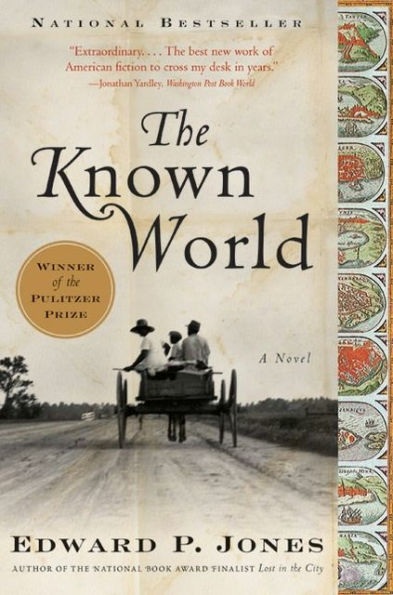
    It is said that you should never judge a book by its cover, but when just glancing at the cover of The Known World, a person can't help but be interested. From the cover, it is obvious the book is about slavery, but one could never guess how twisted the subject of slavery can get.

    The Known World is a story about slavery, not just the regular American slavery. The internal struggle of the book is really about the concept of free blacks owning slaves. Jones really plays with this theme through out the entire novel. He makes it seem as if he is unbiased on the subject throughout the book but his tone is otherwise. An atrocity occurs in everyone's life that owns a slave. The main theme of the book is anyone who participates in slavery is polluted by it and their concepts of justice and humanity become tainted.

    The strange but yet awesome thing about the novel is that all of the characters are connected through a single character, Henry Townsend. Henry is a freed black, who was once a slave, which owns slaves. We are introduced to him in the beginning by learning about his death. He is not the only one. In the beginning Jones states, "In 1855 in Manchester Country, Virginia, there were 34 free black families. and eight of those free families owned slaves." Henry was a boot maker and was a slave for William Robbins. Robbins develops a fatherly bond with Henry and is reluctant to let him go. However, he remains close with him through out the entire novel.

    I would definitely recommend this book to anyone who enjoys reading. History buffs would be especially interested because Jones gives you another side to a long complicated story. I had never even thought about blacks owning other slaves prior to the Civil war. This book will broaden any reader's horizons, as long as they are friendly.

    3 out of 3 people found this review helpful.

    Was this review helpful? Yes  No   Report this review
  • Anonymous

    Posted March 2, 2009

    Sad Book

    I did not like this book. I was surprised. The writing style was difficult to follow. It had important historical information, but I had trouble finishing it. It was a sad book.

    2 out of 4 people found this review helpful.

    Was this review helpful? Yes  No   Report this review
  • Posted October 31, 2011

    Great for Discussion

    I feel this is an important book, though it is not, in my opinion, particularly enticing. I found the flow of the story impeded by numerous side anecdotes and a tendency to jump from present to past and back. The well-developed characters in the book, however, could provide the basis for much good discussion beyond the obvious topic of slavery and the phenomena of freed slaves becoming slave owners themselves. Hence, I feel it would be a great book club selection.

    1 out of 1 people found this review helpful.

    Was this review helpful? Yes  No   Report this review
  • Posted July 26, 2009

    more from this reviewer

    Painfully MESMERIZING!

    This book is an EXCELLENT pick for a book club! It raises several points for discussion... From the various perspectives regarding BLACK OWNED SLAVES to the personalities and life history of the characters, this book depicts another painful aspect of slavery worth talking about. Edward P. Jones is a FASCINATING STORYTELLER. I came to LOVE the way he shares the character's back-story. His writing style provides incredible INSIGHT into the motivations of his characters and invokes the emotion to love and hate and understand why! I must admit it was a tough read to start, but once I understood his style I was ENGROSSED to the end. I would RECOMMEND THIS BOOK to anyone looking for a thought provoking and GRIPPING novel.

    1 out of 1 people found this review helpful.

    Was this review helpful? Yes  No   Report this review
  • Anonymous

    Posted February 20, 2007

    This is a beautiful and thoughtful book

    Okay I know this book is long. I also know there isn't much action in this book either. With that being said this book made me think about the atrocities of slavery and the evil side of the human being. What Mr.Jones has created would not be considered exciting but what this book lacks in action it makes up for and surpesses in depth of characters and setting. Unless you really allow yourself to believe in the story than the many characters in this book won't matter and you will than miss out on some beautiful story telling. Mr. Jones takes a little fragment of history and manages to create his own world and his own masterpeice.

    1 out of 1 people found this review helpful.

    Was this review helpful? Yes  No   Report this review
  • Anonymous

    Posted November 14, 2006

    A must read!

    If you want something with substance and beautifully written, this is the book. The author writes with great imagery and I found myself fully engulfed in it. Not for those who are looking for something 'light'. If you want to read something good, this is it.

    1 out of 1 people found this review helpful.

    Was this review helpful? Yes  No   Report this review
  • Anonymous

    Posted September 2, 2005

    an established and intelligent look into slavery--an American classic

    I really liked Edward P. Jones' The Known World. I really didn't have a favorite character because the novel goes back and forth in time--the point being i got to know each charaster, bit by heartbreaking bit. I loved the way the novel brought so many stories together under the stronghold of slavery. There is an old slave named Stamford who chases around young girls. Moses the overseer satisfies himself by self-gratification in his spare time. (Yes, a story like this can be hilarious.)But yet there are paradoxes: Henry Townsend ,who the novel revolves around, is a black slave owner: John Skiffington is a sheriff that won't own slaves--well his cousin gave him a slave but he treats her as a daughter--but he enforces the slavery laws. There are people who act like they're white but they are not: Oden, the indian patroller and Fern, the English teacher. But there were chracters i wanted to get to know further--Augustus and Mildred Townsend, Henry's parents. Well to be honest I wanted to get to know everybody even further and didn't want to leave them alone at that last sentence.

    1 out of 1 people found this review helpful.

    Was this review helpful? Yes  No   Report this review
  • Anonymous

    Posted May 5, 2004

    Compelling and though provoking

    Much has already been said about the basic plot of this book, so I'd like to address the non-linear writing style...imagine yourself as a leaf tumbling down a stream, sometimes hurtling forward, yet frequently caught in little swirling eddies along the edges. If you relax and 'go with the flow' rather than expecting this book to read as you would wish, you will find it to be an astounding and seductive experience on several levels. The viewpoint of this book is equally fluid; through some magic, Jones has you seeing life through the eyes of whatever character he's currently focused upon. There are terrible, ugly, beautiful, sad, heartwarming things that happen constantly throughout this book and somehow, you are always identifying through the protagonist of the moment, whether this be a slave or a slave patroller, frightening as that might be. There is no melodrama here. Somehow, everything is just taken for granted, assumed...it is, after all, their known world. And, for a brief time, ours as well. We eventually come to take it for granted. We can look back with the smugness of time and condemn slavery and its consequential perverse social structurings. Yet a book like this makes one question our own 'known world,' the social structures and cultural practices we take for granted and assume we are powerless to change. I wonder what our descendents will find equally perverse here...probably our oil addiction which forces us to attempt to control countries half-way around the world rather than simply learning to make do with less here at home.

    1 out of 1 people found this review helpful.

    Was this review helpful? Yes  No   Report this review
  • Posted May 20, 2012

    Very Disjointed

    I rarely leave a book unfinished. As for this one, it was like trying to walk in the mud, slow and tedious. Too much to follow to be a nice read. The author jumped around from paragraph to paragraph so that it made it unenjoyable to read. I did not find any of the history interesting enough to keep me reading (and I have a degree in history). PASS

    Was this review helpful? Yes  No   Report this review
  • Posted January 17, 2012

    too long and boring

    I tried getting into this book... had it for three years and can not finish it.

    Was this review helpful? Yes  No   Report this review
  • Posted August 9, 2011

    Too much information

    This book was filled with too much information for readers to absorb. Often confusing, as it jumped from the present to the past, and back again. Constantly implementing tedious "mini stories" into what was to be a plot....

    Was this review helpful? Yes  No   Report this review
  • Posted November 17, 2010

    I am not one to quit reading a book.........

    but I had the hardest time following this one I just gave up.
    The names alone had my head spinning.
    I keep saying I am going to try again but I just cant.
    My sister in law finished it and liked it but she wrote all the names of the characters on a piece of paper to follow with. Too much work for me to read a book and do that.............

    Was this review helpful? Yes  No   Report this review
  • Posted May 30, 2010

    Oprah thought it was great, I thought it was okay!

    I thought this book had great potential. I liked it but didn't love it. Oprah said it was the best book she has ever read?! Hummm... I thought it was an okay book. This book is about slavery and a man named Henry Townsend, a black farmer and a former slave. This story was a look at slavery from many different perspectives. I thought the book was a bit hard to follow. I didn't know that there was a family tree in the back of the book until after I read it. The family tree would have been helpful early on. I was more interested in some characters a lot more than others.

    Was this review helpful? Yes  No   Report this review
  • Posted December 6, 2009

    more from this reviewer

    I Also Recommend:

    The Known World, The Way to Freedom

    "Master Dead Master Dead," said Alice. Edward P. Jones, winner of the Pulitzer Price, wrote The Known World. This story revolves around the day master Henry Townsend a former black man, who owns slaves, dies and then travels back into time where it all began. This story is based in the 19 century in Manchester County, Virginia had way too many characters, kept skipping around, and was a very long dry book that was trying to get the idea out of black's owning slaves, and revolving around death.
    Far too much is being said, in this 388 page novel. It all revolves around one of the main characters death Henry Townsend who was born into slavery, and his father will eventually buy his freedom. He will become a black master and own slaves with the help of his old master William Robbins. The story starts off really fast, and within the first fifty pages or so you are introduced to so many characters. It becomes really hard to understand for one could even get lost. The author Edward P. Jones never really reveals the characters in depth. In my opinion, some of the characters are mention in the novel, and they really had no reason to be in the novel in the first place. Each character has their own story that gets mentioned in the book. It gets really hard to follow, and the book itself is really dull.
    Next, The Known World through out the book had many flashbacks. In my opinion it made it very confusing to try to read. For example, it would talk about Henry Townsend's funeral in one paragraph, and a paragraph later it would be talking about the past. This is not a type of book I personally enjoy reading. For some positive remarks, the book had some historical events, which made it quite interesting. It talked about how black people could own black slaves as their own property, and how black slaves really weren't treated well. The Known World really did have a good message, but I just wished the author had told the story in sequential order. It would have made it a lot easier to follow, more enjoyable, and would have made more sense.
    After all I strongly believe reading this book was like watching paint dry. It took so long to read, because you had to reread the paragraph over and over to finally understand what was happening. It is not a book I would recommend to many people. I would only recommend this book to adults. You really have to enjoy books with flashbacks and have time to sit and read a book with so much detail. In the book it talks about Henry Townsend dying, his death, his funeral, and the past with all the characters.
    Overall, The Known World by Edward P. Jones wasn't the book for me. Many other people have enjoyed this fictional novel though. Like Jonathan Yardley, Washington Post Book World, said "Extraordinary..The best new work of American fiction to cross my desk in years." So many eyes have different opinion in books they read. Edward P. Jones was trying to get the idea out to the readers how blacks could own slaves, and it all revolved on the death of Henry Townsend. The Known World did have way too many characters, it kept skipping around, and was a very long dry book based in the 19 century. This book just wasn't for me, but that doesn't mean it's not for you.

    0 out of 2 people found this review helpful.

    Was this review helpful? Yes  No   Report this review
  • Posted November 2, 2009

    more from this reviewer

    Truly a heartfelt emotional read

    This story tells a side of slavery in America that is not told or taught by college black history professors. A powerful read that made me miss a few appointments because I simply could not put it down.

    Was this review helpful? Yes  No   Report this review
  • Anonymous

    Posted July 10, 2008

    do not take the time to read it!

    How this book won an award is amazing to me. I am a very avid reader and it took me three years to finish this book. The concept is facinating and could make for a great book if the following things happened: Less jumping around and more focus on specific characters, it was hard to relate to anyone when a paragraph later you were someone else in the book. Way too long and long winded, for concept to work it needed to be about a hundred pages less and more to the point of the actual plot. Place more action closer to the first two hundred pages so readers will actually want to finish the book. The author is talented but just seems to have lost direction or an exact plot in this book. I expected so much more and was let down.

    0 out of 1 people found this review helpful.

    Was this review helpful? Yes  No   Report this review
  • Anonymous

    Posted April 27, 2008

    overrated

    i expected that this book is really great with the praises and all, but personally when I read it, it kind of bored me it's too long yet nothing exciting happend that really made me attach to the book, but from the chapters that i've read because im still finishing it 'sigh' the theme of the book which is slavery and freedom is really showing

    Was this review helpful? Yes  No   Report this review
See All Sort by: Showing 1 – 20 of 140 Customer Reviews

If you find inappropriate content, please report it to Barnes & Noble
Why is this product inappropriate?
Comments (optional)
500 character limit