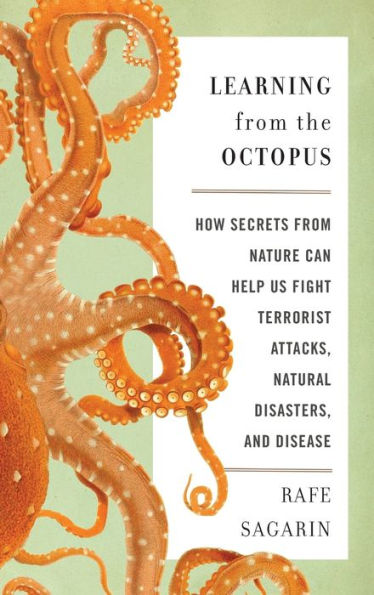
Learning From the Octopus: How Secrets from Nature Can Help Us Fight Terrorist Attacks, Natural Disasters, and Disease

( 1 )

Overview

Despite the billions of dollars we’ve poured into foreign wars, homeland security, and disaster response, we are fundamentally no better prepared for the next terrorist attack or unprecedented flood than we were in 2001. Our response to catastrophe remains unchanged: add another step to airport security, another meter to the levee wall. This approach has proved totally ineffective: reacting to past threats and trying to predict future risks will only waste resources in our ...

See more details below
Hardcover
$17.34
BN.com price
(Save 35%)$26.99 List Price

Pick Up In Store

Reserve and pick up in 60 minutes at your local store

Other sellers (Hardcover)
  • All (45) from $1.99   
  • New (26) from $1.99   
  • Used (19) from $1.99   
Learning From the Octopus: How Secrets from Nature Can Help Us Fight Terrorist Attacks, Natural Disasters, and Disease

Available on NOOK devices and apps  
  • Nook Devices
  • NOOK HD/HD+ Tablet
  • NOOK
  • NOOK Color
  • NOOK Tablet
  • Tablet/Phone
  • NOOK for Windows 8 Tablet
  • NOOK for iOS
  • NOOK for Android
  • NOOK Kids for iPad
  • PC/Mac
  • NOOK for Windows 8
  • NOOK Study
  • NOOK for Web

Want a NOOK? Explore Now

NOOK Book (eBook)
$14.84
BN.com price
(Save 45%)$26.99 List Price

Overview

Despite the billions of dollars we’ve poured into foreign wars, homeland security, and disaster response, we are fundamentally no better prepared for the next terrorist attack or unprecedented flood than we were in 2001. Our response to catastrophe remains unchanged: add another step to airport security, another meter to the levee wall. This approach has proved totally ineffective: reacting to past threats and trying to predict future risks will only waste resources in our increasingly unpredictable world.


In Learning from the Octopus, ecologist and security expert Rafe Sagarin rethinks the seemingly intractable problem of security by drawing inspiration from a surprising source: nature. Biological organisms have been living—and thriving—on a risk-filled planet for billions of years. Remarkably, they have done it without planning, predicting, or trying to perfect their responses to complex threats. Rather, they simply adapt to solve the challenges they continually face.


Military leaders, public health officials, and business professionals would all like to be more adaptable, but few have figured out how. Sagarinargues that we can learn from observing how nature is organized, how organisms learn, how they create partnerships, and how life continually diversifies on this unpredictable planet.


As soon as we dip our toes into a cold Pacific tidepool and watch what we thought was a rock turn into an octopus, jetting away in a cloud of ink, we can begin to see the how human adaptability can mimic natural adaptation. The same mechanisms that enabled the octopus’s escape also allow our immune system to ward off new infectious diseases, helped soldiers in Iraq to recognize the threat of IEDs, and aided Google in developing faster ways to detect flu outbreaks.


While we will never be able to predict the next earthquake, terrorist attack, or market fluctuation, nature can guide us in developing security systems that are not purely reactive but proactive, holistic, and adaptable. From the tidepools of Monterey to the mountains of Kazakhstan, Sagarin takes us on an eye-opening tour of the security challenges we face, and shows us how we might learn to respond more effectively to the unknown threats lurking in our future.

Read More Show Less

Editorial Reviews

Publishers Weekly
A marine biologist applies his expertise to national security, delivering some ingenious ideas. He points out that 3.5 billion years of evolution have given plants and animals tactics that can serve us in dealing with terrorism, hurricanes, and epidemics. Sagarin, environment policy analyst at the University of Arizona, writes that, confronted with a threat, governments, inherently unadaptable, gather specialists to anticipate the next disaster and devise an often clunky plan. Organisms, on the other hand, never plan or anticipate; they adapt and also learn to live with a tolerable level of insecurity. Security in nature is never centralized; every herd animal keeps an eye out. Eradicating risk is impossible because the threat also adapts, e.g., insurgencies adapt faster than standing armies. Sagarin proposes that governments are too cumbersome to adapt, and that we should devise an “adaptable cascade” with decentralized multiple problem solvers. Occasionally, the theory misfires (a politician who advocates tolerating a modest level of terrorism will enjoy a short career), but few readers will deny that Sagarin is onto something. Agent: Esmond Harmsworth, Zachary Shuster Harmsworth Literary Agency. (Apr.)
Kirkus Reviews
A marine ecologist looks at social problems from the perspective of natural science. Sagarin (Environmental Policy/Univ. of Arizona) identifies adaptability as the key to survival in an uncertain world. Improvised responses to threats--the "hillbilly armor" U.S. troops adopted to defend against roadside IEDs--are a clear example. A key point is that natural selection operates not just in the wild but in modern asymmetrical warfare, where lightly armed insurgents take on large professional armies. The high casualty rate among insurgents is a selective pressure; the stupid and incompetent are killed off, and those who survive are better equipped to fight on--as the Taliban has done in Afghanistan. The author argues that dedicated task forces are less effective at problem solving than independent groups seeking answers to a specific challenge. Redundant features, which efficiency experts hate, aid survival by preserving vital information, and cooperation and exchange of information among organisms in the same environment is a major tool for increased security. Sagarin cites cooperation among Middle East countries, bitter rivals in many ways, that helped slow the spread of H1N1 in 2009-10. Even the apparently irrational "sacred truths" of religious minorities can be turned to assets in the survival of larger groups, by such simple means as athletics. The author is sometimes too abstract in his approach. However, when gives real-life examples, either from nature or from human society, the points are usually convincing, and he provides plentiful documentation. Opens interesting doors--it would be good to see more along this line.
Read More Show Less

Product Details

  • ISBN-13: 9780465021833
  • Publisher: Basic Books
  • Publication date: 3/27/2012
  • Pages: 320
  • Sales rank: 405,734
  • Product dimensions: 6.42 (w) x 9.30 (h) x 1.20 (d)

Meet the Author

Rafe Sagarin is a marine ecologist and environmental policy analyst at the University of Arizona. Among his many accolades, Sagarin is a 2011 Guggenheim Fellowship to support his work on natural security, and he was a Congressional Science Fellow in the office of U.S. Representative Hilda Solis. Sagarin has taught ecology and environmental policy at Duke University, California State University Monterey Bay, and University of California, Los Angeles. His research has appeared in Science, Nature, Foreign Policy, and other leading journals, magazines, and newspapers. He lives with his family in Tucson.

Read More Show Less

Table of Contents

Foreword ix

Prologue: Unnatural Disasters xvii

Chapter 1 The Origins of Natural Security 1

Chapter 2 Tide-Pool Security 21

Chapter 3 Learning as a Force of Nature 37

Chapter 4 Organized to Change 63

Chapter 5 Necessary Redundancy 89

Chapter 6 Beyond Mad Fiddler Crabs 109

Chapter 7 Calling Your Bluff and Bluffing Your Call 129

Chapter 8 The Sacred Values of Salmon and Suicide Bombers 149

Chapter 9 Hang Together or Hang Separately 171

Chapter 10 We Have Met the Enemy and He is Us! 195

Conclusion: The End and the Beginning 215

Acknowledgments 231

Notes 235

Index 265

Read More Show Less

Customer Reviews

Average Rating 4
( 1 )
Rating Distribution

5 Star

(0)

4 Star

(1)

3 Star

(0)

2 Star

(0)

1 Star

(0)

Your Rating:

Your Name: Create a Pen Name or

Barnes & Noble.com Review Rules

Our reader reviews allow you to share your comments on titles you liked, or didn't, with others. By submitting an online review, you are representing to Barnes & Noble.com that all information contained in your review is original and accurate in all respects, and that the submission of such content by you and the posting of such content by Barnes & Noble.com does not and will not violate the rights of any third party. Please follow the rules below to help ensure that your review can be posted.

Reviews by Our Customers Under the Age of 13

We highly value and respect everyone's opinion concerning the titles we offer. However, we cannot allow persons under the age of 13 to have accounts at BN.com or to post customer reviews. Please see our Terms of Use for more details.

What to exclude from your review:

Please do not write about reviews, commentary, or information posted on the product page. If you see any errors in the information on the product page, please send us an email.

Reviews should not contain any of the following:

  • - HTML tags, profanity, obscenities, vulgarities, or comments that defame anyone
  • - Time-sensitive information such as tour dates, signings, lectures, etc.
  • - Single-word reviews. Other people will read your review to discover why you liked or didn't like the title. Be descriptive.
  • - Comments focusing on the author or that may ruin the ending for others
  • - Phone numbers, addresses, URLs
  • - Pricing and availability information or alternative ordering information
  • - Advertisements or commercial solicitation

Reminder:

  • - By submitting a review, you grant to Barnes & Noble.com and its sublicensees the royalty-free, perpetual, irrevocable right and license to use the review in accordance with the Barnes & Noble.com Terms of Use.
  • - Barnes & Noble.com reserves the right not to post any review -- particularly those that do not follow the terms and conditions of these Rules. Barnes & Noble.com also reserves the right to remove any review at any time without notice.
  • - See Terms of Use for other conditions and disclaimers.
Search for Products You'd Like to Recommend

Recommend other products that relate to your review. Just search for them below and share!

Create a Pen Name

Your Pen Name is your unique identity on BN.com. It will appear on the reviews you write and other website activities. Your Pen Name cannot be edited, changed or deleted once submitted.

 
Your Pen Name can be any combination of alphanumeric characters (plus - and _), and must be at least two characters long.

Continue Anonymously
Sort by: Showing 1 Customer Reviews
  • Anonymous

    Posted March 30, 2012

    3- cheaper on Kindle...how come? I just bought a Nook and am no

    3- cheaper on Kindle...how come? I just bought a Nook and am now second-guessing my decision.

    1 out of 4 people found this review helpful.

    Was this review helpful? Yes  No   Report this review
Sort by: Showing 1 Customer Reviews

If you find inappropriate content, please report it to Barnes & Noble
Why is this product inappropriate?
Comments (optional)