- Shopping Bag ( 0 items )
Available on NOOK devices and apps
Want a NOOK? Explore Now
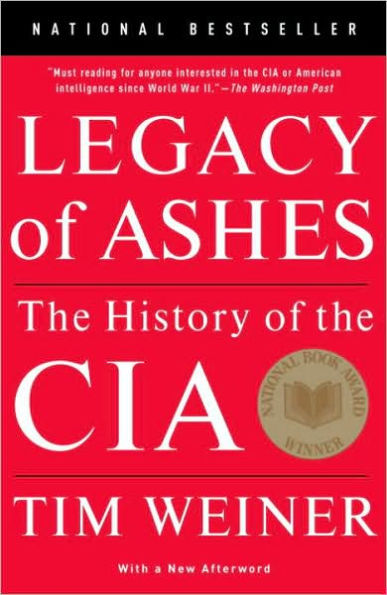
For the last sixty years, the CIA has managed to maintain a formidable reputation in spite of its terrible record, burying its blunders in top-secret archives. Its mission was to know the world. When it did not succeed, it set out to change the world. Its failures have handed us, in the words of President Eisenhower, “a legacy of ashes.”
Now Pulitzer Prize–winning author Tim Weiner offers the first definitive history of the CIA—and everything is on the record. LEGACY OF ASHES is based on more than 50,000 documents, primarily from the archives of the CIA itself, and hundreds of interviews with CIA veterans, including ten Directors of Central Intelligence. It takes the CIA from its creation after World War II, through its battles in the cold war and the war on terror, to its near-collapse after 9/ll.
Tim Weiner’s past work on the CIA and American intelligence was hailed as “impressively reported” and “immensely entertaining” in The New York Times.
The Wall Street Journal called it “truly extraordinary . . . the best book ever written on a case of espionage.” Here is the hidden history of the CIA: why eleven presidents and three generations of CIA officers have been unable to understand the world; why nearly every CIA director has left the agency in worse shape than he found it; and how these failures have profoundly jeopardized our national security.
Winner of the 2007 National Book Award for Nonfiction; Finalist for the 2008 National Book Critics Circle Award for Nonfiction
Pulitzer Prize-winner Weiner combed through the history books and recently declassified records to offer up this fascinating, comprehensive and sometimes appalling history of the Central Intelligence Agency. Weiner documents everything from the agency's formation in the aftermath of WWII to its failure to prevent the events of September 11, 2001, and every misstep, blunder and international incident in between. For an important book like this one, it's important for an audiobook narrator to have a certain gravitas, and Rudnicki has plenty. His deep, resonant voice keeps the listener riveted and is ideally suited to the serious, historical-and often grim-subject matter. Rudnicki occasionally uses accents to add flavor to the text when reading quotations, but for the most part wisely eschews this practice and simply brings Weiner's words to life. Rudnicki is one of the best narrators in the business, and he's in top form here-Legacy of Ashesis one of the best audiobooks of the year. Simultaneous release with the Doubleday hardcover (Reviews, June 4). (July)
Copyright 2007 Reed Business InformationAUTHOR’S NOTE
Legacy of Ashes is the record of the first sixty years of the Central Intelligence Agency. It describes how the most powerful country in the history of Western civilization has failed to create a first-rate spy service. That failure constitutes a danger to the national security of the United States. Intelligence is secret action aimed at understanding or changing what goes on abroad. President Dwight D. Eisenhower called it “a distasteful but vital necessity.” A nation that wants to project its power beyond its borders needs to see over the horizon, to know what is coming, to prevent attacks against its people. It must anticipate surprise. Without a strong, smart, sharp intelligence service, presidents and generals alike can become blind and crippled. But throughout its history as a superpower, the United States has not had such a service.
History, Edward Gibbon wrote in The Decline and Fall of the Roman Empire, is “little more than the register of crimes, follies, and misfortunes of mankind.” The annals of the Central Intelligence Agency are filled with folly and misfortune, along with acts of bravery and cunning. They are replete with fleeting successes and long–lasting failures abroad. They are marked by political battles and power struggles at home. The agency’s triumphs have saved some blood and treasure. Its mistakes have squandered both. They have proved fatal for legions of American soldiers and foreign agents; some three thousand Americans who died in New York, Washington, and Pennsylvania on September 11, 2001; and three thousand more who have died since then in Iraq and Afghanistan. The one crime of lasting consequence has been the CIA’s inability to carry out its central mission: informing the president of what is happening in the world.
The United States had no intelligence to speak of when World War II began, and next to none a few weeks after the war ended. A mad rush to demobilize left behind a few hundred men who had a few years’ experience in the world of secrets and the will to go on fighting a new enemy. “All major powers except the United States have had for a long time past permanent worldwide intelligence services, reporting directly to the highest echelons of their Government,” General William J. Donovan, the commander of the wartime Office of Strategic Services, warned President Truman in August 1945. “Prior to the present war, the United States had no foreign secret intelligence service. It never has had and does not now have a coordinated intelligence system.” Tragically, it still does not have one.
The CIA was supposed to become that system. But the blueprint for the agency was a hasty sketch. It was no cure for a chronic American weakness: secrecy and deception were not our strengths. The collapse of the British Empire left the United States as the sole force able to oppose Soviet communism, and America desperately needed to know those enemies, to provide foresight to presidents, and to fight fire with fire when called upon to light the fuse. The mission of the CIA, above all, was to keep the president forewarned against surprise attack, a second Pearl Harbor.
The agency’s ranks were filled with thousands of patriotic Americans in the 1950s. Many were brave and battle–hardened. Some had wisdom. Few really knew the enemy. Where understanding failed, presidents ordered the CIA to change the course of history through covert action. “The conduct of political and psychological warfare in peacetime was a new art,” wrote Gerald Miller, then the CIA’s covert–operations chief for Western Europe. “Some of the techniques were known but doctrine and experience were lacking.” The CIA’s covert operations were by and large blind stabs in the dark. The agency’s only course was to learn by doing—by making mistakes in battle. The CIA then concealed its failures abroad, lying to Presidents Eisenhower and Kennedy. It told those lies to preserve its standing in Washington. The truth, said Don Gregg, a skilled cold-war station chief, was that the agency at the height of its powers had a great reputation and a terrible record.
Like the American public, the agency dissented at its peril during the Vietnam War. Like the American press, it discovered that its reporting was rejected if it did not fit the preconceptions of presidents. The CIA was rebuked and scorned by Presidents Johnson, Nixon, Ford, and Carter. None of them understood how the agency worked. They took office “with the expectation that intelligence could solve every problem, or that it could not do anything right, and then moved to the opposite view,” notes a former deputy director of central intelligence, Richard J. Kerr. “Then they settled down and vacillated from one extreme to the other.”
To survive as an institution in Washington, the agency above all had to have the president’s ear. But it soon learned that it was dangerous to tell him what he did not want to hear. The CIA’s analysts learned to march in lockstep, conforming to conventional wisdom. They misapprehended the intentions and capabilities of our enemies, miscalculated the strength of communism, and misjudged the threat of terrorism.
The supreme goal of the CIA during the cold war was to steal Soviet secrets by recruiting spies, but the CIA never possessed a single one who had deep insight into the workings of the Kremlin. The number of Soviet spies with important information to reveal–all of them volunteers, not recruits—could be counted on the fingers of two hands. And all of them died, captured and executed by Moscow. Almost all had been betrayed by officers of the CIA’s Soviet division who were spying for the other side, under Presidents Reagan and George H. W. Bush. Under Reagan, the CIA set off on misconceived third–world missions, selling arms to Iran’s Revolutionary Guards to finance a war in Central America, breaking the law and squandering what trust remained reposed in it. More grievously, it missed the fatal weakness of its main enemy.
It fell to machines, not men, to understand the other side. As the technology of espionage expanded its horizons, the CIA’s vision grew more and more myopic. Spy satellites enabled it to count Soviet weapons. They did not deliver the crucial information that communism was crumbling. The CIA’s foremost experts never saw the enemy until after the cold war was over. The agency had bled the Soviets by pouring billions of dollars of weapons into Afghanistan to help fight the Red Army’s occupying forces. That was an epic success. But it failed to see that the Islamic warriors it supported would soon take aim at the United States, and when that understanding came, the agency failed to act. That was an epochal failure.
The unity of purpose that held the CIA together during the cold war came undone in the 1990s, under President Clinton. The agency still had people who strove to understand the world, but their ranks were far too thin. There were still talented officers who dedicated themselves to serving the United States abroad, but their numbers were far too few. The FBI had more agents in New York than the CIA had officers abroad. By the end of the century, the agency was no longer a fully functioning and independent intelligence service. It was becoming a second–echelon field office for the Pentagon, weighing tactics for battles that never came, not strategies for the struggle ahead. It was powerless to prevent the second Pearl Harbor.
After the attacks on New York and Washington, the agency sent a small skilled cadre of covert operators into Afghanistan and Pakistan to hunt down the leaders of al Qaeda. It then forfeited its role as a reliable source of secret information when it handed the White House false reports on the existence of weapons of mass destruction in Iraq. It had delivered a ton of reportage based on an ounce of intelligence. President George W. Bush and his administration in turn misused the agency once proudly run by his father, turning it into a paramilitary police force abroad and a paralyzed bureaucracy at headquarters. Bush casually pronounced a political death sentence upon the CIA in 2004 when he said that the agency was “just guessing” about the course of the war in Iraq. No president had ever publicly dismissed the CIA that way.
Its centrality in the American government ended with the dissolution of the office of director of central intelligence in 2005. Now the CIA must be rebuilt if it is to survive. That task will take years. The challenge of understanding the world as it is has overwhelmed three generations of CIA officers. Few among the new generation have mastered the intricacies of foreign lands, much less the political culture of Washington. In turn, almost every president, almost every Congress, and almost every director of central intelligence since the 1960s has proved incapable of grasping the mechanics of the CIA. Most have left the agency in worse shape than they found it. Their failures have handed future generations, in the words of President Eisenhower, “a legacy of ashes.” We are back where we began sixty years ago, in a state of disarray.
Legacy of Ashes sets out to show how it has come to pass that the United States now lacks the intelligence it will need in the years ahead. It is drawn from the words, the ideas, and the deeds set forth in the files of the American national-security establishment. They record what our leaders really said, really wanted, and really did when they projected power abroad. This book is based on my reading of more than fifty thousand documents, primarily from the archives of the CIA, the White House, and the State Department; more than two thousand oral histories of American intelligence officers, soldiers, and diplomats; and more than three hundred interviews conducted since 1987 with CIA officers and veterans, including ten directors of central intelligence. Extensive endnotes amplify the text.
This book is on the record—no anonymous sources, no blind quotations, no hearsay. It is the first history of the CIA compiled entirely from firsthand reporting and primary documents. It is, by its nature, incomplete: no president, no director of central intelligence, and certainly no outsider can know everything about the agency. What I have written here is not the whole truth, but to the best of my ability, it is nothing but the truth.
I hope it may serve as a warning. No republic in history has lasted longer than three hundred years, and this nation may not long endure as a great power unless it finds the eyes to see things as they are in the world. That once was the mission of the Central Intelligence Agency.
Anonymous
Posted February 21, 2008
If this book had been written by Jimmy Breslin, it would be, ¿The Gang that Couldn¿t Shoot Straight Part Deux.¿ Only this book was not written by Jimmy Breslin and the consequences to our prestige as a nation, respect in the world and national security are much more serious. However it is a very interesting read, at many times incredible in the audacity of some missions sometimes just shocking in the stupidity displayed by what are supposed to be our nation¿s best. Mr. Weiner lays out the history of the CIA from the very beginning until our very recent history. In the process through extensive interviews and research of declassified documents, he tells a very unnerving story of what our CIA is, what it was meant to be and what it thinks it is. It is a damning indictment of the agency, the various directors and many of the presidents in power during its existence. Towards the end of the book, he pretty clearly sums up what the book is about, ¿Nineteen men had served as director of central intelligence. Not one met the high Standards Eisenhower had set. The agency¿s founders had been defeated by their ignorance in Korea and Vietnam and undone by their arrogance in Washington. Their successors were set adrift when the Soviet Union died and caught unaware when terror struck at the heart of American power. Their attempts to make sense of the world had generated heat but little light. As it was in the beginning, the warriors of the pentagon and diplomats at State held them in disdain. For more than half a century, presidents had been frustrated or furious when they turned to the directors for insight and knowledge.¿ Well that is what the book is about but before you get to that point, there is history, poignant stories, incredible blunders, and one of the best actual spy stories ever written. A true opus. Politically, the book is straight down the middle. You will find out that neo-cons were attracted to the agency from the beginning are were wrong from the beginning. I guess we could have seen it coming. They claimed 500 Soviet Missiles aimed at the US when there were only 4 and that is just the beginning. A featured character is Mr. Paul Wolfowitz who has managed to fail upwards for many years now. On the other side of the spectrum, the book paints President Eisenhower as perhaps our sharpest president in this entire era. However the idea of some guy putting on his underwear in the morning is a little disturbing. In today¿s times it¿s hard to remember the red menace and how that colored their thinking of the time, but it is shocking to learn how right wing and secretive Robert Kennedy was. An icon of liberalism definitely not portrayed that way in this book. The entire account of the Bay of Pigs invasion very much syncs with other accounts I have read so I have no reason to doubt the Robert Kennedy reporting. Other presidents: LBJ is an insecure mess. RMN is a drunken hawk. GRF, though having served in the Senate Intelligence committee for many years was surprised to find out he knew nothing of what the CIA was doing. JEC is a nice man, but not entirely as innocent as most people thought. RWR is out of the loop entirely, with a dark side and a cast of incredible characters to carry out some of the most disastrous missions in the entire agency history. Bill Casey definitely is not portrayed in gushing terms as Valerie Plame described him in her book. WJC was not a hands-on manager when it came to intelligence and was distrusted by the CIA and all the military. GWB, the worst period, as much of a nightmare to the agency as the rest of the United States. He would be the one to eventually undo the CIA and turn into ashes. Nobody comes off unscathed. A fair, fascinating look into the annals of the CIA and our presidents policies and relationship with the agency. A must read.
6 out of 7 people found this review helpful.
Was this review helpful? Yes NoThank you for your feedback. Report this reviewThank you, this review has been flagged.JGrind
Posted January 14, 2009
I liked this book from cover to cover, really liked it, and unfortunately believed every word. I found myself jumping right on the bandwagon guided by this author, a successful journalist, and my animosity for our government from the top spot down continued to grow as the author spun his web.
The fact of the matter is that this is an extremely biased novel, starting with the Title and continuing throughout the book. The author mis-quotes, misrepresents, and in my opinion manages to do all the things he accuses our leaders of between the covers of this long work of fiction...lie, manipulate, cover-up, and use information to suite his own purposes and biases.
I am not in any way giving a free pass to some of the decisions that were made by our leaders over the past 200+ years...but my fear is that this book takes it too far and has to use sleight of hand and take advantage of his readers and a national sentiment that wants to believe our government is full of idiots and scoundrels...
Personally I think the author owes everyone an apology, if you have read this, or haven't, Tim Weiner thinks you are an idiot and has completely wasted his considerable writing talent with a bias that is only to easily uncovered. I feel very bad for the large number of readers who have taken this man on his word.
For those of you interested the following link explains Tim's negligence and gives references to reality (the good and the bad).
https://www.cia.gov/library/center-for-the-study-of-intelligence/csi-publications/csi-studies/studies/vol51no3/legacy-of-ashes-the-history-of-cia.html
Regards,
Jesse H Grindeland
grindeland@gmail.com
4 out of 8 people found this review helpful.
Was this review helpful? Yes NoThank you for your feedback. Report this reviewThank you, this review has been flagged.Anonymous
Posted January 10, 2008
Tim Weiner, an American journalist, has written a useful history of the US state¿s Central Intelligence Agency. It has been the president¿s private, secret and illegal army, it does what the president wants, so it is not `a rogue elephant¿, as the Church Committee called it. He shows that from its origin in 1947, the CIA has always been incompetent and incapable. In 1948 the CIA launched a scare about the Russians invading Berlin the next day Congress approved the Marshall Plan. A secret clause let the CIA skim $685 million from Plan funds, what Weiner calls `a global money-laundering scheme¿. In 1948 the CIA set up secret prisons in Germany, Japan and Panama, using torture and drugs on its captives. It carried out 81 major anti-democratic covert operations in Truman¿s second term, 170 in 48 countries under Eisenhower, and 163 in just three years under the liberals¿ hero Kennedy. Its efforts at gathering intelligence from 1948 (`World War Three starting in Berlin¿) to Iraq (`Weapons of Mass Destruction¿) have been consistently wrong. It always said that the Soviet Union was impervious to reason, impossible to reform and understood only force ¿ but this is projection, mirroring the CIA itself. It ran coups overthrowing elected governments and installing tyrants, for example in Iran, Guatemala, Congo, where Eisenhower ordered that Lumumba be `eliminated¿, Chile and Greece. Against Cuba it used biological and chemical weapons, assassination attempts hiring Mafia hit men and a botched invasion. The CIA funded Italy¿s neo-fascist terrorists in the 1970s. It illegally spied on the American people. The CIA lied to Congress, the people and presidents, for example, Weiner notes its director Allen Dulles¿ `practice of deceiving the president¿. To cover for the CIA, presidents lied to Congress and the people. Weiner remarks that the CIA¿s testimony to Congress ¿left the impression that the United States had hired a gang of conmen and thieves to run its foreign affairs.¿ It organised death squads in Nicaragua, El Salvador, Honduras and in Afghanistan and Iraq today. It carries out illegal renditions of innocent suspects to its secret prisons in Thailand, Poland, Afghanistan and Iraq. Could a democratic country use such a vicious tool?
2 out of 3 people found this review helpful.
Was this review helpful? Yes NoThank you for your feedback. Report this reviewThank you, this review has been flagged.Anonymous
Posted September 17, 2008
Wiener's overview of the CIA, at its best and worst, is amazing. A paramilitary organization enthralled by the sophisticated nature of the British spies, Dulles, Donovan, and others went on to find the Agency that has changed the world for better and for ill. At a time when intelligence is at a premium compared to what Rumsfeld says, the history highlights the Agency's brilliant successes--the defection of KGB agents, dismantaling of the AQ Khan network, overthrow of the Chile government and their spectacular failures--overestimating the Soviet's military strength, the numerous attempts on Castro's life, operations in Soviet Russia and Maoist China, and domestic spying. However, the Agency is still facing its own demise.
1 out of 1 people found this review helpful.
Was this review helpful? Yes NoThank you for your feedback. Report this reviewThank you, this review has been flagged.Anonymous
Posted November 22, 2007
Pulitzer Prize¿winning author Tim Weiner does a marvelous job of laying out how the CIA's mission and focus were somewhat hampered from Day One. It's a great read!
1 out of 2 people found this review helpful.
Was this review helpful? Yes NoThank you for your feedback. Report this reviewThank you, this review has been flagged.6911124
Posted April 20, 2011
and for citizens who want to be in the know. Previous reviewer must either be ex CIA or been reading too many Clancy novel; this is reality.
0 out of 1 people found this review helpful.
Was this review helpful? Yes NoThank you for your feedback. Report this reviewThank you, this review has been flagged.Anonymous
Posted February 28, 2011
This book is so jaded and biased that it renders itself useless.
Was this review helpful? Yes NoThank you for your feedback. Report this reviewThank you, this review has been flagged.Anonymous
Posted October 28, 2007
The author's premise of the Presidents are to blame and not us (CIA) won't fly. I've read the Church Committee documents so I know the truth. The author's fawning over Richard Helms sickened me. No mention of Helm's assassination of President Kennedy nor one word of RFK's murder by Manchurian Candidate courtesy of Helms and his MKULTRA program. How come? The book is CIA disinformation disguised as revelations. The author is either ill informed or purposely misleading the reader. Why? Well written though and worth a read.
0 out of 2 people found this review helpful.
Was this review helpful? Yes NoThank you for your feedback. Report this reviewThank you, this review has been flagged.Anonymous
Posted November 15, 2010
No text was provided for this review.
Anonymous
Posted January 3, 2012
No text was provided for this review.
Anonymous
Posted March 11, 2012
No text was provided for this review.
Anonymous
Posted December 31, 2010
No text was provided for this review.
Anonymous
Posted May 26, 2011
No text was provided for this review.
Anonymous
Posted April 18, 2011
No text was provided for this review.
Anonymous
Posted December 4, 2010
No text was provided for this review.
Anonymous
Posted November 13, 2010
No text was provided for this review.
Anonymous
Posted December 1, 2010
No text was provided for this review.
Anonymous
Posted August 22, 2010
No text was provided for this review.
Anonymous
Posted August 18, 2010
No text was provided for this review.
Anonymous
Posted June 19, 2011
No text was provided for this review.
Overview
For the last sixty years, the CIA has managed to maintain a formidable reputation in spite of its terrible record, burying its blunders in top-secret archives. Its mission was to know the world. When it did not succeed, it set out to change the world. Its failures have handed us, in the words of President Eisenhower, “a legacy of ashes.”
Now Pulitzer Prize–winning author Tim Weiner offers the first definitive history of the CIA—and everything is on the record. LEGACY OF ASHES is based on more than 50,000 documents, primarily from the archives of the CIA itself, and hundreds of interviews with CIA veterans, including ten Directors of Central Intelligence....