Lions of the West: Heroes and Villains of the Westward Expansion [NOOK Book]

NOOK Book (eBook)
$16.47
BN.com price
$29.95 List Price (Save 45%)

Available on NOOK devices and apps

  • Nook Devices
  • NOOK
  • NOOK Color
  • NOOK Tablet
  • Tablet/Phone
  • NOOK for iPad
  • NOOK for iPhone
  • NOOK for Android
  • NOOK for Android (Tablet)
  • NOOK Kids for iPad
  • PC/Mac
  • NOOK Study
  • NOOK for PC
  • NOOK for Mac

Want a NOOK? Explore Now

Overview

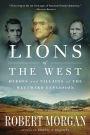
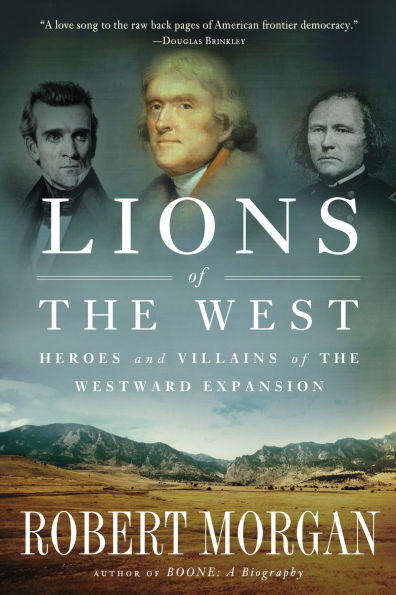
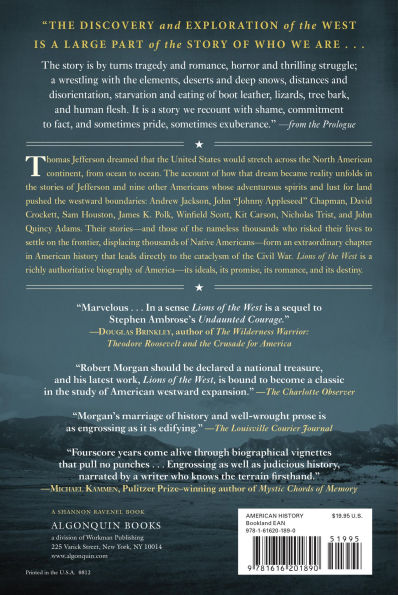
Thomas Jefferson, a naturalist and visionary, dreamed that the United States would stretch across the continent from ocean to ocean. The account of how that dream became reality unfolds in the stories of Jefferson and nine other Americans whose adventurous spirits and lust for land pushed the westward boundaries: Andrew Jackson, John “Johnny Appleseed” Chapman, David Crockett, Sam Houston, James K. Polk, Winfield Scott, Kit Carson, Nicholas Trist, and John Quincy Adams. Their tenacity was matched only by that of their enemies: the Mexican army under Santa Anna at the Alamo, the Comanche and Apache Indians, and the forbidding geography itself.

Known also for his powerful fiction (Gap ...

See more details below

Overview

Thomas Jefferson, a naturalist and visionary, dreamed that the United States would stretch across the continent from ocean to ocean. The account of how that dream became reality unfolds in the stories of Jefferson and nine other Americans whose adventurous spirits and lust for land pushed the westward boundaries: Andrew Jackson, John “Johnny Appleseed” Chapman, David Crockett, Sam Houston, James K. Polk, Winfield Scott, Kit Carson, Nicholas Trist, and John Quincy Adams. Their tenacity was matched only by that of their enemies: the Mexican army under Santa Anna at the Alamo, the Comanche and Apache Indians, and the forbidding geography itself.

Known also for his powerful fiction (Gap Creek, The Truest Pleasure, Brave Enemies), Morgan uses his skill at characterization to give life to the personalities of these ten Americans without whom the United States might well have ended at the Arkansas border. Their stories—and those of the nameless thousands who risked their lives to settle on the frontier, displacing thousands of Native Americans—form an extraordinary chapter in American history that led directly to the cataclysm of the Civil War.

Editorial Reviews

Charlotte Observer
“Robert Morgan should be declared a national treasure, and his latest work, Lions of the West, is bound to become a classic in the study of American westward expansion.”
Minneapolis Star Tribune
“Morgan’s accounts of these key players make for an intriguing journey westward. . . . Morgan has given us a stimulating and engaging account of how it all came about.”
Southern Literary Review
“Nobody writes history like Morgan. His books teach and inspire. He gives the past, with all its heroes and villains, a new life, if not a new purpose.”
The Barnes & Noble Review

After a century of popular and learned enlightenment — Charles Beard and Howard Zinn; civil rights and decolonization; Africana Studies, Chicano Studies, gender studies, genocide studies; the American Indian Movement and the endangered species list — we're supposed to know better.

Yet it's still rather impossible to look at a map of the North American continent and not see a destiny logical and inevitable — indeed, manifest. Once the strip of British colonies on the Atlantic coast wrested a divorce from the mother country, where else could history have gone but west, till it hit another ocean? Like the nursery-catalog saplings assigned to numbered growing zones, Americans — or estadounidenses, to borrow a sorely lacking word from the hemispheric neighbors — seem bred for germination along a sharply bounded clime. In 1783, the new United States' northernmost point, along the border of what was then the Massachusetts exclave of Maine, lay less than a degree south of the 49° N boundary that would eventually stretch from Minnesota to the Pacific. What became the southern extreme of Arizona and New Mexico is just about a parallel (or sixty-nine miles) north of Georgia's. Even the exceptional departures from colonial latitudes — namely, Florida and Texas, those subtropical graftings to the mainland and semi-alien nation-states in their own right - - seem to prove the rule: The American future has always been due west.

Except, of course, when it wasn't. In Lions of the West — Robert Morgan's diverting, if slight, collection of historical profiles — the big cat that casts the longest shadow (in a litter of nine) is probably Andrew Jackson. But, as we learn, that brilliant statesman, strategist, and sociopath of Indian removal only rose to prominence by successfully fighting the Creeks in a sideshow to the War of 1812, whose main offensive thrusts were three comically inept invasions of Canada. Indeed, for its early leaders, freeing the rest of North America from King George's heirs — not to mention getting at the Loyalists that slipped across the St. Lawrence — seems to have been at least as obvious a part of the nation's destiny as settling the scrubland west of the Mississippi. (Perhaps the dream lives on. Declassified in 1974, the Army's 1930s-era "War Plan Red" began with a poison-gas strike on Halifax and was detailed enough to specify the best highway to take in the siege of Vancouver.)

So if not really Founding Father wisdom or constitutional clairvoyance, why west? According to Morgan — whose Appalachia-set poetry and historical novels are romantic nationalism of the oldest school — the high policy and politics of Manifest Destiny always trailed individual fates: "Historians may concentrate on the famous, but most of what happens is the composite deeds of common folk. There is no better example of this paradox than in the narrative of the westward expansion. We must consider the "lions" of the West, but it was the unnoticed thousands on foot and on horseback, in wagons and ox carts, who made the story a fact, who wrote history with their hands and feet, their need and greed , their sweat, and often their blood."

Well put, but if there is a "paradox" to Lions, it's surely one of Morgan's own making. There's more than a few drams of disingenuousness in laying the narrow path of his own project — focused on celebrities as varied as Thomas Jefferson and John "Johnny Appleseed" Chapman, but all celebrities nonetheless — at the feet of historiographical habit. Academic historians, and some civilians, too, have spent a generation or three scouring out-of-the-way archives and family attics for various micro-histories of everyday life; that Morgan prefers as sources big, popular bestsellers about big names is an authorial choice, and not necessarily an ignoble or contradictory one. Lions of the West reads best as the sort of folk hagiography few risk writing for adults anymore: one that lionizes its sub-titular "heroes and villains of the westward expansion" precisely by turning them into everyday lambs, composite commoners. Thus, Morgan's fine nose for telling mundanity: We get Jefferson's exhaustive instructions to Lewis and Clark, touchingly geeky on matters of flora and fauna. And, across several chapters, the apparent centrality of widow marriage as a means of wealth accretion in the early Republic. And dancing as key to the backwoodsman's character. (David Crockett and Sam Houston could get down; James Polk could not.)

Concluding oddly early — in 1849, with the end of the Mexican- American War and the start of the California Gold Rush — Morgan's pocket profiles ring more than a bit mythological. (Reading his treatments of Sam Houston and Winfield Scott, one can't help wondering if horses stand around exchanging stories of how many different human officers were once shot off the back of some illustrious ancestor in the heat of battle.) But the freedom from fact, as such, also makes possible a deceptive shrewdness, and timeliness. "Not until Richard Nixon," Morgan writes of James Polk, "would another president be so concerned with secrecy, claiming both executive privilege and national security." Might Nixon be today remembered as quietly effective as Polk — who pushed the U.S. to the Pacific, through war, treaty, and cunning — if, like Polk, he quit in triumph after one term? Meanwhile, the reader's sense of Andrew Jackson, Polk's mentor, is built less in the chapter devoted to him than in the way he lurks in the background of all the others — the only ex-president, perhaps, that successfully installed himself as a sort of American Putin.

Still, Lions of the West can't really detach itself from a hundred years of having learned better — of a basic skepticism to uncomplicated Destiny — and its attempts to square the circle are problematic. "Sadly," Morgan writes, "Jackson's populism (and Polk's) was a vision of liberty that did not extend to African Americans. While defending and extending the rights of common people, it apparently did not occur to them that the common man included all races and ethnic groups, not to mention women of the common people." This is offered as a blind spot, an "irony," yet more likely his lions understood in a way Morgan can't, or won't, that certain "rights" — like title to land — really are zero-sum games.

Jonathan Liu is a reviewer and journalist who has written for The New York Observer, Gawker.com, and The Harvard Book Review.Reviewer: Jonathan Liu

Product Details

  • ISBN-13: 9781616201197
  • Publisher: Algonquin Books of Chapel Hill
  • Publication date: 10/18/2011
  • Sold by: Barnes & Noble
  • Format: eBook
  • Pages: 508
  • Sales rank: 62,418
  • File size: 4 MB

Meet the Author

ROBERT MORGAN is the author of poetry, fiction, and nonfiction, most notably his novel Gap Creek and his biography of Daniel Boone, both of which were national bestsellers. A professor at Cornell University since 1971 and visiting writer-in-residence at half a dozen universities, his awards include Guggenheim and Rockefeller fellowships and an Academy of Arts and Letters Award for Literature. He was inducted into the North Carolina Literary Hall of Fame in 2010. Find him online at robert-morgan.com.

Customer Reviews

Average Rating 2.5
( 2 )

Rating Distribution

5 Star

(0)

4 Star

(0)

3 Star

(1)

2 Star

(1)

1 Star

(0)

Your Rating:

Your Name: Create a Pen Name or Leave Anonymously

Barnes & Noble.com Review Rules

Our reader reviews allow you to share your comments on titles you liked, or didn't, with others. By submitting an online review, you are representing to Barnes & Noble.com that all information contained in your review is original and accurate in all respects, and that the submission of such content by you and the posting of such content by Barnes & Noble.com does not and will not violate the rights of any third party. Please follow the rules below to help ensure that your review can be posted.

Reviews by Our Customers Under the Age of 13

We highly value and respect everyone's opinion concerning the titles we offer. However, we cannot allow persons under the age of 13 to have accounts at BN.com or to post customer reviews. Please see our Terms of Use for more details.

What to exclude from your review:

Please do not write about reviews, commentary, or information posted on the product page. If you see any errors in the information on the product page, please send us an email.

Reviews should not contain any of the following:

  • - HTML tags, profanity, obscenities, vulgarities, or comments that defame anyone
  • - Time-sensitive information such as tour dates, signings, lectures, etc.
  • - Single-word reviews. Other people will read your review to discover why you liked or didn't like the title. Be descriptive.
  • - Comments focusing on the author or that may ruin the ending for others
  • - Phone numbers, addresses, URLs
  • - Pricing and availability information or alternative ordering information
  • - Advertisements or commercial solicitation

Reminder:

  • - By submitting a review, you grant to Barnes & Noble.com and its sublicensees the royalty-free, perpetual, irrevocable right and license to use the review in accordance with the Barnes & Noble.com Terms of Use.
  • - Barnes & Noble.com reserves the right not to post any review -- particularly those that do not follow the terms and conditions of these Rules. Barnes & Noble.com also reserves the right to remove any review at any time without notice.
  • - See Terms of Use for other conditions and disclaimers.
Search for Products You'd Like to Recommend

Recommend other products that relate to your review. Just search for them below and share!

Create a Pen Name

Your Pen Name is your unique identiy on BN.com. It will appear on the reviews you write and other website activities. Your Pen Name cannot be edited, changed or deleted once submitted.

Your Pen Name can be any combination of alphanumeric characters (plus - and _), and must be at least two characters long.

Continue Anonymously

We're sorry, but penname is already taken.

Please select one of the following:
Your Pen Name can be any combination of alphanumeric characters (plus - and _), and must be at least two characters long.

Continue Anonymously

penname is available!

By visiting the BN.com website or marking a purchase on BN.com, a User is deemed to have accepted the Terms of Use.

Continue Anonymously

Welcome, penname

You have successfully created your Pen Name. Start enjoying the benefits of the BN.com Community today.


If you find inappropriate content, please report it to Barnes & Noble
Why is this product inappropriate?
Comments (optional)
500 character limit