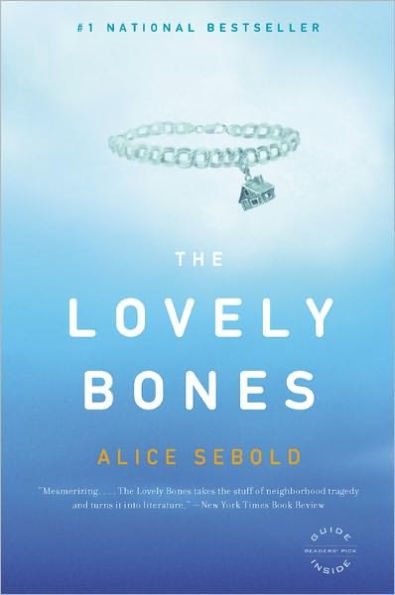
The Lovely Bones

( 4074 )

Pick Up in Store

Reserve and pick up in 60 minutes at your local store

Paperback (Reprint)
$11.22
BN.com price
$14.99 List Price (Save 25%)
Marketplace (New and Used)
from
$0.01
$14.99 List Price (Save 100%)
Usually ships within 1-2 business days
All (790)  
Used (762)  
New (28)  
Close
Sort by
Page 1 of 79
Showing 1 – 10 of 790 (79 pages)
$0.01
(Save 100%)
Seller since 2012

Feedback rating:

(0)

Condition:

New — never opened or used in original packaging.

Like New — packaging may have been opened. A "Like New" item is suitable to give as a gift.

Very Good — may have minor signs of wear on packaging but item works perfectly and has no damage.

Good — item is in good condition but packaging may have signs of shelf wear/aging or torn packaging. All specific defects should be noted in the Comments section associated with each item.

Acceptable — item is in working order but may show signs of wear such as scratches or torn packaging. All specific defects should be noted in the Comments section associated with each item.

Used — An item that has been opened and may show signs of wear. All specific defects should be noted in the Comments section associated with each item.

Refurbished — A used item that has been renewed or updated and verified to be in proper working condition. Not necessarily completed by the original manufacturer.

Very Good

Ships from: Lansing, KS

Usually ships in 1-2 business days

  • Canadian
  • International
  • Standard, 48 States
  • Standard (AK, HI)
  • Express, 48 States
  • Express (AK, HI)
$0.01
(Save 100%)
Seller since 2012

Feedback rating:

(0)

Condition: Good

Ships from: Lansing, KS

Usually ships in 1-2 business days

  • Canadian
  • International
  • Standard, 48 States
  • Standard (AK, HI)
  • Express, 48 States
  • Express (AK, HI)
$0.99
(Save 93%)
Seller since 2009

Feedback rating:

(421)

Condition: Good
2004 Paperback Good Book bent General Used Condiiton. Minor Defects may Exist. Minimal Shelf wear. Text may contain minor marking or highlighting, Binding Tight. Previous ... owners name or bookplate may be present. Like New, May have remainder mark (black line generally made acrossed bottom page edge to indicate close out by publisher) Read more Show Less

Ships from: Wichita, KS

Usually ships in 1-2 business days

  • Canadian
  • International
  • Standard, 48 States
  • Standard (AK, HI)
  • Express, 48 States
  • Express (AK, HI)
$0.99
(Save 93%)
Seller since 2005

Feedback rating:

(3344)

Condition: Good
2004 Trade Paperback Good Good Ships Out Tomorrow!

Ships from: Apollo Beach, FL

Usually ships in 1-2 business days

  • Canadian
  • International
  • Standard, 48 States
  • Standard (AK, HI)
  • Express, 48 States
  • Express (AK, HI)
$0.99
(Save 93%)
Seller since 2009

Feedback rating:

(4400)

Condition: Good
Cover is creased. Some wear to the cover. Pages appear unmarked. Ships the next business day, with tracking and delivery confirmation sent to your email.

Ships from: Beaverton, OR

Usually ships in 1-2 business days

  • Standard, 48 States
  • Standard (AK, HI)
  • Express, 48 States
  • Express (AK, HI)
$0.99
(Save 93%)
Seller since 2009

Feedback rating:

(4400)

Condition: Good
Cover is creased. Slight wear to the cover and pages. Slight markings on outside page edges. Text appears unmarked. Ships the next business day, with tracking and delivery ... confirmation sent to your email. Read more Show Less

Ships from: Beaverton, OR

Usually ships in 1-2 business days

  • Standard, 48 States
  • Standard (AK, HI)
  • Express, 48 States
  • Express (AK, HI)
$0.99
(Save 93%)
Seller since 2009

Feedback rating:

(4400)

Condition: Good
Some wear to the cover. Pages appear unmarked. Ships the next business day, with tracking and delivery confirmation sent to your email.

Ships from: Beaverton, OR

Usually ships in 1-2 business days

  • Standard, 48 States
  • Standard (AK, HI)
  • Express, 48 States
  • Express (AK, HI)
$0.99
(Save 93%)
Seller since 2009

Feedback rating:

(4400)

Condition: Good
Pages discolored due to aging. Slight wear to the cover and pages. Pages appear unmarked. Ships the next business day, with tracking and delivery confirmation sent to your email.

Ships from: Beaverton, OR

Usually ships in 1-2 business days

  • Standard, 48 States
  • Standard (AK, HI)
  • Express, 48 States
  • Express (AK, HI)
$0.99
(Save 93%)
Seller since 2009

Feedback rating:

(4400)

Condition: Very Good
Slight wear to the cover and pages. Pages appear unmarked. Slight shelf wear. Ships the next business day, with tracking and delivery confirmation sent to your email.

Ships from: Beaverton, OR

Usually ships in 1-2 business days

  • Standard, 48 States
  • Standard (AK, HI)
  • Express, 48 States
  • Express (AK, HI)
$0.99
(Save 93%)
Seller since 2011

Feedback rating:

(141)

Condition: Acceptable
2004 Paperback Fair The book is clean but may have markings or highlights througout.

Ships from: St Paul, MN

Usually ships in 1-2 business days

  • Canadian
  • International
  • Standard, 48 States
  • Standard (AK, HI)
  • Express, 48 States
  • Express (AK, HI)
Page 1 of 79
Showing 1 – 10 of 790 (79 pages)
Close
Sort by
NOOK Book (eBook)
$9.99
BN.com price

Available on NOOK devices and apps

  • Nook Devices
  • NOOK
  • NOOK Color
  • NOOK Tablet
  • Tablet/Phone
  • NOOK for iPad
  • NOOK for iPhone
  • NOOK for Android
  • NOOK for Android (Tablet)
  • NOOK Kids for iPad
  • PC/Mac
  • NOOK Study
  • NOOK for PC
  • NOOK for Mac

Need a NOOK? Explore Now

All Available Formats + Editions

Marketplace From
BN.com
 

Overview

When we first meet 14-year-old Susie Salmon, she is already in heaven. This was before milk carton photos and public service announcements, she tells us; back in 1973, when Susie mysteriously disappeared, people still believed these things didn't happen. In the sweet, untroubled voice of a precocious teenage girl, Susie relates the awful events of her death and her own adjustment to the strange new place she finds herself. It looks a lot like her school playground, with the good kind of swing sets. With love, longing, and a growing understanding, Susie watches her family as they cope with their grief, her father embarks on a search for the killer, her sister undertakes a feat of amazing daring, her little brother builds a fort in her honor and begin the difficult process of healing. In the hands of a brilliant novelist, this story of seemingly unbearable tragedy is transformed into a suspenseful and touching story about family, memory, love, heaven, and living.

Third-place winner, 2002 Barnes & Noble Discover Great New Writers Award, Fiction.

  • The Lovely Bones
    The Lovely Bones

Editorial Reviews

From Barnes & Noble
Barnes & Noble Discover Great New Writers
Shockingly original and completely unforgettable, The Lovely Bones is the story of a family devastated by a gruesome murder -- a murder recounted by the teenage victim. Upsetting, you say? Remarkably, first-time novelist Alice Sebold takes this difficult material and delivers a compelling and accomplished exploration of a fractured family's need for peace and closure.

The details of the crime are laid out in the first few pages: from her vantage point in heaven, Susie Salmon describes how she was confronted by the murderer one December afternoon on her way home from school. Lured into an underground hiding place, she was raped and killed. But what the reader knows, her family does not. Anxiously, we keep vigil with Susie, aching for her grieving family, desperate for the killer to be found and punished.

Sebold creates a heaven that's calm and comforting, a place whose residents can have whatever they enjoyed when they were alive -- and then some. But Susie isn't ready to release her hold on life just yet, and she intensely watches her family and friends as they struggle to cope with a reality in which she is no longer a part. To her great credit, Sebold has shaped one of the most loving and sympathetic fathers in contemporary literature.

In the tradition of Alice McDermott, who wrote so elegantly about death in Charming Billy, Sebold unveils a book whose presence will linger with readers for a long, long time and signals the arrival of a novelist to be reckoned with. (Summer 2002 Selection)

Aimee Bender
Intensely wise and gorgeously written, The Lovely Bones is a heart-breaking page-turner...
From The Critics
...explores, with clear-eyed affection and wit, the romance of family life, the shy, funny turbulence of adolescence and the painful tracks love and loss make...

Product Details

  • ISBN-13: 9780316168816
  • Publisher: Little, Brown & Company
  • Publication date: 4/20/2004
  • Edition description: Reprint
  • Pages: 352
  • Sales rank: 249,162
  • Product dimensions: 5.50 (w) x 8.20 (h) x 1.30 (d)

Meet the Author

Alice Sebold
Alice Sebold
With her bestselling, highly praised debut novel The Lovely Bones, Alice Sebold seems to be an overnight success story. The truth is that her career -- and her life -- demonstrate what perseverance, determination, and, yes, talent, can achieve.

Biography

As Alice Sebold relates in her chilling memoir Lucky, she was considered fortunate for surviving a violent, devastating rape in her freshman year at Syracuse University. The woman before her had not been so "lucky": she was murdered and dismembered.

The shadow of this fact survives in Sebold's acclaimed bestseller The Lovely Bones, which is narrated by another not-so-lucky victim from beyond the grave. It's such a maudlin premise that the book shouldn't have been successful—in fact, Sebold's editor has told the author that the manuscript never would have been bought if she had been told what it was about before reading it.

But in her ability to convey the brutal details of crime and its aftermath—both the imagined instance and the real—Sebold proved herself a gripping writer. In a style that is straightforward but more than reportorial, she projected in The Lovely Bones the pitch-perfect voice of a dead 14-year-old girl who, from her vantage point in heaven, remains engaged with life on earth. The book was a sensation and appeared on most "best books" lists for 2002.

Five years later, Sebold produced The Almost Moon, the chilling tale of a woman driven by circumstances to commit an unspeakable act. The novel begins with one of the most arresting first lines in recent memory: "When all is said and done, killing my mother came easily."

Good To Know

Sebold is married to author Glen David Gold, author of Carter Beats the Devil. The two met when Sebold was in the fiction writing program at University of California, Irvine.

Part of the aftermath of Sebold's traumatic rape in college was a long period of self-abuse, including heroin addiction. After a hard trial in New York trying (and failing) to get published, Sebold decided to leave the city and ultimately applied to grad school at Irvine. ''I couldn't handle the rejection and the failure anymore…and the 'almost' of it all,'' she told Entertainment Weekly. ''Everybody from New York has their almost-but-not-quite story, and I just felt like I don't want to be walking around on the planet trotting out mine.''

Sebold says that her continued failures ended up creating a good mindset for her writing. "After a while, you don't think what can't be done and what can be done, because no one's going to care anyway," she said in an Associated Press interview. "You just go and have fun in your room, which is what, to me, art should be about anyway."

    1. Hometown:
      Long Beach, California
    1. Date of Birth:
      September 6, 1963
    2. Place of Birth:
      Madison, Wisconsin
    1. Education:
      B.A., Syracuse University; studied poetry, University of Houston, 1984-85; M.F.A. in fiction, UC-Irvine, 1998

Read an Excerpt

One

My name was Salmon, like the fish; first name, Susie. I was fourteen when I was murdered on December 6, 1973. In newspaper photos of missing girls from the seventies, most looked like me: white girls with mousy brown hair. This was before kids of all races and genders started appearing on milk cartons or in the daily mail. It was still back when people believed things like that didn't happen.

In my junior high yearbook I had a quote from a Spanish poet my sister had turned me on to, Juan Ram?n Jim?nez. It went like this: "If they give you ruled paper, write the other way." I chose it both because it expressed my contempt for my structured surroundings ? la the classroom and because, not being some dopey quote from a rock group, I thought it marked me as literary. I was a member of the Chess Club and Chem Club and burned everything I tried to make in Mrs. Delminico's home ec class. My favorite teacher was Mr. Botte, who taught biology and liked to animate the frogs and crawfish we had to dissect by making them dance in their waxed pans.

I wasn't killed by Mr. Botte, by the way. Don't think every person you're going to meet in here is suspect. That's the problem. You never know. Mr. Botte came to my memorial (as, may I add, did almost the entire junior high school-I was never so popular) and cried quite a bit. He had a sick kid. We all knew this, so when he laughed at his own jokes, which were rusty way before I had him, we laughed too, forcing it sometimes just to make him happy. His daughter died a year and a half after I did. She had leukemia, but I never saw her in my heaven.

My murderer was a man from our neighborhood. My mother liked his border flowers, and my father talked to him once about fertilizer. My murderer believed in old-fashioned things like eggshells and coffee grounds, which he said his own mother had used. My father came home smiling, making jokes about how the man's garden might be beautiful but it would stink to high heaven once a heat wave hit.

But on December 6, 1973, it was snowing, and I took a shortcut through the cornfield back from the junior high. It was dark out because the days were shorter in winter, and I remember how the broken cornstalks made my walk more difficult. The snow was falling lightly, like a flurry of small hands, and I was breathing through my nose until it was running so much that I had to open my mouth. Six feet from where Mr. Harvey stood, I stuck my tongue out to taste a snowflake.

"Don't let me startle you," Mr. Harvey said. Of course, in a cornfield, in the dark, I was startled. After I was dead I thought about how there had been the light scent of cologne in the air but that I had not been paying attention, or thought it was coming from one of the houses up ahead.

"Mr. Harvey," I said. "You're the older Salmon girl, right?" "Yes." "How are your folks?"

Although the eldest in my family and good at acing a science quiz, I had never felt comfortable with adults.

"Fine," I said. I was cold, but the natural authority of his age, and the added fact that he was a neighbor and had talked to my father about fertilizer, rooted me to the spot.

"I've built something back here," he said. "Would you like to see?"

"I'm sort of cold, Mr. Harvey," I said, "and my mom likes me home before dark."

"It's after dark, Susie," he said.

I wish now that I had known this was weird. I had never told him my name. I guess I thought my father had told him one of the embarrassing anecdotes he saw merely as loving testaments to his children. My father was the kind of dad who kept a nude photo of you when you were three in the downstairs bathroom, the one that guests would use. He did this to my little sister, Lindsey, thank God. At least I was spared that indignity. But he liked to tell a story about how, once Lindsey was born, I was so jealous that one day while he was on the phone in the other room, I moved down the couch—he could see me from where he stood—and tried to pee on top of Lindsey in her carrier. This story humiliated me every time he told it, to the pastor of our church, to our neighbor Mrs. Stead, who was a therapist and whose take on it he wanted to hear, and to everyone who ever said "Susie has a lot of spunk!"

"Spunk!" my father would say. "Let me tell you about spunk," and he would launch immediately into his Susie-peed-on-Lindsey story.

But as it turned out, my father had not mentioned us to Mr. Harvey or told him the Susie-peed-on-Lindsey story. Mr. Harvey would later say these words to my mother when he ran into her on the street: "I heard about the horrible, horrible tragedy. What was your daughter's name, again?"

"Susie," my mother said, bracing up under the weight of it, a weight that she naively hoped might lighten someday, not knowing that it would only go on to hurt in new and varied ways for the rest of her life.

Mr. Harvey told her the usual: "I hope they get the bastard. I'm sorry for your loss."

I was in my heaven by that time, fitting my limbs together, and couldn't believe his audacity. "The man has no shame," I said to Franny, my intake counselor. "Exactly," she said, and made her point as simply as that. There wasn't a lot of bullshit in my heaven.

Mr. Harvey said it would only take a minute, so I followed him a little farther into the cornfield, where fewer stalks were broken off because no one used it as a shortcut to the junior high. My mom had told my baby brother, Buckley, that the corn in the field was inedible when he asked why no one from the neighborhood ate it. "The corn is for horses, not humans," she said. "Not dogs?" Buckley asked. "No," my mother answered. "Not dinosaurs?" Buckley asked. And it went like that.

"I've made a little hiding place," said Mr. Harvey. He stopped and turned to me.

"I don't see anything," I said. I was aware that Mr. Harvey was looking at me strangely. I'd had older men look at me that way since I'd lost my baby fat, but they usually didn't lose their marbles over me when I was wearing my royal blue parka and yellow elephant bell-bottoms. His glasses were small and round with gold frames, and his eyes looked out over them and at me.

"You should be more observant, Susie," he said. I felt like observing my way out of there, but I didn't. Why didn't I? Franny said these questions were fruitless: "You didn't and that's that. Don't mull it over. It does no good. You're dead and you have to accept it."

"Try again," Mr. Harvey said, and he squatted down and knocked against the ground.

"What's that?" I asked. My ears were freezing. I wouldn't wear the multicolored cap with the pompom and jingle bells that my mother had made me one Christmas. I had shoved it in the pocket of my parka instead. I remember that I went over and stomped on the ground near him. It felt harder even than frozen earth, which was pretty hard. "It's wood," Mr. Harvey said. "It keeps the entrance from collapsing. Other than that it's all made out of earth." "What is it?" I asked. I was no longer cold or weirded out by the look he had given me. I was like I was in science class: I was curious.

"Come and see."

It was awkward to get into, that much he admitted once we were both inside the hole. But I was so amazed by how he had made a chimney that would draw smoke out if he ever chose to build a fire that the awkwardness of getting in and out of the hole wasn't even on my mind. You could add to that that escape wasn't a concept I had any real experience with. The worst I'd had to escape was Artie, a strange-looking kid at school whose father was a mortician. He liked to pretend he was carrying a needle full of embalming fluid around with him. On his notebooks he would draw needles spilling dark drips.

"This is neato!" I said to Mr. Harvey. He could have been the hunchback of Notre Dame, whom we had read about in French class. I didn't care. I completely reverted. I was my brother Buckley on our day-trip to the Museum of Natural History in New York, where he'd fallen in love with the huge skeletons on display. I hadn't used the word neato in public since elementary school.

"Like taking candy from a baby," Franny said.

I can still see the hole like it was yesterday, and it was. Life is a perpetual yesterday for us. It was the size of a small room, the mud room in our house, say, where we kept our boots and slickers and where Mom had managed to fit a washer and dryer, one on top of the other. I could almost stand up in it, but Mr. Harvey had to stoop. He'd created a bench along the sides of it by the way he'd dug it out. He immediately sat down. "Look around," he said.

I stared at it in amazement, the dug-out shelf above him where he had placed matches, a row of batteries, and a battery-powered fluorescent lamp that cast the only light in the room-an eerie light that would make his features hard to see when he was on top of me.

There was a mirror on the shelf, and a razor and shaving cream. I thought that was odd. Wouldn't he do that at home? But I guess I figured that a man who had a perfectly good split-level and then built an underground room only half a mile away had to be kind of loo-loo. My father had a nice way of describing people like him: "The man's a character, that's all."

So I guess I was thinking that Mr. Harvey was a character, and I liked the room, and it was warm, and I wanted to know how he had built it, what the mechanics of the thing were and where he'd learned to do something like that.

But by the time the Gilberts' dog found my elbow three days later and brought it home with a telling corn husk attached to it, Mr. Harvey had closed it up. I was in transit during this. I didn't get to see him sweat it out, remove the wood reinforcement, bag any evidence along with my body parts, except that elbow. By the time I popped up with enough wherewithal to look down at the goings-on on Earth, I was more concerned with my family than anything else.

My mother sat on a hard chair by the front door with her mouth open. Her pale face paler than I had ever seen it. Her blue eyes staring. My father was driven into motion. He wanted to know details and to comb the cornfield along with the cops. I still thank God for a small detective named Len Fenerman. He assigned two uniforms to take my dad into town and have him point out all the places I'd hung out with my friends. The uniforms kept my dad busy in one mall for the whole first day. No one had told Lindsey, who was thirteen and would have been old enough, or Buckley, who was four and would, to be honest, never fully understand.

Mr. Harvey asked me if I would like a refreshment. That was how he put it. I said I had to go home.

"Be polite and have a Coke," he said. "I'm sure the other kids would."

"What other kids?" "I built this for the kids in the neighborhood. I thought it could be some sort of clubhouse."

I don't think I believed this even then. I thought he was lying, but I thought it was a pitiful lie. I imagined he was lonely. We had read about men like him in health class. Men who never married and ate frozen meals every night and were so afraid of rejection that they didn't even own pets. I felt sorry for him.

"Okay," I said, "I'll have a Coke." In a little while he said, "Aren't you warm, Susie? Why don't you take off your parka."

I did. After this he said, "You're very pretty, Susie." "Thanks," I said, even though he gave me what my friend Clarissa and I had dubbed the skeevies. "Do you have a boyfriend?"

"No, Mr. Harvey," I said. I swallowed the rest of my Coke, which was a lot, and said, "I got to go, Mr. Harvey. This is a cool place, but I have to go." He stood up and did his hunchback number by the six dug-in steps that led to the world. "I don't know why you think you're leaving."

I talked so that I would not have to take in this knowledge: Mr. Harvey was no character. He made me feel skeevy and icky now that he was blocking the door.

"Mr. Harvey, I really have to get home." "Take off your clothes." "What?"

"Take your clothes off," Mr. Harvey said. "I want to check that you're still a virgin." "I am, Mr. Harvey," I said.

"I want to make sure. Your parents will thank me." "My parents?" "They only want good girls," he said. "Mr. Harvey," I said, "please let me leave." "You aren't leaving, Susie. You're mine now."

Fitness was not a big thing back then; aerobics was barely a word. Girls were supposed to be soft, and only the girls we suspected were butch could climb the ropes at school.

I fought hard. I fought as hard as I could not to let Mr. Harvey hurt me, but my hard-as-I-could was not hard enough, not even close, and I was soon lying down on the ground, in the ground, with him on top of me panting and sweating, having lost his glasses in the struggle.

I was so alive then. I thought it was the worst thing in the world to be lying flat on my back with a sweating man on top of me. To be trapped inside the earth and have no one know where I was. I thought of my mother.

My mother would be checking the dial of the clock on her oven. It was a new oven and she loved that it had a clock on it. "I can time things to the minute," she told her own mother, a mother who couldn't care less about ovens.

She would be worried, but more angry than worried, at my lateness. As my father pulled into the garage, she would rush about, fixing him a cocktail, a dry sherry, and put on an exasperated face: "You know junior high," she would say. "Maybe it's Spring Fling." "Abigail," my father would say, "how can it be Spring Fling when it's snowing?" Having failed with this, my mother might rush Buckley into the room and say, "Play with your father," while she ducked into the kitchen and took a nip of sherry for herself.

Mr. Harvey started to press his lips against mine. They were blubbery and wet and I wanted to scream but I was too afraid and too exhausted from the fight. I had been kissed once by someone I liked. His name was Ray and he was Indian. He had an accent and was dark. I wasn't supposed to like him. Clarissa called his large eyes, with their half-closed lids, "freak-a-delic," but he was nice and smart and helped me cheat on my algebra exam while pretending he hadn't. He kissed me by my locker the day before we turned in our photos for the yearbook. When the yearbook came out at the end of the summer, I saw that under his picture he had answered the standard "My heart belongs to" with "Susie Salmon." I guess he had had plans. I remember that his lips were chapped.

"Don't, Mr. Harvey," I managed, and I kept saying that one word a lot. Don't. And I said please a lot too. Franny told me that almost everyone begged "please" before dying. "I want you, Susie," he said.

"Please," I said. "Don't," I said. Sometimes I combined them. "Please don't" or "Don't please." It was like insisting that a key works when it doesn't or yelling "I've got it, I've got it, I've got it" as a softball goes sailing over you into the stands. "Please don't."

But he grew tired of hearing me plead. He reached into the pocket of my parka and balled up the hat my mother had made me, smashing it into my mouth. The only sound I made after that was the weak tinkling of bells.

As he kissed his wet lips down my face and neck and then began to shove his hands up under my shirt, I wept. I began to leave my body; I began to inhabit the air and the silence. I wept and struggled so I would not feel. He ripped open my pants, not having found the invisible zipper my mother had artfully sewn into their side.

"Big white panties," he said. I felt huge and bloated. I felt like a sea in which he stood and pissed and shat. I felt the corners of my body were turning in on themselves and out, like in cat's cradle, which I played with Lindsey just to make her happy. He started working himself over me.


"Susie! Susie!" I heard my mother calling. "Dinner is ready." He was inside me. He was grunting. "We're having string beans and lamb." I was the mortar, he was the pestle. "Your brother has a new finger painting, and I made apple crumb cake."


Mr. Harvey made me lie still underneath him and listen to the beating of his heart and the beating of mine. How mine skipped like a rabbit, and how his thudded, a hammer against cloth. We lay there with our bodies touching, and, as I shook, a powerful knowledge took hold. He had done this thing to me and I had lived. That was all. I was still breathing. I heard his heart. I smelled his breath. The dark earth surrounding us smelled like what it was, moist dirt where worms and animals lived their daily lives. I could have yelled for hours.

I knew he was going to kill me. I did not realize then that I was an animal already dying.

"Why don't you get up?" Mr. Harvey said as he rolled to the side and then crouched over me. His voice was gentle, encouraging, a lover's voice on a late morning. A suggestion, not a command. I could not move. I could not get up.

When I would not—was it only that, only that I would not follow his suggestion?—he leaned to the side and felt, over his head, across the ledge where his razor and shaving cream sat. He brought back a knife. Unsheathed, it smiled at me, curving up in a grin.

He took the hat from my mouth. "Tell me you love me," he said. Gently, I did. The end came anyway.


Copyright © 2002 by Alice Sebold

First Chapter

My name was Salmon, like the fish; first name, Susie. I was fourteen when I was murdered on December 6, 1973. In newspaper photos of missing girls from the seventies, most looked like me: white girls with mousy brown hair. This was before kids of all races and genders started appearing on milk cartons or in the daily mail. It was still back when people believed things like that didn't happen.

In my junior high yearbook I had a quote from a Spanish poet my sister had turned me on to, Juan Ram?n Jim?nez. It went like this: "If they give you ruled paper, write the other way." I chose it both because it expressed my contempt for my structured surroundings ? la the classroom and because, not being some dopey quote from a rock group, I thought it marked me as literary. I was a member of the Chess Club and Chem Club and burned everything I tried to make in Mrs. Delminico's home ec class. My favorite teacher was Mr. Botte, who taught biology and liked to animate the frogs and crawfish we had to dissect by making them dance in their waxed pans.

I wasn't killed by Mr. Botte, by the way. Don't think every person you're going to meet in here is suspect. That's the problem. You never know. Mr. Botte came to my memorial (as, may I add, did almost the entire junior high school —I was never so popular) and cried quite a bit. He had a sick kid. We all knew this, so when he laughed at his own jokes, which were rusty way before I had him, we laughed too, forcing it sometimes just to make him happy. His daughter died a year and a half after I did. She had leukemia, but I never saw her in my heaven.

My murderer was a man from our neighborhood. My mother liked his border flowers, and my father talked to him once about fertilizer. My murderer believed in old-fashioned things like eggshells and coffee grounds, which he said his own mother had used. My father came home smiling, making jokes about how the man's garden might be beautiful but it would stink to high heaven once a heat wave hit.

But on December 6, 1973, it was snowing, and I took a shortcut through the cornfield back from the junior high. It was dark out because the days were shorter in winter, and I remember how the broken cornstalks made my walk more difficult. The snow was falling lightly, like a flurry of small hands, and I was breathing through my nose until it was running so much that I had to open my mouth. Six feet from where Mr. Harvey stood, I stuck my tongue out to taste a snowflake.

"Don't let me startle you," Mr. Harvey said.

Of course, in a cornfield, in the dark, I was startled. After I was dead I thought about how there had been the light scent of cologne in the air but that I had not been paying attention, or thought it was coming from one of the houses up ahead.

"Mr. Harvey," I said.

"You're the older Salmon girl, right?"

"Yes."

"How are your folks?"

Although the eldest in my family and good at acing a science quiz, I had never felt comfortable with adults.

"Fine," I said. I was cold, but the natural authority of his age, and the added fact that he was a neighbor and had talked to my father about fertilizer, rooted me to the spot.

"I've built something back here," he said. "Would you like to see?"

"I'm sort of cold, Mr. Harvey," I said, "and my mom likes me home before dark."

"It's after dark, Susie," he said.

I wish now that I had known this was weird. I had never told him my name. I guess I thought my father had told him one of the embarrassing anecdotes he saw merely as loving testaments to his children. My father was the kind of dad who kept a nude photo of you when you were three in the downstairs bathroom, the one that guests would use. He did this to my little sister, Lindsey, thank God. At least I was spared that indignity. But he liked to tell a story about how, once Lindsey was born, I was so jealous that one day while he was on the phone in the other room, I moved down the couch —he could see me from where he stood —and tried to pee on top of Lindsey in her carrier. This story humiliated me every time he told it, to the pastor of our church, to our neighbor Mrs. Stead, who was a therapist and whose take on it he wanted to hear, and to everyone who ever said "Susie has a lot of spunk!"

"Spunk!" my father would say. "Let me tell you about spunk," and he would launch immediately into his Susie-peed-on-Lindsey story.

But as it turned out, my father had not mentioned us to Mr. Harvey or told him the Susie-peed-on-Lindsey story.

Mr. Harvey would later say these words to my mother when he ran into her on the street: "I heard about the horrible, horrible tragedy. What was your daughter's name, again?"

"Susie," my mother said, bracing up under the weight of it, a weight that she naively hoped might lighten someday, not knowing that it would only go on to hurt in new and varied ways for the rest of her life.

Mr. Harvey told her the usual: "I hope they get the bastard. I'm sorry for your loss."

I was in my heaven by that time, fitting my limbs together, and couldn't believe his audacity. "The man has no shame," I said to Franny, my intake counselor. "Exactly," she said, and made her point as simply as that. There wasn't a lot of bullshit in my heaven.

Mr. Harvey said it would only take a minute, so I followed him a little farther into the cornfield, where fewer stalks were broken off because no one used it as a shortcut to the junior high. My mom had told my baby brother, Buckley, that the corn in the field was inedible when he asked why no one from the neighborhood ate it. "The corn is for horses, not humans," she said. "Not dogs?" Buckley asked. "No," my mother answered. "Not dinosaurs?" Buckley asked. And it went like that.

"I've made a little hiding place," said Mr. Harvey.

He stopped and turned to me.

"I don't see anything," I said. I was aware that Mr. Harvey was looking at me strangely. I'd had older men look at me that way since I'd lost my baby fat, but they usually didn't lose their marbles over me when I was wearing my royal blue parka and yellow elephant bell-bottoms. His glasses were small and round with gold frames, and his eyes looked out over them and at me.

"You should be more observant, Susie," he said.

I felt like observing my way out of there, but I didn't. Why didn't I? Franny said these questions were fruitless: "You didn't and that's that. Don't mull it over. It does no good. You're dead and you have to accept it."

"Try again," Mr. Harvey said, and he squatted down and knocked against the ground.

"What's that?" I asked.

My ears were freezing. I wouldn't wear the multicolored cap with the pompom and jingle bells that my mother had made me one Christmas. I had shoved it in the pocket of my parka instead.

I remember that I went over and stomped on the ground near him. It felt harder even than frozen earth, which was pretty hard.

"It's wood," Mr. Harvey said. "It keeps the entrance from collapsing. Other than that it's all made out of earth."

"What is it?" I asked. I was no longer cold or weirded out by the look he had given me. I was like I was in science class: I was curious.

"Come and see."

It was awkward to get into, that much he admitted once we were both inside the hole. But I was so amazed by how he had made a chimney that would draw smoke out if he ever chose to build a fire that the awkwardness of getting in and out of the hole wasn't even on my mind. You could add to that that escape wasn't a concept I had any real experience with. The worst I'd had to escape was Artie, a strange-looking kid at school whose father was a mortician. He liked to pretend he was carrying a needle full of embalming fluid around with him. On his notebooks he would draw needles spilling dark drips.

"This is neato!" I said to Mr. Harvey. He could have been the hunchback of Notre Dame, whom we had read about in French class. I didn't care. I completely reverted. I was my brother Buckley on our day-trip to the Museum of Natural History in New York, where he'd fallen in love with the huge skeletons on display. I hadn't used the word neato in public since elementary school.

"Like taking candy from a baby," Franny said.

I can still see the hole like it was yesterday, and it was. Life is a perpetual yesterday for us. It was the size of a small room, the mud room in our house, say, where we kept our boots and slickers and where Mom had managed to fit a washer and dryer, one on top of the other. I could almost stand up in it, but Mr. Harvey had to stoop. He'd created a bench along the sides of it by the way he'd dug it out. He immediately sat down.

"Look around," he said.

I stared at it in amazement, the dug-out shelf above him where he had placed matches, a row of batteries, and a battery-powered fluorescent lamp that cast the only light in the room —an eerie light that would make his features hard to see when he was on top of me.

There was a mirror on the shelf, and a razor and shaving cream. I thought that was odd. Wouldn't he do that at home? But I guess I figured that a man who had a perfectly good split-level and then built an underground room only half a mile away had to be kind of loo-loo. My father had a nice way of describing people like him: "The man's a character, that's all."

So I guess I was thinking that Mr. Harvey was a character, and I liked the room, and it was warm, and I wanted to know how he had built it, what the mechanics of the thing were and where he'd learned to do something like that.

But by the time the Gilberts' dog found my elbow three days later and brought it home with a telling corn husk attached to it, Mr. Harvey had closed it up. I was in transit during this. I didn't get to see him sweat it out, remove the wood reinforcement, bag any evidence along with my body parts, except that elbow. By the time I popped up with enough wherewithal to look down at the goings-on on Earth, I was more concerned with my family than anything else.

My mother sat on a hard chair by the front door with her mouth open. Her pale face paler than I had ever seen it. Her blue eyes staring. My father was driven into motion. He wanted to know details and to comb the cornfield along with the cops. I still thank God for a small detective named Len Fenerman. He assigned two uniforms to take my dad into town and have him point out all the places I'd hung out with my friends. The uniforms kept my dad busy in one mall for the whole first day. No one had told Lindsey, who was thirteen and would have been old enough, or Buckley, who was four and would, to be honest, never fully understand.

Mr. Harvey asked me if I would like a refreshment. That was how he put it. I said I had to go home.

"Be polite and have a Coke," he said. "I'm sure the other kids would."

"What other kids?"

"I built this for the kids in the neighborhood. I thought it could be some sort of clubhouse."

I don't think I believed this even then. I thought he was lying, but I thought it was a pitiful lie. I imagined he was lonely. We had read about men like him in health class. Men who never married and ate frozen meals every night and were so afraid of rejection that they didn't even own pets. I felt sorry for him.

"Okay," I said, "I'll have a Coke."

In a little while he said, "Aren't you warm, Susie? Why don't you take off your parka."

I did.

After this he said, "You're very pretty, Susie."

"Thanks," I said, even though he gave me what my friend Clarissa and I had dubbed the skeevies.

"Do you have a boyfriend?"

"No, Mr. Harvey," I said. I swallowed the rest of my Coke, which was a lot, and said, "I got to go, Mr. Harvey. This is a cool place, but I have to go."

He stood up and did his hunchback number by the six dug-in steps that led to the world. "I don't know why you think you're leaving."

I talked so that I would not have to take in this knowledge: Mr. Harvey was no character. He made me feel skeevy and icky now that he was blocking the door.

"Mr. Harvey, I really have to get home."

"Take off your clothes."

"What?"

"Take your clothes off," Mr. Harvey said. "I want to check that you're still a virgin."

"I am, Mr. Harvey," I said.

"I want to make sure. Your parents will thank me."

"My parents?"

"They only want good girls," he said.

"Mr. Harvey," I said, "please let me leave."

"You aren't leaving, Susie. You're mine now."

Fitness was not a big thing back then; aerobics was barely a word. Girls were supposed to be soft, and only the girls we suspected were butch could climb the ropes at school.

I fought hard. I fought as hard as I could not to let Mr. Harvey hurt me, but my hard-as-I-could was not hard enough, not even close, and I was soon lying down on the ground, in the ground, with him on top of me panting and sweating, having lost his glasses in the struggle.

I was so alive then. I thought it was the worst thing in the world to be lying flat on my back with a sweating man on top of me. To be trapped inside the earth and have no one know where I was.

I thought of my mother.

My mother would be checking the dial of the clock on her oven. It was a new oven and she loved that it had a clock on it. "I can time things to the minute," she told her own mother, a mother who couldn't care less about ovens.

She would be worried, but more angry than worried, at my lateness. As my father pulled into the garage, she would rush about, fixing him a cocktail, a dry sherry, and put on an exasperated face: "You know junior high," she would say. "Maybe it's Spring Fling." "Abigail," my father would say, "how can it be Spring Fling when it's snowing?" Having failed with this, my mother might rush Buckley into the room and say, "Play with your father," while she ducked into the kitchen and took a nip of sherry for herself.

Mr. Harvey started to press his lips against mine. They were blubbery and wet and I wanted to scream but I was too afraid and too exhausted from the fight. I had been kissed once by someone I liked. His name was Ray and he was Indian. He had an accent and was dark. I wasn't supposed to like him. Clarissa called his large eyes, with their half-closed lids, "freak-a-delic," but he was nice and smart and helped me cheat on my algebra exam while pretending he hadn't. He kissed me by my locker the day before we turned in our photos for the yearbook. When the yearbook came out at the end of the summer, I saw that under his picture he had answered the standard "My heart belongs to" with "Susie Salmon." I guess he had had plans. I remember that his lips were chapped.

"Don't, Mr. Harvey," I managed, and I kept saying that one word a lot. Don't. And I said please a lot too. Franny told me that almost everyone begged "please" before dying.

"I want you, Susie," he said.

"Please," I said. "Don't," I said. Sometimes I combined them. "Please don't" or "Don't please." It was like insisting that a key works when it doesn't or yelling "I've got it, I've got it, I've got it" as a softball goes sailing over you into the stands.

"Please don't."

But he grew tired of hearing me plead. He reached into the pocket of my parka and balled up the hat my mother had made me, smashing it into my mouth. The only sound I made after that was the weak tinkling of bells.

As he kissed his wet lips down my face and neck and then began to shove his hands up under my shirt, I wept. I began to leave my body; I began to inhabit the air and the silence. I wept and struggled so I would not feel. He ripped open my pants, not having found the invisible zipper my mother had artfully sewn into their side.

"Big white panties," he said.

I felt huge and bloated. I felt like a sea in which he stood and pissed and shat. I felt the corners of my body were turning in on themselves and out, like in cat's cradle, which I played with Lindsey just to make her happy. He started working himself over me.


"Susie! Susie!" I heard my mother calling. "Dinner is ready."

He was inside me. He was grunting.

"We're having string beans and lamb."

I was the mortar, he was the pestle.

"Your brother has a new finger painting, and I made apple crumb cake."


Mr. Harvey made me lie still underneath him and listen to the beating of his heart and the beating of mine. How mine skipped like a rabbit, and how his thudded, a hammer against cloth. We lay there with our bodies touching, and, as I shook, a powerful knowledge took hold. He had done this thing to me and I had lived. That was all. I was still breathing. I heard his heart. I smelled his breath. The dark earth surrounding us smelled like what it was, moist dirt where worms and animals lived their daily lives. I could have yelled for hours.

I knew he was going to kill me. I did not realize then that I was an animal already dying.

"Why don't you get up?" Mr. Harvey said as he rolled to the side and then crouched over me.

His voice was gentle, encouraging, a lover's voice on a late morning. A suggestion, not a command.

I could not move. I could not get up.

When I would not —was it only that, only that I would not follow his suggestion? —he leaned to the side and felt, over his head, across the ledge where his razor and shaving cream sat. He brought back a knife. Unsheathed, it smiled at me, curving up in a grin.

He took the hat from my mouth.

"Tell me you love me," he said.

Gently, I did.

The end came anyway.

Copyright © 2002 by Alice Sebold

Reading Group Guide

1. In Susie's Heaven, she is surrounded by things that bring her peace. What would your Heaven be like? Is it surprising that in Susie's inward, personal version of the hereafter there is no God or larger being that presides?

2. Why does Ruth become Susie's main connection to Earth? Was it accidental that Susie touched Ruth on her way up to Heaven, or was Ruth actually chosen to be Susie's emotional conduit?

3. Rape is one of the most alienating experiences imaginable. Susie's rape ends in murder and changes her family and friends forever. Alienation is transferred, in a sense, to Susie's parents and siblings. How do they each experience loneliness and solitude after Susie's death?

4. Why does the author include details about Mr. Harvey's childhood and his memories of his mother? By giving him a human side, does Sebold get us closer to understanding his motivation? Sebold explained in an interview about the novel that murderers "are not animals but men," and that is what makes them so frightening. Do you agree?

5. Discuss the way in which guilt manifests itself in the various characters - Jack, Abigail, Lindsay, Mr. Harvey, Len Fenerman.

6. "Pushing on the inbetween" is how Susie describes her efforts to connect with those she has left behind on Earth. Have you ever felt as though someone was trying to communicate with you from "the inbetween"?

7. Does Buckley really see Susie, or does he make up a version of his sister as a way of understanding, and not being too emotionally damaged by, her death? How do you explain tragedy to a child? Do you think Susie's parents do a good job of helping Buckley comprehend the loss of his sister?

8. Susie is killed just as she was beginning to see her mother and father as real people, not just as parents. Watching her parents' relationship change in the wake of her death, she begins to understand how they react to the world and to each other. How does this newfound understanding affect Susie?

9. Can Abigail's choice to leave her family be justified?

10. Why does Abigail leave her dead daughter's photo outside the Chicago Airport on her way back to her family?

11. Susie observes that "The living deserve attention, too." She watches her sister, Lindsay, being neglected as those around her focus all their attention on grieving for Susie. Jack refuses to allow Buckley to use Susie's clothes in his garden. When is it time to let go?

12. Susie's Heaven seems to have different stages, and climbing to the next stage of Heaven requires her to remove herself from what happens on Earth. What is this process like for Susie?

13. In The Lovely Bones, adult relationships (Abigail and Jack, Ray's parents) are dysfunctional and troubled, whereas the young relationships (Lindsay and Samuel, Ray and Susie, Ray and Ruth) all seem to have depth, maturity, and potential. What is the author saying about young love? About the trials and tribulations of married life?

14. Is Jack Salmon allowing himself to be swallowed up by his grief? Is there a point where he should have let go? How does his grief process affect his family? Is there something admirable about holding on so tightly to Susie's memory and not denying his profound sadness?

15. Ray and Susie's final physical experience (via Ruth's body) seems to act almost as an exorcism that sweeps away, if only temporarily, Susie's memory of her rape. What is the significance of this act for Susie, and does it serve to counterbalance the violent act that ended Susie's life?

16. Alice Sebold seems to be saying that out of tragedy comes healing. Susie's family fractures and comes back together, a town learns to find strength in each other. Do you agree that good can come of great trauma?

Customer Reviews
Average Rating 4
( 4074 )

Rating Distribution

If you've bought this product, tell the world how you liked it.
Write a Review
See All Sort by: Showing 1 – 20 of 4081 Customer Reviews
  • Posted January 5, 2010

    The Lovely Bones is a gripping and wonderfully played out novel.

    When I first picked up The Lovely Bones I had a feeling it was a book I was going to like, there was so much hype about it and it seemed like it was becoming a modern day classic. As I began to read it more and more, not only did I like it, but I began to be so attached to the story and especially the characters, which the author ,Alice Sebold, writes about in great detail. The story is about a 13 year old girl named Susie Salmon who has a normal, but nice life. Her life is soon put to an end though once she is murdered by one of her neighbors. She than goes off to heaven and looks down on her murderer and on her coping family. Alice Sebold has made an imaginative story which has a wonderfully set up plot that features suspense, romance, some mystery, tragedy, and hope. The Lovely Bones is a book that I think everybody of all ages and gender should read.

    13 out of 16 people found this review helpful.

    Was this review helpful? Yes  No   Report this review
  • Anonymous

    Posted August 27, 2009

    Slightly Disappointing

    I decided to pick up this book randomly when having the desire for a new read, a fresh one. A lot of my friends have read it and told me it was great, and its got a lot of hype (and is now apparently a movie) so I decided, why not?
    The story itself is interesting.. it kept me reading. Sadly there isn't really a climax because, in a way, there isn't really an ending... at least not a satisfying one. I thought the concept of the story was original (kind of) that the story was being told by a dead 14 year-old from her heaven. The events that take place keep you reading.. until a certain point. The book kind of comes to a stop and then slowly takes you to the end... and then a couple weird things happen, at which point before finishing the book you realize nothing is REALLY going to happen.
    But that wasn't really the thing that disappointed me. It was the fact that I felt I already knew the message and the "ending" of this story before I even read it. The "realistic" ending and perspective of this terrible situation, which didn't seem very satisfying to me. Though the message, I would say, is nice and can offer someone something to take away from it, that wasn't the case for me. I feel that this book would be an eye opener for someone much younger than me. At the age of 20, I have read too many novels, seen to many movies, and have gone through enough pain in my life to take away any valuable or inspiring message from this book. It's message was nice, like I said, but didn't do much for me and left me disappointed. Plus Alice's writing style kind of jumped around and could become confusing for some.
    So, overall, I would recommend this book to a 14-18 year old with good reading skills and is mature enough to read some slightly graphic material. Anyone older than that I don't think will get anything out of it or be moved by its message. The book is good, but just wasn't inspiring to me.

    10 out of 15 people found this review helpful.

    Was this review helpful? Yes  No   Report this review
  • Posted January 14, 2010

    Don't waste your time

    This book was a HUGE disappointment and waste of time. I kept thinking it was going to get better. It had to get better so I read it to the end. Sorry to say I was extremely disappointed. The writer is kind of boring. It goes on and on. You're expecting a murder mystery to be solved and then when you get to the end, you say "That's how it ends?". Don't waste your time reading it.

    8 out of 14 people found this review helpful.

    Was this review helpful? Yes  No   Report this review
  • Posted May 28, 2009

    Lovely book!

    Although I have read this book some time ago, it left me and still leaves me not sad but very thoughtful of life, love, and wondering so many things at once that I was just plain speechless....in a good way. I immediately had to recommend this to my friends. It is hard to describe. A very surprising read for me. It is probably one of the best books I have ever read, and this is not usually my normal genre of reading.

    8 out of 11 people found this review helpful.

    Was this review helpful? Yes  No   Report this review
  • Posted August 23, 2009

    I Also Recommend:

    LOVELY BONES

    At first this book is very unsettling. Having young children myself the heinous murder of a child-I am not giving anything away here- affected me deeply. The story reaffirms the fragile nature of life and the enormous consequences a loss of life has on family and friends. What started as a tragic tale transformed into one of love and redemption sweetly told by the victim, Susie Salmon. The book was not perfect.There were a couple of sequences near the end that seemed unnecessary or too contrived-I would be giving too much away here to expound. I gave it 5 stars because the book was unusual, thought provoking and it captured my interest from beginning to end. Read it. And love your children.

    6 out of 8 people found this review helpful.

    Was this review helpful? Yes  No   Report this review
  • Posted August 19, 2009

    more from this reviewer

    Where's the Climax??

    This story was able to captivate my attention in the beginning with its inventive and unique plot-line, however, as the story continued, it left a lot to be desired. With the death of Mr.Harvey by way of an icicle...obviously that left me confused and craving for a more justified conclusion. The only thing that capitivated me to keep reading was the reactions of Susie's mother, Abigail. The fact that she could leave her family and treat them as a burden, as well as Susie's death, left me enthralled. I did not believe her reaction and found the impossibility of it rather curious, though not enough to have me be fulfilled with the end of the story. Because Mr.Harvey was never caught and the continuance of his story seemed exceedingly pointless and aggrivating. I felt no rise in the story, no exciting point that cooled over; it was a constant drull that seemed to be waiting to end...

    6 out of 9 people found this review helpful.

    Was this review helpful? Yes  No   Report this review
  • Anonymous

    Posted January 25, 2010

    Not a murder mystery!

    The end of this book is very disappointing and feels a little rushed meanwhile was very slow throughout. It is supposed to make you value life/those around you, but leaves you hanging. You don't get closure with her murder and neither does her family.

    5 out of 7 people found this review helpful.

    Was this review helpful? Yes  No   Report this review
  • Posted May 11, 2009

    I Also Recommend:

    Truly Amazing

    I'm 13 years old but read at a very high reading level. This book, to me, was absolutely amazing. I will never forget it. The plot was amazing, the story line great. The emotion Alice Sebold puts into the book is literal, yet touching. A girl murdered tells the story of her life, then watches her family grow, have problems, and become better people from heaven. She watches the murderer of herself cover up his path. She watches her sister grow up. It's all very heartbreaking, yet very amazing. Truly a must-read.

    5 out of 6 people found this review helpful.

    Was this review helpful? Yes  No   Report this review
  • Anonymous

    Posted November 25, 2008

    Haunting yet Satisfying Story

    The Lovely Bones by Alice Sebold is hands down the best book I have ever read. Sebold thrills us with a depressing book of a little girl named Susie who is raped and murdered. She pulls on our emotions by separating the girl from her family by placing her in heaven only to contact them through the family¿s sad memories. The book harnesses our curiosity through the pursuit that slowly fades to find the twisted murder Mr. Harvey, a neighbor. It is prominent throughout the story that Sebold wants us to understand the steps of grieving. She shows how grieving families are ripped apart because they handle the death in their own individual ways. The mother and father grow farther apart as the father locks himself away in his own thoughts and memories. The mother longs for comfort and the necessity to extinguish her feeling of cold loneliness by convening feelings for the detective on the case. Her brother slowly grows into a boy plagued by anger for his mother upon her abandonment of her family. Her sister shuts herself off from her family and the world in a deep mourning for Susie. Though, she slowly comes to terms when she gains a steady loving boyfriend. Susie grows jealous from heaven enduring the fact that she can¿t solidify her feelings for a boy like her sister on earth. She is harnessed by the feelings she has for a boy named Ray who on earth she was becoming close to. He is deeply sorrowed and flashes back to their memories made in the short time after their first kiss. He becomes great friends with an outcast girl, Ruth who admired Susie and can feel and become in touch with spirits. Over the eight years in which the novel takes place Susie brings us deeply in touch with the members of her family and each of their steps in grieving. She is connected to earth because she cannot understand her own death. This is mainly in part of comprehending what is happening to those she loves but being unable to let go herself. Susie refers to the penguin snow globe in a way that we start to believe she is getting at a perfect world. I feel she is trying to open our eyes to search for perfection in the novel among the overwhelming grief. Sebold fascinates us with perfection by making us search in depth for it throughout the rest of the book, a perfection almost that could be thought to be exemplified in the Climax and end of the story.(to be seen upon reading the book) I am also deeply fascinated with the interlude in the book called Snapshots. Sebold captures our curiosity of the rolls and rolls of undeveloped pictures under Susie¿s bed. I feel she wants us to believe that the pictures are the memories of people¿s lives on earth that Susie has left behind. She wants us to better understand the choices people made from the pictures. The book can be described as a Supernatural thriller mostly in the part I will leave you hanging on. As Ruth and Ray become older and Susie longs for Ray because of her want to make love with him an extraordinary happening unfolds. While Ray and Ruth visit home they go to the sinkhole where Susie¿s body unfound sits in a safe at the bottom. After years of running Mr. Harvey is back in town and passes by the area only to connect eyes with Ruth while passing by. Susie feels an overwhelming tug to earth as Ruth blacks out on the ground connecting with heaven. Some supernatural occurrences take place leaving Susie with an inconceivable path towards acceptance and settlement.

    5 out of 6 people found this review helpful.

    Was this review helpful? Yes  No   Report this review
  • Posted January 3, 2010

    I Also Recommend:

    Gruesome or heartwarming?

    THE LOVELY BONES was given to me to read. It would not have been my choice of reading material but somehow this gruesome, horrible thing that happened to Susie, the narrator speaking from HEAVEN, turned out to be one of the most heartwarming books I've ever read! WELL WORTH YOUR TIME!

    Other books that left me with a warm heart are THE SHACK, EXPLOSION IN PARIS, THE GUERNSEY LITERARY and POTATO PEEL PIE SOCIETY....

    4 out of 4 people found this review helpful.

    Was this review helpful? Yes  No   Report this review
  • Anonymous

    Posted February 17, 2010

    Torture to read

    Before reading The Lovely Bones, I had been told by two people what a great book it is and that they both considered it one of the best books they've ever read. This got me really intrigued and I couldn't wait to read it. I was so disappointed when I discovered how boring this book is. I still have about 25 pages left to go, and I'm only reading it so that I can say I finished it. It feels like torture every time I pick the book up and start to read. Maybe it's just me, but I can't stand the way this author writes. There is no suspense or page-turning quality to the story whatsoever, and it feels like as she tells the story she spends a great deal of her time merely rambling about irrelevant details. Oftentimes, I find myself wondering why she is now talking about this or that, and if she will ever get on with the "meat" of the story. She also has a very vague, sometimes confusing writing style, and I find myself having to reread or ponder what she has written because it doesn't seem to make sense. I feel like as I'm reading, I'm pushing a heavy sled uphill, anticipating the top but wondering if I'll ever get there. It's painful and tiring, and I can't wait to be done! Don't waste your money on this book; if you insist on reading it, check it out at the library.

    3 out of 4 people found this review helpful.

    Was this review helpful? Yes  No   Report this review
  • Posted January 13, 2010

    Amazing

    I truely loved this book! It was a sad story, the entire time you can feel the families pain of losing their daughter and never get justice. What makes this book different is that it is told by the main character has she views her on her family in heaven. The entire time you wonder if the killer is ever brought to justice and it upsetting that he does not. Easy read, I could not put the book down!!!

    3 out of 3 people found this review helpful.

    Was this review helpful? Yes  No   Report this review
  • Posted January 4, 2010

    more from this reviewer

    I couldn't put it down.

    Beautifully written, sometimes disturbing, touching, a book you couldn't put down once you read the first sentence. I really hope the movie captures the true essence of the book.

    3 out of 4 people found this review helpful.

    Was this review helpful? Yes  No   Report this review
  • Posted January 6, 2012

    AN AMAZING NOVEL THAT WILL BLOW YOUR MIND!!! :)

    The Lovely Bones is a must read for all high school students and young adults. It truly deserved to be named the number one bestseller of 2002 because Alice Sebold, the author, developed the characters realistically, used an interesting point of view, and created a captivating plot that even attracted me, a non-reader. This novel was a touching story about a fourteen-year-old girl named Susie Salmon who was raped and murdered on her way home from school. It was partly a detective story and partly a family drama with morals that could teach young adults a little something about life. I found it so unique that Susie, herself, narrated her story from up in heaven as she watched her family cope with her death and her killer and neighbor, Mr. Harvey, use lies to get away with her murder. I mean, in what other book would a dead person be telling their story from heaven?

    Each of the characters were developed realistically. I got to know all of them in depth because I could relate to them so easily. Susie was raped and murdered by her neighbor, and so this book also taught me about that you can't trust everyone. Alice Sebold's poetic writing style truly enhanced the story. She used metaphors, like that in the prologue, where Susie talked about the penguin in her father's snowglobe and how it, now like her, was trapped in a perfect world. Throughout the story, Susie watched her family, her friends, her loved ones, and her killer as their lovely bones grew up and lived life without her. I have to warn you, though, that there are some inappropriate scenes in the story that may not appeal to all readers.

    Without any hesitation would I recommend this book to young adults and mature audiences. The way that Sebold described each of the characters realistically and set you up in a front row seat with Susie truly enhanced the story. This novel is amazing and it touched my heart and if you read it, it will not disappoint you.

    2 out of 2 people found this review helpful.

    Was this review helpful? Yes  No   Report this review
  • Posted January 6, 2012

    INSANELY GOOD BOOK!!!!!!!!!!

    Hey, you teenagers and young adults! You should definitely read this book because of the attracting plot, realistic characters/situations, and realistic themes. If any of you have watched the movie, read a summary, or heard anything from those who have read this book, you might know that this book starts off with a graphically described rape and murder. Once I read the first chapter, my heart became attached to the next chapters, just to see how heaven is like and how the dead attach to the living, especially the murderer. The intricate details, themes, and individual stories of each character are absolutely amazing. Everything was so realistic that I had a hard time accepting the fact that this book is fiction. Even though some people may not believe in heaven, this book may change their minds. The Lovely Bones is strong and captivating in so many ways that I consider this as one of my favorite books of all time. The themes are family issues, friendship, haunting, love, and a little dab of suspense. Even though I didn't experience many family problems prior to reading this book, I do admit that that has changed. Because the book is told in first-person narration, I got to experience first-hand how Susie Salmon feels about the tragic splits within her family. Friendship also gets a spotlight. Susie Salmon dies when she is only 14 years old, but from heaven, she watches everyone grow older, from her murderer, to her friends/first love, to her siblings. In the book, the reader gets to see eight continuous years after Susie's death, which is enough time for her younger sister and friends, Ray and Ruth, to graduate from college. After reading this book, I thought, "WOW". Get this book the next time you go shopping!

    2 out of 2 people found this review helpful.

    Was this review helpful? Yes  No   Report this review
  • Anonymous

    Posted February 20, 2010

    A title that makes no sense and a boring read.

    The book never went anywhere. She was killed. She went to heaven and that was it. The book should be called, 'Alice's Version of Heaven'. I was only barely able to finish it because I was waiting for something to happen.

    2 out of 4 people found this review helpful.

    Was this review helpful? Yes  No   Report this review
  • Anonymous

    Posted February 3, 2010

    A Movie??

    I'm sorry I wasted my time and money on this book. It was a bore so I certainly won't be seeing the movie.

    2 out of 5 people found this review helpful.

    Was this review helpful? Yes  No   Report this review
  • Posted November 27, 2009

    more from this reviewer

    Not as emotional or realistic as you might think.

    The Lovely Bones was kind of slow at times, and I didn't feel tons of sadness and sympathy towards the Susie and her family. The writer described the family as being in grieving or running away from the emotional pain, but she didn't really go deep enough to make the story completely realistic and tear jerking. Don't get me wrong, I teared up at parts, but I could have put the book down easily and walked away if I didn't want to see the man who killed and raped Susie get what was coming for him.

    The story was mainly focused on Susie's family, and how they dealt with her death. She watches as her sister, Lindsey, holds her grief and feelings deep under the surface.She sees her Father fighting to have Susie's killer thrown in jail without any proof other than his gut feelings.She see's her true childhood love, Ray grow, yearning for one last kiss. She see's a misunderstood friend and artist suffer from her death. And she sees her mother running away, and her younger brother, Buckley becoming a stone at heart. Susie also watches over her killer, seeing as he manages to go under the radar during the investigation.


    It was never described as to why he murdered and raped Susie and other women, young and old, but it was hinted that his childhood involved stealing and men stalking his mother looking for a "good night". I felt it needed more detail to make the story feel more realistic.


    I also wished that we knew more about Susie's feelings.. Does she hate the man who who took her life at 14 and raped her, or does she find it in her heart to forgive him?

    More on Susie's feelings, she didn't really express enough emotion on wanting to be alive or even reaching out to her family, saying goodbye and "I love you". She did mention wanting to kiss Ray again a few times, and *****SLIGHT SPOILER***** was granted that wish in the form of being in Ruth's body (artist friend) and expressing her love.. I found that to be kind of odd, and weird honestly, but moving on to another point on this topic..

    I grew frustrated that when she had the chance to call the police to inform them that her missing killer was in the neighborhood and didn't do anything because she was expressing her love to Ray physically. I found this to be kind of selfish, because you would have thought she would also try to call her family once it happened. But this doesn't seem to occur to her until she's being sent back to Heaven.******


    Moving on.. I didn't hate the ending because it showed that her family was able to reunite and heal, but I wished the killer would have been arrested, and that the family would have felt more closure knowing the full story. However, he does meet his end, so his lack of arrest wasn't terribly disappointing.

    This book got 3 stars because the killer's motives weren't described and you never really get sucked beneath the surface and know the character's feeling completely. I also didn't find Susie's character to be very realistic, as I've explained by voicing my opinions on her lack of feelings on things and her behavior.

    Lovely Bones was also a little slow while reading, but never to the point I had to take several breaks from reading. I would recommend this book to a mature friend who enjoys deep books that let you jump out of a sheltered world.

    (Note) If you're thinking about letting a person under 16 read this, I'd read it and decide for yourself.

    2 out of 2 people found this review helpful.

    Was this review helpful? Yes  No   Report this review
  • Anonymous

    Posted February 20, 2009

    The lovely bones is a mysterious drama.

    The Lovely Bones is Alice Sebold's first novel, but you can't tell. Her vivid details tell the story of Susie Salmons and her family's tragedy. This book will keep you on your toes the whole time. She has received quite a few reviews for this book.

    Fourteen year old Susie is narrating her story of being kidnapped, raped, and murdered by her neighbor Mr. Botts who is later found to be a serial killer. Susie's family has a hard time coping after her death; her dad becomes obsessed with proving that their neighbor killed her. This leads her Mother to have an affair and run away to California. Her sister is worried that she will only be known as the girl whose sister died instead of her being known for her grand accomplishments. Her brother is the one that really suffers not really understanding what has happened and loosing his family. Susie is telling her story by looking down from heaven. She describes heaven as her school playground with big swing sets. She is with a girl named Holly and when she thinks of something it will just appear for her but all she really wants is to be back with her family and tell them what happened.

    The book has started a little puzzling but as it goes on it becomes easier to understand. The mood of the book is a mixture of a mystery and a sob story. The only thing I did not enjoy about The Lovely Bones was that it repeated itself a lot. But overall it was a great book.

    In the end the book Susie's family starts to move on with their lives. Her sister has a boyfriend. And her dad has given up the hunt to prove that their neighbor was the killer, but it will always be in the back of his mind. Susie's love ones are finally at peace, but she will never be forgotten.

    I really appreciated reading this wonderful book. I recommend this book to Middle School Students or older. Its mysterious mood will keep you on your toes. Once you start this book you won't be able to put it down. If you haven't read this you better get to it.

    2 out of 2 people found this review helpful.

    Was this review helpful? Yes  No   Report this review
  • Anonymous

    Posted December 14, 2007

    A reviewer

    I really enjoyed reading the book The Lovely Bones, by Alice Sebold. I enjoyed this book for many reasons. The thing I liked most about the book was how Susie, a murder victim, narrates the story from her personalized heaven. I expected this book to be more like an investigation, but found it to be something completely different. You know the whole time who the murderer is, and you, the reader, also know other secrets throughout the book as well. The story is mostly about what Susie sees from Heaven. I also think the book was well written because the author has personal experience with a situation related to the story.

    2 out of 2 people found this review helpful.

    Was this review helpful? Yes  No   Report this review
See All Sort by: Showing 1 – 20 of 4081 Customer Reviews

If you find inappropriate content, please report it to Barnes & Noble
Why is this product inappropriate?
Comments (optional)
500 character limit