In 1793 William Smith, a canal digger, made a startling discovery that was to turn the fledgling science of the history of the earth — and a central plank of established Christian religion — on its head. He noticed that the rocks he was excavating were arranged in layers; more important, he could see quite clearly that the fossils found in one layer were very different from those found in another. And out of that realization came an epiphany: that by following the fossils, one could trace layers of rocks as they dipped and rose and fell — clear across England and, indeed, clear across the world. Determined to publish his discovery by creating a map that would display the hidden underside of England, he spent twenty years traveling the length and breadth of the kingdom by stagecoach and on foot, studying rock outcrops and fossils, piecing together the image of this unseen universe.
In 1815 he published his epochal beautiful hand-painted map, more than eight feet tall and six feet wide. But four years after its triumphant publication, and with his young wife going steadily mad to the point of nymphomania, Smith ended up in debtors' prison, a victim of plagiarism, swindled out of his recognition and his profits. He left London for the north of England and remained homeless for ten long years as he searched for work. It wasn't until 1831, when his employer, a sympathetic nobleman, brought him into contact with the Geological Society of London — which had earlier denied him a fellowship — that at last this quiet genius was showered with the honors long overdue him. He was summoned south to receive the society's highest award, and King William IV offered him a lifetime pension.
The Map That Changed the World is, at its foundation, a tale of endurance and achievement, of one man's dedication in the face of ruin and homelessness. The world's coal and oil industry, its gold mining, its highway systems, and its railroad routes were all derived entirely from the creation of Smith's first map.; and with a keen eye and thoughtful detail, Simon Winchester unfolds the poignant sacrifice behind this world-changing discovery.
In 1793 William Smith, a canal digger, made a startling discovery that was to turn the fledgling science of the history of the earth — and a central plank of established Christian religion — on its head. He noticed that the rocks he was excavating were arranged in layers; more important, he could see quite clearly that the fossils found in one layer were very different from those found in another. And out of that realization came an epiphany: that by following the fossils, one could trace layers of rocks as they dipped and rose and fell — clear across England and, indeed, clear across the world. Determined to publish his discovery by creating a map that would display the hidden underside of England, he spent twenty years traveling the length and breadth of the kingdom by stagecoach and on foot, studying rock outcrops and fossils, piecing together the image of this unseen universe.
In 1815 he published his epochal beautiful hand-painted map, more than eight feet tall and six feet wide. But four years after its triumphant publication, and with his young wife going steadily mad to the point of nymphomania, Smith ended up in debtors' prison, a victim of plagiarism, swindled out of his recognition and his profits. He left London for the north of England and remained homeless for ten long years as he searched for work. It wasn't until 1831, when his employer, a sympathetic nobleman, brought him into contact with the Geological Society of London — which had earlier denied him a fellowship — that at last this quiet genius was showered with the honors long overdue him. He was summoned south to receive the society's highest award, and King William IV offered him a lifetime pension.
The Map That Changed the World is, at its foundation, a tale of endurance and achievement, of one man's dedication in the face of ruin and homelessness. The world's coal and oil industry, its gold mining, its highway systems, and its railroad routes were all derived entirely from the creation of Smith's first map.; and with a keen eye and thoughtful detail, Simon Winchester unfolds the poignant sacrifice behind this world-changing discovery.
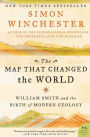

The Map That Changed the World: William Smith and the Birth of Modern Geology
368


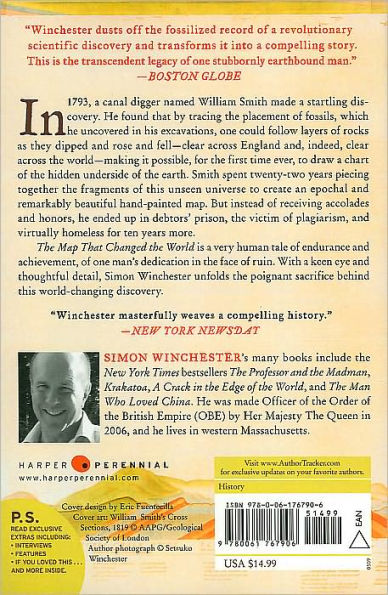
The Map That Changed the World: William Smith and the Birth of Modern Geology
368
Product Details
| ISBN-13: | 9780061767906 |
|---|---|
| Publisher: | HarperCollins |
| Publication date: | 04/28/2009 |
| Series: | P.S. Series |
| Pages: | 368 |
| Product dimensions: | 5.31(w) x 8.00(h) x 0.83(d) |
About the Author