
Jugnu and Chanda have disappeared. Like thousands of people all over England, they were lovers and living together out of wedlock. To Chanda’s family, however, the disgrace was unforgivable. Perhaps enough so as to warrant murder.
As he explores the disappearance and its aftermath through the eyes of Jugnu’s worldly older brother, Shamas, and his devout wife, Kaukab, Nadeem Aslam creates a closely observed and affecting portrait of people whose traditions threaten to bury them alive. The result is a tour de force, intimate, affecting, tragic and suspenseful.
Jugnu and Chanda have disappeared. Like thousands of people all over England, they were lovers and living together out of wedlock. To Chanda’s family, however, the disgrace was unforgivable. Perhaps enough so as to warrant murder.
As he explores the disappearance and its aftermath through the eyes of Jugnu’s worldly older brother, Shamas, and his devout wife, Kaukab, Nadeem Aslam creates a closely observed and affecting portrait of people whose traditions threaten to bury them alive. The result is a tour de force, intimate, affecting, tragic and suspenseful.

eBook
Available on Compatible NOOK devices, the free NOOK App and in My Digital Library.
Related collections and offers
Overview
Jugnu and Chanda have disappeared. Like thousands of people all over England, they were lovers and living together out of wedlock. To Chanda’s family, however, the disgrace was unforgivable. Perhaps enough so as to warrant murder.
As he explores the disappearance and its aftermath through the eyes of Jugnu’s worldly older brother, Shamas, and his devout wife, Kaukab, Nadeem Aslam creates a closely observed and affecting portrait of people whose traditions threaten to bury them alive. The result is a tour de force, intimate, affecting, tragic and suspenseful.

Product Details
| ISBN-13: | 9780307426789 |
|---|---|
| Publisher: | Knopf Doubleday Publishing Group |
| Publication date: | 12/18/2007 |
| Series: | Vintage International |
| Sold by: | Random House |
| Format: | eBook |
| Pages: | 400 |
| File size: | 602 KB |
About the Author
Read an Excerpt
The Night of the Great Peacock Moths
Shamas stands in the open door and watches the earth, the magnet that it is, pulling snowflakes out of the sky towards itself. With their deliberate, almost-impaired pace, they fall like feathers sinking in water. The snowstorm has rinsed the air of the incense that drifts into the houses from the nearby lake with the xylophone jetty, but it is there even when absent, drawing attention to its own disappearance.
This is the first snow of the season and the neighbourhood’s children will be on the slopes all day today, burning candles to heat the runners of toboggans to make them slip with increased fluency, daring each other to lick the frozen spikes of the railings around the church and those around the mosque, smuggling cheese-graters out of the kitchens to refine the symmetry of the snowmen they will build, oblivious to the cold because everything is a sublime adventure at that age; an oyster tolerates the pearl embedded in its flesh, and so the pebbles on the lake shore don’t seem to pain the soles of the children’s bare feet.
An icicle breaks off from above and drops like a radiant dagger towards Shamas, shattering on the stone step he is standing on, turning into white powder the way a crystal of sugar loses its transparency when crushed. With a movement of his foot, Shamas sends this temporary debris into the snow-covered front garden where in May and June there will be rosebuds the size and solidity of strawberries, into the corner where one of his children had buried a dead finch many years ago, not allowing anyone to set foot on that spot afterwards lest the delicate bones crack under the weight, the tiny skull as fragile as the eggshell within which it had formed the previous spring.
The house is on a street that runs along the base of a hill. This street is linked by a side-street to a shelf-like road higher up the hill and, in late summer, when the abundant dropped fruit of the wild cherry trees gets trodden on, the footpaths up there are stained with red and dark-blue smears.
In the mornings the adolescents from down here can be seen keep- ing an eye on the elevated road for the bus that takes them to school, eating breakfast on the doorstep if the parents and the weather permit it, racing up the side-street when they glimpse the vanilla-and-green vehicle coming between the cherry trees—up there between the gaps in the trunks where a small figure is walking through the snow now. Fishing for carp one night, Shamas’s younger son had catapulted into the lake a mass of flowers from those trees, hoping they would prove an alternative to the expensive hyacinths which drew the fish to the surface within moments, but the cherry blossom was a failure, as were the dandelions that lit up the dark water the following night with a hundred vivid suns; perfume was the key and only the clusters of lilac were a success but their season was soon gone.
According to the children, the lake—as dazzling as a mirror and shaped like the letter X—was created in the early days of the earth when a towering giant fell out of the sky; and he is still there, still alive, the regu- lar ebb and flow of the tides being the gentle rhythm of his heart still beating, the crashing waves of October his convulsive attempts to free himself. Just inside the water’s margin the stones are covered in tufts of wet moss, bringing to mind the broken pulp of a squeezed lemon, and to stand up to the waist in the calm summer water is to become two- headed like the jacks and queens on playing cards, right side up either way. On the shore the winds rush from every direction during the win- ter months to twist themselves around the body like a sari, and he remembers one of his children saying that his biology teacher dis- patched a pair of boys with cellophane bags to the lake whenever she needed a frog for dissection. Very occasionally in the past, the lake has frozen over and then the children have walked on it, “pretending to be Jesus.”
Even though it is not yet daybreak, the dawn-like translucence of the fallen snow enables him to see clearly the person walking on the road up there, and he decides that it is someone on his way to the mosque for the day’s first prayer.
Or it could be Queen Elizabeth II. Shamas smiles, in spite of himself. Once, marvelling at the prosperity of England, a visitor from Pakistan had remarked that it was almost as though the Queen disguised herself every night and went out into the streets of her country to find out personally what her subjects most needed and desired in life, so she could arrange for their wishes to come true the next day; it was what the caliph Harun al-Rashid was said to have done according to the tales of the Thousand and One Nights, with the result that his perfumed Baghdad became the most easeful and prosperous place imaginable.
Perspective tricks the eyes and makes the snowflakes falling in the far distance appear as though they are falling slower than those nearby, and he stands in the open door with an arm stretched out to receive the small light pieces on his hand. A habit as old as his arrival in this country; he has always greeted the season’s first snow in this manner, the flakes losing their whiteness on the palm of his hand to become clear wafers of ice before melting to water—crystals of snow transformed into a monsoon raindrop. Among the innumerable other losses, to come to England was to lose a season, because, in the part of Pakistan that he is from, there are five seasons in a year, not four, the schoolchildren learning their names and sequence through classroom chants: Mausam-e-Sarma, Bahar, Mausam-e-Garma, Barsat, Khizan. Winter, Spring, Summer, Monsoon, Autumn.
The snow falls and, yes, the hand stretched into the flakes’ path is a hand asking back a season now lost.
The person on the hill is indeed a woman and, whoever she is, she has left the high shelf of the road and is coming down the side-street towards him, one arm carrying an umbrella, the other steadying her descent by holding on to the field maples growing at regular intervals along the edges of the inclining street. With that umbrella she is a riddle personified: the solution being a foetus attached to a placenta by the umbilical cord. She would soon be near and would no doubt consider him lacking good judgement: a man of almost sixty-five years standing here with his hand thrust into the path of the snow—and so he withdraws into the house.
The front door opens directly into the kitchen. One blue, one strawberry pink, one the yellow of certain Leningrad exteriors: these were the colours of the three rooms in the olive-green house in Sohni Dharti—the small place in Pakistan where he was born and had lived permanently until his mid-twenties—and a few years ago, by mixing ground-up chalk and rabbit-skin glue with the appropriate pigments, he had painted the rooms in this house with those three colours, surprising himself by reproducing the three shades precisely. It’s almost as though when he stood facing a corner as a child during a game of hide-and-seek, it was for the sole purpose of committing its colour to memory, to be able to conjure it up in the years of exile and banishment.
During the school holidays he would approach the bookcase in the pink room and stand before it, his hand alighting on this or that volume with the arbitrariness of a moth, half deciding on something before sliding it back in place and moving on, as though experimenting with the keys of a piano, all briefly opened books eager to engage his eye, each flickeringly glimpsed paragraph enticing him hurriedly with its secret, and having made his choice he would drift through the house in search of the coolest spot to read through the long summer afternoons that had a touch of eternity to them, altering the arrangement of his limbs as much for comfort as for the fear that his undisturbed shadow would leave a stain on the wall.
There is someone at the door. Three informal taps are given on the glass panel instead of the doorbell being pressed, the bell that has a little amber light burning in it, the moths dancing around it all through the sum- mer nights. As though he has sucked too hard through a paper straw and flattened it shut, he inhales but cannot find his breath, his chest solidifying into heavy stone, in terror. Who could it be? However enriched with light this hour is—this pause between night and day—it is still too early for a call not to be out of the ordinary. But he is aware that he would have reacted similarly had it been the middle of the day, imprisoned as he has been in a shadowy area between sleep and waking for almost five months—ever since his younger brother, Jugnu, and his girlfriend, Chanda, vanished from their house next door.
Almost five months of not knowing when time would stir again and in which direction it would move, tip him into darkness or deliver him into light.
He doesn’t know what to do about the knock.
There it is again, the knock, the sound of finger-bone on glass, louder this time, but he is in a paralysed trance, his skull full of moths. Garden Tiger. Cinnabar. Early Thorn. Nail Mark. He loves the names of moths that Jugnu taught him. Ghost Moth.
The sound of the doorbell runs through him like an electric current, jolting him out of his funk.
“I am sorry to trouble you this early, Shamas . . . Good morning. But my father has had to spend the entire night on the floor because I can’t lift him back into his bed.” It is Kiran—a ray of light. “Could you please come with me for a few minutes, please.” She indicates the direction of her house with a turn of her head—up the sloping side-street with its twenty maples, and then along the high road with the cherry trees where he had seen her earlier without recognizing her.
He opens the door wider for her to step inside, handfuls of snow on a gust of wind rushing in inquisitively either side of her and then past him into the house, sticking softly to the linoleum in whose pattern of ivory-and-green roses a peeled almond is hard to find once it has slipped out of the fingers, or out of which, as though one of the green roses has shed a petal, a mint or coriander leaf curling at the edges strangely appears when the floor is swept at the end of the day, having lain undetected against the pattern since lunch.
“You should have telephoned, Kiran.”
She doesn’t enter the house—uneasy no doubt about encountering Shamas’s wife, Kaukab. Kiran is a Sikh and had three decades ago wanted to marry Kaukab’s brother, a Muslim. The two were in love. He was a migrant worker here in England, and when during a visit to Pakistan he told his family of his intentions of marrying Kiran, they were appalled and refused to allow him to return to England. Kiran boarded a plane in London and arrived at Karachi airport to be with him, but her telegram had been intercepted by the young man’s older brother who was wait- ing at the airport to tell her to take the next flight back to England, any reunion—or union—between his brother and her an impossibility. A marriage was hastily arranged for him within the next few days.
Shamas asks her to step in now. “Come in out of the rain, I mean, snow, while I put on my Wellingtons. Kaukab is still in bed.” This is a narrow house where all the doors disappear into the walls, except for the two that give on to the outside world at the front and back, and he slides open the space under the stairs to look for the shoes, stored somewhere here amid all the clutter at the end of last winter. There are fishing rods leaning like stick-insects in the corner. Soft cages for her feet, there is a pair of jellied sandals that had belonged to his daughter, lying one in front of the other as though he has surprised them in the act of taking a step, the straps spiralling like apple peel.
“I apologize again for having troubled you so early. I was hoping one of your sons would be visiting, and I would bring him with me.”
“All three children are far away, the boys and the girl,” he says as he rummages. There is a lobster buoy from Maine, USA, that is used as a doorstopper at the back of the house on hot mornings, to let in the sun and the trickling song of the stream which runs beside the narrow lane there; the stream that is more stones than water as the summer advances but a great catcher of pollen nevertheless, the stones white as chalk in the sun, black underwater. During autumn the speed of the water is so great that you fear your foot would be instantly sliced off at the ankle if you stepped into it.
Outside, as he walks behind Kiran in that below-zero monsoon, there are gentle skirmishes between the falling snowflakes now that the wind has risen a little.
Two sets of Kiran’s footprints lie before him as he follows her to her house. Each perfect cylinder punched into the deep snow has at its base a thin sheet of packed ice through which the dry leaves of the field maples can be seen as though sealed behind glass. They are as intricate as the gold jewellery from the Subcontinent—treasures buried under the snow till a rainy day.
Planted between two field maples on the slope, the telephone pole has had several of its wires broken during the night, and, encased in thick cylinders of ice, they lie snapped like candles in the snow. The chilled air is as keen as a needle on the skin and the incline is forcing him to take a hummingbird’s 300 breaths per minute. A frozen buried clump of grass breaks under his weight and the cracking sound is the sound that Kaukab produces when she halves and quarters cinnamon sticks in the kitchen.
Reading Group Guide
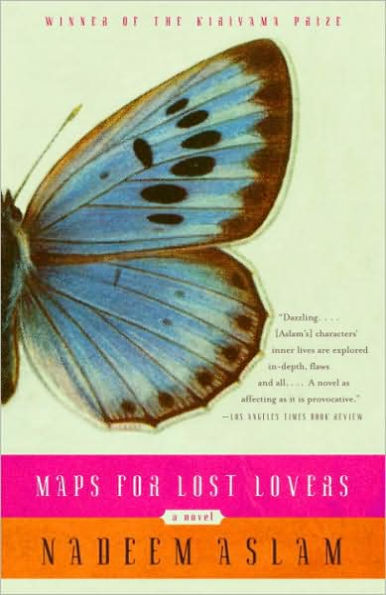
“Aslam’s . . . prose is stylistically dazzling, full of poetic, richly descriptive and tender passages. . . . His characters’ inner lives are explored in-depth, flaws and all. . . . A novel as affecting as it is provocative.” –Los Angeles Times Book Review
The introduction, discussion questions, suggestions for further reading, and author biography that follow are designed to enliven your group’s discussion of Maps for Lost Lovers, the spellbinding and often heart-wrenching new novel by the Pakistani-English writer Nadeem Aslam. At once a story of romantic longing and sexual repression; a portrait of a community of Asian immigrants surreally isolated in rural England; and a shocking yet empathetic foray into the mind–and heart–of religious extremism, Maps for Lost Lovers transplants themes as timeless as those found in Romeo and Juliet into the religious and ethnic minefields of modernity.
1. Early in the novel, Shamas remembers a visitor from Pakistan who was so impressed by England’s affluence that he imagined the Queen venturing forth in disguise to discover the desires of her subjects. How does one reconcile this attitude with the characters’ other feelings about England?
2. Maps for Lost Lovers is fraught with images of nature: Jugnu’s prized moths and butterflies, the peacocks that invade his house after his and Chanda’s disappearance, the lilacs used to entice fish, the flock of Indian rose-ringed parakeets that mysteriously appear in English gardens. How does Aslam use these images to evoke mood, explore his characters’ psychology, and even advance his plot? Is there a difference in the way he treats the natural elements of England and Asia? Which seems more “natural”?
3. Many of Aslam’s characters, Kaukab chief among them, have rejected English culture and manners, and even the English language. But some of them feel that it is England that has rejected them: “We are stranded in a foreign country where no one likes us” [p. 278]. Does Aslam give the reader any evidence to support this claim? Are his Asian characters only responding to English racism, or does the book describe a more nuanced interaction between different kinds of small-mindedness and mistrust?
4. The novel has several scenes in which characters are deeply affected by music: among them, Shamas’s memory of listening to jazz records with Kiran and her father and a concert by the ecstatic singer Nusrat Fateh Ali Khan. What role does music play in the lives of these people? And what is the significance of an evening of religious songs paving the way for adultery?
5. The lovers of the title appear to be Chanda and Jugnu, whom some people prefer to imagine as being in hiding rather than being dead (though “lost” can also be a euphemism for dead). Their love is both passionate and illicit, and it leads to their destruction. What other instances of forbidden love occur in this novel, and what are their consequences? What is it that makes them forbidden? Could it be passion itself? And what other lovers in Dasht-e-Tanhaii might be described as lost?
6. Throughout the novel Kaukab displays a puritanical squeamishness about sex, even rebuffing her husband’s advances. Yet we learn earlier in their marriage that she used to wake him by seductively sprinkling him with drops of water from her freshly washed hair. What might account for the change in her attitude? What other kinds of passion has she allowed herself in place of sex?
7. Before he became involved with Chanda, Jugnu was seeing a white woman, whom Kaukab once entertained unwillingly and disastrously. Her son Charag has also had a white lover with whom he has a child. Does Kaukab see those relationships as more or less shameful than the one that cost Jugnu his life? How would you sum up the Asian characters’ feelings about whites and how are those feelings inconsistent? For example, how do some of them feel about the town’s white prostitute?
8. For Kaukab and her neighbors, shame is not individual but communal. Chanda’s adultery disgraces not just her but her entire family, just as Suraya’s visit to the home of her in-laws’ enemies humiliates her husband and leads to the breakup of their marriage. Contrast this with what you know of the English (or American) sense of shame. Is the Asian characters’ sensitivity to the sins of their relatives entirely negative? Is there any significance to the fact that Shamas’s affair with Suraya is never discovered by their spouses?
9. The novel’s principal characters are Muslim. However, they also have relationships with Hindus, and Shamas’s father lived as a Hindu for a time, after he lost his memory as a child. How has his ambiguous status affected his son? What other roles do Hindus (and Sikhs) play in Maps for Lost Lovers, and how do they–and the Muslim characters’ feelings about them–amplify the book’s themes of difference and defilement?
10. In the course of this novel, we see Kaukab alienating her sons, bullying her daughter into a loveless marriage, and betraying her brother-in-law in a way that leads to his murder. How does Aslam keep her from being an unsympathetic character–and, indeed, make her intensely sympathetic? Might this manipulative and closed-minded woman actually be the most loving character in the book?
11. Because Shamas is more worldly and tolerant than his wife, we may be inclined to see him as the wronged party in their marriage. Is this perception accurate? Is Shamas a better person than Kaukab, or just more familiar to a western reader? What role has he played in Kaukab’s unhappiness, and in her estrangement from her children? Might he have some responsibility for his brother’s murder?
12. Most of the characters seem to suffer from some form of homesickness. Their name for their town means “Desert of Loneliness.” The neighbors of a woman from Bangladesh wonder why her children refer to that country as “‘abroad’ because Bangladesh isn’t abroad, England is abroad; Bangladesh is home” [p. 47]. Yet what is the experience of those who return to Pakistan–particularly those children who are sent back for arranged marriages? Is homesickness, as Aslam imagines it, a condition treatable simply by going home?
13. At various points in the narrative different characters use Islam as a justification for brutalizing wives and daughters, condoning the sexual abuse of a small child, and, of course, murder, not to mention forgoing kinds of happiness that most westerners take for granted. Does Maps for Lost Lovers constitute an indictment of Islam? Does it present any counterarguments in Islam’s favor? Might Kaukab be right when she observes that Muslim morality is higher than that of its western counterpart because it recognizes that certain actions hurt not just other people, but God [p. 44]?
14. Would you characterize this novel as a work of realist fiction? What are we to make of such elements as Jugnu’s phosphorescent hands or the human heart that is found in town? (It makes its appearance just after Jugnu discovers his father’s severed tongue.) What is the effect of these suspensions or interruptions of reality? How do they work with the novel’s heightened–almost fragrant–language?