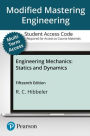
Mastering Engineering with Pearson eText Access Code for Engineering Mechanics: Statics & Dynamics

This ISBN is for the Modified Mastering access card. Pearson eText is included.

Engineering Mechanics: Statics & Dynamics excels in providing a clear and thorough presentation of the theory and application of engineering mechanics. Engineering Mechanics empowers you to succeed by drawing upon Professor Hibbeler’s decades of everyday classroom experience and his knowledge of how students learn. The text is shaped by the comments and suggestions of hundreds of reviewers in the teaching profession, as well as many of the author’s students.

A variety of new video types are available for the 15th Edition. The author carefully developed each video to expertly demonstrate how to solve problems, model the best way to reach a solution, and give you extra opportunities to practice honing your problem-solving skills; he also summarizes key concepts discussed in the text, supported by additional figures, animations, and photos. The text provides a large variety of problems, 30% of which are new, with varying levels of difficulty that cover a broad range of engineering disciplines and stress practical, realistic situations. An expanded Answer Section in the back of the book now includes additional information related to the solution of select Fundamental and Review Problems in order to offer even more guidance in solving the problems.

Personalize learning with Mastering Engineering with Pearson eText
This flexible digital platform combines unrivaled content, online assessments, and customizable features to personalize learning and improve results.

Pearson eText is an easy-to-use digital textbook available within Mastering that lets you read, highlight, and take notes, all in one place.

NOTE: Before purchasing, check with your instructor to confirm the correct ISBN. Several versions of the Mastering® platforms exist for each title, and registrations are not transferable. To register for and use Mastering, you may also need a Course ID, which your instructor will provide.

Used books, rentals, and purchases made outside of Pearson
If purchasing or renting from companies other than Pearson, the access codes for the Mastering platform may not be included, may be incorrect, or may be previously redeemed. Check with the seller before completing your purchase.
1144347649
Mastering Engineering with Pearson eText Access Code for Engineering Mechanics: Statics & Dynamics

This ISBN is for the Modified Mastering access card. Pearson eText is included.

Engineering Mechanics: Statics & Dynamics excels in providing a clear and thorough presentation of the theory and application of engineering mechanics. Engineering Mechanics empowers you to succeed by drawing upon Professor Hibbeler’s decades of everyday classroom experience and his knowledge of how students learn. The text is shaped by the comments and suggestions of hundreds of reviewers in the teaching profession, as well as many of the author’s students.

A variety of new video types are available for the 15th Edition. The author carefully developed each video to expertly demonstrate how to solve problems, model the best way to reach a solution, and give you extra opportunities to practice honing your problem-solving skills; he also summarizes key concepts discussed in the text, supported by additional figures, animations, and photos. The text provides a large variety of problems, 30% of which are new, with varying levels of difficulty that cover a broad range of engineering disciplines and stress practical, realistic situations. An expanded Answer Section in the back of the book now includes additional information related to the solution of select Fundamental and Review Problems in order to offer even more guidance in solving the problems.

Personalize learning with Mastering Engineering with Pearson eText
This flexible digital platform combines unrivaled content, online assessments, and customizable features to personalize learning and improve results.

Pearson eText is an easy-to-use digital textbook available within Mastering that lets you read, highlight, and take notes, all in one place.

NOTE: Before purchasing, check with your instructor to confirm the correct ISBN. Several versions of the Mastering® platforms exist for each title, and registrations are not transferable. To register for and use Mastering, you may also need a Course ID, which your instructor will provide.

Used books, rentals, and purchases made outside of Pearson
If purchasing or renting from companies other than Pearson, the access codes for the Mastering platform may not be included, may be incorrect, or may be previously redeemed. Check with the seller before completing your purchase.

179.99 In Stock
Mastering Engineering with Pearson eText Access Code for Engineering Mechanics: Statics & Dynamics

Mastering Engineering with Pearson eText Access Code for Engineering Mechanics: Statics & Dynamics

by Russell Hibbeler
Mastering Engineering with Pearson eText Access Code for Engineering Mechanics: Statics & Dynamics

Mastering Engineering with Pearson eText Access Code for Engineering Mechanics: Statics & Dynamics

by Russell Hibbeler

(Access Card - 15th ed.)

$179.99 
  • SHIP THIS ITEM
    In stock. Ships in 1-2 days.
  • PICK UP IN STORE

    Your local store may have stock of this item.

Related collections and offers


Overview

This ISBN is for the Modified Mastering access card. Pearson eText is included.

Engineering Mechanics: Statics & Dynamics excels in providing a clear and thorough presentation of the theory and application of engineering mechanics. Engineering Mechanics empowers you to succeed by drawing upon Professor Hibbeler’s decades of everyday classroom experience and his knowledge of how students learn. The text is shaped by the comments and suggestions of hundreds of reviewers in the teaching profession, as well as many of the author’s students.

A variety of new video types are available for the 15th Edition. The author carefully developed each video to expertly demonstrate how to solve problems, model the best way to reach a solution, and give you extra opportunities to practice honing your problem-solving skills; he also summarizes key concepts discussed in the text, supported by additional figures, animations, and photos. The text provides a large variety of problems, 30% of which are new, with varying levels of difficulty that cover a broad range of engineering disciplines and stress practical, realistic situations. An expanded Answer Section in the back of the book now includes additional information related to the solution of select Fundamental and Review Problems in order to offer even more guidance in solving the problems.

Personalize learning with Mastering Engineering with Pearson eText
This flexible digital platform combines unrivaled content, online assessments, and customizable features to personalize learning and improve results.

Pearson eText is an easy-to-use digital textbook available within Mastering that lets you read, highlight, and take notes, all in one place.

NOTE: Before purchasing, check with your instructor to confirm the correct ISBN. Several versions of the Mastering® platforms exist for each title, and registrations are not transferable. To register for and use Mastering, you may also need a Course ID, which your instructor will provide.

Used books, rentals, and purchases made outside of Pearson
If purchasing or renting from companies other than Pearson, the access codes for the Mastering platform may not be included, may be incorrect, or may be previously redeemed. Check with the seller before completing your purchase.


Product Details

ISBN-13: 9780134867243
Publisher: Pearson Education
Publication date: 12/06/2021
Edition description: 15th ed.
Product dimensions: 5.90(w) x 8.90(h) x 0.05(d)

About the Author

R.C. Hibbeler graduated from the University of Illinois at Urbana with a BS in Civil Engineering (majoring in Structures) and an MS in Nuclear Engineering. He obtained his PhD in Theoretical and Applied Mechanics from Northwestern University. Professor Hibbeler’s professional experience includes postdoctoral work in reactor safety and analysis at Argonne National Laboratory, and structural and stress analysis work at Chicago Bridge and Iron, as well as at Sargent and Lundy in Chicago. He has practiced engineering in Ohio, New York, and Louisiana.

Professor Hibbeler currently teaches both civil and mechanical engineering courses at the University of Louisiana— Lafayette. In the past, he has taught at the University of Illinois at Urbana, Youngstown State University, Illinois Institute of Technology, and Union College.

Table of Contents


1 General Principles 3

Chapter Objectives 3

1.1 Mechanics 3

1.2 Fundamental Concepts 4

1.3 Units of Measurement 7

1.4 T he International System of Units 9

1.5 Numerical Calculations 10

1.6 General Procedure for Analysis 12

2 Force Vectors 17

Chapter Objectives 17

2.1 Scalars and Vectors 17

2.2 Vector Operations 18

2.3 Vector Addition of Forces 20

2.4 Addition of a System of Coplanar Forces 32

2.5 C artesian Vectors 43

2.6 Addition of Cartesian Vectors 46

2.7 Position Vectors 56

2.8 Force Vector Directed Along a Line 59

2.9 Dot Product 69

3 Equilibrium of a Particle 85

Chapter Objectives 85

3.1 Condition for the Equilibrium of a Particle 85

3.2 The Free-Body Diagram 86

3.3 Coplanar Force Systems 89

3.4 Three-Dimensional Force Systems 103

4 Force System Resultants 117

Chapter Objectives 117

4.1 Moment of a Force—Scalar Formulation 117

4.2 Cross Product 121

4.3 Moment of a Force—Vector Formulation 124

4.4 Principle of Moments 128

4.5 Moment of a Force about a Specified Axis 139

4.6 Moment of a Couple 148

4.7 Simplification of a Force and Couple System 160

4.8 Further Simplification of a Force and Couple System 170

4.9 Reduction of a Simple Distributed Loading 183

5 Equilibrium of a Rigid Body 199

Chapter Objectives 199

5.1 Conditions for Rigid-Body Equilibrium 199

5.2 Free-Body Diagrams 201

5.3 Equations of Equilibrium 214

5.4 Two- and Three-Force Members 224

5.5 Free-Body Diagrams 237

5.6 Equations of Equilibrium 242

5.7 Constraints and Statical Determinacy 243

6 Structural Analysis 263

Chapter Objectives 263

6.1 Simple Trusses 263

6.2 The Method of Joints 266

6.3 Zero-Force Members 272

6.4 The Method of Sections 280

6.5 Space Trusses 290

6.6 Frames and Machines 294

7 Internal Forces 331

Chapter Objectives 331

7.1 Internal Loadings Developed in Structural Members 331

7.2 Shear and Moment Equations and Diagrams 347

7.3 Relations between Distributed Load, Shear, and Moment 356

7.4 Cables 367

8 Friction 389

Chapter Objectives 389

8.1 Characteristics of Dry Friction 389

8.2 Problems Involving Dry Friction 394

8.3 Wedges 416

8.4 Frictional Forces on Screws 418

8.5 Frictional Forces on Flat Belts 425

8.6 Frictional Forces on Collar Bearings, Pivot Bearings, and Disks 433

8.7 Frictional Forces on Journal Bearings 436

8.8 Rolling Resistance 438

9 Center of Gravity and Centroid 451

Chapter Objectives 451

9.1 Center of Gravity, Center of Mass, and the Centroid of a Body 451

9.2 Composite Bodies 474

9.3 Theorems of Pappus and Guldinus 488

9.4 Resultant of a General Distributed Loading 497

9.5 Fluid Pressure 498

10 Moments of Inertia 515

Chapter Objectives 515

10.1 Definition of Moments of Inertia for Areas 515

10.2 Parallel-Axis Theorem for an Area 516

10.3 Radius of Gyration of an Area 517

10.4 Moments of Inertia for Composite Areas 526

10.5 Product of Inertia for an Area 534

10.6 Moments of Inertia for an Area about Inclined Axes 538

10.7 Mohr’s Circle for Moments of Inertia 541

10.8 Mass Moment of Inertia 549

11 Virtual Work 567

Chapter Objectives 567

11.1 Definition of Work 567

11.2 Principle of Virtual Work 569

11.3 Principle of Virtual Work for a System of Connected Rigid Bodies 571

11.4 Conservative Forces 583

11.5 Potential Energy 584

11.6 Potential-Energy Criterion for Equilibrium 586

11.7 Stability of Equilibrium Configuration 587 Appendix

Contents

12 Kinematics of a Particle

12.1 Introduction

12.2 Rectilinear Kinematics: Continuous Motion

12.3 Rectilinear Kinematics: Erratic Motion

12.4 General Curvilinear Motion

12.5 Curvilinear Motion: Rectangular Components

12.6 Motion of a Projectile

12.7 Curvilinear Motion: Normal and Tangential Components

12.8 Curvilinear Motion: Cylindrical Components

12.9 Absolute Dependent Motion Analysis of Two Particles

12.10 Relative-Motion of Two Particles Using Translating Axes

13 Kinetics of a Particle: Force and

Acceleration

13.1 Newton’s Second Law of Motion

13.2 The Equation of Motion

13.3 Equation of Motion for a System

of Particles

13.4 Equations of Motion: Rectangular Coordinates

13.5 Equations of Motion: Normal

and Tangential Coordinates

13.6 Equations of Motion: Cylindrical Coordinates

*13.7 Central-Force Motion and Space Mechanics

14 Kinetics of a Particle: Work and

Energy

14.1 The Work of a Force

14.2 Principle of Work and Energy

14.3 Principle of Work and Energy for a System of Particles

14.4 Power and Efficiency

14.5 Conservative Forces and Potential Energy

14.6 Conservation of Energy

15 Kinetics of a Particle: Impulse

and Momentum

15.1 Principle of Linear Impulse and Momentum

15.2 Principle of Linear Impulse and Momentum for a System of Particles

15.3 Conservation of Linear Momentum for a System of Particles

15.4 Impact

15.5 Angular Momentum

15.6 Relation Between Moment of a Force and Angular Momentum

15.7 Principle of Angular Impulse and Momentum

15.8 Steady Flow of a Fluid Stream

*15.9 Propulsion with Variable Mass

16 Planar Kinematics of a Rigid

Body

16.1 Planar Rigid-Body Motion

16.2 Translation

16.3 Rotation about a Fixed Axis

16.4 Absolute Motion Analysis

16.5 Relative-Motion Analysis: Velocity

16.6 Instantaneous Center of Zero Velocity

16.7 Relative-Motion Analysis: Acceleration

16.8 Relative-Motion Analysis using Rotating Axes

17 Planar Kinetics of a Rigid Body:

Force and Acceleration

17.1 Mass Moment of Inertia

17.2 Planar Kinetic Equations of Motion

17.3 Equations of Motion: Translation

17.4 Equations of Motion: Rotation about a Fixed Axis

17.5 Equations of Motion: General Plane Motion

18 Planar Kinetics of a Rigid Body:

Work and Energy

18.1 Kinetic Energy

18.2 The Work of a Force

18.3 The Work of a Couple Moment

18.4 Principle of Work and Energy

18.5 Conservation of Energy

19 Planar Kinetics of a Rigid Body:

Impulse and Momentum

19.1 Linear and Angular Momentum

19.2 Principle of Impulse and Momentum

19.3 Conservation of Momentum

*19.4 Eccentric Impact

20 Three-Dimensional Kinematics of

a Rigid Body

20.1 Rotation About a Fixed Point

*20.2 The Time Derivative of a Vector Measured from Either a Fixed

or Translating-Rotating System

20.3 General Motion

*20.4 Relative-Motion Analysis Using Translating and Rotating Axes

21 Three-Dimensional Kinetics of a

Rigid Body

*21.1 Moments and Products of Inertia

21.2 Angular Momentum

21.3 Kinetic Energy

*21.4 Equations of Motion

*21.5 Gyroscopic Motion

21.6 Torque-Free Motion

22 Vibrations

*22.1 Undamped Free Vibration

*22.2 Energy Methods

*22.3 Undamped Forced Vibration

*22.4 Viscous Damped Free Vibration

*22.5 Viscous Damped Forced Vibration

*22.6 Electrical Circuit Analogs

A Mathematical Expressions

B Vector Analysis

C The Chain Rule

Fundamental Problems Partial

Solutions and Answers

From the B&N Reads Blog

Customer Reviews