Praise for The Nine
"I almost didn't finish this book. Not because it wasn't extraordinary—but because it was too extraordinary. Because somewhere around the third chapter, I realized I was holding my breath, terrified that if I exhaled too loudly, these nine women might disappear like smoke, like so many others did...What breaks you isn't the brutality—though there's plenty of that. It's the tenderness...Strauss has given us more than a war story. She's given us a love story disguised as a survival story, a reminder that even in humanity's darkest hour, there were women who chose each other, who refused to let evil have the final word. These nine women didn't just survive—they proved that love can outlast anything, even death, even forgetting, even the worst that humans can do to each other."
—The Book Nook on The Nine
Praise for Milena and Margarete
"Striking... a propulsive recounting of a powerful love. "
—Publisher Weekly, starred review
"The lives of these two brave women have been all but “erased from history.” But Strauss’ research into and reimagining of their four years together amount to an essential rediscovery of this history. Her work is as alert to the tenderness of their connection as to the immense evil of their surroundings... remarkable."
—Kirkus
"Strauss draws us skillfully into the world of the prison camp at Ravensbrück.... Milena and Margarete remind us that, amidst depravity and cruelty, the passionate friendship of women can be its own act of powerful resistance."
—Tilar Mazzeo, bestselling and award-winning author of Irene's Children and Sisters in Resistance
"Riveting, mesmerizing important.... The details and perspectives of women prisoners at Ravensbruck concentration camp are juxtaposed to these extraordinary individuals' proximity to the lives of the Martin Buber family and to Franz Kafka.... A magnificent work of contextualization that opens new doors of understanding."
—Sarah Schulman, Lambda Literary Award winner, author of Let the Record Show
"For the first time, Strauss writes about Ravensbrück as a place of a great romantic story, of love between two women. In equal parts intellectual history, queer history, and history of the Holocaust, Milena and Margarete forces us to rethink our understanding of the concentration camps."
—Anna Hájková, University of Warwick, pioneer of queer Holocaust history
"Reads like a novel, a brutal but sensory world, evocative characters and a forbidden passion that bubbles with joy in...a concentration camp!... I am so grateful for the existence of this book and for the existence of its marvellous writer. Oh, this Gwen Straus is a wonder! I'd read anything she writes, on any subject."
—Golda Goldbloom, award winning author of On Division
"Gripping, moving, and ultimately groundbreaking, this unusual account of a “passionate friendship” between two extraordinary women in Ravensbrück is a crucial contribution to the less-explored field of women in the Holocaust. Gwen Strauss’s humane and sympathetic book is a must-read."
—Ruth Franklin, author of The Many Lives of Anne Frank
A profoundly moving celebration of love under the darkest of circumstances
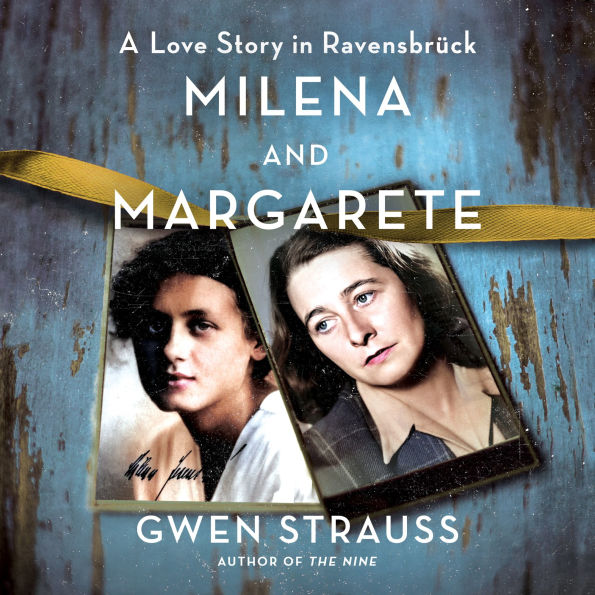
From the moment they met in 1940 in Ravensbrück concentration camp, Milena Jesenska and Margarete Buber-Neumann were inseparable. Czech Milena was Kafka's first translator and epistolary lover, and a journalist opposed to fascism. A non-conformist, bisexual feminist, she was way ahead of her time. With the German occupation of Czechoslovakia, her home became a central meeting place for Jewish refugees. German Margarete, born to a middle-class family, married the son of the Jewish philosopher Martin Buber. But soon swept up in the fervor of the Bolshevik Revolution, she met her second partner, the Communist Heinz Neumann. Called to Moscow for his “political deviations,” he fell victim to Stalin's purges while Margarete was exiled to the hell of the Soviet gulag. Two years later, traded by Stalin to Hitler, she ended up outside Berlin in Ravensbrück, the only concentration camp built for women.
Milena and Margarete loved each other at the risk of their lives. But in the post-war survivors' accounts, lesbians were stigmatized, and survivors kept silent. This audiobook explores those silences, and finally celebrates two strong women who never gave up and continue to inspire. As Margaret wrote: “I was thankful for having been sent to Ravensbrück, because it was there I met Milena.”
A Macmillan Audio production from St. Martin's Press
A profoundly moving celebration of love under the darkest of circumstances
From the moment they met in 1940 in Ravensbrück concentration camp, Milena Jesenska and Margarete Buber-Neumann were inseparable. Czech Milena was Kafka's first translator and epistolary lover, and a journalist opposed to fascism. A non-conformist, bisexual feminist, she was way ahead of her time. With the German occupation of Czechoslovakia, her home became a central meeting place for Jewish refugees. German Margarete, born to a middle-class family, married the son of the Jewish philosopher Martin Buber. But soon swept up in the fervor of the Bolshevik Revolution, she met her second partner, the Communist Heinz Neumann. Called to Moscow for his “political deviations,” he fell victim to Stalin's purges while Margarete was exiled to the hell of the Soviet gulag. Two years later, traded by Stalin to Hitler, she ended up outside Berlin in Ravensbrück, the only concentration camp built for women.
Milena and Margarete loved each other at the risk of their lives. But in the post-war survivors' accounts, lesbians were stigmatized, and survivors kept silent. This audiobook explores those silences, and finally celebrates two strong women who never gave up and continue to inspire. As Margaret wrote: “I was thankful for having been sent to Ravensbrück, because it was there I met Milena.”
A Macmillan Audio production from St. Martin's Press


Milena and Margarete: A Love Story in Ravensbrück
Milena and Margarete: A Love Story in Ravensbrück
FREE
with a B&N Audiobooks Subscription

Editorial Reviews
Product Details
| BN ID: | 2940191183534 |
|---|---|
| Publisher: | Macmillan Audio |
| Publication date: | 08/19/2025 |
| Edition description: | Unabridged |
Videos