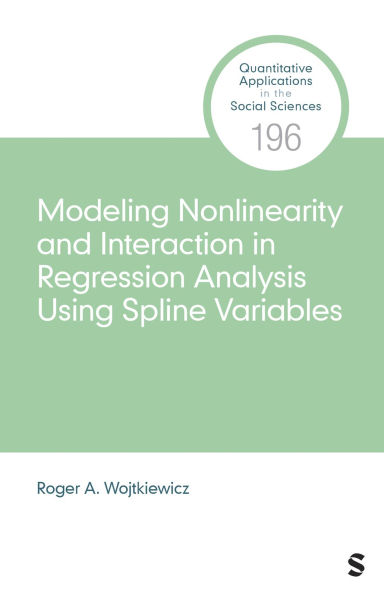
Modeling Nonlinearity and Interaction in Regression Analysis Using Spline Variables

"Spline variables and their interactions play a crucial role in the field of social science. This book offers a comprehensive and detailed exploration of this method, providing valuable insights and information for researchers in the field."
--Man-Kit Lei, The University of Georgia

This volume addresses the issue of linear constraints in regression modeling. Author Roger A. Wojtkiewicz uses the method of knotted spline variables (also known as piecewise linear regression) and a new method involving group spline variables to model nonlinearity in a variety of situations. Using spline variables to model nonlinearity allows researchers to specify unrestricted models for models that involve interval variables, allowing for greater flexibility in modeling any possible interaction.


1146956491
Modeling Nonlinearity and Interaction in Regression Analysis Using Spline Variables

"Spline variables and their interactions play a crucial role in the field of social science. This book offers a comprehensive and detailed exploration of this method, providing valuable insights and information for researchers in the field."
--Man-Kit Lei, The University of Georgia

This volume addresses the issue of linear constraints in regression modeling. Author Roger A. Wojtkiewicz uses the method of knotted spline variables (also known as piecewise linear regression) and a new method involving group spline variables to model nonlinearity in a variety of situations. Using spline variables to model nonlinearity allows researchers to specify unrestricted models for models that involve interval variables, allowing for greater flexibility in modeling any possible interaction.


39.0 In Stock
Modeling Nonlinearity and Interaction in Regression Analysis Using Spline Variables

Modeling Nonlinearity and Interaction in Regression Analysis Using Spline Variables

by Roger A. Wojtkiewicz
Modeling Nonlinearity and Interaction in Regression Analysis Using Spline Variables

Modeling Nonlinearity and Interaction in Regression Analysis Using Spline Variables

by Roger A. Wojtkiewicz

eBook

$39.00 

Available on Compatible NOOK devices, the free NOOK App and in My Digital Library.
WANT A NOOK?  Explore Now

Related collections and offers


Overview

"Spline variables and their interactions play a crucial role in the field of social science. This book offers a comprehensive and detailed exploration of this method, providing valuable insights and information for researchers in the field."
--Man-Kit Lei, The University of Georgia

This volume addresses the issue of linear constraints in regression modeling. Author Roger A. Wojtkiewicz uses the method of knotted spline variables (also known as piecewise linear regression) and a new method involving group spline variables to model nonlinearity in a variety of situations. Using spline variables to model nonlinearity allows researchers to specify unrestricted models for models that involve interval variables, allowing for greater flexibility in modeling any possible interaction.


Product Details

ISBN-13: 9781071950364
Publisher: SAGE Publications
Publication date: 05/22/2025
Series: Quantitative Applications in the Social Sciences
Sold by: Barnes & Noble
Format: eBook
Pages: 192
File size: 18 MB
Note: This product may take a few minutes to download.

About the Author

Roger A. Wojtkiewicz is a professor in the Department of Sociology at Ball State University in Muncie, Indiana. He spent the first 12 years of his career in the Department of Sociology at Louisiana State University and has since been at Ball State where he served as department chairperson for 12 years. At LSU, he taught undergraduate statistics and a graduate course in regression modeling in the PhD program. At Ball State, he has taught both the first and second semester courses in the statistics sequence in the master’s program. He was trained as a quantitative methodologist in the graduate sociology program at the University of Wisconsin—Madison. He is author of Elementary Regression Modeling: A Discrete Approach published by Sage Publications in 2017.

Table of Contents

Series Editor Introduction
Acknowledgments
About the Author
Chapter 1: Introduction
Main Focus of the Book
The Necessity to Provide Theoretical Justifications for Interactions
Plan of the Book
Chapter 2: Basics of Spline Variables
Derivation of Knotted Spline Model
General Equation for Knotted Spline Model
Empirical Example for Knotted Spline Model
Derivation of Group Spline Model
General Equation for Group Spline Model
Empirical Example of Group Spline Model
Conceptual Difference Between Knotted Splines and Group Splines
Summary
Chapter 3: Applications of Spline Variables
Modeling an Interval Variable With a Smaller Number of Values
Modeling an Interval Variable With a Larger Number of Values
Problem in Using Dummy Variables to Model Interval Variable
Advantages of Spline Variables Over Polynomial Variables
Interrupted Regression and Spline Variables
General Equation for Interrupted Regression Model
Empirical Example of Interrupted Regression Model
Summary
Chapter 4: Interaction Between Interval and Categorical Variables
Derivation of Model for Interval Conditioned on Categorical Interaction
General Equation for Interval Conditioned on Categorical Interaction Model
Empirical Example for Interval Conditioned on Categorical Interaction Model
Derivation of Model for Categorical Conditioned on Interval Interaction
General Equation for Categorical Conditioned on Interval Interaction Model
Empirical Example for Categorical Conditioned on Interval Interaction Model
Summary
Chapter 5: Interaction Between Interval Variables
Derivation of Model for Interval and Interval Interaction With Fewer Values
General Equation for Interval Conditioned on Interval Interaction
Empirical Example for Interval and Interval Interaction With Fewer Values
Derivation of Model for Interval and Interval Interaction With Many Values
Empirical Example for Interval and Interval Interaction With Many Values
Summary
Chapter 6: Concluding Remarks
Key Points
Final Comments
Appendix 1: Example of Derivation of Interaction Model With Interval Variable Conditioned on Categorical Variable From Dummy Variable Model
Appendix 2: Example of Derivation of Interaction Model With Interval Variable Conditioned on Interval Variable From Dummy Variable Model
References
Index
From the B&N Reads Blog

Customer Reviews