
Money in the Macroeconomy
This is a textbook designed for senior undergraduate courses in monetary economics, advanced macroeconomics, or macroeconomic policy. Students will feel comfortable with this material if they have completed an intermediate course in macroeconomics, relying on one of the more demanding texts in this field. The prime focus of the book is on the role of money in the macroeconomy and on the place of monetary policy as an instrument for controlling inflation and unemployment. There are only three important macrovariables that are features: the rate of inflation, the interest rate, and output or income. Behavioural relationships in the goods, money, and labor markets determine these variables, using only the now common IS-LM-AS model. The model is not ideological, but opposing views of the efficiacy of stabilization policy are allowed to confront each other. There is a great deal of emphasis on relating the theoretical propositions to recent Canadian and U.S. macroeconomic performance. To expose students to diversity of experience, both countries receive equal treatment, one to serve as an example of a closed economy and the other as an example of an open economy. The book relies mostly on verbal and diagrammatical exposition; equations are used to show why and how curves shift in the diagrams. Also, numerical examples are provided in 'boxes' at appropriate places in the text, and exercises are given at the end of most chapters. A booklet containing answers to these exercises is available to instructors on request to the author.
1103778857
Money in the Macroeconomy
This is a textbook designed for senior undergraduate courses in monetary economics, advanced macroeconomics, or macroeconomic policy. Students will feel comfortable with this material if they have completed an intermediate course in macroeconomics, relying on one of the more demanding texts in this field. The prime focus of the book is on the role of money in the macroeconomy and on the place of monetary policy as an instrument for controlling inflation and unemployment. There are only three important macrovariables that are features: the rate of inflation, the interest rate, and output or income. Behavioural relationships in the goods, money, and labor markets determine these variables, using only the now common IS-LM-AS model. The model is not ideological, but opposing views of the efficiacy of stabilization policy are allowed to confront each other. There is a great deal of emphasis on relating the theoretical propositions to recent Canadian and U.S. macroeconomic performance. To expose students to diversity of experience, both countries receive equal treatment, one to serve as an example of a closed economy and the other as an example of an open economy. The book relies mostly on verbal and diagrammatical exposition; equations are used to show why and how curves shift in the diagrams. Also, numerical examples are provided in 'boxes' at appropriate places in the text, and exercises are given at the end of most chapters. A booklet containing answers to these exercises is available to instructors on request to the author.
50.0
In Stock
5
1


Money in the Macroeconomy
362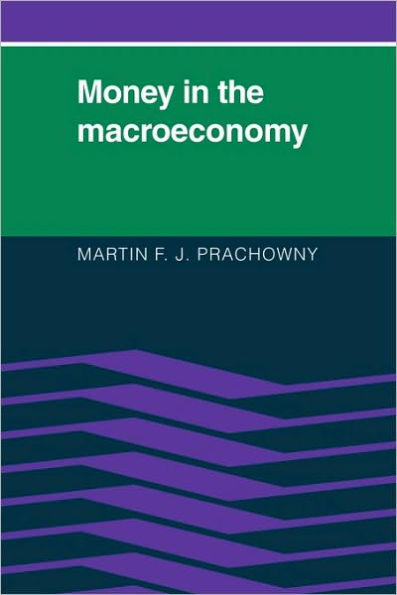
Money in the Macroeconomy
362Paperback
$50.00
50.0
In Stock

Product Details
| ISBN-13: | 9780521315944 |
|---|---|
| Publisher: | Cambridge University Press |
| Publication date: | 01/31/1986 |
| Pages: | 362 |
| Product dimensions: | 6.10(w) x 9.21(h) x 1.10(d) |
From the B&N Reads Blog