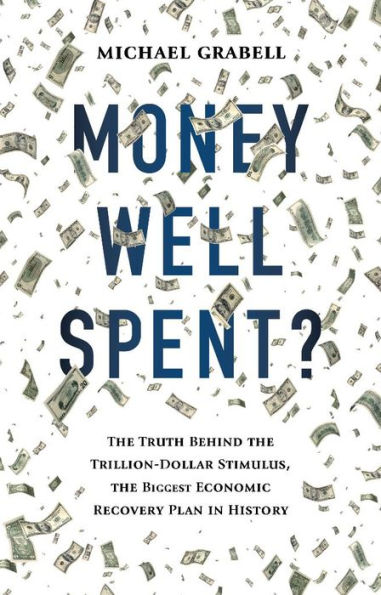
Money Well Spent?: The Truth Behind the Trillion-Dollar Stimulus, the Biggest Economic Recovery Plan in History

( 3 )

Overview

The 2012 presidential campaign will, above all else, be a referendum on the Obama administration’s handling of the financial crisis, recalling the period when Obama’s “audacity of hope” met the austerity of reality. Central to this is the ’’American Recovery and Reinvestment Act of 2009’’—the largest economic recovery plan in American history. Senator Mitch McConnell gave a taste of the enormity of the money committed: if you had spent $1 million a day since Jesus was born, it ...

See more details below
Hardcover
$19.09
BN.com price
(Save 34%)$28.99 List Price
Other sellers (Hardcover)
  • All (37) from $1.99   
  • New (19) from $1.99   
  • Used (18) from $1.99   
Money Well Spent?: The Truth Behind the Trillion-Dollar Stimulus, the Biggest Economic Recovery Plan in History

Available on NOOK devices and apps  
  • Nook Devices
  • NOOK HD/HD+ Tablet
  • NOOK
  • NOOK Color
  • NOOK Tablet
  • Tablet/Phone
  • NOOK for Windows 8 Tablet
  • NOOK for iOS
  • NOOK for Android
  • NOOK Kids for iPad
  • PC/Mac
  • NOOK for Windows 8
  • NOOK Study
  • NOOK for Web

Want a NOOK? Explore Now

NOOK Book (eBook)
$15.94
BN.com price
(Save 45%)$28.99 List Price

Overview

The 2012 presidential campaign will, above all else, be a referendum on the Obama administration’s handling of the financial crisis, recalling the period when Obama’s “audacity of hope” met the austerity of reality. Central to this is the ’’American Recovery and Reinvestment Act of 2009’’—the largest economic recovery plan in American history. Senator Mitch McConnell gave a taste of the enormity of the money committed: if you had spent $1 million a day since Jesus was born, it still would not add up to the price tag of the stimulus package.

A nearly entirely partisan piece of legislation— Democrats voted for it, Republicans against— the story of how the bill was passed and, more importantly, how the money was spent and to what effect, is known barely at all. Stepping outside the political fray, ProPublica’s Michael Grabell offers a perceptive, balanced, and dramatic story of what happened to the tax payers’ money, pursuing the big question through behind-the-scenes interviews and on-the-ground reporting in more than a dozen states across the country.

Read More Show Less

Editorial Reviews

Publishers Weekly
ProPublica reporter Grabell puts the "American Recovery and Reinvestment Act of 2009" under a microscope, focusing on its effect in three cities: Elkhart, Ind., whose civic plaza advertised "File Your Unemployment Electronically"; Aiken, S.C. where stimulus money funded the Savannah River cleanup; and Fremont, Calif. home to solar panel startup Solyndra, which received over $500 million. Grabell shares stories of workers who lost jobs and homes, and discusses the impact of the stimulus on goals like increasing Internet connectivity, improving education, and creating green jobs. From an energetic, auspicious beginning, with promises of detailed online tracking and immediate economic impact, the stimulus has played out over two years with some wins (the successful river cleanup created many jobs) and some losses (Solyndra went bankrupt). However, "With money spread so thinly... it was difficult for the public to grasp what the stimulus was about. But it was easy for small projects to capture the media coverage... and overwhelm the narrative the administration was desperately trying to reclaim." Grabell concludes that the problems that were seen nationwide were not a surprise: politics, insufficient funding, and cost overruns. "In this new era, audacity had met reality." This thorough exploration of the stimulus will educate readers about where money went, not just in the focus cities but around the country, and the lasting impact of the Great Recession.
(c) Copyright PWxyz, LLC. All rights reserved.
Kirkus Reviews
A journalist investigates the American Recovery and Reinvestment Act of 2009, seeking to determine whether the Obama administration's effort to ameliorate the previous administration's economic recession has been performing as hoped. ProPublica reporter Grabell began the book after hearing Joe Biden present a speech seven months after Congressional Democrats approved the law without a single Republican vote in the House of Representatives and nearly zero support in the Senate. Because the stimulus involved so much money scattered over so many government programs, Grabell decided to go broad instead of deep in the narrative. He does, however, dig deep in regards to three portions of the stimulus package: providing new jobs in Elkhart, Ind., after the collapse of industry there; the cleanup of an aging nuclear power plant in Aiken, S.C.; and the manufacturing of solar panels in Fremont, Calif., as part of a concerted effort to reduce air pollution across the nation. Some of Grabell's saga is necessarily grounded in previously reported partisan politics, as the newly elected president realized his Republican opposition seemed to be placing his hoped-for election defeat in 2012 above any nonpartisanship that might create new jobs and save existing ones. The author explains how the Republican strategy of fierce opposition led to its takeover of the House of Representatives in the 2010 election. Wisely, though, Grabell devotes much of the narrative to state and local government officials, including K-12 educators, who have been trying to determine how to obtain and wisely spend dollars from the stimulus package. The author concludes that Obama and his team succeeded in saving lots of jobs and creating a modest number of new jobs, but that the Democrats oversold the impact of the stimulus. A deeply reported, well-written account of a difficult topic to capture, partly because of the complexity and partly because the stimulus package remains a work in progress.
Read More Show Less

Product Details

  • ISBN-13: 9781610390095
  • Publisher: PublicAffairs
  • Publication date: 1/31/2012
  • Pages: 416
  • Sales rank: 1,354,542
  • Product dimensions: 6.20 (w) x 9.30 (h) x 1.60 (d)

Meet the Author

Michael Grabell has been a reporter at ProPublica since 2008, producing stories for USA Today, Salon, NPR, MSNBC.com and the CBS Evening News. Before joining ProPublica, he was a reporter at The Dallas Morning News. He has twice been a finalist for the Livingston Award for Young Journalists. He lives in New Jersey.

Read More Show Less

Table of Contents

Introduction ix

Part 1 Recession

1 File Your Unemployment Electronically 3

2 The Ditch 17

3 Let's Make a Deal 36

4 Follow the Money 61

5 No, Thank You 82

Part 2 Recovery?

6 Shovel-Ready 99

7 Recovery Inaction 119

8 One Man's Waste 140

9 Cash for Clunkers 160

10 Jobs, Jobs, Jobs 180

Part 3 Reinvestment

11 The Green Economy 209

12 "The Carrot That Feels Like a Stick" 239

13 The Shellacking 266

14 Connecting the Country 293

15 Sputnik Moment? 314

16 Magic Bullets 339

Notes 361

Credits 373

Acknowledgments 375

Index 377

Read More Show Less

Customer Reviews

Average Rating 4.5
( 3 )
Rating Distribution

5 Star

(2)

4 Star

(1)

3 Star

(0)

2 Star

(0)

1 Star

(0)

Your Rating:

Your Name: Create a Pen Name or

Barnes & Noble.com Review Rules

Our reader reviews allow you to share your comments on titles you liked, or didn't, with others. By submitting an online review, you are representing to Barnes & Noble.com that all information contained in your review is original and accurate in all respects, and that the submission of such content by you and the posting of such content by Barnes & Noble.com does not and will not violate the rights of any third party. Please follow the rules below to help ensure that your review can be posted.

Reviews by Our Customers Under the Age of 13

We highly value and respect everyone's opinion concerning the titles we offer. However, we cannot allow persons under the age of 13 to have accounts at BN.com or to post customer reviews. Please see our Terms of Use for more details.

What to exclude from your review:

Please do not write about reviews, commentary, or information posted on the product page. If you see any errors in the information on the product page, please send us an email.

Reviews should not contain any of the following:

  • - HTML tags, profanity, obscenities, vulgarities, or comments that defame anyone
  • - Time-sensitive information such as tour dates, signings, lectures, etc.
  • - Single-word reviews. Other people will read your review to discover why you liked or didn't like the title. Be descriptive.
  • - Comments focusing on the author or that may ruin the ending for others
  • - Phone numbers, addresses, URLs
  • - Pricing and availability information or alternative ordering information
  • - Advertisements or commercial solicitation

Reminder:

  • - By submitting a review, you grant to Barnes & Noble.com and its sublicensees the royalty-free, perpetual, irrevocable right and license to use the review in accordance with the Barnes & Noble.com Terms of Use.
  • - Barnes & Noble.com reserves the right not to post any review -- particularly those that do not follow the terms and conditions of these Rules. Barnes & Noble.com also reserves the right to remove any review at any time without notice.
  • - See Terms of Use for other conditions and disclaimers.
Search for Products You'd Like to Recommend

Recommend other products that relate to your review. Just search for them below and share!

Create a Pen Name

Your Pen Name is your unique identity on BN.com. It will appear on the reviews you write and other website activities. Your Pen Name cannot be edited, changed or deleted once submitted.

 
Your Pen Name can be any combination of alphanumeric characters (plus - and _), and must be at least two characters long.

Continue Anonymously
Sort by: Showing all of 3 Customer Reviews
  • Posted May 1, 2012

    more from this reviewer

    The economy is improving, but the recovery is not as robust as i

    The economy is improving, but the recovery is not as robust as it could and should have been, contends journalist Michael Grabell. The biggest economic recovery act in history – with an estimated cost of more than a trillion dollars – brought various economic solutions into collision with Washington, DC’s tough political realities, producing middling results. Grabell argues that taxpayers got their money’s worth because the act saved millions of jobs and forestalled another Great Depression. But political miscalculations and poor management hobbled what could have been an even stronger recovery. Whether you’re a Republican or a Democrat, a fan of Barack Obama, a member of the Tea Party or an overseas onlooker marveling at the swirl of American politics, this detailed, intelligent overview can help you understand exactly what the American Recovery and Reinvestment Act accomplished and failed to accomplish. getAbstract recommends Grabell’s reporting to anyone who participates in America’s slowly reinvigorating economy or has felt the impact of its ups and downs.

    Was this review helpful? Yes  No   Report this review
  • Anonymous

    Posted February 2, 2012

    No text was provided for this review.

  • Anonymous

    Posted November 22, 2012

    No text was provided for this review.

Sort by: Showing all of 3 Customer Reviews

If you find inappropriate content, please report it to Barnes & Noble
Why is this product inappropriate?
Comments (optional)