- Shopping Bag ( 0 items )
When the Sultan commissions a great book to celebrate his royal self and his extensive dominion, he directs Enishte Effendi to assemble a cadre of the most acclaimed artists in the land. Their task: to illuminate the work in the European style. But because figurative art can be deemed an affront to Islam, this commission is a dangerous proposition indeed, and no one in the elite circle can know the full scope or nature of the project.
Panic erupts when one of the chosen miniaturists disappears, and the Sultan demands answers within three days. The only clue to the mystery—or crime?—lies in the half-finished illuminations themselves. Has an avenging angel discovered the blasphemous work? Or is a jealous contender for the hand of Enishte’s ravishing daughter, the incomparable Shekure, somehow to blame?
Orhan Pamuk’s My Name Is Red is at once a fantasy and a philosophical puzzle, a kaleidoscopic journey to the intersection of art, religion, love, sex, and power.
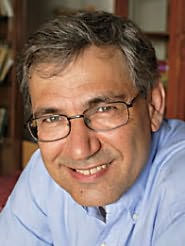
Orhan Pamuk: Winner of the 2006 Nobel Prize for Literature
I Am a Corpse
I am nothing but a corpse now, a body at the bottom of a well. Although I drew my last breath long ago and my heart has stopped beating, no one, apart from that vile murderer, knows what's happened to me. As for that wretch, he felt for my pulse and listened for my breath to be sure I was dead, then kicked me in the midriff, carried me to the edge of the well, raised me up and dropped me below. As I fell, my head, which he had smashed with a stone, broke apart; my face, my forehead and cheeks, were crushed; my bones shattered, and my mouth filled with blood.
For nearly four days I have been missing: My wife and children must be searching for me; my daughter, spent from crying, must be staring fretfully at the courtyard gate. Yes, I know they're all at the window, hoping for my return.
But, are they truly waiting? I can't even be sure of that. Maybe they've gotten used to my absence-how dismal! For here, on the other side, one gets the feeling that one's former life persists. Before my birth there was infinite time, and after my death, inexhaustible time. I never thought of it before: I'd been living luminously between two eternities of darkness.
I was happy; I realize now that I'd been happy. I made the best illuminations in Our Sultan's workshop; no one could rival my mastery. Through the work I did privately, I earned nine hundred silver coins a month, which, naturally, only makes all this even harder to bear.
I was responsible for painting and embellishing books. I illuminated the edges of pages, coloring their borders with the most lifelike designs of leaves, branches, roses, flowers and birds. I painted scalloped Chinese-style clouds, clusters of overlapping vines and forests of color that hid gazelles, galleys, sultans, trees, palaces, horses and hunters. In my youth, I would decorate a plate, or the back of a mirror, or a chest, or at times, the ceiling of a mansion or of a Bosphorus manor, or even, a wooden spoon. In later years, however, I applied myself only to manuscript pages because Our Sultan paid well for them. I can't say it seems insignificant now. You know the value of money even when you're dead.
After hearing the miracle of my voice, you might think, "Who cares what you earned when you were alive? Tell us what you can see. Is there life after death? Where's your soul? What about Heaven and Hell? What is death like? Are you in pain?" You're right, people are extremely curious about the Afterlife. Maybe you've heard the story of the man who was so driven by this curiosity that he roamed among soldiers in battlefields. He sought a man who had died and returned to life amid the wounded struggling for their lives in pools of blood, a soldier who could tell him about the secrets of the Otherworld. But one of Tamerlane's warriors, taking the seeker for one of the enemy, cleared him in half with a smooth stroke of his scimitar, causing him to conclude that in the Hereafter man is split in two.
Nonsense! Quite the opposite, I'd even allege that souls divided in life merge in the Hereafter. Contrary to the claims of sinful infidels who have fallen under the sway of the Devil, there is indeed another world, thank God, and the proof is that I am speaking to you from here. I've died, but as you can plainly tell, I haven't ceased to be. Granted, I must confess, I haven't encountered the rivers flowing beside the silver and gold kiosks of Heaven, the broad-leaved trees bearing plump fruit and the beautiful virgins mentioned in the Glorious Koran-though I do very well recall how often and enthusiastically I made pictures of those wide-eyed houris described in the chapter "That Which Is Coming." Nor is there a trace of those rivers of milk, wine, fresh water and honey described with such flourish, not in the Koran, but by visionary dreamers like Ibn Arabi. But I have no intention of tempting the faith of those who live rightly through their hopes and visions of the Otherworld, so let me declare that all I've seen relates specifically to my own very personal circumstances. Any believer with even a little knowledge of life after death would know that a malcontent in my state would be hard-pressed to see the rivers of Heaven.
In short, I, who am known as Master Elegant Effendi, am dead, but have not been interred, therefore my soul has not completely left my body. This extraordinary situation, although naturally my case is not the first, has inflicted a horrible suffering upon the immortal part of me. Though I cannot feel my crushed skull or my decomposing body covered in wounds, full of broken bones and partially submerged in ice-cold water, I do feel the deep torment of my soul struggling desperately to escape its mortal coil. It's as if the whole world, along with my body, were contracting into a bolus of anguish.
I can only compare this contraction to the surprising sense of release I felt during the unequaled moment of my death. Yes, I instantly understood that that wretch wanted to kill me when he unexpectedly struck me with a stone and cracked my skull, but I didn't believe he'd be able to follow through. I suddenly realized I was a hopeful man, something I hadn't been aware of while living my life in the shadows between workshop and household. I clung passionately to life with my nails, my fingers and my teeth, which I sank into his skin. I won't bore you with the painful details of the subsequent blows I received.
When in the course of this agony I knew I would die, an incredible feeling of relief filled me. I felt this relief during the moment of departure; my arrival to this side was soothing, like the dream of seeing oneself asleep. The snow- and mud-covered shoes of my murderer were the last things I noticed. I closed my eyes as if I were going to sleep, and I gently passed over.
My present complaint isn't that my teeth have fallen like nuts into my bloody mouth, or even that my face has been maimed beyond recognition, or that I've been abandoned in the depths of a well-it's that everyone assumes I'm still alive. My troubled soul is anguished that my family and intimates, who, yes, think of me often, imagine me engaged in some trivial business somewhere in Istanbul, or even chasing after another woman. Enough! Find my body without delay, pray for me and have me buried. Above all, find my murderer! For even if you bury me in the most magnificent of tombs, so long as that wretch remains free, I'll writhe restlessly in my grave, waiting, infecting you all with faithlessness. Find that son-of-a-whore murderer and I'll tell you in detail just what I see in the Afterlife-but know this, when he's caught, he must be tortured by slowly splintering eight or ten of his bones, preferably his ribs with a vise, before piercing his scalp with those skewers made especially for the task by torturers, and plucking out his disgusting, oily hair, strand by strand, so he shrieks each time.
Who is this murderer who vexes me so? Why has he killed me in this surprising way? Be curious and mindful of such matters. You say the world is full of base and worthless criminals? Perhaps this one did it, perhaps that one? In that case let me caution you: My death conceals an appalling conspiracy against our religion, our traditions and the way we see the world. Open your eyes, discover why the enemies of the life in which you believe, of the life you're living, and of Islam, have destroyed me. Learn why one day they might do the same to you. One by one, everything predicted by the great preacher Nusret Hoja of Erzurum, to whom I've tearfully listened, is coming to pass. Let me say also that if the situation into which we've fallen were described in a book, even the most expert of miniaturists could never hope to illustrate it. As with the Koran-God forbid I'm misunderstood-the staggering power of such a book arises from the impossibility of its being depicted. I doubt you've comprehended this fact.
Listen to me. When I was an apprentice, I too feared and thus ignored the underlying truths and the voices from beyond. I'd joke about such matters. But I've ended up in the depths of this deplorable well! It could happen to you, be wary. Now, I've nothing left to do but hope for thorough decay, so they can find me by tracing my stench. I've nothing to do but hope-and imagine the torture that some benevolent man will inflict upon that wretched murderer once he's been caught.
Anonymous
Posted February 9, 2009
I had just finished studying Islamic art extensively in one of my art history classes (I am an art history major) when I began reading this book. This was a great read, but I feel it would be difficult to understand for those not interested in art and religion, and particularly for those who have little background in Islamic art. If you are, however, what a great book! The detail with which the author describes the process of illuminating manuscripts and the passion the miniaturists possess for doing so is incredible and moving. The plot is intriguing and just when you think you know what's going to happen, something surprises you.
3 out of 3 people found this review helpful.
Was this review helpful? Yes NoThank you for your feedback. Report this reviewThank you, this review has been flagged.Anonymous
Posted August 13, 2004
I am an avid reader of Orhan Pamuk, however I must say that this one is his masterpiece. My name is Red is taking us to historical labyrinths of Istanbul. His trademark 'detailed description of the characters and events' is at its best. What I like most is Pamuk usually tells his stories from different points of view. This books looks like a murder-suspense book at the first place, however page by page you start to see Islam and its philosopy from the eyes of 16th century miniaturists. What I learnt from his interviews is Pamuk could not finish writing this book for a long time and he always prefers handwriting (just like his friend, great Paul Auster). You can see his precise technique and talented storytelling page by page. Pamuk has obviously done a great research about the 16th century Istanbul and the result is awesome. I may critize the translation a little bit but I appreciate that to translate a book by O.Pamuk must be tough! My name is red is 'a must' Because of this book Pamuk got the 2003 IMPAC award. You will see his talent starting from the first chapter. Amazing, sad, humorous, brilliant. Well, do yourself a favor and purchase this one and then spare the time to read it carefully.
3 out of 3 people found this review helpful.
Was this review helpful? Yes NoThank you for your feedback. Report this reviewThank you, this review has been flagged.Anonymous
Posted May 30, 2003
I wanted to read over and over.Sometimes makes you smile,sometimes makes you feel sad.Incredible !! Orhan Pamuk is really talented author.I'm looking forward his next book.
1 out of 1 people found this review helpful.
Was this review helpful? Yes NoThank you for your feedback. Report this reviewThank you, this review has been flagged.Anonymous
Posted March 10, 2003
The latest of Pamuk's books takes place in 15th century Istanbul. A time and place we know very little about. The characters are detailed and surprising (dog, death, satan etc.). The story is told from many different points of view which adds depth and richness. This book is another example of Pamuk's mastery in telling a timeless story of love, hate, murder and art taking place in a remote point in time. From the first sentence you will know that you are reading the work of a very clever and able writer.
Was this review helpful? Yes NoThank you for your feedback. Report this reviewThank you, this review has been flagged.Anonymous
Posted December 20, 2002
Full of wonder and discovery in a most unlikely place. It's a pity so few people will probably find there way to this astonishing work. From the first page I was swept up in a sub-culture and time that I knew absolutely nothing about. It gives a lot of perspective to what's going on in the world today. We don't always take the time to observe and empatize with the way others lived, centuries before us. His writing is pure poetry, full of tenderness and savagery. It takes you into the realm of a thriller yet you feel it take shape in Pamut's mind as he seduces you.
Was this review helpful? Yes NoThank you for your feedback. Report this reviewThank you, this review has been flagged.Anonymous
Posted October 1, 2002
I love this book. It is astonishingly beautiful. Definitely a book to savor. Also, I have an Arts Education - which was really an education in Western Art - and it has been very interesting to learn about Eastern Art and the East's perceptions of the West, particularly in the 16th century. Fascinating, mysterious and beautiful!
Was this review helpful? Yes NoThank you for your feedback. Report this reviewThank you, this review has been flagged.Anonymous
Posted December 17, 2001
To combine history, mystery, romance, and philosophy in a beautifully written story is a remarkable achievement. I couldn't put the book down, and now, can't forget it.
Was this review helpful? Yes NoThank you for your feedback. Report this reviewThank you, this review has been flagged.Anonymous
Posted March 7, 2002
This book was a real page turner! I can't get the story out of my head and felt a deep sadness when the book finally finished.To fully enjoy this gift of a book one must read My name is Red slowly very slowly.
Was this review helpful? Yes NoThank you for your feedback. Report this reviewThank you, this review has been flagged.Anonymous
Posted January 3, 2010
No text was provided for this review.
Anonymous
Posted August 27, 2009
No text was provided for this review.
Anonymous
Posted January 29, 2011
No text was provided for this review.
Anonymous
Posted September 5, 2011
No text was provided for this review.
Anonymous
Posted March 5, 2010
No text was provided for this review.
Anonymous
Posted July 4, 2011
No text was provided for this review.
Anonymous
Posted January 12, 2010
No text was provided for this review.
Anonymous
Posted February 28, 2010
No text was provided for this review.
Anonymous
Posted July 27, 2011
No text was provided for this review.
Anonymous
Posted August 13, 2010
No text was provided for this review.
Anonymous
Posted January 16, 2010
No text was provided for this review.
Anonymous
Posted November 28, 2008
No text was provided for this review.
Overview
From one of the most important and acclaimed writers at work today, a thrilling new novel—part murder mystery, part love story—set amid the perils of religious repression in sixteenth-century Istanbul.When the Sultan commissions a great book to celebrate his royal self and his extensive dominion, he directs Enishte Effendi to assemble a cadre of the most acclaimed artists in the land. Their task: to illuminate the work in the European style. But because figurative art can be deemed an affront to Islam, this commission is a dangerous proposition indeed, and no one in the elite circle can know the full scope or nature of the project.
Panic erupts when one...