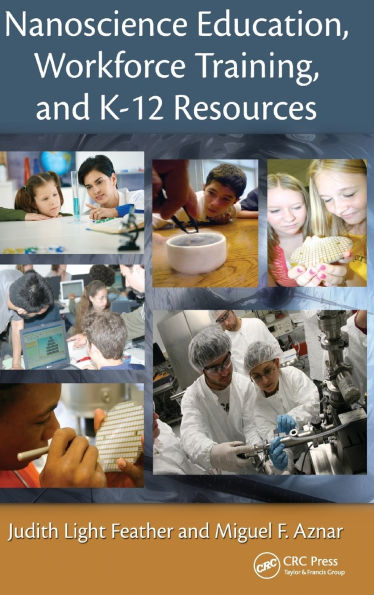
Nanoscience Education, Workforce Training, and K-12 Resources
The nanotech revolution waits for no man, woman or child. To revitalize science, technology, engineering, and mathematics (STEM) performance, the U.S. educational system requires a practical strategy to better educate students about nanoscale science and engineering research. This is particularly important in grades K 12, the effective gestation point for future ideas and information.

Optimize your use of free resources from the National Science Foundation

The first book of its kind, Nanoscience Education, Workforce Training, and K 12 Resources promotes nano-awareness in both the public and private sectors, presenting an overview of the current obstacles that must be overcome within the complex U.S. educational system before any reform is possible. It‘s a race against time and other countries and the fear is that U.S. students could lag behind for decades, with ineffective teaching and learning methods handicapping their ability to compete globally.

Focusing on the application of new knowledge, this concise and highly readable book explores the transdisciplinary nature of nanoscience and its societal impact, also addressing workforce training and risk management. Illustrating the historical perspective of the complexity of K 12 education communities, it defines nanotechnology and evaluates pertinent global and national landscapes, presenting examples of successful change within them.

This book is composed of four sections:

Foundations addresses the national educational matrix, exploring the scientific and social implications associated with the delay in adopting nanoscience education in public schools

Teaching Nanotechnology discusses the critical process of teaching K 12 students the skills to understand and evaluate emerging technologies they will encounter
1120466047
Nanoscience Education, Workforce Training, and K-12 Resources
The nanotech revolution waits for no man, woman or child. To revitalize science, technology, engineering, and mathematics (STEM) performance, the U.S. educational system requires a practical strategy to better educate students about nanoscale science and engineering research. This is particularly important in grades K 12, the effective gestation point for future ideas and information.

Optimize your use of free resources from the National Science Foundation

The first book of its kind, Nanoscience Education, Workforce Training, and K 12 Resources promotes nano-awareness in both the public and private sectors, presenting an overview of the current obstacles that must be overcome within the complex U.S. educational system before any reform is possible. It‘s a race against time and other countries and the fear is that U.S. students could lag behind for decades, with ineffective teaching and learning methods handicapping their ability to compete globally.

Focusing on the application of new knowledge, this concise and highly readable book explores the transdisciplinary nature of nanoscience and its societal impact, also addressing workforce training and risk management. Illustrating the historical perspective of the complexity of K 12 education communities, it defines nanotechnology and evaluates pertinent global and national landscapes, presenting examples of successful change within them.

This book is composed of four sections:

Foundations addresses the national educational matrix, exploring the scientific and social implications associated with the delay in adopting nanoscience education in public schools

Teaching Nanotechnology discusses the critical process of teaching K 12 students the skills to understand and evaluate emerging technologies they will encounter

170.0 Out Of Stock
Nanoscience Education, Workforce Training, and K-12 Resources

Nanoscience Education, Workforce Training, and K-12 Resources

by Judith Light Feather
Nanoscience Education, Workforce Training, and K-12 Resources

Nanoscience Education, Workforce Training, and K-12 Resources

by Judith Light Feather

Hardcover

$170.00 
  • SHIP THIS ITEM
    Temporarily Out of Stock Online
  • PICK UP IN STORE

    Your local store may have stock of this item.

Related collections and offers


Overview

The nanotech revolution waits for no man, woman or child. To revitalize science, technology, engineering, and mathematics (STEM) performance, the U.S. educational system requires a practical strategy to better educate students about nanoscale science and engineering research. This is particularly important in grades K 12, the effective gestation point for future ideas and information.

Optimize your use of free resources from the National Science Foundation

The first book of its kind, Nanoscience Education, Workforce Training, and K 12 Resources promotes nano-awareness in both the public and private sectors, presenting an overview of the current obstacles that must be overcome within the complex U.S. educational system before any reform is possible. It‘s a race against time and other countries and the fear is that U.S. students could lag behind for decades, with ineffective teaching and learning methods handicapping their ability to compete globally.

Focusing on the application of new knowledge, this concise and highly readable book explores the transdisciplinary nature of nanoscience and its societal impact, also addressing workforce training and risk management. Illustrating the historical perspective of the complexity of K 12 education communities, it defines nanotechnology and evaluates pertinent global and national landscapes, presenting examples of successful change within them.

This book is composed of four sections:

Foundations addresses the national educational matrix, exploring the scientific and social implications associated with the delay in adopting nanoscience education in public schools

Teaching Nanotechnology discusses the critical process of teaching K 12 students the skills to understand and evaluate emerging technologies they will encounter


Product Details

ISBN-13: 9781138453494
Publisher: Taylor & Francis
Publication date: 06/28/2018
Pages: 342
Product dimensions: 6.12(w) x 9.19(h) x (d)

About the Author

Judith Light Feather is president of The NanoTechnology Group, Inc., which provides resources for every aspect of nanoscience education, from curriculum to development tools for teachers. The company’s News Division provides informal educational information and news for the public at www.NanoNEWS.TV presently serving on the Board of the NanoEthics Group, and multiple boards at Lifeboat Foundation. Miguel F. Aznar serves as executive director of KnowledgeContext, director of education for Foresight Institute, and on the advisory boards of both the Nanoethics Group and the Acceleration Studies Foundation. He has presented at educational conferences, including Computer Using Educators (CUE), California Educational Research Association (CERA), and California League of Middle Schools (CLMS).

Table of Contents

Section I: Foundations Introduction to Nanoscience, Technology, and Social Implications. Education Is a Complex System: History, Matrix, Politics, Solutions. Students Are Shifting the Paradigm. Nobel Laureates Are Role Models in Teaching Nanoscience. Section II: Teaching Nanotechnology What is Nanotechnological Literacy? How Do We Teach Nanotechnology’s Identity? How Do We Teach about Change in Nanotechnology? How Do We Teach Evaluation of Nanotechnology? Section III: Nanoscience Resources and Programs K–12 Outreach Programs. Overviews of Nanotechnology Workforce Programs. Informal Science Resources. Overviews: Global Nanotechnology Initiatives and Resources. Section IV: Framework Applied Assessing the Options for Action and Implementation. The Twenty-First Century Paradigm—Working Together. Rethinking Education—Can We Succeed?

What People are Saying About This

From the Publisher

"There’s a stack of books on our desk and a cloud of PDFs on our desktop that focus on the social and ethical implications (SEI) of nanotech, but this 2011 collection by Judith Light Feather and Migeul F. Aznar will be among the few “go to” texts for our classes and research in coming years. With critical essays, lively pedagogical ideas and techniques, and a veritable database of resources that more than deliver on the title keyword, the book is a timely tool for growing the best of all plausible nanotechnological futures. ... The sheer variety of perspectives represented here helps the volume avoid the usual monotone voice of jargon that too often haunts such compilations. The result is a fresh and lucid take on the metaphorical roadmap to nanotechnology, with a welcome emphasis on bottom-up approaches to education and workforce training. There is much to like here—an impressive, sometimes dizzying array of resources and approaches for educators and administrators in time to make a difference in today’s classroom and hacklab."
— U.S. Journal of Nanophotonics, Vol. 5, 2011

From the B&N Reads Blog

Customer Reviews