
This open access book summarizes research being pursued within the FENIX project, funded by the EU community under the H2020 programme, the goal of which is to design a new product service paradigm able to promote innovative business models, to open added value to the vessels and to create new market segments. It experiments and validates its approach on three new concepts of added-value specialized vessels able to run requested services for several maritime sectors in the most effective, efficient, economic valuable and eco-friendly way. The three vessels share the same lean design methodology, IoT tools and HPC simulation strategy: a lean fact-based design model approach, which combines real operative data at sea with lean methodology, to support the development and implementation of the vessel concepts; IT customized tools to enable the acquisition, processing and usage of on board and local weather data, through an IoT platform, to provide business services to different stakeholders; HPC simulation, providing a virtual towing tank environment, for early vessel design improvement and testing. The book demonstrates that an integrated LCC analysis and LCC strategy to guarantee sustainability to vessels concepts and the proper environmental attention inside the maritime industry.
This open access book summarizes research being pursued within the FENIX project, funded by the EU community under the H2020 programme, the goal of which is to design a new product service paradigm able to promote innovative business models, to open added value to the vessels and to create new market segments. It experiments and validates its approach on three new concepts of added-value specialized vessels able to run requested services for several maritime sectors in the most effective, efficient, economic valuable and eco-friendly way. The three vessels share the same lean design methodology, IoT tools and HPC simulation strategy: a lean fact-based design model approach, which combines real operative data at sea with lean methodology, to support the development and implementation of the vessel concepts; IT customized tools to enable the acquisition, processing and usage of on board and local weather data, through an IoT platform, to provide business services to different stakeholders; HPC simulation, providing a virtual towing tank environment, for early vessel design improvement and testing. The book demonstrates that an integrated LCC analysis and LCC strategy to guarantee sustainability to vessels concepts and the proper environmental attention inside the maritime industry.

New Business Models for the Reuse of Secondary Resources from WEEEs: The FENIX Project
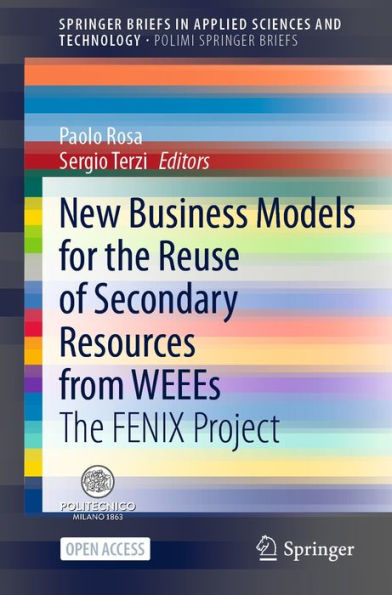
New Business Models for the Reuse of Secondary Resources from WEEEs: The FENIX Project
eBook (1st ed. 2021)
Related collections and offers

Product Details
| ISBN-13: | 9783030748869 |
|---|---|
| Publisher: | Springer-Verlag New York, LLC |
| Publication date: | 06/18/2021 |
| Series: | SpringerBriefs in Applied Sciences and Technology |
| Sold by: | Barnes & Noble |
| Format: | eBook |
| File size: | 40 MB |
| Note: | This product may take a few minutes to download. |