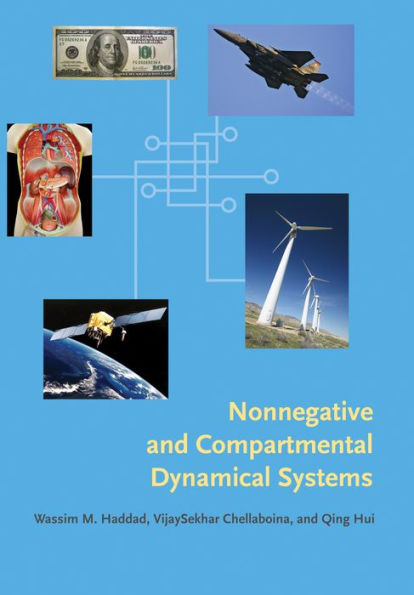
Nonnegative and Compartmental Dynamical Systems

This comprehensive book provides the first unified framework for stability and dissipativity analysis and control design for nonnegative and compartmental dynamical systems, which play a key role in a wide range of fields, including engineering, thermal sciences, biology, ecology, economics, genetics, chemistry, medicine, and sociology. Using the highest standards of exposition and rigor, the authors explain these systems and advance the state of the art in their analysis and active control design.


Nonnegative and Compartmental Dynamical Systems presents the most complete treatment available of system solution properties, Lyapunov stability analysis, dissipativity theory, and optimal and adaptive control for these systems, addressing continuous-time, discrete-time, and hybrid nonnegative system theory. This book is an indispensable resource for applied mathematicians, dynamical systems theorists, control theorists, and engineers, as well as for researchers and graduate students who want to understand the behavior of nonnegative and compartmental dynamical systems that arise in areas such as biomedicine, demographics, epidemiology, pharmacology, telecommunications, transportation, thermodynamics, networks, heat transfer, and power systems.
1147760175
Nonnegative and Compartmental Dynamical Systems

This comprehensive book provides the first unified framework for stability and dissipativity analysis and control design for nonnegative and compartmental dynamical systems, which play a key role in a wide range of fields, including engineering, thermal sciences, biology, ecology, economics, genetics, chemistry, medicine, and sociology. Using the highest standards of exposition and rigor, the authors explain these systems and advance the state of the art in their analysis and active control design.


Nonnegative and Compartmental Dynamical Systems presents the most complete treatment available of system solution properties, Lyapunov stability analysis, dissipativity theory, and optimal and adaptive control for these systems, addressing continuous-time, discrete-time, and hybrid nonnegative system theory. This book is an indispensable resource for applied mathematicians, dynamical systems theorists, control theorists, and engineers, as well as for researchers and graduate students who want to understand the behavior of nonnegative and compartmental dynamical systems that arise in areas such as biomedicine, demographics, epidemiology, pharmacology, telecommunications, transportation, thermodynamics, networks, heat transfer, and power systems.

158.0 In Stock
Nonnegative and Compartmental Dynamical Systems

Nonnegative and Compartmental Dynamical Systems

Nonnegative and Compartmental Dynamical Systems

Nonnegative and Compartmental Dynamical Systems

eBookCourse Book (Course Book)

$158.00 

Available on Compatible NOOK devices, the free NOOK App and in My Digital Library.
WANT A NOOK?  Explore Now

Related collections and offers


Overview

This comprehensive book provides the first unified framework for stability and dissipativity analysis and control design for nonnegative and compartmental dynamical systems, which play a key role in a wide range of fields, including engineering, thermal sciences, biology, ecology, economics, genetics, chemistry, medicine, and sociology. Using the highest standards of exposition and rigor, the authors explain these systems and advance the state of the art in their analysis and active control design.


Nonnegative and Compartmental Dynamical Systems presents the most complete treatment available of system solution properties, Lyapunov stability analysis, dissipativity theory, and optimal and adaptive control for these systems, addressing continuous-time, discrete-time, and hybrid nonnegative system theory. This book is an indispensable resource for applied mathematicians, dynamical systems theorists, control theorists, and engineers, as well as for researchers and graduate students who want to understand the behavior of nonnegative and compartmental dynamical systems that arise in areas such as biomedicine, demographics, epidemiology, pharmacology, telecommunications, transportation, thermodynamics, networks, heat transfer, and power systems.


Product Details

ISBN-13: 9781400832248
Publisher: Princeton University Press
Publication date: 01/04/2010
Sold by: Barnes & Noble
Format: eBook
Pages: 616
File size: 5 MB

About the Author

Wassim M. Haddad is professor in the School of Aerospace Engineering at Georgia Institute of Technology. VijaySekhar Chellaboina holds a PhD in aerospace engineering from Georgia Tech and works for Tata Consultancy Services in Hyderabad, India. Haddad and Chellaboina have coauthored six books, including Nonlinear Dynamical Systems and Control (Princeton). Qing Hui is assistant professor in the Department of Mechanical Engineering at Texas Tech University.

Table of Contents

Preface xv


CHAPTER 1. Introduction 1
CHAPTER 2. Stability Theory for Nonnegative Dynamical Systems 7
2.1 Introduction 7
2.2 Lyapunov Stability Theory for Nonnegative Dynamical Systems 7
2.3 Invariant Set Stability Theorems 16
2.4 Semistability of Nonnegative Dynamical Systems 21
2.5 Stability Theory for Linear Nonnegative Dynamical Systems 30
2.6 Nonlinear Compartmental Dynamical Systems 43
2.7 Compartmental Systems in Biology, Ecology, Epidemiology, and Pharmacology 49
2.8 Discrete-Time Lyapunov Stability Theory for Nonnegative Dynamical Systems 61
2.9 Discrete-Time Invariant Set Theorems and Semistability Theorems 64
2.10 Stability Theory for Discrete-Time Linear Nonnegative Dynamical Systems 69
2.11 Discrete-Time Nonlinear Compartmental Dynamical Systems 83


CHAPTER 3. Stability Theory for Nonnegative and Compartmental Dynamical Systems with Time Delay 89
3.1 Introduction 89
3.2 Lyapunov Stability Theory for Time-Delay Nonnegative Dynamical Systems 90
3.3 Invariant Set Stability Theorems 93
3.4 Stability Theory for Continuous-Time Nonnegative Dynamical Systems with Time Delay 97
3.5 Discrete-Time Lyapunov Stability Theory for Time-Delay Nonnegative Dynamical Systems 103
3.6 Stability Theory for Discrete-Time Nonnegative Dynamical Systems with Time Delay 106


CHAPTER 4. Nonoscillation and Monotonicity of Solutions of Nonnegative Dynamical Systems 111
4.1 Introduction 111
4.2 Nonoscillation and Monotonicity of Linear Nonnegative Dynamical Systems 112
4.3 Mammillary Systems 119
4.4 Monotonicity of Nonlinear Nonnegative Dynamical Systems 123
4.5 Monotonicity of Discrete-Time Linear Nonnegative Dynamical Systems 127
4.6 Monotonicity of Discrete-Time Nonlinear Nonnegative Dynamical Systems 132
4.7 Monotonicity of Nonnegative Dynamical Systems with Time Delay 135


CHAPTER 5. Dissipativity Theory for Nonnegative Dynamical Systems 143
5.1 Introduction 143
5.2 Dissipativity Theory for Nonnegative Dynamical Systems 145
5.3 Feedback Interconnections of Nonnegative Dynamical Systems 153
5.4 Dissipativity Theory for Nonlinear Nonnegative Dynamical Systems 158
5.5 Feedback Interconnections of Nonnegative Nonlinear Dynamical Systems 164
5.6 Dissipativity Theory for Discrete-Time Nonnegative Dynamical Systems 166
5.7 Specialization to Discrete-Time Linear Nonnegative Dynamical Systems 173
5.8 Feedback Interconnections of Discrete-Time Nonnegative Dynamical Systems 177
5.9 Dissipativity Theory for Nonnegative Dynamical Systems with Time Delay 183
5.10 Feedback Interconnections of Nonnegative Dynamical Systems with Time Delay 188
5.11 Dissipativity Theory for Discrete-Time Nonnegative Dynamical Systems with Time Delay 191
5.12 Feedback Interconnections of Discrete-Time Nonnegative Dynamical Systems with Time Delay 194


CHAPTER 6. Hybrid Nonnegative and Compartmental Dynamical Systems 197
6.1 Introduction 197
6.2 Stability Theory for Nonlinear Hybrid Nonnegative Dynamical Systems 199
6.3 Hybrid Compartmental Dynamical Systems 203
6.4 Dissipativity Theory for Hybrid Nonnegative Dynamical Systems 207
6.5 Specialization to Linear Impulsive Dynamical Systems 215
6.6 Feedback Interconnections of Nonlinear Hybrid Nonnegative Dynamical Systems 217


CHAPTER 7. System Thermodynamics, Irreversibility, and Time Asymmetry 223
7.1 Introduction 223
7.2 Dynamical System Model 226
7.3 Reversibility, Irreversibility, Recoverability, and Irrecoverability 228
7.4 Reversible Dynamical Systems, Volume-Preserving Flows, and Poincar´e Recurrence 233
7.5 System Thermodynamics 243
7.6 Entropy and Irreversibility 247
7.7 Semistability and the Entropic Arrow of Time 254
7.8 Monotonicity of System Energies in Thermodynamic Processes
259


CHAPTER 8. Finite-Time Thermodynamics 263
8.1 Introduction 263
8.2 Finite-Time Semistability of Nonlinear Nonnegative Dynamical Systems 264
8.3 Homogeneity and Finite-Time Semistability 268
8.4 Finite-Time Energy Equipartition in Thermodynamic Systems 275


CHAPTER 9. Modeling and Analysis of Mass-Action Kinetics 281
9.1 Introduction 281
9.2 Reaction Networks 282
9.3 The Law of Mass Action and the Kinetic Equations 284
9.4 Nonnegativity of Solutions 288
9.5 Realization of Mass-Action Kinetics 290
9.6 Reducibility of the Kinetic Equations 293
9.7 Stability Analysis of Linear and Nonlinear Kinetics 297
9.8 The Zero-Deficiency Theorem 301


CHAPTER 10. Semistability and State Equipartition of Nonnegative Dynamical Systems 315
10.1 Introduction 315
10.2 Semistability and State Equipartitioning 315
10.3 Semistability and Equipartition of Linear Compartmental Systems with Time Delay 324
10.4 Semistability and Equipartition of Nonlinear Compartmental Systems with Time Delay 328


CHAPTER 11. Robustness of Nonnegative Dynamical Systems 343
11.1 Introduction 343
11.2 Nominal System Model 343
11.3 Semistability and Homogeneous Dynamical Systems 347
11.4 Uncertain System Model 348


CHAPTER 12. Modeling and Control for Clinical Pharmacology 359
12.1 Introduction 359
12.2 Pharmacokinetic Models 360
12.3 State Space Models 361
12.4 Drug Action, Effect, and Interaction 362
12.5 Pharmacokinetic Parameter Estimation 363
12.6 Pharmacodynamic Models 365
12.7 Open-Loop Drug Dosing 366
12.8 Closed-Loop Drug Dosing 368
12.9 Closed-Loop Control of Cardiovascular Function 369
12.10 Closed-Loop Control of Anesthesia 371
12.11 Electroencephalograph-Based Control 372
12.12 Bispectral Index-Based Control 373
12.13 Pharmacokinetic and Pharmacodynamic Models for Drug Distribution 374
12.14 Challenges and Opportunities in Pharmacological Control 377


CHAPTER 13. Optimal Fixed-Structure Control for Nonnegative Systems 379
13.1 Introduction 379
13.2 Optimal Zero Set-Point Regulation for Nonnegative Dynamical Systems 379
13.3 Optimal Nonzero Set-Point Regulation for Nonnegative Dynamical Systems 383
13.4 Suboptimal Control for Nonnegative Dynamical Systems 390
13.5 Optimal Fixed-Structure Control for Nonnegative
Dynamical Systems 392
13.6 Nonnegative Control for Nonnegative Dynamical Systems 394
13.7 Optimal Fixed-Structure Control for General Anesthesia 396


CHAPTER 14. H2 Suboptimal Control for Nonnegative Dynamical Systems Using Linear Matrix Inequalities 405
14.1 Introduction 405
14.2 H2 Suboptimal Control for Nonnegative Dynamical Systems 405
14.3 Suboptimal Estimation for Nonnegative Dynamical Systems 413
14.4 H2 Suboptimal Dynamic Controller Design for Nonnegative
Dynamical Systems 418


CHAPTER 15. Adaptive Control for Nonnegative Systems 425
15.1 Introduction 425
15.2 Adaptive Control for Linear Nonnegative Uncertain Dynamical Systems 427
15.3 Adaptive Control for Linear Nonnegative Dynamical Systems with Nonnegative Control 435
15.4 Adaptive Control for General Anesthesia: Linear Model 438
15.5 Adaptive Control for Nonlinear Nonnegative Uncertain Dynamical Systems 444
15.6 Adaptive Control for General Anesthesia: Nonlinear Model 451
15.7 Adaptive Control for Nonlinear Nonnegative Uncertain Dynamical Systems 454
15.8 Adaptive Control for Linear Nonnegative Uncertain Dynamical Systems with Time Delay 463
15.9 Adaptive Control for Linear Nonnegative Dynamical Systems with Nonnegative Control and Time Delay 476
15.10 Adaptive Control for Nonnegative Systems with Time Delay and Actuator Amplitude Constraints 480
15.11 Adaptive Control for General Anesthesia: Linear Model with Time Delay and Actuator Constraints 484


CHAPTER 16. Adaptive Disturbance Rejection Control for Compartmental Systems 491
16.1 Introduction 491
16.2 Compartmental Systems with Exogenous Disturbances 492
16.3 Adaptive Control for Linear Compartmental Uncertain Systems with Exogenous Disturbances 493
16.4 Adaptive Control for Linear Compartmental Dynamical Systems with L2 Disturbances 502
16.5 Adaptive Control for Automated Anesthesia with Hemorrhage and Hemodilution Effects 512


CHAPTER 17. Limit Cycle Stability Analysis and Control for Respiratory Compartmental Models 523
17.1 Introduction 523
17.2 Ultrametric Matrices, Periodic Orbits, and Poincar´e Maps 524
17.3 Compartmental Modeling of Lung Dynamics: Dichotomy Architecture 528
17.4 State Space Multicompartment Lung Model 531
17.5 Limit Cycle Analysis of the Multicompartment Lung Model 534
17.6 A Regular Dichotomy Model 538
17.7 A General Tree Structure Model 541
17.8 Direct Adaptive Control for Switched Linear Time-Varying Systems 545
17.9 Adaptive Control for a Multicompartment Lung Model 548


CHAPTER 18. Identification of Stable Nonnegative and Compartmental Systems 553
18.1 Introduction 553
18.2 State Reconstruction 554
18.3 Constrained Optimization for Subspace Identification of Stable Nonnegative Systems 557
18.4 Constrained Optimization for Subspace Identification of Compartmental Systems 566
18.5 Illustrative Numerical Examples 567


CHAPTER 19. Conclusion 571
Bibliography 573
Index 599

From the B&N Reads Blog

Customer Reviews