Read an Excerpt
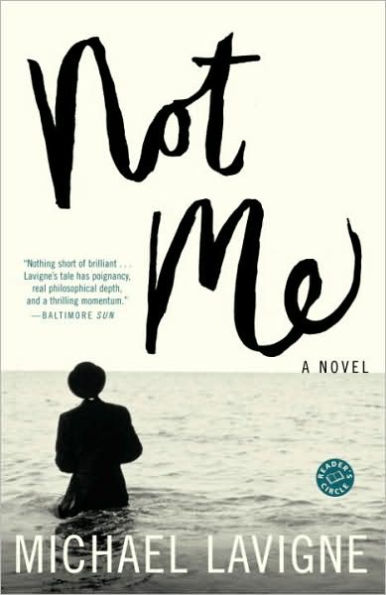
Not Me
By Michael Lavigne Random House
Michael Lavigne
All right reserved. ISBN: 0812973321
Chapter One
Chapter 1
The last person in the world I wanted to know about was my father. I did not want to know if he had lovers. I did not want to know if he took diuretics. I certainly did not want to know if he liked to masturbate, or if, even occasionally, he fantasized about teenage boys. It was of absolutely no interest to me if he cheated at bridge, or if his secret ambition was to become a ballet dancer, or if he had an obsession with women's shoes, or if he washed his body with lemon, or if he hit my mother (especially, God forbid, if she liked it). So when I was presented with twenty-four volumes of journals, each bound with a rubber band so old it was as brittle as the leather cover it held together, and was told, "These are your father's, take them," I was less than enthusiastic. Especially since it was my father who gave them to me.
"These are your father's," he said, "take them."
"Dad," I said, "you are my father."
He looked at me quizzically. His eyes were like aspic. Cloudy. Beneath which something obscure, unappetizing.
"Where's Karen?" he asked.
"Karen is dead," I reminded him.
"That's not true," he said. "She was just here. I was speaking to her. Take these."
With his feet, he pushed the box of journals toward my chair.
"All right," I said, "I'll take them. But I won'tread them."
Then he turned away, and looked out the window.
"I'm waiting for Frau Hellman," he said.
"Okay, Dad," I said. I had no idea who Frau Hellman was. Maybe someone from his childhood, or maybe his name for the lady who washed him.
After a little while I realized he had forgotten I was in the room. The space between us seemed to grow as if I were standing on a dock, and he were sailing away on the Queen Mary. I say the Queen Mary because he once actually did sail away on her, and I really was left behind, waving. Still, it was unthinkable that I would have a troubled relationship with my father. If I was not the perfect son, he was certainly the perfect father.
I reminded myself of that as I sat there looking at him drooling, his head lolling back like a toddler's asleep in his car seat.
"He's doing just great, isn't he?" the station nurse said. "We just love him!"
I held out the box to her. "Where did he get these? They weren't in his room before."
"I don't know. I think someone brought them."
"Who brought them?"
"He has so many visitors."
"He does?"
"You know how popular he is!"
Actually, I didn't know he knew anybody. I thought everybody he knew was dead. I thanked Nurse Clara--her name was emblazoned on her ample, nurturing breast--and walked out into the brutal Florida heat. The car was only a few steps away, but I might as well have been crossing the Amazon River. By the time I got there, my shirt was soaked and my legs were sticking together. I turned on the air-conditioning in the Caddy, but had to wait outside for the temperature to drop--the car was an oven. In my arms was the box of journals. They weighed me down painfully. Finally I sank into the plush leather seat and let the frigid jets cool my face, my underarms. I tugged my shirt away from my body to let the air caress my stomach with its icy fingers. I sighed in relief. I put the shift in reverse, and pulled out of the spot. It's amazing how long a Caddy will last, particularly if you never drive it. Dad bought his in '78. I looked down at the odometer. It had twenty-two thousand miles on it. And I had to admit it was comfortable, bobbing down the road on those marshmallow shocks, riding on tires of Jell-O. Like the kiddy-car rides he used to take me on before I graduated to the bumper cars and roller coasters. I recalled how I used to be embarrassed being seen in it, especially when my dad drove twenty miles an hour in a forty-mile zone. But not anymore. His Caddy was now the coolest thing going, only he would never know it. As far as he was concerned we still had the 1952 Studebaker. If he kept regressing on schedule, in another couple of weeks he'd be curled up with a bottle in the back of his father's '23 Daimler.
I pulled out of the parking lot and turned onto Military Trail. All the roads in West Palm Beach County look the same. Six lanes. No curves. Fast food. And every few feet the entrance to some development. The Lakes. The Bonaventure. The Greens. Everything had a The in it. They liked the word The. They also liked the word at. The Villages at The Palms. The Fairways at The Willows. I turned left at The Turn at Lake Worth Avenue.
The box of journals was sitting there beside me, sort of the way Mom used to sit next to Dad, waiting for an accident to happen. But unlike her, they smelled bad--musty and moldy, decayed. Well, maybe she smelled that way now, too, I thought. But I shook that away. I didn't know why my mind let such thoughts sneak in. I hated when that happened. But it was just part of being a comic. You always think funny. For instance, the box they were in--I noticed it was a Cheez Whiz box. This made me laugh. This is what Father chose to contain his life's writings? I also noticed the logo was different than it is now. So it was a really old box. He'd been working at this a long, long time. Saving this stuff up, just for this moment. His patrimony. Since he had no money, maybe he thought I could get it published or something. Why would he think that? He ran a wallpaper store all his life. Who would want to read about that?
I was jolted suddenly, by someone honking the horn. I looked up and the guy passed me, making a fist. I glanced down at the speedometer. I was doing twenty in a forty-mile zone. For some reason this did not strike me as funny--and I stepped on the gas.
I pulled up to his building at The Ponds at Lakeshore and turned off the engine. There were only American cars in the lot, primarily Cadillacs and Buicks, and most of them had American flags on them. A gaggle of women were standing near the entrance. They were all small. How did they get so small? I wondered. They had to be less small once upon a time. Will Ella be that small one day? She's five-eight now--could she end up four-ten? I stepped out of the car, thinking I would just leave the journals in the front seat for a while, but I knew I couldn't. I would have to take them upstairs. But I thought: Wait. How come they weren't in the apartment in the first place? I didn't remember ever seeing them there. I didn't remember him ever speaking about them. I didn't remember him ever working on them, for that matter. Why would they suddenly appear at the nursing home? Why wouldn't he just say, there are journals in the closet at home--I want you to read them?
The box suddenly looked even more dangerous to me. Poisonous. Like a scorpion that had crawled into my sleeping bag. I went around the other side and picked it up. It had to have been stored in a basement or attic--it had that smell to it, like damp earth. I thought: shouldn't I remember something about this? How could he have written twenty-four volumes without my ever having noticed? Maybe they were someone else's journals. Maybe he only thought they were his. That was possible. Totally possible. Sometimes he thought I was some cousin or someone named Israel--so why not?
I walked past the little ladies, and they all said hello. I said hello back and got into the elevator. I heard someone say, that was Gladys's son. No, someone else said, that's Rose's.
They never mentioned the men. The men had no children. Only the women. And anyway, my mother's name was Lily.
The elevator smelled like an indoor swimming pool. It crawled slowly up the side of the building like a dying man clawing his way out of a hole. It was only four floors, but in San Francisco I'd already be at the top of the Transamerica Pyramid. At least it was air-conditioned. But then the door opened onto the hall--which was no hall, it was actually a kind of gangway stuck on the outside of the building like an exposed rib--and the heat hit me again. I could feel rivers of moisture forming on my arms where the box rubbed against them. As always, it was a struggle to open the door. Finally, though, I stepped inside, shut the heat behind me, and put the box down on the dining room table. I went to the refrigerator and made myself a seltzer.
Then I picked up the phone to call Ella, but then I didn't.
You call because you want to connect, but you don't connect, you can never connect, you can't wait to hang up, you hang up, you feel utterly alone--like you're stuck in the bottom of a swimming pool and can't hear anything except your own breathing. The thing is, you see, it's the words. It's just like a stand-up routine, or a sermon maybe. You work hard on the words, and you think the words say it, but actually it's the delivery, and the delivery is in your body, your eyes, the fact that someone is right there in front of you and even if you can't see them as individuals, it's that you smell them, you sense their bodies there, it's physical, it's visceral.
But then why do comedy albums work? And radio? Not to mention things that are written, like, say, the Talmud? My theory was hopeless, and I knew it.
Anyway what would I say to her?
She was oddly vexed that I'd come out here again. "If you'd pay as much attention to your son as you do your father . . ." she said when I first told her, but then she just let herself drift into silence. "By the time I get there he might not even recognize me," I'd tried to explain. But I doubted she heard me, since she'd already hung up.
I supposed I could tell her about the box. I could ask her if she remembered anyone named Frau Hellman. Then I could ask her what she thought I ought to do.
"I don't know," she would say. "I'm not sure." She didn't like to make decisions for me. At least not since the divorce.
If I told her I didn't think I wanted to read them, she would say, "That's fine." If I said I was going to read them, she'd say, "That's fine too."
Really, when you think about it, you don't have to have actual conversations with people you know well.
Also if I called, what if Josh answered? I couldn't face him just then. I wasn't sure why. And why was my own father suddenly so desperate to talk to me--now when he didn't even know what year it was. I looked over at the Cheez Whiz box. All its little advertising slogans seemed more like curses and portents than inducements to slather some spread on a cracker.
I finished my seltzer, marveling at the tenacity of that generation of Jews to hold on to its old habits. How many places in the world could you still get seltzer delivered to your door?
I fixed myself a little sandwich and sat down at the dining room table. On the wall directly above my head was a tapestry of the Old City of Jerusalem--bright, tacky colors, somewhat abstract, and obviously made in Israel. In the living room just beyond, the walls seemed festooned with Judaica--fiddlers on roofs, flying goats, old, bearded men wrapped in prayer shawls, framed calligraphic paper cutouts of Hebrew letters. On the bookshelves were innumerable tchotchkes--cloisonne ashtrays in the shape of menorahs, ritual spice boxes, candlesticks, commemorative Israeli coins set off in black velvet, a sterling silver-covered Passover Haggadah (also made in Israel), and on the top shelf, standing like the guardian of all that is Jewish, the Hanukkah menorah--which in fact was surrounded by four lesser menorahs, all of which were given to my father in honor of some achievement for the Temple Men's Club, or the B'nai B'rith, or AIPAC. There were photos stuck among the books, too--of Mom on the Hadassah Executive, the Sisterhood, and the ladies from ORT. Of Dad shaking hands with Elie Wiesel. Of Dad shaking hands with Natan Sharansky. Of Dad shaking hands with Golda Meir. (That was his favorite--it hung on the wall in a big frame, right between my sixth-grade school portrait and Karen, two months old, naked on a blanket.)
I think it got worse once they moved down to Florida. In New Jersey it was more prints of famous paintings--Rembrandt, van Gogh, Picasso. The books on the shelves didn't seem so relentlessly Hebraic. A Stephen King novel or two. Valley of the Dolls. And all the things we kids brought home that had to be displayed: drawings, ceramics, term papers, birthday cards. But even then, the Jewish paraphernalia seemed to swallow up everything like kudzu, and by the time I left for college, my parents' house could have been mistaken for the temple gift shop. It was funny, really. I used it as material for one of my best routines.
But now as I sat there regarding the Cheez Whiz box of leather-bound diaries, and hearing somewhere not too far away the laconic song of a bull alligator emerging from the canal that cut through the eighth fairway of The Ponds at Lakeshore golf course, and picking up the aroma from next door, or perhaps from the floor below, of brisket simmering in the Dutch oven, and noting as well that Mrs. Eagleberg, several doors down, had reached that point in the day when she spoke to her daughter in Chicago as if there were no telephone line connecting them, so loudly did she elucidate the machinations of her bowels and the tribulations of her swollen ankles--all these things filled me with a terrible longing.
From the Hardcover edition.
Excerpted from Not Me by Michael Lavigne Excerpted by permission.
All rights reserved. No part of this excerpt may be reproduced or reprinted without permission in writing from the publisher.
Excerpts are provided by Dial-A-Book Inc. solely for the personal use of visitors to this web site.