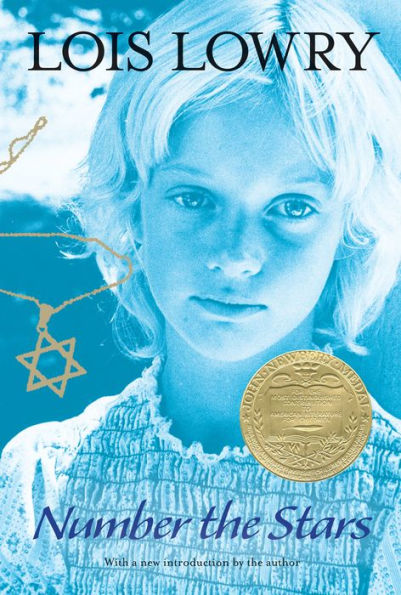
Number the Stars [NOOK Book]

NOOK Book (eBook)
$5.59
BN.com price
$6.99 List Price (Save 20%)

Available on NOOK devices and apps

  • Nook Devices
  • NOOK
  • NOOK Color
  • NOOK Tablet
  • Tablet/Phone
  • NOOK for iPad
  • NOOK for iPhone
  • NOOK for Android
  • NOOK for Android (Tablet)
  • NOOK Kids for iPad
  • PC/Mac
  • NOOK Study
  • NOOK for PC
  • NOOK for Mac

Need a NOOK? Explore Now

Overview

This Newbery Medal Book describes how a ten-year-old Danish girl's bravery is tested when her best friend is threatened by Nazis in 1943.

In 1943, during the German occupation of Denmark, ten-year-old Annemarie learns how to be brave and courageous when she helps shelter her Jewish friend from the Nazis.

... See more details below

All Available Formats + Editions

Marketplace From
BN.com
 

Overview

This Newbery Medal Book describes how a ten-year-old Danish girl's bravery is tested when her best friend is threatened by Nazis in 1943.

In 1943, during the German occupation of Denmark, ten-year-old Annemarie learns how to be brave and courageous when she helps shelter her Jewish friend from the Nazis.

Editorial Reviews

Publishers Weekly
Set in Nazi-occupied Denmark in 1943, this 1990 Newbery winner tells of a 10-year-old girl who undertakes a dangerous mission to save her best friend. Ages 10-14. (Sept.)
From The Critics
"The whole work is seamless, compelling, and memorable -- impossible to put down; difficult to forget."

Product Details

  • ISBN-13: 9780547345444
  • Publisher: Houghton Mifflin Harcourt
  • Publication date: 4/24/1989
  • Sold by: Barnes & Noble
  • Format: eBook
  • Pages: 144
  • Sales rank: 1,471
  • Age range: 9 - 11 Years
  • File size: 158 KB
  • Items ship to U.S, APO/FPO and U.S. Protectorate addresses.

Meet the Author

Lois Lowry
Lois Lowry

Ron Rifkin has appeared in the films Wolf and JFK, starred on Broadway in Arthur Miller's Broken Glass and has played recurring roles on television in the series The Trials of Rosie O'Neill and the award-winning drama series ER.

Read an Excerpt


“I’ll race you to the corner, Ellen!” Annemarie adjusted the thick leather pack on her back so that her school books balanced evenly. “Ready?” She looked at her best friend.
Ellen made a face. “No,” she said, laughing. “You know I can’t beat you-my legs aren’t as long. Can’t we just walk, like civilized people?” She was a stocky ten year-old, unlike lanky Annemarie.
“We have to practice for the athletic meet on Friday- I know I’m going to win the girls’ race this week. I was second last week, but I’ve been practicing every day. Come on, Ellen,” Annmarie pleaded, eyeing the distance to the next corner of the Copenhagen street. “Please?”
Ellen hesitated, then nodded and shifted her own rucksack of books against her shoulders. “Oh, all right. Ready,” she said.
“Go!” shouted Annemarie, and the two girls were off, racing along the residential sidewalk. Annemarie’s silvery blond hair flew behind her, and Ellen’s dark pigtails bounced against her shoulders.
“Wait for me!” wailed little Kirsti, left behind, but the two older girls weren’t listening.
Annemarie outdistanced her friend quickly, even though one of her shoes came untied as she sped along the street called osterbrograde, past the small shops and cafés of her neighborhood here in northeast Copenhagen. Laughing, she skirted an elderly lady in black who carried a shopping bag made of string. A young woman pushing a baby in a carriage moved aside to make way. The corner was just ahead.
Annemarie looked up, panting, just as she reached the corner. Her laughter stopped. Her heart seemed to skip a beat.
“Halte!” the solider ordered in a stern voice. The German word was familiar as it was frightening. Annemarie had heard it often enough before, but it had never been directed at her until now.
Behind her, Ellen also slowed and stopped. Far back, Kirsti was plodding along, her face in a pout cause the girls hadn’t waited for her.
Annemarie stared up. There was two of them. That meant two helmets, two sets of cold eyes glaring at her, and four shiny boots planted firmly on the sidewalk, blocking her path home.
And it meant two rifles, gripped in the hands of the soldiers. She stared at the rifles first. Then, finally, she looked into the face of the soldier who had ordered her to halt.
“Why are you running?” the harsh voice asked. His Danish was very poor. Three years, Annemarie thought with contempt. Three years they’ve been in our country, and still they can’t speak our language.
“I was racing my friend,” she answered politely. “We have races at school every Friday, and I want to do well, so I —“ Her voice trailed away, the sentence unfinished. Don’t talk so much, she told herself. Just answer them, that’s all.
She glanced back. Ellen was motionless on the sidewalk, a few yards behind her. Farther back, Kirsti was still sulking, and walking slowly toward the corner. Nearby, a woman had come to the doorway of a shop and was standing silently, watching.
One of the soldiers, the taller one, moved toward her. Annemarie recognized him as the one she and Ellen always called, in whispers, “the Giraffe” because of his height and the long neck that extended from his stiff collar. He and his partner were always on this corner.
He prodded the corner of her backpack with the stock of his rifle. Annemarie trembled. “What is in here?” he asked loudly. From the corner of her eye, she saw the shopkeeper move quietly back into the shadows of the doorway, out of sight.
“Schoolbooks,” she answered truthfully.
“Are you a good student?” the soldier asked. He seemed to be sneering.
“Yes.”
“What is your name?”
“Annemarie Johanson.”
“Your friend is she a good student, too?” He was looking beyond her, at Ellen, who hadn’t moved.
Annemarie looked back, too, and saw that Ellen’s face, usually rosy-cheecked, was pale, and her dark eyes were wide.
She nodded at the soldier. “Better than me,” she said.
“What is her name?”
“Ellen.”
“And who is this?” he asked, looking to Annemarie’s side. Kirsti had appeared there suddenly, scowling at everyone.
“My little sister.” She reached down for Kirsti’s hand, but Kirsti, always stubborn, refused it and put her hands on her hips defiantly.
The soldier reached down and stroked her little sister’s short, tangled curls. Stand still, Kirsti, Annemarie ordered silently, praying that somehow the obstinate five-year-old would receive the message.
But Kirsti reached up and pushed the soldier’s hand away. “Don’t,” she said loudly.
Both soldiers began to laugh. They spoke to each other in rapid German that Annemarie couldn’t understand.
“She is pretty, like my own little girl,” the tall one said in a more pleasant voice.
Annemarie tried to smile politely.
“Go home, all of you. Go study your schoolbooks. And don’t run. You look like hoodlums when you run.”
The two soldiers turned away. Quickly Annemarie reached down again and grabbed her sister’s hand before Kirsti could resist. Hurrying the little girl along, she rounded the corner. In a moment Ellen was beside her. They walked quickly not speaking with Kirsti between them, toward the large apartment building where both families lived.
When they were almost home, Ellen whispered suddenly, “I was so scared.”
“Me too,” Annemarie whispered back.
As they turned to enter their building, both girls looked straight ahead, toward the door. They did it purposely so that they would not catch the eyes or the attention of two more soldiers, who stood with their guns on this corner as well. Kirsti scurried ahead of them through the door, chattering about the picture she was bringing home from kindergarten to show Mama. For Kirsti, the soldiers were simply part of the landscape, something that had always been there, on every corner, as unimportant as lampposts, throughout her remembered life.
“Are you going to tell your mother?” Ellen asked Annemarie as they trudged together up the stairs. “I’m not. My mother would be upset.”
“No, I won’t, tell either. Mama would probably scold me for running on the street.”
She said goodbye to Ellen on the second floor, where Ellen lived, and continued to the third, practicing in her mind a cheerful greeting for her mother; a smile, a description of today’s spelling test, in which she had done well.
But she was too late. Kirsti had gotten there first. “and he poked Annemarie’s book bag with his gun, and then he grabbed my hair!” Kirsti was chattering as she took off her sweater in the center of the apartment living room. “But I wasn’t scared. Annemarie was, and Ellen, too. But not me!”
Mrs. Johansen rose quickly from the chair by the window where she’d been sitting. Mrs. Rosen, Ellen’s mother, was there, too, in the opposite chair. They’d been having coffee together, as they did many afternoons. O f course it wasn’t really coffee, though the mothers still called it that; “having coffee.” There had been no real coffee in Copenhagen since the beginning of the Nazi occupation. Not even any real tea. The mothers sipped at hot water flavored with herbs.
“Annemarie, what happened? What is Kirsti talking about?” her mother asked anxiously.
“Where’s Ellen?” Mrs. Rosen had a frightened look.
“Ellen’s in your apartment. She didn’t realize you were here,” Annemarie explained. “Don’t worry. It wasn’t anything. It was the two soldiers who stand on Osterbrogade–you’ve seen them; you know the tall one with the long neck, the one who looks like a silly giraffe?” She told her mother and Mrs. Rosen of the incident, trying to make it sound humorous and unimportant. But their uneasy looks didn’t change.
“ I slapped his hand and shouted at him,” Kirsti announced importantly.
“No, she didn’t, Mama,” Annemarie reassured her mother. “She’s exaggerating, as she always does.”
Mrs. Johansen moved to the window and looked down to the street below. The Copenhagen neighborhood was quiet; it looked the same as always: people coming and going from the shops, children at play, the soldiers on the corner.
She spoke in a low voice to Ellen’s mother. “They must be edgy because of the latest Resistance incidents. Did you read in De Frie Danske about the bombings in Hillerod and Norrebro?”
Although she pretended to be absorbed in unpacking her schoolbooks, Annemarie listened, and she knew what her mother was referring to. De Frie Danske–The Free Danes__ was an illegal newspaper; Peter Neilson brought it to them occasionally, carefully folded and hidden among ordinary books and papers, and Mama always burned it after she and Papa had read it. But Annemarie heard mama and Papa talk, sometimes at night, about the news they received that way: news of sabotage against the Nazis, bombs hidden and exploded in the factories that produced war materials, and industrial railroad lines damaged so that goods couldn’t be transported.
And she knew what Resistance meant. Papa had explained, when she overheard the word and asked. The Resistance fighters where Danish people–no one knew who, because they were very secret–who were determined to bring harm to the Nazis however they could. They damaged the German trucks and cars, and bombed their factories. They were very brave. Sometimes they were caught and killed.
“I must go and speak to Ellen.” Mrs. Rosen said, moving toward the door. “you girls walk a different way to school. Promise me, Annemarie. And Ellen will promise, too.”
“We will, Mrs. Rosen. But what does it matter? There are German soldiers on every corner.”
“They will remember your faces,” Mrs. Rosen said, turning in the doorway to the hall. “It is important to be one of the crowd, always. Be one of many. Be sure that they never have reason to remember your face.” She diappeared into the hall and closed the door behind her.
“He’ll remember my face, Mama,” Kirsti announced happily, “because he said I look like his little girl. He said I was pretty.”
“If he has such a pretty little, why doesn’t he go back to her like a good father?” Mrs. Johansen murmured, stroking Kirsti’s cheek. “Why doesn’t he go back to his own country?”
“Mama, is there anything to eat?” Annemarie asked, hoping to take her mother’s mind away from the soldiers.
“Take some bread. And give a piece to your sister.”
“With butter?” Kirsti asked hopefully.
“No butter,” her mother replied. “You know that.”
Kirsti sighed as Annemarie went to the breadbox in the kitchen. “I wish I could have a cupcake,” she said. “A big yellow cupcake, with pink frosting.”
Her mother laughed. “For a little girl, you have a long memory,” she told Kirsti. “There hasn’t been any butter, or sugar for cupcakes, for a long time. A year, at least.”
“When will there be cupcakes again?”
“When the war ends,” Mrs. Johansen said. She glanced through the window, down the street corner where the soldiers stood, their faces impassive beneath the metal helmets. “When the soldiers leave.”

Customer Reviews
Average Rating 4.5
( 1041 )

Rating Distribution

If you've bought this product, tell the world how you liked it.
Write a Review
See All Sort by: Showing 1 – 20 of 1049 Customer Reviews
  • Anonymous

    Posted May 6, 2009

    Number the Stars

    I have recently read Number the Stars by Lois Lowry. At first I thought that it wouldn't be the book for me because I like real life and modern books. I was wrong because this book may not be modern but it is real life and at some points in the book it is a thriller and it keeps you on the edge of your seat.

    This book is about a ten year old girl named Annemarie Johansen and her friend Ellen Rosen. It is 1943 and they live in Copenhagen, Denmark. The Nazi's have come and have applied food shortages and soldiers on every street corner. At one point in the book I felt as if the Nazis would never leave. Then the Nazi's began "relocating" the Jews and would go to Jewish churches to get all the names of the Jews so the could capture them. That's when the Rosens runaway from there home and Ellen moves in to Annemarie's house while they figure out what to do so that the Nazi soldiers will not find the Rosens. That is how Annemarie gets involved in scary encounters and tries to save her best friends life. So now you can see why I thought this was a thriller. Personally I would suggest this to 5-8 graders because it is pretty easy to read and doesn't have many big words but some to keep the story from getting old. So really think about reading this book! You wouldn't regret it!

    14 out of 15 people found this review helpful.

    Was this review helpful? Yes  No   Report this review
  • Posted August 18, 2011

    I Also Recommend:

    Loved it

    Very good read- you will not forget this one

    10 out of 11 people found this review helpful.

    Was this review helpful? Yes  No   Report this review
  • Anonymous

    Posted January 3, 2012

    I like yogurt

    Thii,s story is to die for! Discriptive,lot of climax, and shows the true meanig of friendship.

    5 out of 6 people found this review helpful.

    Was this review helpful? Yes  No   Report this review
  • Anonymous

    Posted December 26, 2011

    :)

    I read this book in school, i recommend it to anybody!

    4 out of 4 people found this review helpful.

    Was this review helpful? Yes  No   Report this review
  • Posted July 17, 2009

    wow

    i loved the book number the stars because it captures you!!! i didn't want to read it at first but after the first page i was hooked!!! (the reason i didn't want to read it was because it looked like a depressing book)!!! but i really enjoyed it!!!

    4 out of 5 people found this review helpful.

    Was this review helpful? Yes  No   Report this review
  • Anonymous

    Posted May 16, 2009

    Great introduction to the period of WWII for the future history buff.

    My 8 year old grandson wanted to read about WWII and the holocaust but I felt that he was too young to read about the full horror of the time. This seems to have been a wonderful compromise. He was totally absorbed in this and will read further later.

    4 out of 4 people found this review helpful.

    Was this review helpful? Yes  No   Report this review
  • Posted January 22, 2009

    Number the Stars by Coby Percy

    I recently read the book Number the Stars by Louis Lowlry and I thought it was a great book. The setting takes place in Copenhagen, Denmark in 1943 during World War II. This story is about a young girl named Annemarie who, with the help of her family, is trying to save her best friend Ellen and Ellen's family, who are Jews from being discovered by the Nazis. My favorite part of the book is when Ellen and AnneMarie are looking out over the bay and they say that's Swedan over there. The fact that they talk about Swedan shows me that they are hopeful, curious, and anxious.
    Anyone who is interested in the Holocaust or the lives of Jewish families and their friends should read this book. I think this is a book I will always remember. I would recommend this book to anyone and everyone who is looking for a good read.

    3 out of 4 people found this review helpful.

    Was this review helpful? Yes  No   Report this review
  • Anonymous

    Posted January 20, 2012

    Very good

    My fifth grade class started to read this and I thought it would be a horrible book!I was so wrong!!!! I was one of the best books I have ever read!!!!!!!!! I think everyone should read this !!!! :D

    2 out of 2 people found this review helpful.

    Was this review helpful? Yes  No   Report this review
  • Anonymous

    Posted January 22, 2012

    Amazing

    Impossible to put down, difficult to forget.

    2 out of 2 people found this review helpful.

    Was this review helpful? Yes  No   Report this review
  • Anonymous

    Posted December 31, 2011

    Awesome

    Very compelling, once you start you cant stop

    2 out of 2 people found this review helpful.

    Was this review helpful? Yes  No   Report this review
  • Anonymous

    Posted December 31, 2011

    Amazing

    It is soooooo amazing you should tottaly read it or you'll be missing out:)

    2 out of 2 people found this review helpful.

    Was this review helpful? Yes  No   Report this review
  • Anonymous

    Posted December 25, 2011

    Eeeeeeeiiiiiiiiuiuuuaaaaaaaaa!!!!!!! Great book!

    I could read this book five times in a row without getting board of it. My favorite tipe of story is books with brave people and i love the hollocast.this book is both of those put together! I love how annemarie stands up for ellen.my favorite charicter is kristie. She reminds me of my sister when she was little.it was sad they drugged the police dogs because i like dogs but they were bad dogs anyway . Eeeeeiiiiuuuuaaaa!!!#1!

    2 out of 2 people found this review helpful.

    Was this review helpful? Yes  No   Report this review
  • Anonymous

    Posted February 8, 2012

    Anonymus

    Awesome book !!!!!

    1 out of 1 people found this review helpful.

    Was this review helpful? Yes  No   Report this review
  • Anonymous

    Posted February 8, 2012

    Awsome!!!!!!!

    I just read it and it was awsome and good!!!!!!!!

    1 out of 1 people found this review helpful.

    Was this review helpful? Yes  No   Report this review
  • Anonymous

    Posted December 26, 2011

    I read this in school.....

    I got bored this is not my book srry

    1 out of 5 people found this review helpful.

    Was this review helpful? Yes  No   Report this review
  • Posted September 1, 2011

    a MUST READ BOOK!

    I read this book for a class in school, and i really enjoyed it. I highly reccommend this book for people who are interested in World War II and The Holocaust. There are moment of suspense, sadness, and even fear. Not being able to know what happens next keeps you excited to just keep reading and reading.

    1 out of 1 people found this review helpful.

    Was this review helpful? Yes  No   Report this review
  • Posted June 18, 2011

    Awful

    An extremely boring and pointless outlook on the holocaust. And the entire book seems too stretched out; it probably could've just been shortened into one chapter. Then, the author could've continued his book after that chapter, but instead he didn't do any of this, and he wrote a horrifyingly boring book.

    1 out of 5 people found this review helpful.

    Was this review helpful? Yes  No   Report this review
  • Anonymous

    Posted November 11, 2009

    I Also Recommend:

    Very well written

    I enjoyed this book greatly, as i do most of Lois Lowry. this book was based on true events and felt real as you were reading. most books are a little slow starting out. as was this one but it got to the action with just a couple chapters. overall it was a small book but i think that made it all the more enjoyable to read.

    1 out of 1 people found this review helpful.

    Was this review helpful? Yes  No   Report this review
  • Anonymous

    Posted November 5, 2009

    very intersting

    Lois Lowry's Number the Stars
    Lois Lowry's Number The Stars is a Historical fiction book about the Jews and Germans. In Copenhagen Denmark in 1943. Lois Lowry wrote the book because she wants to tell the world that the Danish families risk their lives for the Jews. They hide Jews and they smuggled them out of the country. They got involved with this issue because they were good neighbors and their neighbors were Jews.
    This book tells the story the story about one family that helped a Jewish family that was in trouble. The dans risked their life just to help the families. I learned that the Danish families accomplished the trip of families to their destination. The book was interesting and suspenseful. A car pulled outside the car doors slammed everyone was tense no one spoke. The soldiers were pounding on the door, and then the heavy frighteningly familiar staccato of the boots on the kitchen floor.
    The women with the baby began to weep. The male voice from the kitchen was loud. The soldier said we have observed "he said, that an unusual number of people gathered at the house tonight. The Danish said there has been a death. That is our custom to gather and pay our respect. I am sure you are familiar with our customs. The officer pushed one of her ahead of him and entered the living room.
    The officer looked for a long time at the casket. When his eyes reached her she looked back at him steadily. The officer asked who died he asked harshly. The girl answered "my great aunt Birte" she lied in a firm voice. The officer moved forward suddenly, across the room to the casket. He placed one gloved hand on its lid. Poor great aunt Birte" he said in a condescending voice. I know it is the custom to pay one's respect by looking your loved one on the face. It seems odd to me that you have it closed this coffin up so tightly." I was stuck to this book because it had me wanting more about what was going to happen next. The author did a good job. Explaining the story.

    1 out of 1 people found this review helpful.

    Was this review helpful? Yes  No   Report this review
  • Posted August 10, 2009

    more from this reviewer

    This book is very interesting.

    When I started reading Number the Stars I couldn't stop until I knew what was going to happen next. It is a historical fiction and for people who like historical fictions I think that you would like this book. I didn't really know about the Nazi invasion in 1943 but this book gave me alot of information about what happened. I thought the story was well written.

    1 out of 1 people found this review helpful.

    Was this review helpful? Yes  No   Report this review
See All Sort by: Showing 1 – 20 of 1049 Customer Reviews

If you find inappropriate content, please report it to Barnes & Noble
Why is this product inappropriate?
Comments (optional)
500 character limit