Read an Excerpt
Introduction
This is a book for beer leaguers. For every kid who ever laced up their skates. It’s for everyone who had to pick up a net and move it when somebody else yelled, “Car!”
This is a book for everyone who ever dreamed of making it — but didn’t — and for everyone who ever dreamed of hitting the NHL ice for just one night or just one shift.
Like countless other Canadian kids, I dreamed of one day playing in the NHL. Those dreams quickly disappeared, when at the age of eight, I was assigned to a Novice 2 team instead of the uber-talented Novice 1 squad (at least I thought they were uber-talented). It was around that time that I decided to find a way to still be a part of the hockey world even though I wasn’t good enough to play in it. Luckily for me, I found my way into sports broadcasting.
But that idea of strapping on the blades at the game’s highest level has never really left my imagination. As a kid, you dream of scoring the winning goal in Game 7 of the Stanley Cup Final, but as you grow older reality begins to set in. Not everyone will get to do that. And then maybe you settle on just making it to the NHL for a few years. But not everyone can do that either.
I’m sure there were many others who, like me, settled on this thought: “I’d give anything to play just one game in the NHL.”
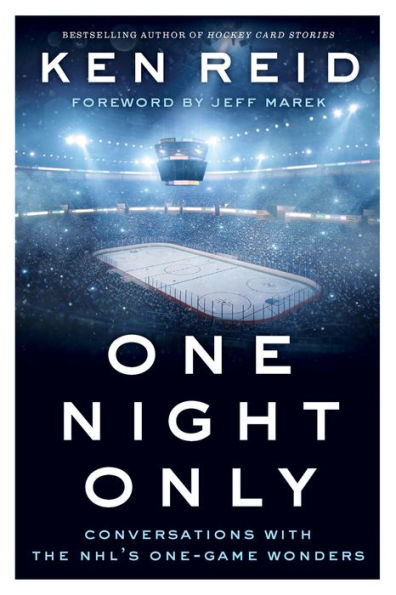
In fact, about 350 men, give or take, managed to do just that — play in a single NHL game, not one game more. One Night Only comprises the stories of men who made it all the way to the best league in the world — if only for the briefest hockey moment.
So, was their one game a dream come true? Or did they feel more like Cinderella, their dreams cruelly snatched away? Were they bitter? Or were they simply satisfied to have defied the odds by making it to the sport’s pinnacle?
Back in my minor-hockey days, a hockey school would visit my hometown in Nova Scotia at the start of each season. It was called Coach International. Every year, we were told an NHLer who had some Nova Scotian roots, Trevor Fahey, ran the school. I don’t remember ever seeing Mr. Fahey, but I’m sure he was there — he just didn’t stand out among the other instructors decked out in their maroon Coach International track suits. It wasn’t like it is now; after a session with the guys from Coach International, we couldn’t just head home and google the names of our instructors. I knew Bobby Heighton played for the Pictou Jr. C Mariners — but Trevor Fahey always remained a bit of a mystery. Many years later I learned that Trevor Fahey played in one contest for the New York Rangers in 1964–65. It was his only NHL game. He went on to play university hockey (imagine that, suiting up in university after making it all the way to the NHL) and was one of the first Canadians to head over to Russia to study how that country produced such great hockey players.
Fast forward to just a couple of years ago. I was up late one night, racking my brain for ideas. Hockey Card Stories was in stores and I was rummaging through my past, looking for something else to write about. I had been debating between writing another hockey-card book (I’m going to, for those who have been asking) or taking a different path. I was thinking of some of the guys from my neck of the woods who had made it to the NHL, when I thought of Trevor Fahey again. Suddenly I wanted to know more about him.
What was it like to make it all the way to the NHL for one game? A dream come true? Or was it heartbreaking? Could he even remember the actual game? Does it in any way define him all these years later? A quick online search showed me exactly how many men had played just a single game. I figured I was on to something.
A few days later in our wardrobe room at Sportsnet, Jeff Marek asked me about my next book idea and I told him. He said he’d had exactly the same idea. The original plan was for Marek and I to write this book together, but that didn’t happen. Jeff’s a busy guy. Luckily for me he did write the foreword. (Thanks, “Palm Isle.”) It was good to find out that, like Jeff, I’m not the only freak out there who’s not only obsessed with the superstars of the game but also the super stories of the game.
So I started making phone calls, tracking down the men who suited up in the world’s greatest hockey league for just a single night. Playing detective and finding out where these guys are now was a lot of fun, but the true thrill of putting together a book like this is getting to know the men who, if for only the briefest moment, fulfilled all of our childhood dreams.
But does a dream really come true when it only lasts for a few hours, or, in some cases, a few seconds? Let’s find out.
BOB RING: A Saving Grace
The Boston Bruins, Acadia University and the Vietnam War. Those three things are part of Bob Ring’s amazing hockey journey. His hockey story is unlike any I’ve ever heard. And it goes like this . . .
Bob Ring graduated from high school in Wakefield, Massachusetts, in 1964. Growing up, he used to watch the Bruins at the Boston Garden. Ring and his high school buddies would sit in some cheap seats right down by the ice, and on most nights, they’d watch the Bruins struggle. Then, in the summer of 1964, Bob Ring signed with the team as a goalie and became a part of the Bruins organization. His first assignment took him to the Ontario Hockey League to play junior with the Niagara Falls Flyers. They, along with the Oshawa Generals, were one of two Bruins-controlled teams.
Boston was retooling. Actually, that’s putting things lightly. The team hadn’t won a Stanley Cup since 1941 and had finished sixth in the six-team NHL four seasons in a row. When Ring joined the organization, their junior system was ripe with future NHL stars like Jean Pronovost, Derek Sanderson and Bernie Parent on the Niagara Falls Flyers and Bobby Orr and Wayne Cashman on the Oshawa Generals. Ring spent the 1964–65 season playing mostly Junior A and Junior B in the Niagara Falls area. The next year, he was with the big club. But while the rest of Ring’s teammates, all Canadians, were just going about their business, something else was hanging over Bob Ring’s head: the Vietnam draft. “I had a slightly different situation going, because we had the draft in the U.S. at that time. Vietnam was going on so you really had to be in the top of your class in college to have a student deferment. So that sort of sets the stage.”
In October 1965, Ring was in Niagara Falls when the team’s general manager, Hap Emms, called the young American into his office. “He said that they were sending me to Boston.” When Ring heard those words, he immediately thought the Flyers were sending him home and that his time with the team was over. No, when Emms said Boston, he meant the Bruins. A goalie was down with an injury, and Ring was on his way to the NHL. “So a year out of high school I was playing in the Garden, which was just a tremendous thrill.”
Ring headed for home with a plan to surprise his parents with the big news. Unfortunately, the Boston papers got word of the local-boy-makes-good story first, and the Wakefield kid’s arrival in his hometown was already making headlines by the time he returned. Apparently the news didn’t make its way to the Garden’s security though: when the youthful-looking Ring arrived for his first NHL practice, he had a little trouble getting into the building. “I went into the Garden through the main gate and I had my equipment with me. And the guard at the gate informed me that the high school practice was not until four o’clock and that the Bruins were practising. And of course, I’m trying to convince him that I’m going to practise with them.” Security was having none of it but, luckily for Ring, along came a familiar face. It was Bruins centre Ron Schock, who Ring was more than familiar with from his time in the organization. “[Ronnie] sort of brushed me aside and said, ‘Excuse me, kid, high school doesn’t start until four.’ He threw me under the bus,” laughs Ring. “But I finally managed to talk my way in.”
The Bruins’ plan was to go with their veteran goalie Eddie Johnston in the crease with Ring on the bench until Cheevers came back to play, but plans don’t always work out. On October 30, 1965, Johnston got the start against the New York Rangers. With the Bruins down, Ring got the word from Bruins head coach Milt Schmidt that he was going in. In those days, if you replaced a goaltender during the game the backup got a chance for a little warm-up. Ring loosened up. When the referee blew his whistle for the game to resume, Ring’s old buddy Ron Schock showed up again. “Shocker had three pucks about 15 feet out in front of the net, so he skates over and he shoots one into the lower corner and one into the upper corner and another to the other side. Boom, boom, boom and they’re in the net. He taps me on the pads and he says, ‘Good luck, rookie.’” A really nice guy, that Ron Schock.
As play resumed, Bob Ring found himself in a surreal world. He was on the ice at the Gardens playing for the Bruins. He was now the guy that just a couple of years ago he had paid to watch. “I can remember it was like an out-of-body experience. You’re looking out into the stands and you’re seeing your old high school buddies that you used to sit with the year before. They’re watching the game and you’re sort of saying, ‘This is weird.’”
It was Ring’s first NHL game and it was the first NHL game for the Rangers goalie as well. Future Hall of Famer Eddie Giacomin was at the other end of the ice. Before Ring knew it, another future member of the Hall came barrelling in on him. “Leo Boivin was a defenceman who used to throw some big hip checks in those days. The first goal that was scored on me was from Jean Ratelle. He came up the right wing and Boivin threw a hip check at him at the blue line and Ratelle sort of jumped over him, danced over him, skipped over him, and then came in on a breakaway and went to the upper-right-hand corner.”
Bob Ring ended up making nine saves on 13 Rangers shots that night in an 8–2 home loss for the Bruins. The next day Ring was back at the Garden and was getting ready to join the Bruins for his first NHL road trip. That’s when Bob Ring got his first official NHL lecture. And it was from an unlikely source. “I had packed my bag to get ready for the trip, and the trainer went berserk. Because it was his responsibility to make sure that all of the equipment arrived at the city. It was his job to pack the bags. But you know, as a kid you always pack your own bag. You had no idea that somebody was supposed to pack it for you. You didn’t