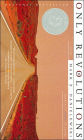
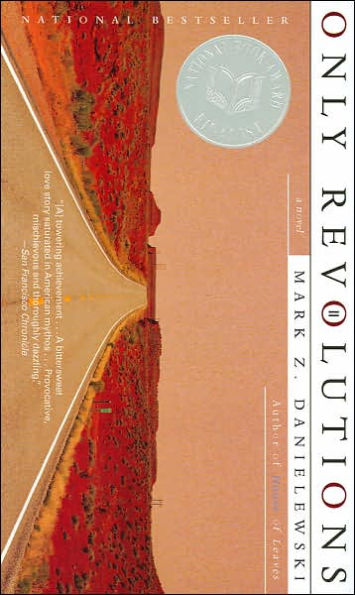
Only Revolutions

( 17 )

Overview

Sam:
They were with us before Romeo & Juliet. And long after too. Because they’re forever around. Or so both claim, carolling gleefully:

We’re allways sixteen.

Sam & Hailey, powered by an ever-rotating fleet of cars, from Model T to Lincoln Continental, career from the Civil War to the Cold War, barrelling down through the Appalachians, up the Mississippi River, ...

See more details below
Hardcover
$18.59
BN.com price
(Save 28%)$26.00 List Price
Other sellers (Hardcover)
  • All (78) from $1.99   
  • New (16) from $5.98   
  • Used (62) from $1.99   
Sending request ...

Overview

Sam:
They were with us before Romeo & Juliet. And long after too. Because they’re forever around. Or so both claim, carolling gleefully:

We’re allways sixteen.

Sam & Hailey, powered by an ever-rotating fleet of cars, from Model T to Lincoln Continental, career from the Civil War to the Cold War, barrelling down through the Appalachians, up the Mississippi River, across the Badlands, finally cutting a nation in half as they try to outrace History itself.

By turns beguiling and gripping, finally worldwrecking, Only Revolutions is unlike anything ever published before, a remarkable feat of heart and intellect, moving us with the journey of two kids, perpetually of summer, perpetually sixteen, who give up everything except each other.

Hailey:
They were with us before Tristan & Isolde. And long after too. Because they’re forever around. Or so both claim, gleefully carolling:

We’re allways sixteen.

Hailey & Sam, powered by an ever-rotating fleet of cars, from Shelby Mustang to Sumover Linx, careen from the Civil Rights Movement to the Iraq War, tearing down to New Orleans, up the Mississippi River, across Montana, finally cutting a nation in half as they try to outrace History itself.

By turns enticing and exhilarating, finally breathtaking, Only Revolutions is unlike anything ever conceived before, a remarkable feat of heart and intellect, moving us with the journey of two kids, perpetually of summer, perpetually sixteen, who give up everything except each other.

Read More Show Less

Editorial Reviews

Steven Moore
To appreciate a novel as meticulously crafted as this, it needs to be studied, its patterns and symbolism deciphered, its historical cross-references pondered. It's certainly one of the great road novels, joining that dusty convoy stretching from Petronius's Satyricon through Cervantes's Don Quixote to the late Gilbert Sorrentino's The Sky Changes. It's an exhilarating trip, a literary experience unlike anything else piled up in book stores. Only revolutions against the conventional novel like this one keep the genre truly novel.
— The Washington Post
Troy Patterson
The book — its plot is both a perpetual-motion machine and nonexistent — is baffling, quite possibly an elaborate folly that finds the author subordinating meaning to schema and human emotion to the presumed power of myth. But it’s clear that Danielewski has an entrancing way with overrich wordplay: “Sam admiring / how I tear through the current. / I am the current. And currently bare. / The currency of every dare.” And anyone can see that the “dream” at stake is America, a country that wouldn’t make complete sense if you thought on it till the end of time.
— The New York Times
Publishers Weekly
A pastiche of Joyce and Beckett, with heapings of Derrida's Glas and Thomas Pynchon's The Crying of Lot 49 thrown in for good measure, Danielewski's follow-up to House of Leaves is a similarly dizzying tour of the modernist and postmodernist heights and a similarly impressive tour de force. It comprises two monologues, one by Sam and one by Hailey, both "Allmighty sixteen and freeeeee," each narrating the same road trip, or set of neo-globo-revolutionary events or a revolution's end: "Everyone loves the Dream but I kill it." Figuring out what's happening is a big part of reading the book. The verse-riffs narrations, endlessly alliterative and punning (like Joyce) and playfully, bleakly existential (like Beckett), begin at opposite ends of the book, upside down from one another, with each page divided and shared. Each gets 180 words per page, but in type that gets smaller as they get closer to their ends (Glas was more haphazard), so they each gets exactly half a page only at the midway point of the book: page 180 or half of a revolution of 360 degrees. A time line of world events, from November 22, 1863 ("the abolition of slavery"), to January 19, 2063 (blank, like everything from January 18, 2006, on), runs down the side of every page. The page numbers, when riffled flip-book style, revolve. The book's design is a marvel, and as a feat of Pynchonesque puzzlebookdom, it's magnificent. The book's difficulty, though, carries a self-consciousness that Joyce & Co. decidedly lack, and the jury will be out on whether the tricks are of the for-art's-sake variety or more like a terrific video game. (Sept. 5) Copyright 2006 Reed Business Information.
Library Journal
Sam and Hailey are perpetual 16 year olds, madly in love and on the lam from 1863 to 2063 in a constantly changing array of conveyances, from a mule to Sumover Linx. Sam tells the first 100 years, while Hailey simultaneously relates the second in alternating chapters with exactly 180 words of story and a parallel 180 words of news and sports headlines per page. This is ironic, as the young couple seems entirely aware of each other and of little else in their almost endless pursuit of love and liberty. Doubly ironic, the author seems to have little to say about love and liberty, arguably two of the most important themes in American literature. Danielewski's House of Leaves was a diamond of a book with a great story and dozens of brilliantly burnished facets. Only Revolutions is every bit as polished, but the relative lack of depth makes it more like cubic zirconium-more style than substance. (This review is exactly 180 words, too. So what?) Still, a fascinating read; recommended for medium to large academic and public libraries.-Jim Dwyer, California State Univ. Lib., Chico Copyright 2006 Reed Business Information.
Kirkus Reviews
The daunting maze explored in Danielewski's Borgesian first novel, House of Leaves (2000), only hinted at the depths to be plumbed in its intimidatingly innovative successor. It's a love story, road novel and paean to untrammeled freedom, presented in dual free-verse narratives spoken by Sam and Hailey, two 16-year-old vagabonds who embark on a mythic and allegorical journey across America, in a succession of variously acquired automobiles, during an expanding time period that stretches from the American Civil War to the immediate present. Rebels and malcontents, they repeatedly indulge in Whitmanesque, Rabelaisian arias ("I'm The World which / The Mountain descends from and / I laugh because it tickles"), while proclaiming their allegiance to nothing but each other ("Liberty and Love are one"), and eluding or battling characters emblematic of entrenched interests, convention and complacency (e.g., "Mad Robber Barons," "Hoovercrats"). The publisher helpfully suggests reading eight pages of Sam's story, then flipping the volume upside-down and reversing it, for eight pages in Hailey's voice, until the two narratives meet in the middle of the book. Further complications arise from chronological enumerations of historical events on each page's margins and versified comments on every page presented, upside-down, at the bottom of said page. Self-indulgence? Surely. But there's a real story here, and a persuasive sense that the couple's wild ride is a kind of creation myth that mirrors, as it presumes to explain, America's unruly energies-as Sam and Hailey experience Hailey's brief dalliance with a macho avatar of military, militant power ("The Creep"), an Ongoing Party in New Orleans, afarcical hospital stay following an apparent overdose and an escape to the heartland and a climactic encounter with "the peril pursuing US." They're Bonnie and Clyde, Tristan and Isolde, an X-rated Archie and Veronica and perhaps All in the Family's embattled liberal couple Mike and Gloria. You have to work at it, but it's a trip well worth taking. First printing of 100,000
From the Publisher
KIRKUS REVIEWS
7/15/06
starred review

The daunting maze explored in Danielewski’s Borgesian first novel, House of Leaves (2000), only hinted at the depths to be plumbed in its intimidatingly innovative successor.
It’s a love story, road novel and paean to untrammeled freedom, presented in dual free-verse narratives spoken by Sam and Hailey, two 16-year-old vagabonds who embark on a mythic and allegorical journey across America, in a succession of variously acquired automobiles, during an expanding time period that stretches from the American Civil War to the immediate present. Rebels and malcontents, they repeatedly indulge in Whitmanesque, Rabelaisian arias (“I’m The World which / The Mountain descends from and / I laugh because it tickles”), while proclaiming their allegiance to nothing but each other (“Liberty and Love are one”), and eluding or battling characters emblematic of entrenched interests, convention and complacency (e.g., “Mad Robber Barons,” “Hoovercrats”). The publisher helpfully suggests reading eight pages of Sam’s story, then flipping the volume upside-down and reversing it, for eight pages in Hailey’s voice, until the two narratives meet in the middle of the book. Further complications arise from chronological enumerations of historical events on each page’s margins and versified comments on every page presented, upside-down, at the bottom of said page. Self-indulgence? Surely. But there’s a real story here, and a persuasive sense that the couple’s wild ride is a kind of creation myth that mirrors, as it presumes to explain, America’s unruly energies —- as Sam and Hailey experience Hailey’s brief dalliance with a macho avatar of military, militant power (“The Creep”), an Ongoing Party in New Orleans, a farcical hospital stay following an apparent overdose and an escape to the heartland and a climactic encounter with “the peril pursuing US.” They’re Bonnie and Clyde, Tristan and Isolde, an X-rated Archie and Veronica and perhaps All in the Family’s embattled liberal couple Mike and Gloria.
You have to work at it, but it’s a trip well worth taking.

“In his new novel, the author of House of Leaves is up to his old tricks–multicolored and upside-down text–and some flabbergasting new ones, including a double-ended structure that obliges the reader to flip the book every eight pages.”–The New Yorker

“Ambitious, meticulous, and original, Danielewski continues to survey the frontiers of the novel . . . The book hurtles you straight onto the road and into the split-screen vortex of the folie à deux of its couple.”–Los Angeles City Beat

“A lot is expected of Danielewski as a novelist who forgoes conventions, and he certainly delivers in his latest effort.” –San Fransico Chronicle

"A brisk page-turner . . . the heart of the book is its language, a patois somewhere between Kerouac's swagger and Joyce's chin-stroking wordplay. . . . Only Revolutions reveals an even stranger side of Danielewski.” –Los Angeles Times

Read More Show Less

Product Details

  • ISBN-13: 9780375421761
  • Publisher: Knopf Doubleday Publishing Group
  • Publication date: 9/12/2006
  • Pages: 384
  • Sales rank: 204,456
  • Product dimensions: 5.80 (w) x 9.30 (h) x 0.60 (d)

Meet the Author

Mark Z.  Danielewski

Mark Z. Danielewski was born in New York City and now lives in Los Angeles. He is the author of House of Leaves.

Biography

Mark Z. Danielewski was born in New York City and now lives in Los Angeles. He is the author of House of Leaves and Only Revolutions.

Author biography courtesy of Pantheon Books.

Good To Know

Danielewski is the son of Polish avant-garde film director Tad Danielewski and the brother of singer-songwriter Annie Decatur Danielewski, a.k.a. Poe.

In 2000, Danielewski toured with Poe across America to promote his sister's record Haunted, which mirrors themes in his debut novel, House of Leaves.

He served as an assistant editor of Derrida, a documentary film about the French literary critic and philosopher Jacques Derrida.

Read More Show Less
    1. Hometown:
      Los Angeles, California
    1. Date of Birth:
      March 5, 1966
    2. Place of Birth:
      New York, New York
    1. Education:
      B.A., Yale University, 1988; M.F.A., University of Southern California, 1993
    2. Website:

Reading Group Guide

1. Who are Sam & Hailey? Why and how are Sam & Hailey “allways sixteen”?

2. The narrative of Only Revolutions is written in first person present tense. Why do Sam & Hailey use present tense when telling their story? The dedication, “You were there,” is the only instance of second person past tense within the novel. What does this say about the reader? What does this say about the author? About Sam & Hailey? About the connection between the reader and Sam & Hailey?

3. Why are the names of the characters Hailey & Sam? Why is the main antagonist simply called THE CREEP? Why are “Them” never specifically referred to except in an ambiguous third person accusative plural personal pronoun?

4. Why does THE CREEP represent such a threat to Sam & Hailey? Does he have a part in one or both of their past lives? Why is The creep printed in purple? The dates in the History Sidelines are also printed in purple–do you find a connection between the historical events and THE CREEP? Is there a connection between the passing of time and THE CREEP?

5. Why does Hailey’s story begin in 1963? Why does Sam's story begin in 1863? Do you find the novel to be "Chronologically Arranged,"as stated on the copyright page? How can they be experiencing the same events when their lives seem separated by such a span of time? Given that the chronology extends through a period of two hundred years while Sam & Hailey remain "allways sixteen," could they be considered immortal? Ghosts? If their timelessness is merely a claim, how does this impact the novel?

6. Sam is associated with animals, while Hailey is associated with plants. Why is Hailey associated with plants? Why is Sam associated with animals? Each character is shown speaking to their respective kingdoms at the beginning of the text, yet the animals and plants become silent near the end of the text. How does this fact connect to the outcome of each character’s story? What connections can be made between the flora and fauna presented and the characters’ geographical location? What connections can be made between the type of actions displayed by the animals/plants and the procession of seasons in the novel?

7. Both Sam’s & Hailey’s stories begin with a descent from The Mountain and end with an ascent back up The Mountain. What is the significance of The Mountain in Only Revolutions? What Mythological connections can be drawn between Sam & Hailey, their animals/plants, and The Mountain? What Religious connections? Historical? Ecological? Geological?

8. What is the significance of Sam’s Horse? What is the significance of Hailey’s Tree? What incident(s) led Hailey & Sam to begin traveling?

9. Why is Hailey without shoes? Why is she concerned about this? Why doesn’t Sam have a hat? Why is he concerned about this? Is either situation resolved?

10. Sex is an important theme in the book. How is the sexual relationship between Hailey & Sam portrayed? Why does Sam promise to "allways only come outside" (S/H 48.3)? Does this change? Why is Hailey unable to have orgasms? Is this resolved? When and how?

11. What is the significance of Honey throughout the novel? Why do they begin with twelve jars? Hailey is allergic to bees and is hospitalized for it, yet Sam, who seemed immune to bee stings at that point, takes on a similar reaction to bees at the end of Hailey's story. What does this say about the nature of Sam & Hailey's union at the "end" of the novel and how it has changed? Though bees represent a danger to both Sam & Hailey, Honey is used for many positive purposes by Hailey & Sam. In what ways is Honey used in Only Revolutions? Currency? Sustenance? An elixir? Given that Honey is a substance highly resistant to bacterial contamination and was often used for purposes of embalming (for its supposed "immortal" qualities), what can be implied by the fact that the only food Sam & Hailey are shown eating is Honey?

12. What is the significance of the "Leftwrist Twist" in Only Revolutions? Why does the stone or jewel of Hailey & Sam's "Leftwrist Twist" constantly change? Does the quality of their jewelry reflect upon the events of the novel in which they appear? On the state of their union? The first mention of the Leftwrist Bracelets by either character is accompanied by a given valuation: "Priceless." How does this relate to the fact that the Leftwrist Twists are constantly changing?

13. Consider the models of the automobiles in respect to the given chronology found in the History Sideline of the page and the state of Sam & Hailey's union. Why are the models of cars used by Sam & Hailey's constantly changing? Sam & Hailey are never shown using the same model of automobile twice, what does this say about the nature of their vehicle?

14. Why do the names of the diner in St. Louis, and its manager and owner constantly change?

15. Can a connection be made between the appearance of the first person plural "US" and its use as the acronym of the United States in the History Sidelines? Why do Hailey & Sam capitalize both letters when using "US"? Can they be considered their own nation, their own "United States"? Does the phrase appearing on the copyright page, "The Democracy Of Two," relate to this? Can it be looked at as a critique of America? Is this historical book about adolescence or adolescence of a country? Is it political?

16. The first page of each character’s side has the sentence “Everyone loves the Dream but I kill it” (1.5-6). The last page of either side has the sentence “Everyone betrays the Dream but who cares for it?” (360.12-13). How does this concept of “the Dream” evolve throughout the novel? Do Hailey & Sam betray “the Dream”?

17. Similarly, the first page of Sam’s side contains the passage “I’ll devastate the World” (S 1.11), while Hailey’s contains the passage “I’ll destroy the World” (H 1.11). The last page of either side alters these statements, where each character admits, “I’ll destroy no World.” How does the concept of “the World” evolve throughout the novel? How do the concepts of “the World” and “the Dream” interact and affect each other? How do the characters’ relationship with the world change and why? How does the concept of themselves change? Are they less egotistical and more aware of the other?

18. What do Sam & Hailey mean when they say “We are the time” (243.16)? How can this statement be associated with the phrase “We are at once” (320.15)? How does this relate to the methods and themes of the novel?

19. On page 289 of either side, there appears the phrase “we’re bloodless.” In light of what we know about these characters, how can this be interpreted?

20. Why does Sam stop traffic as a gift to Hailey on page 299? For what occasion does he give her this gift? How does this connect with the themes of the book? What does Hailey give Sam?

21. At one point, Hailey & Sam refer to themselves as being valueless, and liken themselves to a man-made atrocity. Sam’s: “Because I’m without value. I’m the coming of every holocaust.” (348.1-2). Hailey’s: “Because I’m without worth. I’m the march of every genocide.” (348.1-2). How do these statements connect with the narrative at that point? What does this say about each character’s perspective of their union with the other at that point? What does this say about their perspectives of themselves?

22. In many ways, Only Revolutions is a pair of monologues from egocentric characters caught in the self-centeredness common of teenagers. How does this egocentrism appear? Sam & Hailey’s love for each other often overshadows their egocentrism. In what ways are they in symbiosis? Despite the egocentrism mentioned above, Hailey & Sam are sympathetic to each other and to the various forces that oppose them (the manager of the diner in St. Louis, “Them,” and even The creep). In which ways does this sympathy manifest?

23. The egocentrism of Sam & Hailey could be a cause for the difference in each character’s account. Given that no two eyewitness accounts of any incident ever completely agree, do the differences in Sam’s & Hailey’s accounts make the events seem more or less real?

24. Throughout the text, there are a number of misaligned letters, such as the “a” in “Dream” on each character’s first page. Is it significant that the only letters that appear misaligned are A, B, C, D, E, F, & G? With what are these letters commonly associated? Why are some set higher than the line of text in which they appear, and why are some set lower?

25. In an interview, Mark Z. Danielewski said of Only Revolutions that it is “already a movie.” In which ways could the book be considered a movie? Are there any elements of the book that resemble film or filmmaking? Which movies does it recall? If Only Revolutions is a sort of movie, the dots at the top of certain pages (67/71, 139/143, 211/215, 283/287, 355/359) could be considered “cigarette burns” or reel-change warnings that appear in films. How does this reflect on the narrative of these pages? In which colors do the dots and circles appear, and why? In what ways are the dots appearing on page 359 of either side different from the others? What purpose do they serve that differs from the others?

26. There are many methods of textual arrangement that the author put into the writing of Only Revolutions, such as having 360 pages with 360 words per page printed in 36 lines. Also, the text from either side begins large, occupying the top two thirds of the page (22 lines), while the opposite character’s text fills the bottom third of the page in a much smaller size, and upside down. At the center of the novel, the text for both characters appears in the same size font. The first letter of each eight-page section is part of a continuing series spelling either H. A. I. L. E. Y. A. N. D. S. A. M. or S. A. M. A. N. D. H. A. I. L. E. Y., depending on which side you begin. How do they connect well with the themes of the work? Why do you think the author chose to structure the book in this way?

27. On the inside cover of each side of the book is printed a Concordance full of reversed words. However, besides “BEAUTY, BROOD, CHOOSE, DEVOTION, GRACE” printed within the black circles with the struck words “Found Once Once There”/”Found Once Once Here” ringing them, none of the words appear within the novel itself. What is the significance of those words, which do appear in the novel? Why is it called “The Now Here Found Concordance”? Why is its “title” struck out? The missing words are arranged by categories such as media, sight/vision, religion, race, color, interior, writing/language, etc. What does it mean, in relation to the novel, that words belonging to these categories are missing? Why is the word “house” printed in blue? Is there a connection between Only Revolutions and House of Leaves?

28. Why is the “logo” for Only Revolutions two vertical parallel lines enclosed in a circle? Does this image recall anything? Why is Hailey’s color separated from Sam’s by purple? What does the purple represent? In what ways does this reflect on the characters and the novel?

29. Why does the prefix “al-“ always appear with two “l”s? How does this theme reflect upon the novel? Why do Sam & Hailey spell “feer” with two “e”s? Why do they spell “chear” with an “a”?

30. The page numbers for each side are located within small circles, one in green for Sam and one in gold for Hailey, which are located within a larger circle. The circle for each character begins at the top of the larger circle and makes a full revolution back to the top by the end of the book. How can this be related to each character’s sense of self at the beginning and the end of the novel? The circles are shown revolving around each other. How does this relate to the novel?

31. In Hailey’s narrative, all “o”s and “0”s are printed in gold, while in Sam’s all “o”s and “0”s are printed in green. Because this seems to correspond to the eye color of each character, eyes must have a strong significance in the book. In what ways do you find eyes to be significant in the novel? In the center of the book (pages 177-184 on either side), there are 16 “o”s that are printed in the color opposite from the character’s usual color. What does this imply about the connection between Sam & Hailey at that point in the story?

32. What is your interpretation of the phrase “Expiration Date: Now,” which appears at the bottom of each character’s copyright page? Why is the phrase inverted? Why are the “o”s in this phrase printed in the color opposite of the character on which side it appears?

33. How does Sam’s narrative “end”? Hailey’s? The novel follows a procession of seasons, beginning in spring and ending in winter. Sam’s side begins with “Haloes,” while Hailey’s side begins with “Samsara,” both of which connote a rebirth or a return of some sort. Considering this, is the end of Hailey’s side the end of the novel? Sam’s? Does the novel end?

34. Why is the title Only Revolutions? How do you interpret the meaning of the title in relation to the book? How does the appearance of “Only” in the title alter the concept of “Revolutions” in the title? Does it increase it? Reduce it? Does it focus it? Isolate it? What “revolutions” can be found within the text? Political revolutions? Ecological revolutions? Spiritual?

35. How did you read the book? By the publisher’s recommendation? All of one character’s story, then the other? On which side did you begin, Sam’s or Hailey’s? Did you read the History Sidelines in a particular pattern? Did you read them thoroughly or just skim them to get the general idea? Did you find any connections between the History Sidelines and the narrative? Were the references easily identified as historical events? How do you think different reading strategies might effect the experience?

36. In which genre(s) could this book be classified? Is this a novel, in the conventional sense? Consider the item on the title page:

“Volume 0 : 360 : ∞” / “Volume 0 : 360 : ∞”

Read More Show Less

Customer Reviews

Average Rating 3.5
( 17 )
Rating Distribution

5 Star

(3)

4 Star

(7)

3 Star

(2)

2 Star

(3)

1 Star

(2)

Your Rating:

Your Name: Create a Pen Name or

Barnes & Noble.com Review Rules

Our reader reviews allow you to share your comments on titles you liked, or didn't, with others. By submitting an online review, you are representing to Barnes & Noble.com that all information contained in your review is original and accurate in all respects, and that the submission of such content by you and the posting of such content by Barnes & Noble.com does not and will not violate the rights of any third party. Please follow the rules below to help ensure that your review can be posted.

Reviews by Our Customers Under the Age of 13

We highly value and respect everyone's opinion concerning the titles we offer. However, we cannot allow persons under the age of 13 to have accounts at BN.com or to post customer reviews. Please see our Terms of Use for more details.

What to exclude from your review:

Please do not write about reviews, commentary, or information posted on the product page. If you see any errors in the information on the product page, please send us an email.

Reviews should not contain any of the following:

  • - HTML tags, profanity, obscenities, vulgarities, or comments that defame anyone
  • - Time-sensitive information such as tour dates, signings, lectures, etc.
  • - Single-word reviews. Other people will read your review to discover why you liked or didn't like the title. Be descriptive.
  • - Comments focusing on the author or that may ruin the ending for others
  • - Phone numbers, addresses, URLs
  • - Pricing and availability information or alternative ordering information
  • - Advertisements or commercial solicitation

Reminder:

  • - By submitting a review, you grant to Barnes & Noble.com and its sublicensees the royalty-free, perpetual, irrevocable right and license to use the review in accordance with the Barnes & Noble.com Terms of Use.
  • - Barnes & Noble.com reserves the right not to post any review -- particularly those that do not follow the terms and conditions of these Rules. Barnes & Noble.com also reserves the right to remove any review at any time without notice.
  • - See Terms of Use for other conditions and disclaimers.
Search for Products You'd Like to Recommend

Recommend other products that relate to your review. Just search for them below and share!

Create a Pen Name

Your Pen Name is your unique identity on BN.com. It will appear on the reviews you write and other website activities. Your Pen Name cannot be edited, changed or deleted once submitted.

 
Your Pen Name can be any combination of alphanumeric characters (plus - and _), and must be at least two characters long.

Continue Anonymously
Sort by: Showing all of 17 Customer Reviews
  • Posted October 27, 2008

    more from this reviewer

    Only Revolutions

    The book is comprised of two stories, narrated by Sam and Hailey respectively in tandem but opposite of each other, so that starting the book from one end will reveal one of the character¿s story, and turning the book upsidedown and reading from the other end, reveals the other characters side of the same story. It is a He-says, She-says type narration, where you see from their own perspective how they see the story unfold. Each one of them is given exactly 180 words per page (half a revolution) and it takes the two of them together to complete 360 that fill one page in its entirety. Though they are only divided evenly at the halfway point (page 180), before that the text starts larger and gradually decreases as the books reach their end. The placing of its content is also meticulously planned, so that as the story unfolds, characters appear at the begining of the book, when they appeared at the beginning (you can see this when The Creep character returns towards the end of the book, and reading it upside down it matches to when he was first introduced in the book.<BR/><BR/>Playing over a span of about 200 years, in which the reader is given a list of events through history from 1863 through 2063 (from 2006 onward the history columns are blank), the story of Sam and Haley carries out like a road trip of sorts, starting from the moment they meet as strangers and following through their evolving relationship, from which they go from casual interst to deep love.<BR/><BR/>It is a VERY difficult read, not only in the way it is arranged but also in the fact that it resembles poetry, with a number of obscure words, which make having a thesaurus handy an advantage. In other cases, the thesaurus is entirely useless, because some of the words are actually made up. Simple mispellings underscore the meaning of common words, such as ¿already¿ or ¿altogether¿ which are often misspelled as ¿allready¿ and ¿alltogether¿ respectively. Furthermore, often times Danielewski creates words that need no meaning, because they seem to make perfect sense in their usage.<BR/><BR/>Coming across as very illustrative poetry, reading this book can be a challenge through out and it takes about 64 pages to truly get into his method of writing, and often times the events are so obscured in the way they are described by Sam and Hailey, that some sections require a second glance over. For this very reason, it is good to take the suggestion of the publisher and read the books eight pages at a time, alternating between Sam¿s story and Hailey¿s story. Even though the points of view over the same accounts may be different, it does help clarify the events themselves, given that each of them uses slightly different slang.<BR/><BR/>However, this same complexity that makes it such an astonishing piece of work, can also be detrimental so less patient readers. Until one gets used to the writing, trying to figure out what is happening can be frustrating, and even then a lot of things you have to re-read very carefully to understand, often left out for reader interpretation. For this reason alone, I will say I like House of Leaves better, which is a horror, story that complex as it may be, still makes sense. Here, it often turns into metaphors of sorts that make ense. Here, it often turns into metaphors of sorts that make for amazing visuals, but often make it difficult to translate. However, if you wish to exercise your brain, I highly recommend this book.

    4 out of 4 people found this review helpful.

    Was this review helpful? Yes  No   Report this review
  • Anonymous

    Posted September 25, 2006

    Great book

    I think this was a very good book. What attracted it to me was the crazy format. It was a challenge to read, but once you get the hang of it, it's really quite enjoyable. (If you don't mind people staring at you when you flip over the book every few minutes.)

    1 out of 1 people found this review helpful.

    Was this review helpful? Yes  No   Report this review
  • Anonymous

    Posted September 13, 2006

    You have to be kidding me

    If Danielewski actually had a story worth reading (or telling), he wouldn't completely bury it under page format tricks and nonsense under the guise of 'free verse'

    1 out of 1 people found this review helpful.

    Was this review helpful? Yes  No   Report this review
  • Anonymous

    Posted March 5, 2013

    A compelling love story, written in quite a unique format. Danie

    A compelling love story, written in quite a unique format. Danielewski's poetic writing, unconventional style, and beautifully unreliable narrators combine to create quite the work of art.

    Was this review helpful? Yes  No   Report this review
  • Posted October 24, 2009

    The author got a little lost.

    I wanted to love this book. The style and the format is beautiful. I was excited to read a different kind of book that would make me work at figuring it out. However, I found that the author got too caught up in trying to make this a "different" book. The poetry just seems like words on a page to me, that only make sense to the author himself. I tried taking things slow to really think about what each sentence meant, but it just turned into me not being excited to read anymore. Even when there were parts that were understandable the plot just was not there and I didn't find the characters as complex as I would have hoped.
    Only Revolutions is a great piece of art though. Just not literary art.

    Was this review helpful? Yes  No   Report this review
  • Posted May 10, 2009

    I Also Recommend:

    Interesting read. No other novel like it!

    This book although a complicated read (the author suggests reading eight pages from one side of the book, then eight from the other, and so on)the writing style is poetic and original. At times it isn't easy understanding exactly what is happening due to obscure nouns, but this makes the story open to individual interpretation which is interesting.

    Near the binding of the book on each page is a year with interesting and catastrophic events that occurred within it, as well as famous quotes. I am not sure if they really tie into the story, or what the author intended with them, but they add to the complexity of this novel in a purely original way.

    This book is a must for fan of original writing style! I also recommend it to poetry fans because the book is surprisingly lyrical. Also a must for fans of the author.

    Was this review helpful? Yes  No   Report this review
  • Posted February 23, 2009

    Confusing

    I couldn't get into this book (books) much as I wanted to. Even with reading just 7 pages from each book at a time and then reading 7 pgs from the other, I couldn't follow the authors point or plot or year. Some of the writing is poetic, but it didn't mesh for me. It is offbeat and unique.

    Was this review helpful? Yes  No   Report this review
  • Anonymous

    Posted December 24, 2006

    Book Has Potential

    I haven't read this book yet, but the first review is completely unfair. Danielewski's other book, 'House of Leaves' was a magnificent work of literary horror. I've had the book for over 2-3 years now, and it's still one of my favorites which I always come back to for a good read. I think 'Only Revolutions' has potential.

    0 out of 3 people found this review helpful.

    Was this review helpful? Yes  No   Report this review
  • Anonymous

    Posted March 24, 2009

    No text was provided for this review.

  • Anonymous

    Posted June 23, 2009

    No text was provided for this review.

  • Anonymous

    Posted August 24, 2010

    No text was provided for this review.

  • Anonymous

    Posted May 31, 2010

    No text was provided for this review.

  • Anonymous

    Posted October 27, 2008

    No text was provided for this review.

  • Anonymous

    Posted October 26, 2008

    No text was provided for this review.

  • Anonymous

    Posted February 16, 2011

    No text was provided for this review.

  • Anonymous

    Posted November 16, 2009

    No text was provided for this review.

  • Anonymous

    Posted November 24, 2010

    No text was provided for this review.

Sort by: Showing all of 17 Customer Reviews

If you find inappropriate content, please report it to Barnes & Noble
Why is this product inappropriate?
Comments (optional)