
Many significant problems in metaphysics are tied to ontological questions, but ontology and its relation to larger questions in metaphysics give rise to a series of puzzles that suggest that we don't fully understand what ontology is supposed to do, nor what ambitions metaphysics can have for finding out about what reality is like. Thomas Hofweber aims to solve these puzzles about ontology and consequently to make progress on four central metaphysical problems: the philosophy of arithmetic, the metaphysics of ordinary objects, the problem of universals, and the question of whether the reality is independent of us. Crucial parts of the proposed solution involve considerations about quantification and its relationship to ontology, the place of reference in natural languages, the possibility of ineffable facts, the extent of empirical evidence in metaphysics, and whether metaphysics can be properly esoteric. Overall, Hofweber defends a rationalist account of arithmetic, an empiricist picture in the philosophy of ordinary objects, a restricted form of nominalism, and realism about reality, understood as all there is, but idealism about reality, understood as all that is the case. He defends metaphysics as having some questions of fact that are distinctly its own, with a limited form of autonomy from other parts of inquiry, but rejects several metaphysical projects and approaches as being based on a mistake.
1123454579
Ontology and the Ambitions of Metaphysics
Many significant problems in metaphysics are tied to ontological questions, but ontology and its relation to larger questions in metaphysics give rise to a series of puzzles that suggest that we don't fully understand what ontology is supposed to do, nor what ambitions metaphysics can have for finding out about what reality is like. Thomas Hofweber aims to solve these puzzles about ontology and consequently to make progress on four central metaphysical problems: the philosophy of arithmetic, the metaphysics of ordinary objects, the problem of universals, and the question of whether the reality is independent of us. Crucial parts of the proposed solution involve considerations about quantification and its relationship to ontology, the place of reference in natural languages, the possibility of ineffable facts, the extent of empirical evidence in metaphysics, and whether metaphysics can be properly esoteric. Overall, Hofweber defends a rationalist account of arithmetic, an empiricist picture in the philosophy of ordinary objects, a restricted form of nominalism, and realism about reality, understood as all there is, but idealism about reality, understood as all that is the case. He defends metaphysics as having some questions of fact that are distinctly its own, with a limited form of autonomy from other parts of inquiry, but rejects several metaphysical projects and approaches as being based on a mistake.
26.59
In Stock
5
1


Ontology and the Ambitions of Metaphysics
320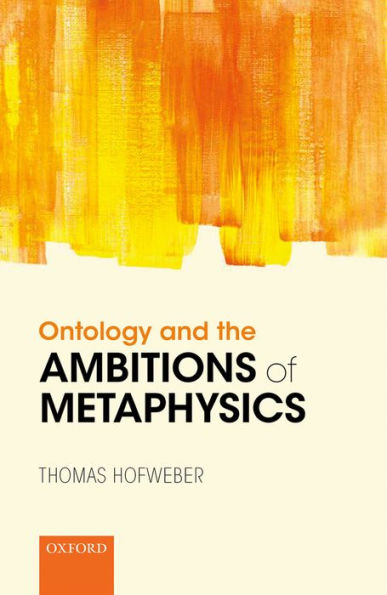
Ontology and the Ambitions of Metaphysics
320Related collections and offers
26.59
In Stock

Product Details
| ISBN-13: | 9780191091254 |
|---|---|
| Publisher: | OUP Oxford |
| Publication date: | 08/18/2016 |
| Sold by: | Barnes & Noble |
| Format: | eBook |
| Pages: | 320 |
| File size: | 653 KB |
About the Author
From the B&N Reads Blog