
- Shopping Bag ( 0 items )
-
All (21) from $1.99
-
New (10) from $7.95
-
Used (11) from $1.99
More About This Textbook
Overview
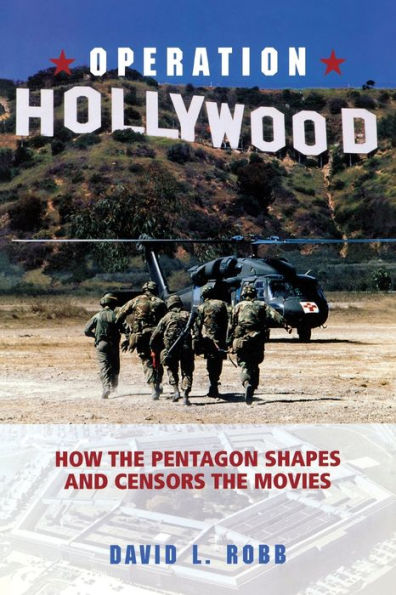
The only thing Hollywood likes more than a good movie is a good deal. For more than fifty years producers and directors of war and action movies have been getting a great deal from America’s armed forces by receiving access to billions of dollars worth of military equipment and personnel for little or no cost. Although this arrangement considerably lowers a film’s budget, the cost in terms of intellectual freedom can be quite steep. In exchange for access to sophisticated military hardware and expertise, filmmakers must agree to censorship from the Pentagon.
As veteran Hollywood journalist David L. Robb shows in this revealing insider’s look into Hollywood’s "dirtiest little secret," the final product that moviegoers see at the theater is often not just what the director intends but also what the powers-that-be in the military want to project about America’s armed forces. Sometimes the censor demands removal of just a few words; other times whole scenes must be scrapped or completely revised. What happens if a director refuses the requested changes? Robb quotes a Pentagon spokesman: "Well I’m taking my toys and I’m going home. I’m taking my tanks and my troops and my location, and I’m going home." That can be quite a persuasive threat to a filmmaker trying to keep his movie within budget.
Robb takes us behind the scenes during the making of many well-known movies. From The Right Stuff to Top Gun and even Lassie, the list of movies in which the Pentagon got its way is very long. Only when a director is determined to spend more money than necessary to make his own movie without interference, as in the case of Oliver Stone in the creation of Platoon or Francis Ford Coppola in Apocalypse Now, is a film released that presents the director’s unalloyed vision.
For anyone who loves movies and cares about freedom of expression, Operation Hollywood is an engrossing, shocking, and very entertaining book.
Editorial Reviews
Publishers Weekly
Every year, Hollywood producers ask the Pentagon for help in making films, seeking everything from locations and technical advice to Blackhawk helicopters and nuclear-powered submarines. The military will happily oblige, it says in an army handbook, so long as the movie "aid[s] in the recruiting and retention of personnel." The producers want to make money; the Defense Department wants to make propaganda. Former Hollywood Reporter staffer Robb explores the conflicts resulting from these negotiations in this illuminating though sometimes tedious study of the military-entertainment complex over the last 50 years. Robb shows how, in the Nicholas Cage film Windtalkers, the Marine Corps strong-armed producers into deleting a scene where a Marine pries gold teeth from a dead Japanese soldier (a historically accurate detail). And in The Perfect Storm, the air force insisted on giving the Air National Guard credit for rescuing a sinking fishing boat, instead of the actual Coast Guard heroes. Even seemingly flawless recruiting vehicles had troubles: in Top Gun, the navy demanded Tom Cruise's love interest be changed from a military instructor to a civilian contractor (fraternization between officers and enlisted personnel being a no-no). At its worst, the author argues, the Pentagon unscrupulously targets children; Robb reveals how the Defense Department helped insert military story lines into the Mickey Mouse Club. To help, Robb suggests a schedule of uniform fees by which producers could rent aircraft carriers, F-16s and the like. It's an intriguing idea, though producers can go it alone: as Robb points out, blockbusters Forrest Gump, An Officer and a Gentleman and Platoon were all made without military assistance. Agent, Michael Hamilburg. (Apr.) Copyright 2004 Reed Business Information.Library Journal
Although the U.S. military has no constitutional authorization to help or hinder the making of commercial films, the various branches of the armed services, the Department of Defense, and intelligence organizations have offices to make deals with filmmakers, reveals Robb, a freelance journalist thrice nominated for the Pulitzer Prize. In exchange for military hardware, personnel, and location filming on bases or ships, the military attempts to modify scripts. Additionally, it will monitor films with which it has no real connection. To Robb, this is de facto censorship and an irregular use of taxpayer money. The military's goal of supporting stories that always present it favorably and thus become recruitment tools is verified by Phil Strub, head of the Pentagon's film liaison office, who is quoted as saying, "There's no question that we do things to influence public opinion and to help recruiting and retention." In addition, Robb cites sample letters from the Office of the Assistant Secretary of Defense. Condemning those who yield to the military's efforts to use films as propaganda, Robb praises directors who have successfully resisted, including Robert Aldrich (Attack), Taylor Hackford (An Officer and a Gentleman), Clint Eastwood (Heartbreak Ridge), and Kevin Costner (13 Days). This is a fully documented broadside fit for all public and academic libraries.-Kim Holston, American Inst. for Chartered Property Casualty Underwriters, Malvern, PA Copyright 2004 Reed Business Information.Product Details
Related Subjects
Meet the Author
David Robb (Beverly Hills, CA), an award-winning freelance journalist who has been nominated for the Pulitzer Prize three times, has published articles in the New York Times, Washington Post, Los Angeles Daily News, The Nation, LA Weekly, Salon.com, and Brill’s Content. For many years he was a labor and legal reporter for The Hollywood Reporter and Daily Variety.
Table of Contents

