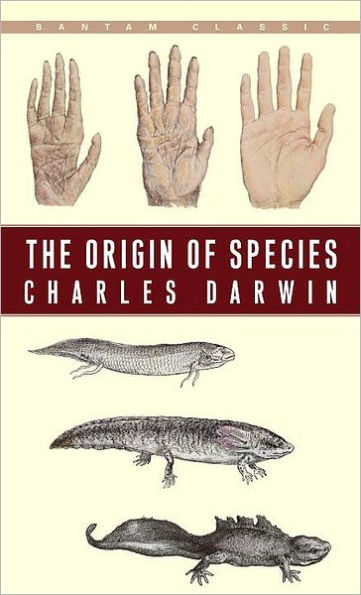
The Origin of Species

( 176 )

Overview

Origin of Species is still one of the most controversial works of science and it is one of the most outstanding works of science in the 19th century. The studies made by Darwin during the voyage of the HMS Beagle form a large part of the basis for this work.

As early as 1837, Darwin's notes describe the transmutation (evolution) of species. The work on this proceeded in private -- available for discussion with only a few close friends -- for ...

See more details below
Paperback (Reissue)
$6.95
BN.com price

Pick Up In Store

Reserve and pick up in 60 minutes at your local store

Other sellers (Paperback)
  • All (57) from $1.99   
  • New (16) from $2.93   
  • Used (41) from $1.99   
The Origin of Species

Available on NOOK devices and apps  
  • Nook Devices
  • NOOK HD/HD+ Tablet
  • NOOK
  • NOOK Color
  • NOOK Tablet
  • Tablet/Phone
  • NOOK for Windows 8 Tablet
  • NOOK for iOS
  • NOOK for Android
  • NOOK Kids for iPad
  • PC/Mac
  • NOOK for Windows 8
  • NOOK for PC
  • NOOK for Mac
  • NOOK Study
  • NOOK for Web

Want a NOOK? Explore Now

NOOK Book (eBook)
$5.99
BN.com price
Marketplace
BN.com

All Available Formats & Editions

Overview

Origin of Species is still one of the most controversial works of science and it is one of the most outstanding works of science in the 19th century. The studies made by Darwin during the voyage of the HMS Beagle form a large part of the basis for this work.

As early as 1837, Darwin's notes describe the transmutation (evolution) of species. The work on this proceeded in private -- available for discussion with only a few close friends -- for the next twenty-two years. Darwin recognized how controversial it would be once published.

The ideas were presented, along with the parallel concepts by Alfred Wallace, in 1958 and published as the Origin of Species in 1859.

The famous classic on evolution that revolutionized the course of science. Darwin's theory that species derive from other species by a gradual evolutionary process and that the average age level of each species is heightened by the "survival of the fittest" stirred popular debate of his time to a fever pitch. "Next to the Bible, no work has been quite as influential."--Ashley Montagu.

Read More Show Less

Editorial Reviews

Library Journal

Amazingly, 150 years after the publication of The Origin of Species, Darwin's seminal work on the theory of evolution remains the authoritative tract on the subject. Veteran narrator David Case (The Hunchback of Notre Dame) provides an authentic English accent that suits the material well; his diction is precise, making his narration easy to follow. Though this title has previously been recorded on audio, Tantor Media's addition of a full-text PDF ebook is a tremendous enhancement. Highly recommended for all collections.
—Gloria Maxwell

Victorian Studies
A masterful condensation.
From the Publisher
"Veteran narrator David Case...provides an authentic English accent that suits the material well; his diction is precise, making his narration easy to follow." —-Library Journal Starred Audio Review

Read More Show Less

Product Details

  • ISBN-13: 9780553214635
  • Publisher: Random House Publishing Group
  • Publication date: 6/28/1999
  • Edition description: Reissue
  • Pages: 512
  • Sales rank: 299,034
  • Product dimensions: 4.20 (w) x 6.88 (h) x 0.80 (d)

Meet the Author

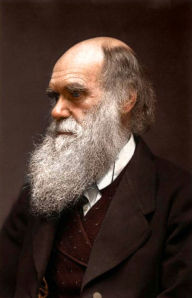
Charles Darwin

Charles Darwin, a British naturalist, geologist, biologist, and author, revolutionized the science of biology by developing the theory of evolution by natural selection. Among his important works are On the Origin of Species and The Descent of Man. A journal that he kept during a five-year journey on the HMS Beagle eventually was published as The Voyage of the Beagle. A highly respected and enthusiastic audiobook narrator, David Case specialized in creating unique and interesting character voices. AudioFile magazine named him a Golden Voice, writing after he died in 2005 that "David's cultured British voice, his flair for accents and dialects, and his comedic timing made him one of the industry's most sought-after narrators." He narrated over 700 audiobooks. In one of his last interviews, David said, "I really believe I was born to record audiobooks." Fans everywhere tend to agree.

Biography

Robert Charles Darwin was born in Shrewsbury, England, on February 12, 1809, into a wealthy and highly respected family. His grandfather, Erasmus Darwin, was a doctor and the author of many works, including his well-known Zoonomia, or the Laws of Organic Life, which suggested a theory of evolution. Charles's father, Robert Waring Darwin, was also a prosperous doctor; his mother, Susannah, was the daughter of Josiah Wedgwood, founder of the renowned Wedgwood potteries. The Darwins and the Wedgwoods had close and long-standing relations, and Charles was to marry his cousin, Emma Wedgwood.

In 1825 at age sixteen, Darwin matriculated at Edinburgh University to study medicine. There, his early interest in natural history developed, and he studied particularly crustaceans, sea creatures, and beetles. Nauseated by the sight of blood, however, he decided that medicine was not his vocation, left Edinburgh in 1827 and entered Christ's College, Cambridge University, with no clear sense of possible vocation, theology itself being an option. At Cambridge he became friends with J. S. Henslow, a clergyman who was also professor of botany. Although Darwin was to graduate from Cambridge with a B.A. in theology, he spent much time with Henslow, developing his interest in natural science. It was Henslow who secured a position for Darwin on an exploratory expedition aboard the HMS Beagle.

In December 1831, the year he graduated from Cambridge, Darwin embarked upon a five-year voyage to Africa and South America, acting as a companion to the captain, Robert Fitzroy. Darwin spent more time in land expeditions than at sea, where he was always seasick, but during the long voyages he continued his collecting and, cramped in his tiny cabin, meticulously wrote up his ideas. Several years after his return, at the time of the birth of his first son, William, Darwin fell ill. It is conjectured that while in South America he had contracted Chagas's disease, but whatever the cause, the effects were debilitating for the rest of Darwin's life.

By the time he returned to London in 1835, many of his letters, some to scientists like Charles Lyell and Adam Sedgwick, had been read before scientific societies, and he was already a well known and respected naturalist. His first published book, an account of his voyage aboard the Beagle, entitled Journal of Researches, appeared in 1839 and was widely popular. He married the same year; soon after, the family moved from London to a secluded house at Down, in Kent, where Darwin wrote initial sketches of his theory and then preparing himself for the full exposition, spent eight years writing a detailed set of definitive monographs on barnacles.

In 1858, when Darwin was halfway through writing his book, "Natural Selection," A. R. Wallace sent him a paper called, "On the Tendency of Varieties to Depart Indefinitely from the Original Type." In language similar to Darwin's own, Wallace laid out the argument for natural selection. Wallace asked Darwin to help get the paper published -- obviously an alarming development for a man who had given twenty years of his life to getting the argument for natural selection right. Darwin's scientific friends advised him to gather materials giving evidence of his priority but to have the Wallace paper read before the Linnaean Society, along with a brief account of his own ideas. Immediately after the reading, Darwin began work on his "abstract" of "Natural Selection." The result was On the Origin of Species by Means of Natural Selection, published in 1859. Despite the controversy it generated, it was an immense success and went through five more editions in Darwin's lifetime.

Darwin devoted the rest of his life to researching and writing scientific treatises, drawing on his notebooks and corresponding with scientists all over the world, and thus developing and modifying parts of his larger argument.

Darwin never traveled again and much of his scientific work was done in his own garden and study at home. Others, particularly his "bulldog," T. H. Huxley, fought the battle for evolution publicly, and as Darwin remained quietly ailing at home, his family grew -- he had ten children -- and so did his reputation. Although he was always ill with symptoms that made it impossible for him to work full days, he produced an enormous volume of work. His death, on April 19, 1882, was a national event. Despite the piety of his wife, Emma, Darwin had fallen away from religion as he reflected both on the way nature worked and on the way his favorite daughter, Annie, died painfully from an unknown feverish illness, when she was ten. Nevertheless, ironically, he was buried in Westminster Abbey.

Author biography from the Barnes & Noble Classics edition of The Origin of Species.

Good To Know

Darwin was born on the same day as U.S. president Abraham Lincoln.

He broke his longtime snuff habit by keeping his snuff box in the basement and the key to it in the attic.

Read More Show Less
    1. Date of Birth:
      February 12, 1809
    2. Place of Birth:
      Shrewsbury, England
    1. Date of Death:
      April 19, 1882
    2. Place of Death:
      London, England
    1. Education:
      B.A. in Theology, Christ’s College, Cambridge University, 1831

Read an Excerpt

Chapter One


Variation Under Domestication

Causes of Variability—Effects of Habit—Correlation of Growth—Inheritance—Character of Domestic Varieties—Difficulty of distinguishing between Varieties and Species—Origin of Domestic Varieties from one or more Species—Domestic Pigeons, their Differences and Origin—Principle of Selection anciently followed, its Effects—Methodical and Unconscious Selection—Unknown Origin of our Domestic Productions—Circumstances favourable to Man's power of Selection

WHEN WE look to the individuals of the same variety or sub-variety of our older cultivated plants and animals, one of the first points which strikes us, is, that they generally differ much more from each other, than do the individuals of any one species or variety in a state of nature. When we reflect on the vast diversity of the plants and animals which have been cultivated, and which have varied during all ages under the most different climates and treatment, I think we are driven to conclude that this greater variability is simply due to our domestic productions having been raised under conditions of life not so uniform as, and somewhat different from, those to which the parent species have been exposed under nature. There is, also, I think, some probability in the view propounded by Andrew Knight, that this variability may be partly connected with excess of food. It seems pretty clear that organic beings must be exposed during several generations to the new conditions of life to cause any appreciable amount of variation; and that when the organisation has once begun to vary, it generally continues to vary for many generations. No case is on record of a variable being ceasing to be variable under cultivation. Our oldest cultivated plants, such as wheat, still often yield new varieties: our oldest domesticated animals are still capable of rapid improvement or modification.
It has been disputed at what period of life the causes of variability, whatever they may be, generally act; whether during the early or late period of development of the embryo, or at the instant of conception. Geoffroy St Hilaire's experiments show that unnatural treatment of the embryo causes monstrosities; and monstrosities cannot be separated by any clear line of distinction from mere variations. But I am strongly inclined to suspect that the most frequent cause of variability may be attributed to the male and female reproductive elements having been affected prior to the act of conception. Several reasons make me believe in this; but the chief one is the remarkable effect which confinement or cultivation has on the functions of the reproductive system; this system appearing to be far more susceptible than any other part of the organization, to the action of any change in the conditions of life. Nothing is more easy than to tame an animal, and few things more difficult than to get it to breed freely under confinement, even in the many cases when the male and female unite. How many animals there are which will not breed, though living long under not very close confinement in their native country! This is generally attributed to vitiated instincts; but how many cultivated plants display the utmost vigour, and yet rarely or never seed! In some few such cases it has been found out that very trifling changes, such as a little more or less water at some particular period of growth, will determine whether or not the plant sets a seed. I cannot here enter on the copious details which I have collected on this curious subject; but to show how singular the laws are which determine the reproduction of animals under confinement, I may just mention that carnivorous animals, even from the tropics, breed in this country pretty freely under confinement, with the exception of the plantigrades or bear family; whereas, carnivorous birds, with the rarest exceptions, hardly ever lay fertile eggs. Many exotic plants have pollen utterly worthless, in the same exact condition as in the most sterile hybrids. When, on the one hand, we see domesticated animals and plants, though often weak and sickly, yet breeding quite freely under confinement; and when, on the other hand, we see individuals, though taken young from a state of nature, perfectly tamed, long-lived, and healthy (of which I could give numerous instances), yet having their reproductive system so seriously affected by unperceived causes as to fail in acting, we need not be surprised at this system, when it does act under confinement, acting not quite regularly, and producing offspring not perfectly like their parents or variable.

Sterility has been said to be the bane of horticulture; but on this view we owe variability to the same cause which produces sterility; and variability is the source of all the choicest productions of the garden. I may add, that as some organisms will breed most freely under the most unnatural conditions (for instance, the rabbit and ferret kept in hutches), showing that their reproductive system has not been thus affected; so will some animals and plants withstand domestication or cultivation, and vary very slightly—perhaps hardly more than in a state of nature.

A long list could easily be given of 'sporting plants;' by this term gardeners mean a single bud or offset, which suddenly assumes a new and sometimes very different character from that of the rest of the plant. Such buds can be propagated by grafting, &c., and sometimes by seed. These 'sports' are extremely rare under nature, but far from rare under cultivation; and in this case we see that the treatment of the parent has affected a bud or offset, and not the ovules or pollen. But it is the opinion of most physiologists that there is no essential difference between a bud and an ovule in their earliest stages of formation; so that, in fact, 'sports' support my view, that variability may be largely attributed to the ovules or pollen, or to both, having been affected by the treatment of the parent prior to the act of conception. These cases anyhow show that variation is not necessarily connected, as some authors have supposed, with the act of generation.

Seedlings from the same fruit, and the young of the same litter, sometimes differ considerably from each other, though both the young and the parents, as Mxller has remarked, have apparently been exposed to exactly the same conditions of life; and this shows how unimportant the direct effects of the conditions of life are in comparison with the laws of reproduction, and of growth, and of inheritance; for had the action of the conditions been direct, if any of the young had varied, all would probably have varied in the same manner. To judge how much, in the case of any variation, we should attribute to the direct action of heat, moisture, light, food, &c., is most difficult: my impression is, that with animals such agencies have produced very little direct effect, though apparently more in the case of plants. Under this point of view, Mr Buckman's recent experiments on plants seem extremely valuable. When all or nearly all the individuals exposed to certain conditions are affected in the same way, the change at first appears to be directly due to such conditions; but in some cases it can be shown that quite opposite conditions produce similar changes of structure. Nevertheless some slight amount of change may, I think, be attributed to the direct action of the conditions of life—as, in some cases, increased size from amount of food, colour from particular kinds of food and from light, and perhaps the thickness of fur from climate.

Habit also has a deciding influence, as in the period of flowering with plants when transported from one climate to another. In animals it has a more marked effect; for instance, I find in the domestic duck that the bones of the wing weigh less and the bones of the leg more, in proportion to the whole skeleton, than do the same bones in the wild-duck; and I presume that this change may be safely attributed to the domestic duck flying much less, and walking more, than its wild parent. The great and inherited development of the udders in cows and goats in countries where they are habitually milked, in comparison with the state of these organs in other countries, is another instance of the effect of use. Not a single domestic animal can be named which has not in some country drooping ears; and the view suggested by some authors, that the drooping is due to the disuse of the muscles of the ear, from the animals not being much alarmed by danger, seems probable.

There are many laws regulating variation, some few of which can be dimly seen, and will be hereafter briefly mentioned. I will here only allude to what may be called correlation of growth. Any change in the embryo or larva will almost certainly entail changes in the mature animal. In monstrosities, the correlations between quite distinct parts are very curious; and many instances are given in Isidore Geoffroy St Hilaire's great work on this subject. Breeders believe that long limbs are almost always accompanied by an elongated head. Some instances of correlation are quite whimsical; thus cats with blue eyes are invariably deaf; colour and constitutional peculiarities go together, of which many remarkable cases could be given amongst animals and plants. From the facts collected by Heusinger, it appears that white sheep and pigs are differently affected from coloured individuals by certain vegetable poisons. Hairless dogs have imperfect teeth; long-haired and coarse-haired animals are apt to have, as is asserted, long or many horns; pigeons with feathered feet have skin between their outer toes; pigeons with short beaks have small feet, and those with long beaks large feet. Hence, if man goes on selecting, and thus augmenting, any peculiarity, he will almost certainly unconsciously modify other parts of the structure, owing to the mysterious laws of the correlation of growth.

The result of the various, quite unknown, or dimly seen laws of variation is infinitely complex and diversified. It is well worth while carefully to study the several treatises published on some of our old cultivated plants, as on the hyacinth, potato, even the dahlia, &c.; and it is really surprising to note the endless points in structure and constitution in which the varieties and subvarieties differ slightly from each other. The whole organization seems to have become plastic, and tends to depart in some small degree from that of the parental type.

Any variation which is not inherited is unimportant for us. But the number and diversity of inheritable deviations of structure, both those of slight and those of considerable physiological importance, is endless. Dr Prosper Lucas's treatise, in two large volumes, is the fullest and the best on this subject. No breeder doubts how strong is the tendency to inheritance: like produces like is his fundamental belief: doubts have been thrown on this principle by theoretical writers alone. When a deviation appears not unfrequently, and we see it in the father and child, we cannot tell whether it may not be due to the same original cause acting on both; but when amongst individuals, apparently exposed to the same conditions, any very rare deviation, due to some extraordinary combination of circumstances, appears in the parent—say, once amongst several million individuals—and it reappears in the child, the mere doctrine of chances almost compels us to attribute its reappearance to inheritance. Every one must have heard of cases of albinism, prickly skin, hairy bodies, &c., appearing in several members of the same family. If strange and rare deviations of structure are truly inherited, less strange and commoner deviations may be freely admitted to be inheritable. Perhaps the correct way of viewing the whole subject, would be, to look at the inheritance of every character what ever as the rule, and non-inheritance as the anomaly.

The laws governing inheritance are quite unknown; no one can say why the same peculiarity in different individuals of the same species, and in individuals of different species, is sometimes inherited and sometimes not so; why the child often reverts in certain characters to its grandfather or grandmother or other much more remote ancestor; why a peculiarity is often transmitted from one sex to both sexes, or to one sex alone, more commonly but not exclusively to the like sex. It is a fact of some little importance to us, that peculiarities appearing in the males of our domestic breed are often transmitted either exclusively, or in a much greater degree, to males alone. A much more important rule, which I think may be trusted, is that, whatever period of life a peculiarity first appears in, it tends to appear in the offspring at a corresponding age, though sometimes earlier. In many cases this could not be otherwise; thus the inherited peculiarities in the horns of cattle could appear only in the offspring when nearly mature; peculiarities in the silkworm are known to appear at the corresponding caterpillar or cocoon stage. But hereditary diseases and some other facts make me believe that the rule has a wider extension, and that when there is no apparent reason why a peculiarity should appear at any particular age, yet that it does tend to appear in the offspring at the same period at which it first appeared in the parent. I believe this rule to be of the highest importance in explaining the laws of embryology. These remarks are of course confined to the first appearance of the peculiarity, and not to its primary cause, which may have acted on the ovules or male element; in nearly the same manner as in the crossed offspring from a short-horned cow by a long-horned bull, the greater length of horn, though appearing late in life, is clearly due to the male element.

Having alluded to the subject of reversion, I may here refer to a statement often made by naturalists—namely, that our domestic varieties, when run wild, gradually but certainly revert in character to their aboriginal stocks. Hence it has been argued that no deductions can be drawn from domestic races to species in a state of nature. I have in vain endeavoured to discover on what decisive facts the above statement has so often and so boldly been made. There would be great difficulty in proving its truth: we may safely conclude that very many of the most strongly-marked domestic varieties could not possibly live in a wild state. In many cases we do not know what the aboriginal stock was, and so could not tell whether or not nearly perfect reversion had ensued. It would be quite necessary, in order to prevent the effects of intercrossing, that only a single variety should be turned loose in its new home. Nevertheless, as our varieties certainly do occasionally revert in some of their characters to ancestral forms, it seems to me not improbable, that if we could succeed in naturalising, or were to cultivate, during many generations, the several races, for instance, of the cabbage, in very poor soil (in which case, however, some effect would have to be attributed to the direct action of the poor soil), that they would to a large extent, or even wholly, revert to the wild aboriginal stock. Whether or not the experiment would succeed, is not of great importance for our line of argument; for by the experiment itself the conditions of life are changed. If it could be shown that our domestic varieties manifested a strong tendency to reversion,—that is, to lose their acquired characters, whilst kept under unchanged conditions, and whilst kept in a considerable body, so that free intercrossing might check, by blending together, any slight deviations of structure, in such case, I grant that we could deduce nothing from domestic varieties in regard to species. But there is not a shadow of evidence in favour of this view: to assert that we could not breed our cart and race-horses, long and short-horned cattle, and poultry of various breeds, and esculent vegetables, for an almost infinite number of generations, would be opposed to all experience. I may add, that when under nature the conditions of life do change, variations and reversions of character probably do occur; but natural selection, as will hereafter be explained, will determine how far the new characters thus arising shall be preserved.

Read More Show Less

Table of Contents

Additions and Corrections, to the Sixth Edition xv
Historical Sketch xviii
Introduction 1
Chapter I. Variation under Domestication 7
Chapter II. Variation under Nature 51
Chapter III. Struggle for Existence 75
Chapter IV. Natural Selection; or the Survival of the Fittest 97
Chapter V. Laws of Variation 164
Chapter VI. Difficulties of the Theory 207
Chapter VII. Miscellaneous Objections to the Theory of Natural Selection 262
Chapter VIII. Instinct 319
Chapter IX. Hybridism 365
Chapter X. On the Imperfection of the Geological Record 412
Chapter XI. On the Geological Succession of Organic Beings 453
Chapter XII. Geographical Distribution 493
Chapter XIII. Geographical Distribution--continued 535
Chapter XIV. Mutual Affinities of Organic Beings: Morphology: Embryology: Rudimentary Organs 566
Chapter XV. Recapitulation and Conclusion 631
Glossary of Scientific Terms 671
Index 687
Read More Show Less

Customer Reviews

Average Rating 4
( 176 )
Rating Distribution

5 Star

(99)

4 Star

(31)

3 Star

(21)

2 Star

(11)

1 Star

(14)

Your Rating:

Your Name: Create a Pen Name or

Barnes & Noble.com Review Rules

Our reader reviews allow you to share your comments on titles you liked, or didn't, with others. By submitting an online review, you are representing to Barnes & Noble.com that all information contained in your review is original and accurate in all respects, and that the submission of such content by you and the posting of such content by Barnes & Noble.com does not and will not violate the rights of any third party. Please follow the rules below to help ensure that your review can be posted.

Reviews by Our Customers Under the Age of 13

We highly value and respect everyone's opinion concerning the titles we offer. However, we cannot allow persons under the age of 13 to have accounts at BN.com or to post customer reviews. Please see our Terms of Use for more details.

What to exclude from your review:

Please do not write about reviews, commentary, or information posted on the product page. If you see any errors in the information on the product page, please send us an email.

Reviews should not contain any of the following:

  • - HTML tags, profanity, obscenities, vulgarities, or comments that defame anyone
  • - Time-sensitive information such as tour dates, signings, lectures, etc.
  • - Single-word reviews. Other people will read your review to discover why you liked or didn't like the title. Be descriptive.
  • - Comments focusing on the author or that may ruin the ending for others
  • - Phone numbers, addresses, URLs
  • - Pricing and availability information or alternative ordering information
  • - Advertisements or commercial solicitation

Reminder:

  • - By submitting a review, you grant to Barnes & Noble.com and its sublicensees the royalty-free, perpetual, irrevocable right and license to use the review in accordance with the Barnes & Noble.com Terms of Use.
  • - Barnes & Noble.com reserves the right not to post any review -- particularly those that do not follow the terms and conditions of these Rules. Barnes & Noble.com also reserves the right to remove any review at any time without notice.
  • - See Terms of Use for other conditions and disclaimers.
Search for Products You'd Like to Recommend

Recommend other products that relate to your review. Just search for them below and share!

Create a Pen Name

Your Pen Name is your unique identity on BN.com. It will appear on the reviews you write and other website activities. Your Pen Name cannot be edited, changed or deleted once submitted.

 
Your Pen Name can be any combination of alphanumeric characters (plus - and _), and must be at least two characters long.

Continue Anonymously
See All Sort by: Showing 1 – 20 of 177 Customer Reviews
  • Posted April 15, 2010

    more from this reviewer

    I Also Recommend:

    The Origin of Species

    Most people are at least familiar with the theory of natural selection, but that is not to say that they are familiar with what Darwin actually said in Origin and how he said it. Thus I agree with the reviewers who say this is essential reading.

    Although Darwin says it is "one long argument", it is in fact two: that the diversity of life shares a common ancestry, and second that this divergence came about primarily as a result of natural selection. One other reviewer said it was hard to keep focussed on the argument, if this is the case I recommend you start with Darwin's intro, chapters 3, 4, 6 and 14. This gives the basic argument. You might then go back and fill in.

    There are a number of re-editions of Origin out there, especially given the recent 150th anniversary of its publication, so why choose this one?

    Above all it is an ideal student edition (and I include here anyone who reads critically): it is cheap, has abundant margins for notes, and is as lightweight a paperback as you will find for a 400 page book. The type is large and accessible, and the introduction by George Levine is, at 20 pages, short enough to hold one's interest while with enough content to warrant its inclusion. Also, given all the recent re-editions available there are few that provide the 1859 text of the first edition. This one does.

    This is important if you want to know how Darwin originally presented his ideas. Later editions (there were six in total, the last published in 1876) included clarifications and answers to specific later objections. As a result the first edition reads better and is a more straightforward argument. If you are a Darwin scholar you will probably want to engage with these later editions - the sixth is widely available, for the others you can find them in specialist libraries (the University of Oklahoma has the lot!), or now also in beautifully scanned editions through the Darwin online website.

    This is not the place to go into the detail of what gets added to the later editions, but if this book gets you hooked you might want to take your Darwin studies further. Perhaps the most notable and certainly the most famous addition is the insertion from the second edition onwards of the words "by the Creator" into the poetic last paragraph of the book (There is grandeur in this view of life... ) This is interesting stuff: was Darwin seeking to clarify that he saw evolution as God's mechanism for creating the awesome diversity of life that we see around us? Or, was this a judicious attempt to allay theological concerns that distracted his readers from the science? The jury is still out on this. Darwin certainly wrote to his friend and confidante Joseph Hooker that he later regretted "truckling to public opinion", but he did not remove the insertion from later editions. In his autobiography, written towards the end of his life, he confided that while he had gradually lost his faith in a personal God, he recognized that others had found natural selection quite compatible with religious belief, most notably the Anglican theologian Charles Kingsley and the American botanist and Presbyterian, Asa Gray.

    There is so much in this book that it will keep you coming back. You might also want to take this further: Although Darwin only hinted at human evolution in Origin, he addressed that hot potato explicitly in Descent of Man.

    9 out of 9 people found this review helpful.

    Was this review helpful? Yes  No   Report this review
  • Anonymous

    Posted December 4, 2005

    Best Book ever written.

    A wonderful book that really shows one where they are truly at in the animal kingdom. After reading the book so many things make sense that seemed unexplainable before. A wonderful display of Logic at it's best. Evolution has stood the test of time and has been proven repeatedly. The 'Theory' of evolution is not about whether evolution occured, but rather, how.

    8 out of 11 people found this review helpful.

    Was this review helpful? Yes  No   Report this review
  • Posted September 26, 2009

    I Also Recommend:

    Darwin for Evolution and Extinction

    This was a good book for being a required textbook. Darwin still is an incredible unique scientific literary genius. Even if not required anyone who loves science should read "The Origin" because it is an incredible well written scientific argument on a controversial topic and it has stood the time of history while staying correct.

    6 out of 8 people found this review helpful.

    Was this review helpful? Yes  No   Report this review
  • Anonymous

    Posted April 9, 2007

    A reviewer

    This book clearly explains the theory of Natural Selection. If you really want to know what Natural Selection(Evolution) really is, you need to read this book.

    6 out of 7 people found this review helpful.

    Was this review helpful? Yes  No   Report this review
  • Anonymous

    Posted December 12, 2011

    You don't have to believe

    It's not a matter of opinion. Evolution occurs. Denying it won't make it go away. Start here to understand the basics.

    3 out of 3 people found this review helpful.

    Was this review helpful? Yes  No   Report this review
  • Anonymous

    Posted August 9, 2002

    Vituperatous Brood

    For those of us Christians who would condem this theory, open your minds to the possibilities of the descriptive power of science. For those of us scientists who would otherwise berate or belittle creationism, remember that they are your brothers and believe that 'What now is has already been, what is to be already is; and God restores what would otherwise be displaced.' (Ecclesiastes 3:15) For both, put down your weapons you vituperatous brood and seek the truth without malice or ego.

    3 out of 5 people found this review helpful.

    Was this review helpful? Yes  No   Report this review
  • Anonymous

    Posted July 13, 2012

    Beautiful Book

    I'm a devout Catholic with a strong interest in biology and genetics so I must say that this is one of the greatest and influential books of all time. Thanks to Darwin's well-thought out theory, we have been allowed to advance our understanding of life and find cures for human diseases that would have been impossible to discover with out this knowledge. Biology is useless without evolution. I believe everyone should read this book regardless of their faith. I'm a believer but I certainly don't believe in a God that gave us a beautiful and wonderous world for us to not explore and learn about. I also don't think Darwin would like us to still be fighting over this.

    2 out of 3 people found this review helpful.

    Was this review helpful? Yes  No   Report this review
  • Anonymous

    Posted February 18, 2012

    Truth

    Charles darwin has even disproved his own theory. I dont understand how you beleive in this. But it is a well written book.

    2 out of 14 people found this review helpful.

    Was this review helpful? Yes  No   Report this review
  • Posted February 6, 2010

    It's a Classic

    This is an awesome book for anyone interested in the origins of the current biological theories. It is well written and very convincing, and quite impressive, considering that it was written well before modern genetics provided such voluminous evidence for his conclusions.

    Have a wonderful day!

    2 out of 2 people found this review helpful.

    Was this review helpful? Yes  No   Report this review
  • Anonymous

    Posted April 20, 2009

    Read when drinking strong coffee

    Very long. Difficult. Bunch of ________, in my opinion.

    2 out of 39 people found this review helpful.

    Was this review helpful? Yes  No   Report this review
  • Anonymous

    Posted December 18, 2003

    This Book Is Great and Informational

    Thhe Origin of Species is a great book. I am 12 years old and i thought it was a great book. It is a best buy for any person.

    2 out of 5 people found this review helpful.

    Was this review helpful? Yes  No   Report this review
  • Anonymous

    Posted February 9, 2012

    Origin of Species

    You'd have to be into these kinda things I guess

    1 out of 12 people found this review helpful.

    Was this review helpful? Yes  No   Report this review
  • Anonymous

    Posted November 26, 2011

    Not just a classic, but a masterpiece

    One of the most important works in the scientific literature, The Origin renains indispensible reading for those wishing to understand the evolution of species as well as the evolution of Reason. A perfect work? No. But cannonical texts are the sphere of religion, not of science. Still, there is much here to amaze and delight --- and to astound the reader as to the range and depth of Darwin's thinking on this subject.

    1 out of 1 people found this review helpful.

    Was this review helpful? Yes  No   Report this review
  • Posted August 6, 2009

    more from this reviewer

    important and valuable

    *I'm rating this book on how important I think it is....not how much I enjoyed it

    It has taken me all of the summer thus far to complete The Origin of Species. It is a very tedious and analytical read. I found my mind wandering while I was reading this and I don't think I retained half of what I read. I do understand Darwin's main ideas though. Charles Darwin was a very insightful man who has had such a great impact on science and society as a whole. Did I enjoy this book? Not really. Do I think this is an important and valuable book? Absolutely!

    1 out of 1 people found this review helpful.

    Was this review helpful? Yes  No   Report this review
  • Posted May 2, 2009

    more from this reviewer

    I Also Recommend:

    A must for anyone who wishes to be knowledgeable about the world we live in.

    There is a lot of confusion still lingering, like some ineffable cloud of ignorance, around the topic of evolution and the real support and arguments made on its behalf. This book does very well to wave much of that cloud away. I had a feeling when beginning this book that it would somehow be so technical as to be overly difficult, or written in such a way as to be inaccessible. This is, I am happy to say, not the case. This book is straight forward, easy to read, well laid out, and dare I say, quite enjoyable.

    A better authority on the subject you cannot find, and to hear the arguments straight from the finch's beak (as it were), is certainly recommended. It becomes clear how such ideas originated, and after hearing the arguments the theory becomes even easier to understand and defend. I would like to point out at this point that this book contains, nor does it claim to contain, any explanation with regard to the origin of life, it merely goes about proving quite definitively how we have come to have as many species as we do currently in the world.

    I believe that this book is an essential edition to the reading pile, and library of every person who claims to have knowledge of the way things work in the world, or who wishes to. This book does not contain all the knowledge one needs to go on claiming to be intelligent, but it is a great start.

    1 out of 1 people found this review helpful.

    Was this review helpful? Yes  No   Report this review
  • Anonymous

    Posted September 4, 2003

    Charles, R. Darwin

    One of the great minds among Newton, and Einstein, that history has misbelieved and forgotten.

    1 out of 1 people found this review helpful.

    Was this review helpful? Yes  No   Report this review
  • Anonymous

    Posted April 10, 2013

    Christians BEWARE!

    Do not read this book at all! In Church, we disccussed Creation and evelotion (which I am not even going to capalize because it disscusts me). They started to talk about this book so I thought that I would llook it up on my NOOK. When it came up, I decided to rate it. 1 Star! Wish I could give it a zero. Dont read it! Read the Bible and believe in God.

    0 out of 3 people found this review helpful.

    Was this review helpful? Yes  No   Report this review
  • Anonymous

    Posted February 3, 2013

    Yuck LIAR!!

    All i can say to this is what another person said in there review: LIAR! LIAR! PANTS ON FIRE!! CREATION IS SO MUCH BETTER!

    0 out of 4 people found this review helpful.

    Was this review helpful? Yes  No   Report this review
  • Anonymous

    Posted January 8, 2013

    Liar liar your pants are on fire

    See genesis1:1 and read the bible

    0 out of 9 people found this review helpful.

    Was this review helpful? Yes  No   Report this review
  • Anonymous

    Posted January 1, 2013

    Liar

    This book is a total lie. See Genesis 1:1 for more info. Have a nice day.

    0 out of 9 people found this review helpful.

    Was this review helpful? Yes  No   Report this review
See All Sort by: Showing 1 – 20 of 177 Customer Reviews

If you find inappropriate content, please report it to Barnes & Noble
Why is this product inappropriate?
Comments (optional)