- Shopping Bag ( 0 items )
-
All (35) from $6.61
-
New (15) from $9.55
-
Used (20) from $6.61
More About This Textbook
Overview
An essential update of the bestselling global phenomenon
A New York Times Notable Book of the Year
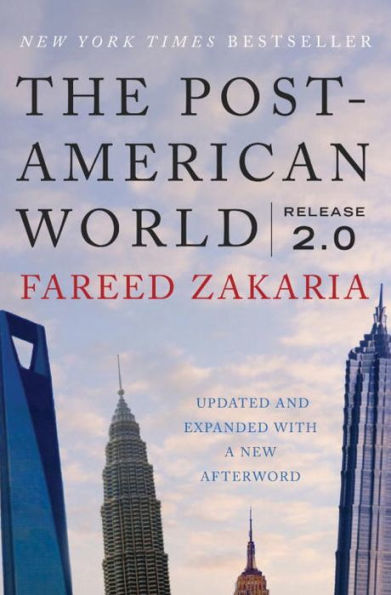
In this new edition of his international blockbuster, Fareed Zakaria continues to explore the shifting role of the United States in the rapidly changing landscape of world affairs. The tilting balance of power, which Zakaria coined in the original edition of The Post-American World as the “rise of the rest,” has proceeded more swiftly than anyone could have anticipated, aided by the financial crisis and the surprising determination and continued growth of emerging markets such as Brazil, China, and India. Zakaria tracks this quickly moving phenomenon and reports on the latest economic, technological, and even military developments that will shape our global future.
“Fareed Zakaria…has written a minor masterpiece full of pragmatic, informed intelligence….“Thought-provoking and important…”—Jason Burke, The Guardian (UK)
“A provocative and often shrewd take that opens a big picture window on the closing of the first American century and the advent of a new world.”—Michiko Kakutani, New York Times
“This is a relentlessly intelligent book that eschews simple-minded projections from crisis to collapse…to remind this faltering giant of its unique and enduring strengths.”—Joseph Joffe, New York Times Book Review
Editorial Reviews
Slate
A far-reaching analysis.Booklist
Starred Review. Zakaria updates his best-selling earlier vision of world economics and politics, which foresaw the decline of American dominance but reassured us that with that decline came the rise of the rest of the world.Boston Sunday Globe
Zakaria . . . may have more intellectual range and insights than any other public thinker in the West.The New York Times Book Review
This is a relentlessly intelligent book that eschews simple-minded projections from crisis to collapse.— Joseph JoffeBusinessWeek
Fareed Zakaria is one of the most thoughtful foreign policy analysts of our day and his new book . . . is a must read for anyone interested in globalization—or the Presidential election.— Bruce NussbaumThe New York Times
A provocative and often shrewd take that opens a big picture window on the closing of the first American century and the advent of a new world.— Michiko KakutaniPublishers Weekly
When a book proclaims that it is not about the decline of America but "the rise of everyone else," readers might expect another diatribe about our dismal post-9/11 world. They are in for a pleasant surprise as Newsweekeditor and popular pundit Zakaria (The Future of Freedom) delivers a stimulating, largely optimistic forecast of where the 21st century is heading. We are living in a peaceful era, he maintains; world violence peaked around 1990 and has plummeted to a record low. Burgeoning prosperity has spread to the developing world, raising standards of living in Brazil, India, China and Indonesia. Twenty years ago China discarded Soviet economics but not its politics, leading to a wildly effective, top-down, scorched-earth boom. Its political antithesis, India, also prospers while remaining a chaotic, inefficient democracy, as Indian elected officials are (generally) loathe to use the brutally efficient tactics that are the staple of Chinese governance. Paradoxically, India's greatest asset is its relative stability in the region; its officials take an unruly population for granted, while dissent produces paranoia in Chinese leaders. Zakaria predicts that despite its record of recent blunders at home and abroad, America will stay strong, buoyed by a stellar educational system and the influx of young immigrants, who give the U.S. a more youthful demographic than Europe and much of Asia whose workers support an increasing population of unproductive elderly. A lucid, thought-provoking appraisal of world affairs, this book will engage readers on both sides of the political spectrum. (May)
Copyright © Reed Business Information, a division of Reed Elsevier Inc.All rights reserved.Library Journal
According to Newsweek International editor Zakaria, the weakened global economic and political position of the United States results not from the waning of its own powers but from the rapid rise of many other global players. The optimistic tone of his previous book, The Future of Freedom: Illiberal Democracy at Home and Abroad, permeates this work. After 500 years of world dominance and following the decline of great states in other parts of the world, the Western powers are seeing countries such as China and India emerge as new and formidable rivals. Zakaria is sharply critical of the current U.S. presidential administration, citing its dysfunctional political stalemate and foreign and military policies that hinder adaptation to the current realities. He argues that it is incumbent upon the Western powers to adapt if they want to thrive instead of trying to reverse these realities, and he remains optimistic that they can change, as they have historically shown themselves able to do so. Zakaria's arguments are accessible to general readers, and his supporting data are not overwhelming to digest. Most libraries will want this. [See Prepub Alert, LJ1/08.]
—Marcia L. Sprules
Kirkus Reviews
Pity the poor think-tanked neocons: Just a moment ago, the talk was of empire and the new world order, and now, it seems, America's day in the sun is about to grow cold. Newsweek International editor Zakaria (The Future of Freedom: Illiberal Democracy at Home and Abroad, 2003, etc.), born in India and a longtime resident of New York, seems unconcerned that his adopted country is sailing down the tubes: "This is a book not about the decline of America but rather about the rise of everyone else." He enumerates: Macao takes in more gambling revenue than Las Vegas, the biggest Ferris wheel in the world is in Singapore, Bollywood has surpassed Hollywood. Even as the global population grows, the number of those living in extreme poverty is falling, at least in three-quarters of the world's nations. Even after 9/11, the author notes, the world economy "grew at its fastest rate in nearly four decades." Inflation exceeds 15 percent only in a dozen-odd failed states such as Burma and Zimbabwe, and fewer and fewer people are dying in wars or spasms of political violence than ever. That all should be good news to globalists, and it's comforting to know, as Zakaria helpfully points out, that Iran spends less than a penny for every dollar we spend on the military. Yet the United States has dawdled, economically speaking, as China, India and other nations have skyrocketed. It helps, Indians note, that the Chinese government, the commander of that nation's command economy, hasn't really had to respond to public opinion, though even that is changing. The good news? By Zakaria's account, America's strength will lie in freedom and diversity-and the post-American era may not last all that long, sinceAmerica's population is growing, and growing younger, while the demographics of Asia and Europe are largely pointing to older populations and, in time, fewer workers. A sharp, well-written work of political economy.New York Times
Compelling.— Thomas FriedmanPhiladelphia Inquirer
Prophetic brilliance,near-perfect clarity, and a stirring eloquence.
Product Details
Related Subjects
Meet the Author
Fareed Zakaria is the editor-at-large of Time magazine and the Emmy-nominated host of CNN’s “Fareed Zakaria GPS.” His previous book was the bestseller The Future of Freedom. He lives in New York City.
Table of Contents
1 The Rise of the Rest 1
2 The Cup Runneth Over 6
3 A Non-Western World? 49
4 The Challenger 87
5 The Ally 129
6 American Power 167
7 American Purpose 215
Notes 261
Acknowledgments 269
Index 273
Interviews & Essays
The Post-American World: Release 2.0
Ian Bremmer- You made clear from the opening sentence of The Post-American World that you do not believe that America faces some kind of inevitable, irreversible decline. But how can US policymakers ensure that the rise of the rest actually strengthens the United States?
Fareed Zakaria- If more countries thrive in the existing global system, it means a larger world economy - more consumers and producers, investors and inventors. That's great for America. As Europe boomed after World War II, America boomed with it. The rise of Japan and Korea and Taiwan has not meant the decline of America. But the key has been that we have to be able to adjust and adapt. The US economy was enormously productive in the 1950s and 1960s - leading the world in almost every way, from technology to infrastructure to mass education. Our problem is that we no longer lead the world on many of these dimensions - think of infrastructure or K-12 education - and the rest of the world has been hard at work catching up. So, the fault lies not in our competitors but in ourselves. The good news is, if we can rectify these mistakes, we should still do well in the emerging world.
Bremmer- Given everything that has happened since 2008—the financial market meltdown, the Eurozone crisis, the Arab Spring—have you become more confident or less that the United States can successfully transition from its previous role as global hegemon to a new role as the most powerful among other powerful countries?
Zakaria- There are two distinct (though related) challenges for Washington in a Post-American World. The first is economic, which I outline above. The second is political. Here the structural challenge might seem daunting. Political power is not like economic power. In economics, others can grow and that can be good for you - win, win. In politics, power is relative. As China and India and Brazil and Turkey all prosper and gain strength and confidence, whose dominant influence are they cutting into? The US. But even here, the picture is actually quite hopeful for America. The truth is, only America has power along all dimensions - economic, military, political, cultural. And that gives it great strength, particularly as an agenda-setter. Also, the rise of these other countries creates uncertainty and anxiety in the international system. If the United States plays its cards well, it can be the crucial stabilizing force in the system. You can see that dynamic at work in Asia where China's rise has unsettled many Asian countries and they look to America to play a stabilizing role. It's a new diplomatic challenge for America, to be more of a catalyst and broker than hegemon and arbiter. It emphasizes brains more than brawn. Let's hope we're up to it.
Bremmer- How can policymakers overcome the polarization of American politics to get this right?
Zakaria- That's the Trillion dollar question. America's economy and society remain dynamic. It's political system is broken. First, recognize the problem. Stop mouthing slogans about how we have the world's greatest democracy. Our system is now highly dysfunctional and corrupt. We need to fix it.
Bremmer- Among rising states, which do you think have the most staying power and why? Will some of the rest be left behind?
Zakaria- China is in a league apart from every other rising power. It has the scale - in terms of sheer numbers—to have a huge global impact. It is also run by a competent elite, technocrats who plan for the long term and are moving China up the value chain. They are making huge investments in education and infrastructure, which will pay off over the long run. I agree with you that China continues to have a long-term political challenge, how to combine a vigorous and open economy with a closed and bureaucratic political system. But so far they have managed to balance it - I think they will need to make much larger political changes in the next decade than they have in the last decade.
Bremmer- How well do you think America is responding to China's continued rise?
Zakaria- American business has been responding well to China's rise, helping it but also benefitting from it. American society is more closed and parochial than American business and so there has been little contact, which is a pity because we can always learn from others. Washington, at a foreign policy level, has actually done quite well in its handling of China. It has encouraged the integration of China into the global economy, it has tried to get China to be more rule-based and more committed to producing (rather than consuming) global public goods. And it has carefully and systematically shored up its alliances with key Asian countries, from India to Japan to South Korea to Australia, which is an important hedge against Chinese expansion. All in all, a solid performance.
Bremmer- You devote a chapter to India's growing prominence. Are you optimistic that India's government will help spur the country toward the next stage of its economic development? Or is this still a country where progress will come mainly in spite of government?
Zakaria- China grows because of its government, and India grows in spite of its government. I don't expect much improvement in India's public policy. The infrastructure will continue to lag, the education system will be poor, the government will keep doling out subsidies, and tax and regulatory policy will be uncompetitive. But Indian businesses are world class. They manage under very difficult conditions to perform amazingly well. They manage capital efficiently, understand global markets and brands, and have high quality management. India has good demographics, with lots of young consumers. India's story is a bottom-up story, rather than China's top-down story. But don't kid yourself. Ultimately, you need good government policy to go to the next stage. Unless there is massive and intelligent investment in human and physical capital, India will lag behind China substantially. Whether in India or America, bad government will be a huge limiting factor on a country's success, no matter how dynamic the society and the economy.