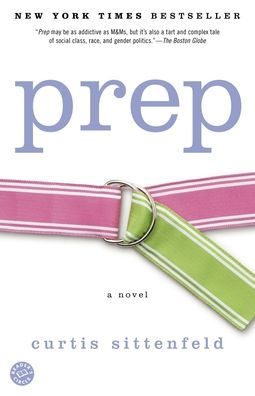
Prep

( 329 )

Pick Up in Store

Reserve and pick up in 60 minutes at your local store

Paperback (Reprint)
$10.99
BN.com price
$14.00 List Price (Save 22%)
Marketplace (New and Used)
from
$0.40
$14.00 List Price (Save 97%)
Usually ships within 1-2 business days
All (431)  
Used (409)  
New (22)  
Close
Sort by
Page 1 of 44
Showing 1 – 10 of 431 (44 pages)
$0.99
(Save 93%)
Seller since 2009

Feedback rating:

(4409)

Condition:

New — never opened or used in original packaging.

Like New — packaging may have been opened. A "Like New" item is suitable to give as a gift.

Very Good — may have minor signs of wear on packaging but item works perfectly and has no damage.

Good — item is in good condition but packaging may have signs of shelf wear/aging or torn packaging. All specific defects should be noted in the Comments section associated with each item.

Acceptable — item is in working order but may show signs of wear such as scratches or torn packaging. All specific defects should be noted in the Comments section associated with each item.

Used — An item that has been opened and may show signs of wear. All specific defects should be noted in the Comments section associated with each item.

Refurbished — A used item that has been renewed or updated and verified to be in proper working condition. Not necessarily completed by the original manufacturer.

Very Good
Slight wear to the cover and pages. Some markings on outside page edges. Text appears unmarked. Ships the next business day, with tracking and delivery confirmation sent to your ... email. Read more Show Less

Ships from: Beaverton, OR

Usually ships in 1-2 business days

  • Standard, 48 States
  • Standard (AK, HI)
  • Express, 48 States
  • Express (AK, HI)
$0.99
(Save 93%)
Seller since 2009

Feedback rating:

(4409)

Condition: Very Good
Slight wear to the cover and pages. Cover is creased. Slight markings on outside page edges. Text appears unmarked. Ships the next business day, with tracking and delivery ... confirmation sent to your email. Read more Show Less

Ships from: Beaverton, OR

Usually ships in 1-2 business days

  • Standard, 48 States
  • Standard (AK, HI)
  • Express, 48 States
  • Express (AK, HI)
$0.99
(Save 93%)
Seller since 2009

Feedback rating:

(4409)

Condition: Good
Some wear to the cover and pages. Slight stain on a few pages. Text appears unmarked. Ships the next business day, with tracking and delivery confirmation sent to your email.

Ships from: Beaverton, OR

Usually ships in 1-2 business days

  • Standard, 48 States
  • Standard (AK, HI)
  • Express, 48 States
  • Express (AK, HI)
$0.99
(Save 93%)
Seller since 2009

Feedback rating:

(4409)

Condition: Very Good
Slight wear to the cover and pages. Some markings on outside page edges. Text appears unmarked. Ships the next business day, with tracking and delivery confirmation sent to your ... email. Read more Show Less

Ships from: Beaverton, OR

Usually ships in 1-2 business days

  • Standard, 48 States
  • Standard (AK, HI)
  • Express, 48 States
  • Express (AK, HI)
$0.99
(Save 93%)
Seller since 2009

Feedback rating:

(4409)

Condition: Very Good
Spine is lightly creased. Slight wear to the cover and pages. Pages appear unmarked. Ships the next business day, with tracking and delivery confirmation sent to your email.

Ships from: Beaverton, OR

Usually ships in 1-2 business days

  • Standard, 48 States
  • Standard (AK, HI)
  • Express, 48 States
  • Express (AK, HI)
$0.99
(Save 93%)
Seller since 2008

Feedback rating:

(2582)

Condition: Very Good
nice copy,mild cover wear noted,interior clean,binding tight

Ships from: San Jose, CA

Usually ships in 1-2 business days

  • Canadian
  • International
  • Standard, 48 States
  • Standard (AK, HI)
  • Express, 48 States
  • Express (AK, HI)
$0.99
(Save 93%)
Seller since 2009

Feedback rating:

(421)

Condition: Good
2005 Paperback Good General Used Condiiton. Minor Defects may Exist. Minimal Shelf wear. Text may contain minor marking or highlighting, Binding Tight. Previous owners name or ... bookplate may be present. Like New, May have remainder mark (black line generally made acrossed bottom page edge to indicate close out by publisher) Read more Show Less

Ships from: Wichita, KS

Usually ships in 1-2 business days

  • Canadian
  • International
  • Standard, 48 States
  • Standard (AK, HI)
  • Express, 48 States
  • Express (AK, HI)
$0.99
(Save 93%)
Seller since 2005

Feedback rating:

(18867)

Condition: Very Good
2005-11 Paperback Very Good Trade paperback (US). Glued binding. 420 p.

Ships from: Sparks, NV

Usually ships in 1-2 business days

  • Canadian
  • International
  • Standard, 48 States
  • Standard (AK, HI)
  • Express, 48 States
  • Express (AK, HI)
$0.99
(Save 93%)
Seller since 2005

Feedback rating:

(18867)

Condition: Very Good
2005-11-22 Trade Paperback Very Good Trade paperback (US). Glued binding. 420 p.

Ships from: Sparks, NV

Usually ships in 1-2 business days

  • Canadian
  • International
  • Standard, 48 States
  • Standard (AK, HI)
  • Express, 48 States
  • Express (AK, HI)
$0.99
(Save 93%)
Seller since 2009

Feedback rating:

(608)

Condition: Good
Very Good This book has been read, but remains in excellent condition. The cover, all pages and the spine are intact. Minimal wear and tear, and few, if any, notes or ... highlighting present. This item was a donation to Goodwill of Greater Washington. Thanks for your order from Goodwill of Greater Washington. Your purchase will help Goodwill provide job training and employment services to people with disadvantages and disabilities. You just made a difference in someone's life today. Your order will be processed within 2 business days of receipt. Read more Show Less

Ships from: Washington, DC

Usually ships in 1-2 business days

  • Canadian
  • International
  • Standard, 48 States
  • Standard (AK, HI)
  • Express, 48 States
  • Express (AK, HI)
Page 1 of 44
Showing 1 – 10 of 431 (44 pages)
Close
Sort by
NOOK Book (eBook)
$9.99
BN.com price

Available on NOOK devices and apps

  • Nook Devices
  • NOOK
  • NOOK Color
  • NOOK Tablet
  • Tablet/Phone
  • NOOK for iPad
  • NOOK for iPhone
  • NOOK for Android
  • NOOK for Android (Tablet)
  • NOOK Kids for iPad
  • PC/Mac
  • NOOK Study
  • NOOK for PC
  • NOOK for Mac

Need a NOOK? Explore Now

Overview

Curtis Sittenfeld’s debut novel, Prep, is an insightful, achingly funny coming-of-age story as well as a brilliant dissection of class, race, and gender in a hothouse of adolescent angst and ambition.

Lee Fiora is an intelligent, observant fourteen-year-old when her father drops her off in front of her dorm at the prestigious Ault School in Massachusetts. She leaves her animated, affectionate family in South Bend, Indiana, at least in part because of the boarding school’s glossy brochure, in which boys in sweaters chat in front of old brick buildings, girls in kilts hold lacrosse sticks on pristinely mown athletic fields, and everyone sings hymns in chapel.

As Lee soon learns, Ault is a cloistered world of jaded, attractive teenagers who spend summers on Nantucket and speak in their own clever shorthand. Both intimidated and fascinated by her classmates, Lee becomes a shrewd observer of–and, ultimately, a participant in–their rituals and mores. As a scholarship student, she constantly feels like an outsider and is both drawn to and repelled by other loners. By the time she’s a senior, Lee has created a hard-won place for herself at Ault. But when her behavior takes a self-destructive and highly public turn, her carefully crafted identity within the community is shattered.

Ultimately, Lee’s experiences–complicated relationships with teachers; intense friendships with other girls; an all-consuming preoccupation with a classmate who is less than a boyfriend and more than a crush; conflicts with her parents, from whom Lee feels increasingly distant, coalesce into a singular portrait of the painful and thrilling adolescence universal to us all.

From the Hardcover edition.

Editorial Reviews

Caitlin macy
In a memorable passage near the opening of Brideshead Revisited, Evelyn Waugh's narrator, Charles Ryder, reflects on how "easy" it is, "retrospectively, to endow one's youth with a false precocity or false innocence." The same double-edged temptation often derails first-time novelists, who end up enervating the protagonist-version of themselves with one or the other pretension. Not, however, Curtis Sittenfeld, whose gripping debut effort, Prep, gives us a more accurate picture of adolescence as an unlovely mix of utter cluelessness, extreme sensitivity and untempered drives.
— The Washington Post
From The Critics
Any feelings of nostalgia for adolescence should be dispelled by the exacting intimacies of this first novel. Lee Fiora, a scholarship student at the prestigious Ault School (not Ault Academy, as her parents embarrassingly refer to it), negotiates her days there in a blaze of self-consciousness that is, by turns, hilarious and excruciating: “I believed then that if you had a good encounter with a person, it was best not to see them again for as long as possible.” And yet she becomes an expert on the rituals that govern the rarefied microenvironment in which she finds herself: the students’ fondness for catchphrases like “therein lies the paradox” and “LMC” (lower middle class); the taboo against enthusiasm for anything other than sports; the fact that the school always sings “God be with you till we meet again” at chapel before breaks. In the end, Lee’s incisive vision of herself and others is her downfall but also—as this richly textured narrative suggests—her greatest gift.

Product Details

  • ISBN-13: 9780812972351
  • Publisher: Random House Publishing Group
  • Publication date: 11/22/2005
  • Edition description: Reprint
  • Pages: 448
  • Sales rank: 106,568
  • Product dimensions: 7.88 (w) x 5.16 (h) x 0.37 (d)

Meet the Author

Curtis Sittenfeld
Curtis Sittenfeld
Curtis Sittenfeld is the author of the acclaimed, bestselling novel Prep, which chronicles a young teen’s experiences at a New England Boarding School. Her writing has also appeared in a number of publications, including The New York Times, The Washington Post, Glamour, and The Atlantic Monthly. Now with her second novel, The Man of My Dreams, she continues to exhibit just why so many have praised her work for its wit and depth of character.

Biography

Before her debut novel Prep hit bookshelves, Curtis Sittenfeld promised her ninth-grade English students that if the novel hit the New York Times Bestseller list she would buy pizza for the class. Well, I hope that her class enjoyed those pizzas, because Prep, a wry coming-of-age story set in a New England boarding school, became a surprise sensation upon its publication in 2005.

Sittenfeld knows the insular world of boarding schools all too well. When the precocious writer was a pre-teen, a recruiter from the exclusive prep school Groton came inquiring about Sittenfeld at her Cincinnati home. Curious about embarking on what she saw as a potential adventure, Sittenfeld decided to attend the school. As she told the Washington Post, "I just became enthralled by the idea of boarding school, and it happened to coincide with this period where I was restless and ready for a new adventure, in a 13-year-old's kind of way. I was just curious about the world. I wanted a change."

That change she sought would eventually become material for her first novel, the witty, insightful bestseller Prep, in which a smart and singular 14-year-old named Lee Fiora finds herself at the fictional Ault prep school near Boston. The shift from a life at home with a loving family to the elite Ault, with its pretty, pampered, yet cynical teenagers, is an eye-opening experience for Lee, whose wariness of their little society does not stop her from drifting into it. In her debut novel, 29-year old Sittenfeld already displayed a sure-handedness with character and dialogue that many of her older and more seasoned contemporaries would surely envy. Little did the high school English teacher know that her first novel would become such a runaway success, being that it had been rejected 14 times before finally being picked up by Random House. "One editor actually called my agent and turned it down, and then she called my agent back and said, 'I've never done this but I want to un-turn it down'," Sittenfeld says. "And then, she called again and turned it down." That editor is quite likely kicking herself now that Prep has not only made it to the New York Times bestseller list, but has received raves right down the line: The Washington Post, The New Yorker, Publisher's Weekly, etc. The New York Times named it one of the ten best books of 2005. Paramount Pictures has optioned its film rights. Sittenfeld's sophomore effort is The Man of My Dreams, yet another coming-of-age story, this time using a dysfunctional household rather than a ritzy prep school as the backdrop. The Man of My Dreams follows Hannah Gavener for over a decade, detailing the travails of her friendships, familial relationships, and therapy sessions. The book is yet another example of Sittenfeld's gift for crafting fully dimensional characters and blending drama and humor. Only recently published, The Man of My Dreams is already receiving accolades from the likes of The Library Journal and acclaimed short story writer Alice Munro. Who knows, Curtis Sittenfeld may even have to buy another round of pizza for her class.

Good To Know

A few fun facts about Sittenfeld from our interview:

"I eat so much fruit that my friends and family tease me about being a monkey."

"I have trouble staying awake past 10:00 p.m."

"I have a big crush on Bruce Springsteen (but then, who doesn't?)."

"When I was in junior high, my parents said they'd let me get my ears pierced if I made honor roll every quarter. And not to brag, but I did."

    1. Hometown:
      Washington, D.C.
    1. Date of Birth:
      August 23, 1975
    2. Place of Birth:
      Cincinnati, Ohio
    1. Education:
      B.A., Stanford University, 1997; M.F.A., University of Iowa (Iowa Writers’ Workshop), 2001
    2. Website:

Read an Excerpt

1. Thieves

Freshman fall

I think that everything, or at least the part of everything that happened to me, started with the Roman architecture mix-up. Ancient History was my first class of the day, occurring after morning chapel and roll call, which was not actually roll call but a series of announcements that took place in an enormous room with twenty-foot-high Palladian windows, rows and rows of desks with hinged tops that you lifted to store your books inside, and mahogany panels on the walls—one for each class since Ault’s founding in 1882—engraved with the name of every person who had graduated from the school. The two senior prefects led roll call, standing at a desk on a platform and calling on the people who’d signed up ahead of time to make announcements. My own desk, assigned alphabetically, was near the platform, and because I didn’t talk to my classmates who sat around me, I spent the lull before roll call listening to the prefects’ exchanges with teachers or other students or each other. The prefects’ names were Henry Thorpe and Gates Medkowski. It was my fourth week at the school, and I didn’t know much about Ault, but I did know that Gates was the first girl in Ault’s history to have been elected prefect.

The teachers’ announcements were straightforward and succinct: Please remember that your adviser request forms are due by noon on Thursday. The students’ announcements were lengthy—the longer roll call was, the shorter first period would be—and filled with double entendres: Boys’ soccer is practicing on Coates Field today, which, if you don’t know where it is, is behind the headmaster’s house, and if you still don’t know where it is, ask Fred. Where are you, Fred? You wanna raise your hand, man? There’s Fred, everyone see Fred? Okay, so Coates Field. And remember—bring your balls.

When the announcements were finished, Henry or Gates pressed a button on the side of the desk, like a doorbell, there was a ringing throughout the schoolhouse, and we all shuffled off to class. In Ancient History, we were making presentations on different topics, and I was one of the students presenting that day. From a library book, I had copied pictures of the Colosseum, the Pantheon, and the Baths of Diocletian, then glued the pictures onto a piece of poster board and outlined the edges with green and yellow markers. The night before, I’d stood in front of the mirror in the dorm bathroom practicing what I’d say, but then someone had come in, and I’d pretended I was washing my hands and left.

I was third; right before me was Jamie Lorison. Mrs. Van der Hoef had set a podium in the front of the classroom, and Jamie stood behind it, clutching index cards. “It is a tribute to the genius of Roman architects,” he began, “that many of the buildings they designed more than two thousand years ago still exist today for modern peoples to visit and enjoy.”

My heart lurched. The genius of Roman architects was my topic, not Jamie’s. I had difficulty listening as he continued, though certain familiar phrases emerged: the aqueducts, which were built to transport water . . . the Colosseum, originally called the Flavian Amphitheater . . .

Mrs. Van der Hoef was standing to my left, and I leaned toward her and whispered, “Excuse me.”

She seemed not to have heard me.

“Mrs. Van der Hoef?” Then—later, this gesture seemed particularly humiliating—I reached out to touch her forearm. She was wearing a maroon silk dress with a collar and a skinny maroon belt, and I only brushed my fingers against the silk, but she drew back as if I’d pinched her. She glared at me, shook her head, and took several steps away.

“I’d like to pass around some pictures,” I heard Jamie say. He lifted a stack of books from the floor. When he opened them, I saw colored pictures of the same buildings I had copied in black-and-white and stuck to poster board.

Then his presentation ended. Until that day, I had never felt anything about Jamie Lorison, who was red-haired and skinny and breathed loudly, but as I watched him take his seat, a mild, contented expression on his face, I loathed him.

“Lee Fiora, I believe you’re next,” Mrs. Van der Hoef said.

“See, the thing is,” I began, “maybe there’s a problem.”

I could feel my classmates looking at me with growing interest. Ault prided itself on, among other things, its teacher-student ratio, and there were only twelve of us in the class. When all their eyes were on me at once, however, that did not seem like such a small number.

“I just can’t go,” I finally said.

“I beg your pardon?” Mrs. Van der Hoef was in her late fifties, a tall, thin woman with a bony nose. I’d heard that she was the widow of a famous archaeologist, not that any archaeologists were famous to me.

“See, my presentation is—or it was going to be—I thought I was supposed to talk about—but maybe, now that Jamie—”

“You’re not making sense, Miss Fiora,” Mrs. Van der Hoef said. “You need to speak clearly.”

“If I go, I’ll be saying the same thing as Jamie.”

“But you’re presenting on a different topic.”

“Actually, I’m talking about architecture, too.”

She walked to her desk and ran her finger down a piece of paper. I had been looking at her while we spoke, and now that she had turned away, I didn’t know what to do with my eyes. My classmates were still watching me. During the school year so far, I’d spoken in classes only when I was called on, which was not often; the other kids at Ault were enthusiastic about participating. Back in my junior high in South Bend, Indiana, many classes had felt like one-on-one discussions between the teacher and me, while the rest of the students daydreamed or doodled. Here, the fact that I did the reading didn’t distinguish me. In fact, nothing distinguished me. And now, in my most lengthy discourse to date, I was revealing myself to be strange and stupid.

“You’re not presenting on architecture,” Mrs. Van der Hoef said. “You’re presenting on athletics.”

“Athletics?” I repeated. There was no way I’d have volunteered for such a topic.

She thrust the sheet of paper at me, and there was my name, Lee Fiora—Athletics, in her writing, just below James Lorison—Architecture. We’d signed up for topics by raising our hands in class; clearly, she had misunderstood me.

“I could do athletics,” I said uncertainly. “Tomorrow I could do them.”

“Are you suggesting that the students presenting tomorrow have their time reduced on your behalf?”

“No, no, of course not. But maybe a different day, or maybe—I could do it whenever. Just not today. All I’d be able to talk about today is architecture.”

“Then you’ll be talking about architecture. Please use the lectern.”

I stared at her. “But Jamie just went.”

“Miss Fiora, you are wasting class time.”

As I stood and gathered my notebook and poster board, I thought about how coming to Ault had been an enormous error. I would never have friends; the best I’d be able to hope for from my classmates would be pity. It had already been obvious to me that I was different from them, but I’d imagined that I could lie low for a while, getting a sense of them, then reinvent myself in their image. Now I’d been uncovered.

I gripped either side of the podium and looked down at my notes. “One of the most famous examples of Roman architecture is the Colosseum,” I began. “Historians believe that the Colosseum was called the Colosseum because of a large statue of the Colossus of Nero which was located nearby.” I looked up from my notes. The faces of my classmates were neither kind nor unkind, sympathetic nor unsympathetic, engaged nor bored.

“The Colosseum was the site of shows held by the emperor or other aristocrats. The most famous of these shows was—” I paused. Ever since childhood, I have felt the onset of tears in my chin, and, at this moment, it was shaking. But I was not going to cry in front of strangers. “Excuse me,” I said, and I left the classroom.

There was a girls’ bathroom across the hall, but I knew not to go in there because I would be too easy to find. I ducked into the stairwell and hurried down the steps to the first floor and out a side door. Outside it was sunny and cool, and with almost everyone in class, the campus felt pleasantly empty. I jogged toward my dorm. Maybe I would leave altogether: hitchhike to Boston, catch a bus, ride back home to Indiana. Fall in the Midwest would be pretty but not overly pretty—not like in New England, where they called the leaves foliage. Back in South Bend, my younger brothers would be spending the evenings kicking the soccer ball in the backyard and coming in for dinner smelling like boy-sweat; they’d be deciding on their Halloween costumes, and when my father carved the pumpkin, he would hold the knife over his head and stagger toward my brothers with a maniacal expression on his face, and as they ran shrieking into the other room, my mother would say, “Terry, quit scaring them.”

I reached the courtyard. Broussard’s dorm was one of eight on the east side of campus, four boys’ dorms and four girls’ dorms forming a square, with granite benches in the middle. When I looked out the window of my room, I often saw couples using the benches, the boy sitting with his legs spread in front of him, the girl standing between his legs, her hands perhaps set on his shoulders briefly, before she laughed and lifted them. At this moment, only one of the benches was occupied. A girl in cowboy boots and a long skirt lay on her back, one knee propped up in a triangle, one arm slung over her eyes.

As I passed, she lifted her arm. It was Gates Medkowski. “Hey,” she said.

We almost made eye contact, but then we didn’t. It made me unsure of whether she was addressing me, which was an uncertainty I often felt when spoken to. I kept walking.

“Hey,” she said again. “Who do you think I’m talking to? We’re the only ones here.” But her voice was kind; she wasn’t making fun of me.

“Sorry,” I said.

“Are you a freshman?”

I nodded.

“Are you going to your dorm right now?”

I nodded again.

“I assume you don’t know this, but you’re not allowed in the dorm during classes.” She swung her legs around, righting herself. “None of us are,” she said. “For Byzantine reasons that I wouldn’t even try to guess at. Seniors are allowed to roam, but roaming only means outside, the library, or the mail room, so that’s a joke.”

I said nothing.

“Are you okay?” she asked.

“Yes,” I said and began to cry.

“Oh God,” Gates said. “I didn’t mean to upset you. Here, come sit down.” She was patting the bench beside her, and then she stood, walked toward me, set one arm around my back—my shoulders were heaving—and guided me toward the bench. When we were sitting, she passed me a blue bandanna that smelled of incense; even through the blur of my tears, I was interested by the fact that she carried this accessory. I hesitated to blow my nose—my snot would be on Gates Medkowski’s bandanna—but my whole face seemed to be leaking.

“What’s your name?” she said.

“Lee.” My voice was high and shaky.

“So what’s wrong? Why aren’t you in class or study hall?”

“Nothing’s wrong.”

She laughed. “For some reason, I don’t think that’s true.”

When I told her what had happened, she said, “Van der Hoef likes to come off like the dragon lady. God knows why. Maybe it’s menopause. But she’s actually pretty nice most of the time.”

“I don’t think she likes me.”

“Oh, don’t worry. It’s still so early in the school year. She’ll have forgotten all about this by November.”

“But I left in the middle of class,” I said.

Gates waved one hand through the air. “Don’t even think about it,” she said. “The teachers here have seen everything. We imagine ourselves as distinct entities, but in their eyes, we merge into a great mass of adolescent neediness. You know what I mean?”

I nodded, though I was pretty sure I had no idea; I’d never heard someone close to my own age talk the way she was talking.

“Ault can be a tough place,” she said. “Especially at first.”

At this, I felt a new rush of tears. She knew. I blinked several times.

“It’s like that for everyone,” she said.

I looked at her, and, as I did, I realized for the first time that she was very attractive: not pretty exactly, but striking, or maybe handsome. She was nearly six feet tall and had pale skin, fine features, eyes of such a washed-out blue they were almost gray, and a massive amount of long light brown hair that was a rough texture and unevenly cut; in places, in the sunlight, there were glints of gold in it. As we’d been talking, she’d pulled it into a high, loose bun with shorter pieces of hair falling around her face. In my own experience, creating such a perfectly messy bun required a good fifteen minutes of maneuvering before a mirror. But everything about Gates seemed effortless. “I’m from Idaho, and I was the biggest hayseed when I got here,” she was saying. “I practically arrived on a tractor.”

“I’m from Indiana,” I said.

“See, you must be way cooler than I was because at least Indiana is closer to the East Coast than Idaho.”

“But people here have been to Idaho. They ski there.” I knew this because Dede Schwartz, one of my two roommates, kept on her desk a framed picture of her family standing on a snowy slope, wearing sunglasses and holding poles. When I’d asked her where it was taken, she’d said Sun Valley, and when I’d looked up Sun Valley in my atlas, I’d learned it was in Idaho.

“True,” Gates said. “But I’m not from the mountains. Anyway, the important thing to remember about Ault is why you applied in the first place. It was for the academics, right? I don’t know where you were before, but Ault beats the hell out of the public high school in my town. As for the politics here, what can you do? There’s a lot of posturing, but it’s all kind of meaningless.”

I wasn’t certain what she meant by posturing—it made me think of a row of girls in long white nightgowns, standing up very straight and balancing hardcover books on their heads.

Gates looked at her watch, a man’s sports watch with black plastic straps. “Listen,” she said. “I better get going. I have Greek second period. What’s your next class?”

“Algebra. But I left my backpack in Ancient History.”

“Just grab it when the bell rings. Don’t worry about talking to Van der Hoef. You can sort things out with her later, after you’ve both cooled off.”

She stood, and I stood, too. We started walking back toward the schoolhouse—it seemed I was not returning to South Bend after all, at least not today. We passed the roll call room, which during the school day functioned as the study hall. I wondered if any of the students were looking out the window, watching me walk with Gates Medkowski.

From the Hardcover edition.

First Chapter

1. Thieves

Freshman fall

I think that everything, or at least the part of everything that happened to me, started with the Roman architecture mix-up. Ancient History was my first class of the day, occurring after morning chapel and roll call, which was not actually roll call but a series of announcements that took place in an enormous room with twenty-foot-high Palladian windows, rows and rows of desks with hinged tops that you lifted to store your books inside, and mahogany panels on the walls—one for each class since Ault's founding in 1882—engraved with the name of every person who had graduated from the school. The two senior prefects led roll call, standing at a desk on a platform and calling on the people who'd signed up ahead of time to make announcements. My own desk, assigned alphabetically, was near the platform, and because I didn't talk to my classmates who sat around me, I spent the lull before roll call listening to the prefects' exchanges with teachers or other students or each other. The prefects' names were Henry Thorpe and Gates Medkowski. It was my fourth week at the school, and I didn't know much about Ault, but I did know that Gates was the first girl in Ault's history to have been elected prefect.

The teachers' announcements were straightforward and succinct: Please remember that your adviser request forms are due by noon on Thursday. The students' announcements were lengthy—the longer roll call was, the shorter first period would be—and filled with double entendres: Boys' soccer is practicing on Coates Field today, which, if you don't know where it is, is behind the headmaster's house, and if you still don't know whereit is, ask Fred. Where are you, Fred? You wanna raise your hand, man? There's Fred, everyone see Fred? Okay, so Coates Field. And remember—bring your balls.

When the announcements were finished, Henry or Gates pressed a button on the side of the desk, like a doorbell, there was a ringing throughout the schoolhouse, and we all shuffled off to class. In Ancient History, we were making presentations on different topics, and I was one of the students presenting that day. From a library book, I had copied pictures of the Colosseum, the Pantheon, and the Baths of Diocletian, then glued the pictures onto a piece of poster board and outlined the edges with green and yellow markers. The night before, I'd stood in front of the mirror in the dorm bathroom practicing what I'd say, but then someone had come in, and I'd pretended I was washing my hands and left.

I was third; right before me was Jamie Lorison. Mrs. Van der Hoef had set a podium in the front of the classroom, and Jamie stood behind it, clutching index cards. "It is a tribute to the genius of Roman architects," he began, "that many of the buildings they designed more than two thousand years ago still exist today for modern peoples to visit and enjoy."

My heart lurched. The genius of Roman architects was my topic, not Jamie's. I had difficulty listening as he continued, though certain familiar phrases emerged: the aqueducts, which were built to transport water . . . the Colosseum, originally called the Flavian Amphitheater . . .

Mrs. Van der Hoef was standing to my left, and I leaned toward her and whispered, "Excuse me."

She seemed not to have heard me.

"Mrs. Van der Hoef?" Then—later, this gesture seemed particularly humiliating—I reached out to touch her forearm. She was wearing a maroon silk dress with a collar and a skinny maroon belt, and I only brushed my fingers against the silk, but she drew back as if I'd pinched her. She glared at me, shook her head, and took several steps away.

"I'd like to pass around some pictures," I heard Jamie say. He lifted a stack of books from the floor. When he opened them, I saw colored pictures of the same buildings I had copied in black-and-white and stuck to poster board.

Then his presentation ended. Until that day, I had never felt anything about Jamie Lorison, who was red-haired and skinny and breathed loudly, but as I watched him take his seat, a mild, contented expression on his face, I loathed him.

"Lee Fiora, I believe you're next," Mrs. Van der Hoef said.

"See, the thing is," I began, "maybe there's a problem."

I could feel my classmates looking at me with growing interest. Ault prided itself on, among other things, its teacher-student ratio, and there were only twelve of us in the class. When all their eyes were on me at once, however, that did not seem like such a small number.

"I just can't go," I finally said.

"I beg your pardon?" Mrs. Van der Hoef was in her late fifties, a tall, thin woman with a bony nose. I'd heard that she was the widow of a famous archaeologist, not that any archaeologists were famous to me.

"See, my presentation is—or it was going to be—I thought I was supposed to talk about—but maybe, now that Jamie—"

"You're not making sense, Miss Fiora," Mrs. Van der Hoef said. "You need to speak clearly."

"If I go, I'll be saying the same thing as Jamie."

"But you're presenting on a different topic."

"Actually, I'm talking about architecture, too."

She walked to her desk and ran her finger down a piece of paper. I had been looking at her while we spoke, and now that she had turned away, I didn't know what to do with my eyes. My classmates were still watching me. During the school year so far, I'd spoken in classes only when I was called on, which was not often; the other kids at Ault were enthusiastic about participating. Back in my junior high in South Bend, Indiana, many classes had felt like one-on-one discussions between the teacher and me, while the rest of the students daydreamed or doodled. Here, the fact that I did the reading didn't distinguish me. In fact, nothing distinguished me. And now, in my most lengthy discourse to date, I was revealing myself to be strange and stupid.

"You're not presenting on architecture," Mrs. Van der Hoef said. "You're presenting on athletics."

"Athletics?" I repeated. There was no way I'd have volunteered for such a topic.

She thrust the sheet of paper at me, and there was my name, Lee Fiora—Athletics, in her writing, just below James Lorison—Architecture. We'd signed up for topics by raising our hands in class; clearly, she had misunderstood me.

"I could do athletics," I said uncertainly. "Tomorrow I could do them."

"Are you suggesting that the students presenting tomorrow have their time reduced on your behalf?"

"No, no, of course not. But maybe a different day, or maybe—I could do it whenever. Just not today. All I'd be able to talk about today is architecture."

"Then you'll be talking about architecture. Please use the lectern."

I stared at her. "But Jamie just went."

"Miss Fiora, you are wasting class time."

As I stood and gathered my notebook and poster board, I thought about how coming to Ault had been an enormous error. I would never have friends; the best I'd be able to hope for from my classmates would be pity. It had already been obvious to me that I was different from them, but I'd imagined that I could lie low for a while, getting a sense of them, then reinvent myself in their image. Now I'd been uncovered.

I gripped either side of the podium and looked down at my notes. "One of the most famous examples of Roman architecture is the Colosseum," I began. "Historians believe that the Colosseum was called the Colosseum because of a large statue of the Colossus of Nero which was located nearby." I looked up from my notes. The faces of my classmates were neither kind nor unkind, sympathetic nor unsympathetic, engaged nor bored.

"The Colosseum was the site of shows held by the emperor or other aristocrats. The most famous of these shows was—" I paused. Ever since childhood, I have felt the onset of tears in my chin, and, at this moment, it was shaking. But I was not going to cry in front of strangers. "Excuse me," I said, and I left the classroom.

There was a girls' bathroom across the hall, but I knew not to go in there because I would be too easy to find. I ducked into the stairwell and hurried down the steps to the first floor and out a side door. Outside it was sunny and cool, and with almost everyone in class, the campus felt pleasantly empty. I jogged toward my dorm. Maybe I would leave altogether: hitchhike to Boston, catch a bus, ride back home to Indiana. Fall in the Midwest would be pretty but not overly pretty—not like in New England, where they called the leaves foliage. Back in South Bend, my younger brothers would be spending the evenings kicking the soccer ball in the backyard and coming in for dinner smelling like boy-sweat; they'd be deciding on their Halloween costumes, and when my father carved the pumpkin, he would hold the knife over his head and stagger toward my brothers with a maniacal expression on his face, and as they ran shrieking into the other room, my mother would say, "Terry, quit scaring them."

I reached the courtyard. Broussard's dorm was one of eight on the east side of campus, four boys' dorms and four girls' dorms forming a square, with granite benches in the middle. When I looked out the window of my room, I often saw couples using the benches, the boy sitting with his legs spread in front of him, the girl standing between his legs, her hands perhaps set on his shoulders briefly, before she laughed and lifted them. At this moment, only one of the benches was occupied. A girl in cowboy boots and a long skirt lay on her back, one knee propped up in a triangle, one arm slung over her eyes.

As I passed, she lifted her arm. It was Gates Medkowski. "Hey," she said.

We almost made eye contact, but then we didn't. It made me unsure of whether she was addressing me, which was an uncertainty I often felt when spoken to. I kept walking.

"Hey," she said again. "Who do you think I'm talking to? We're the only ones here." But her voice was kind; she wasn't making fun of me.

"Sorry," I said.

"Are you a freshman?"

I nodded.

"Are you going to your dorm right now?"

I nodded again.

"I assume you don't know this, but you're not allowed in the dorm during classes." She swung her legs around, righting herself. "None of us are," she said. "For Byzantine reasons that I wouldn't even try to guess at. Seniors are allowed to roam, but roaming only means outside, the library, or the mail room, so that's a joke."

I said nothing.

"Are you okay?" she asked.

"Yes," I said and began to cry.

"Oh God," Gates said. "I didn't mean to upset you. Here, come sit down." She was patting the bench beside her, and then she stood, walked toward me, set one arm around my back—my shoulders were heaving—and guided me toward the bench. When we were sitting, she passed me a blue bandanna that smelled of incense; even through the blur of my tears, I was interested by the fact that she carried this accessory. I hesitated to blow my nose—my snot would be on Gates Medkowski's bandanna—but my whole face seemed to be leaking.

"What's your name?" she said.

"Lee." My voice was high and shaky.

"So what's wrong? Why aren't you in class or study hall?"

"Nothing's wrong."

She laughed. "For some reason, I don't think that's true."

When I told her what had happened, she said, "Van der Hoef likes to come off like the dragon lady. God knows why. Maybe it's menopause. But she's actually pretty nice most of the time."

"I don't think she likes me."

"Oh, don't worry. It's still so early in the school year. She'll have forgotten all about this by November."

"But I left in the middle of class," I said.

Gates waved one hand through the air. "Don't even think about it," she said. "The teachers here have seen everything. We imagine ourselves as distinct entities, but in their eyes, we merge into a great mass of adolescent neediness. You know what I mean?"

I nodded, though I was pretty sure I had no idea; I'd never heard someone close to my own age talk the way she was talking.

"Ault can be a tough place," she said. "Especially at first."

At this, I felt a new rush of tears. She knew. I blinked several times.

"It's like that for everyone," she said.

I looked at her, and, as I did, I realized for the first time that she was very attractive: not pretty exactly, but striking, or maybe handsome. She was nearly six feet tall and had pale skin, fine features, eyes of such a washed-out blue they were almost gray, and a massive amount of long light brown hair that was a rough texture and unevenly cut; in places, in the sunlight, there were glints of gold in it. As we'd been talking, she'd pulled it into a high, loose bun with shorter pieces of hair falling around her face. In my own experience, creating such a perfectly messy bun required a good fifteen minutes of maneuvering before a mirror. But everything about Gates seemed effortless. "I'm from Idaho, and I was the biggest hayseed when I got here," she was saying. "I practically arrived on a tractor."

"I'm from Indiana," I said.

"See, you must be way cooler than I was because at least Indiana is closer to the East Coast than Idaho."

"But people here have been to Idaho. They ski there." I knew this because Dede Schwartz, one of my two roommates, kept on her desk a framed picture of her family standing on a snowy slope, wearing sunglasses and holding poles. When I'd asked her where it was taken, she'd said Sun Valley, and when I'd looked up Sun Valley in my atlas, I'd learned it was in Idaho.

"True," Gates said. "But I'm not from the mountains. Anyway, the important thing to remember about Ault is why you applied in the first place. It was for the academics, right? I don't know where you were before, but Ault beats the hell out of the public high school in my town. As for the politics here, what can you do? There's a lot of posturing, but it's all kind of meaningless."

I wasn't certain what she meant by posturing—it made me think of a row of girls in long white nightgowns, standing up very straight and balancing hardcover books on their heads.

Gates looked at her watch, a man's sports watch with black plastic straps. "Listen," she said. "I better get going. I have Greek second period. What's your next class?"

"Algebra. But I left my backpack in Ancient History."

"Just grab it when the bell rings. Don't worry about talking to Van der Hoef. You can sort things out with her later, after you've both cooled off."

She stood, and I stood, too. We started walking back toward the schoolhouse—it seemed I was not returning to South Bend after all, at least not today. We passed the roll call room, which during the school day functioned as the study hall. I wondered if any of the students were looking out the window, watching me walk with Gates Medkowski.

Reading Group Guide

Curtis Sittenfeld’s debut novel, Prep, is an insightful, achingly funny coming-of-age story as well as a brilliant dissection of class, race, and gender in a hothouse of adolescent angst and ambition.

Lee Fiora is an intelligent, observant fourteen-year-old when her father drops her off in front of her dorm at the prestigious Ault School in Massachusetts. She leaves her animated, affectionate family in South Bend, Indiana, at least in part because of the boarding school’s glossy brochure, in which boys in sweaters chat in front of old brick buildings, girls in kilts hold lacrosse sticks on pristinely mown athletic fields, and everyone sings hymns in chapel.

As Lee soon learns, Ault is a cloistered world of jaded, attractive teenagers who spend summers on Nantucket and speak in their own clever shorthand. Both intimidated and fascinated by her classmates, Lee becomes a shrewd observer of–and, ultimately, a participant in–their rituals and mores. As a scholarship student, she constantly feels like an outsider and is both drawn to and repelled by other loners. By the time she’s a senior, Lee has created a hard-won place for herself at Ault. But when her behavior takes a self-destructive and highly public turn, her carefully crafted identity within the community is shattered.

Ultimately, Lee’s experiences–complicated relationships with teachers; intense friendships with other girls; an all-consuming preoccupation with a classmate who is less than a boyfriend and more than a crush; conflicts with her parents, from whom Lee feels increasingly distant, coalesce into a singular portrait of the painful and thrilling adolescence universal to us all.


Customer Reviews
Average Rating 3.5
( 329 )

Rating Distribution

If you've bought this product, tell the world how you liked it.
Write a Review
See All Sort by: Showing 1 – 20 of 329 Customer Reviews
  • Anonymous

    Posted March 30, 2008

    Hated It

    When I was reading the other reviews for this book, I was so happy to find that others didn't care for it either. I was completed dissapointed by this book, and the message that it was trying to send. The main character improves nothing in her life, she doesn't grow, and let others people ruin her life. There is really no climax in this book, and it seems to really have no point. Except maybe that some people like Lee are just cowardly, and choose to never improve their lives. How depressing. I finished this book only because I hoped that there would be a good ending....there wasn't. It's the first book I've ever thrown away. The one thing that drove me crazy about Lee, was that she let her long term crush, that idiotic boy use her, and treat her terribly. The explicit sex scenes that were introduced into the story were not in anyway helpful to moving the plot along, or even helpful to Lee's opinion of herself. He continued to use her, and she let him, and I think it's important to acknowledge that his behavior was not acceptable. The author never acknowledged this. The people in this book made bad decisions, and seemed to continue to make them, thus destroying themselves. This is not a message that I think should be sent out to the public.

    7 out of 7 people found this review helpful.

    Was this review helpful? Yes  No   Report this review
  • Posted August 26, 2010

    more from this reviewer

    I Also Recommend:

    Just Wow...

    The main character of this book was very unlikable. I found myself waiting for something bad to finally happen to her. She walks all over people who are nice to her in the story. This basically sums up the book until the end when her character finally doesn't make you want to punch her or give you anxiety because she is so awkward. The supporting characters in the book are like-able and are what redeems the book. You feel sorry for them almost. In the end, the book was entertaining enough to get me to finish it. However, as a warning to those of you know prefer to like the main character, I wouldn't suggest this.

    4 out of 4 people found this review helpful.

    Was this review helpful? Yes  No   Report this review
  • Anonymous

    Posted March 18, 2010

    It wasn't good

    The only book I have read where I absolutely hate the main character. She has no redeeming qualities. We never really know what she wants. She climbed over the people who cared for her but was never fully happy when she got to where she wanted to be. If I could have figured her out I may have liked the story.

    2 out of 2 people found this review helpful.

    Was this review helpful? Yes  No   Report this review
  • Posted March 19, 2011

    Why don't people like this book?

    I read this book a few months ago;and i still look over it from time to time. I absolutley liked this book! Ok,Ok,so i did not LOVE it,but i still liked it. I thought it was a good read.

    1 out of 1 people found this review helpful.

    Was this review helpful? Yes  No   Report this review
  • Posted October 18, 2009

    more from this reviewer

    Addicting

    I couldn't stop reading this book. I loved it, I own it and it's deffinently a book that iwll stay in my library.

    1 out of 2 people found this review helpful.

    Was this review helpful? Yes  No   Report this review
  • Anonymous

    Posted September 5, 2009

    Good Read

    Curtis Sittenfeld writes very well. I have enjoyed both this and American Wife.

    1 out of 2 people found this review helpful.

    Was this review helpful? Yes  No   Report this review
  • Anonymous

    Posted August 13, 2009

    Great read....characters are very compelling & you felt like you were back in high school again!

    It is like a modern day female Catcher in the Rye

    1 out of 2 people found this review helpful.

    Was this review helpful? Yes  No   Report this review
  • Anonymous

    Posted February 20, 2009

    amazing.

    This book was great, but it was also deep and depressing. very depressing.
    i dont recommend this book to anyone who can't handle sad situations.
    i wanted to cry at the end of each chapter. but dont think i didn't like it because i absolutely love this book. it makes a person think about
    their lives. and it gives an insight to most of the quiet people who sit in your class and do not speak. i love this book.

    1 out of 2 people found this review helpful.

    Was this review helpful? Yes  No   Report this review
  • Posted December 27, 2008

    more from this reviewer

    A horrible book

    I bought this at a book sale for a dollar and believe me, it's not worth that price. This was one of the worst books that i have ever read. The protaginist is a whiny brat who refuses to become friends with anyone and the reader is forced to listen to her for four years. The plot was unorginal and didn't do anything intersting. It was far from being accurate of teen life because being a teen, I have never met such an annoying person. The depections at the end of the book with Cross were unneeded and made me hate this author. If you choose to read this book, don't buy it because it's a waste of your money.

    1 out of 1 people found this review helpful.

    Was this review helpful? Yes  No   Report this review
  • Anonymous

    Posted September 27, 2008

    For once, an accurate depiction of teen life!

    Curtis Sittenfeld¿s novel, Prep, embodies all of the principles of the quintessential teen novel, yet it still has a message and is an accurate depiction of the cliques, teen angst, and loneliness that we all have to deal with as teenagers. Sittenfeld has neatly captured all of the things that other teen-fiction writers only wish they could describe, and does so while getting across a good point. The main character Lee Fiora changes a great deal through the story, and while some of these changes put her in a bad position, she helps us understand that we must change, no matter how much we want to stay the same. Ms. Sittenfeld has created a masterpiece.

    1 out of 2 people found this review helpful.

    Was this review helpful? Yes  No   Report this review
  • Anonymous

    Posted September 1, 2006

    lover of books

    this book was highly disappointing and i feel like i've wasted my time and money by reading this book. Lee Fiora is annoying and while reading i kept hoping for someone to smack some sense in her. high school was four years in my life that i grew into myself and i felt that Lee didn't change at all. This book is crap. i suggest watching some bad tv instead (it's more fulfilling).

    1 out of 1 people found this review helpful.

    Was this review helpful? Yes  No   Report this review
  • Anonymous

    Posted December 26, 2011

    Private

    This book was rly weird

    Was this review helpful? Yes  No   Report this review
  • Posted October 22, 2011

    Not good to say the least

    The main character, Lee, is unlikable, whiny, and plain annoying. She wonders why she doesn't have any friends when she doesn't actually try to make them, and when people are nice to her so completely treats them like trash, and she's so insecure that the reader cannot feel sorry for her. There is almost no plot development, and she doesn't grow as a character at all. Apparently this has some "insight" into the mind of a teenager, but I'm a teenager, and I can assure you that most of us don't act like her. I wouldn't recommend this is to anyone unless the person didn't mind having to read a book where the main character is extremely unlikable.

    Was this review helpful? Yes  No   Report this review
  • Posted September 22, 2011

    more from this reviewer

    Unpreppy

    If boarding school is anything like this, I am glad I went public. I finished this book feeling underwhelmed and a bit depressed. Prep is the cautionary tale of uninteresting people leading boring lives, it's the feel good story of thank god that's not me. Set in the life of midwestern teen, Lee Fiora who receives a scholarship to the Ault school, it just feels flat, the flow is monotone. It is more of an obituary of the teenage spirt, than a coming of age tale. The editorial reviews state that Sittenfeld's "real gift lies in her ability to expertly give voice to what is often described as the most alienating period in a young person's life: high school", but I found life to be sucked out of the young person. My interpretation of Lee was as a girl trying to escape who she was and where she was from by entering into an elite school. But the upheaval in the end only created a character who was never good enough for the trust fund kids, and never quite fit in to her family again either. There was no acceptance or embracing of who she is, no lesson learned. The confused boring teen became a confused boring adult. Who managed to alienate herself completely from everyone including me and never recovered. It was like the angst that never ended. The story never went very far, the story line was like a trickling stream instead of a raging river, the main heroine was a very rigid unlikable character, who annoyed rather than revered, the romantic side fell flat, and her academic career wasn't spectacular either. I was unsatisfied. Sittenfeld formed from a very fun and interesting premise, a beautifully written dull work of fiction. Honestly I read for the fiction, I want to be excited and surprised, lead on a journey, not dropped into the life or lack of life of the mundane. The biggest surprise was that I actually finished this book, I kept reading hoping something would happen, something that would make me happy for Lee, only to be let down. When I finish a book I want to feel good and excited about the next book or what an author is doing. I only felt disappointed and empty.

    Was this review helpful? Yes  No   Report this review
  • Anonymous

    Posted August 3, 2011

    Most realistic portrayal of boarding school life I have seen

    As someone who attended a school mucn like the one in this book, I was impressed with the way this author portrayed the boarding school experience so succinctly. Brought back memories of the quad, formal dinners, and Mercedes driving juniors. I can see how someone who has not been exposed to this type of thing could have trouble relating, but for those of us that lived through these types of experiences, this is a great book. I read this cover to cover in two days last summer, and am rereading it now.

    Was this review helpful? Yes  No   Report this review
  • Posted July 17, 2011

    Yes

    Really enjoyef this juicy book

    Was this review helpful? Yes  No   Report this review
  • Anonymous

    Posted July 21, 2011

    Wierd...

    This bookbis sooooo frickin wierd i would not reccommend this to anyone. It os just to messed up. I dont even feel like finishing this.

    Was this review helpful? Yes  No   Report this review
  • Anonymous

    Posted June 25, 2011

    Not For Everyone

    Prep was a good and masterfully written book ion which the plot didn't crumble easily into a grand scheme. Reading the book had a similar feel to watching the movie The Truman Show. You're watching a character, you feel as them and you see as them. The book was more of an experience than it was a story. You can look back on it and think of the many events that were true and/or held importance but those who try to look back on the book looking for a cohesive, clear plot often come out of it dissapointed.

    Was this review helpful? Yes  No   Report this review
  • Posted April 27, 2011

    Confused

    I read this book for the first time a couple years ago and just finished rereading it and was curious to see what other people thought of it, I was completely shocked to discover the majority of the people to hate this book! I absolutely adored this book, the main character, however unlikeable I feel shows the insecurities and flaws of many teenage girls in today's age(myself included). And even if some people did not connect to this mostly relate able main character the author's beautiful and poet way of writing should have made up for the flaws in the character of Lee. Overall, this book, I believe is a modern day Cather in the Rye, Lee and Holdon are extremely similar and their search for who they are is as well.

    Was this review helpful? Yes  No   Report this review
  • Posted March 3, 2011

    if someone said it is great they never read it

    was a wast of time and money

    0 out of 1 people found this review helpful.

    Was this review helpful? Yes  No   Report this review
See All Sort by: Showing 1 – 20 of 329 Customer Reviews

If you find inappropriate content, please report it to Barnes & Noble
Why is this product inappropriate?
Comments (optional)
500 character limit