
Principles and Applications of Nonlinear Optical Materials
Nonlinear optics is a topic of much current interest that exhibits a great diversity. Some publications on the subject are clearly physics, while others reveal an engineering bias; some appear to be accessible to the chemist, while others may appeal to biological understanding. Yet all purport to be non linear optics so where is the underlying unity? The answer is that the unity lies in the phenomena and the devices that exploit them, while the diversity lies in the materials used to express the phenomena. This book is an attempt to show this unity in diversity by bringing together contributions covering an unusually wide range of materials, preceded by accounts of the main phenomena and important devices. Because of the diversity, individual materials are treated in separate chapters by different expert authors, while as editors we have shouldered the task of providing the unifying initial chapters. Most main classes of nonlinear optical solids are treated: semiconductors, glasses, ferroelectrics, molecular crystals, polymers, and Langmuir-Blodgett films. (However, liquid crystals are not covered. ) Each class of material is enough for a monograph in itself, and this book is designed to be an introduction suitable for graduate students and those in industry entering the area of nonlinear optics. It is also suitable in parts for final-year undergraduates on project work. It aims to provide a bridge between traditional fields of expertise and the broader field of nonlinear optics.
1029881508
Principles and Applications of Nonlinear Optical Materials
Nonlinear optics is a topic of much current interest that exhibits a great diversity. Some publications on the subject are clearly physics, while others reveal an engineering bias; some appear to be accessible to the chemist, while others may appeal to biological understanding. Yet all purport to be non linear optics so where is the underlying unity? The answer is that the unity lies in the phenomena and the devices that exploit them, while the diversity lies in the materials used to express the phenomena. This book is an attempt to show this unity in diversity by bringing together contributions covering an unusually wide range of materials, preceded by accounts of the main phenomena and important devices. Because of the diversity, individual materials are treated in separate chapters by different expert authors, while as editors we have shouldered the task of providing the unifying initial chapters. Most main classes of nonlinear optical solids are treated: semiconductors, glasses, ferroelectrics, molecular crystals, polymers, and Langmuir-Blodgett films. (However, liquid crystals are not covered. ) Each class of material is enough for a monograph in itself, and this book is designed to be an introduction suitable for graduate students and those in industry entering the area of nonlinear optics. It is also suitable in parts for final-year undergraduates on project work. It aims to provide a bridge between traditional fields of expertise and the broader field of nonlinear optics.
345.0
In Stock
5
1

Principles and Applications of Nonlinear Optical Materials
257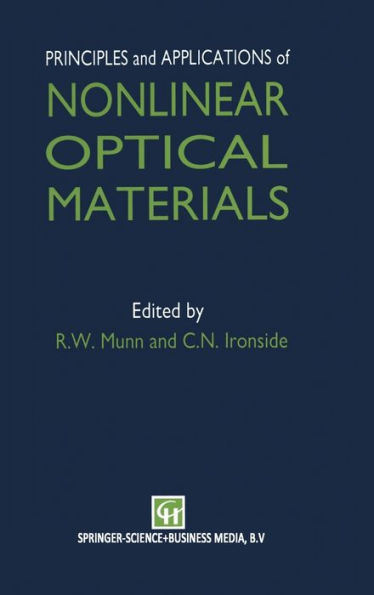
Principles and Applications of Nonlinear Optical Materials
257
345.0
In Stock

Product Details
| ISBN-13: | 9780751400854 |
|---|---|
| Publisher: | Springer-Verlag New York, LLC |
| Publication date: | 08/08/2004 |
| Pages: | 257 |
| Product dimensions: | 6.30(w) x 9.06(h) x (d) |
From the B&N Reads Blog