
Why unfettered free-market capitalism endangers democracy—and what to do about it.
In Private Power and Democracy’s Decline, Mordecai Kurz explores the relationship between free-market capitalism and democracy. He shows that technology made capitalism different from that envisioned in the age of enlightenment. Technology creates centers of market power and monopoly concentration that result in a society in which some people are enriched immensely, while many workers’ livelihoods are often destroyed. Contrary to conventional thinking, technological competition does not remove market power, which becomes a permanent fixture of free-market capitalism. Such private power creates political inequality and generates forces causing democracy’s decline and possible destruction.
Applying these ideas to the US, Kurz shows that today’s problems begin with the policy of unregulated free-market capitalism introduced in the 1980s. Coupled with the information technology revolution, this combination created a techno-winner-takes-all economy—leading to a second Gilded Age of unsustainable inequality and extreme political polarization. In the last 50 years, the economy “boomed” for some while leaving behind the majority of America's workers.
Kurz concludes that capitalism can support democracy only by being regulated, where the benefits of technology are more equally shared and no person’s livelihood is destroyed to enable others to be enriched. To save democracy, he proposes a “Preservation of Livelihood” policy, offering firms managerial flexibility to maintain rising productivity, but ensuring that technology does not destroy the livelihood of others.
1148039788
In Private Power and Democracy’s Decline, Mordecai Kurz explores the relationship between free-market capitalism and democracy. He shows that technology made capitalism different from that envisioned in the age of enlightenment. Technology creates centers of market power and monopoly concentration that result in a society in which some people are enriched immensely, while many workers’ livelihoods are often destroyed. Contrary to conventional thinking, technological competition does not remove market power, which becomes a permanent fixture of free-market capitalism. Such private power creates political inequality and generates forces causing democracy’s decline and possible destruction.
Applying these ideas to the US, Kurz shows that today’s problems begin with the policy of unregulated free-market capitalism introduced in the 1980s. Coupled with the information technology revolution, this combination created a techno-winner-takes-all economy—leading to a second Gilded Age of unsustainable inequality and extreme political polarization. In the last 50 years, the economy “boomed” for some while leaving behind the majority of America's workers.
Kurz concludes that capitalism can support democracy only by being regulated, where the benefits of technology are more equally shared and no person’s livelihood is destroyed to enable others to be enriched. To save democracy, he proposes a “Preservation of Livelihood” policy, offering firms managerial flexibility to maintain rising productivity, but ensuring that technology does not destroy the livelihood of others.
Private Power and Democracy's Decline: How to Make Capitalism Support Democracy
Why unfettered free-market capitalism endangers democracy—and what to do about it.
In Private Power and Democracy’s Decline, Mordecai Kurz explores the relationship between free-market capitalism and democracy. He shows that technology made capitalism different from that envisioned in the age of enlightenment. Technology creates centers of market power and monopoly concentration that result in a society in which some people are enriched immensely, while many workers’ livelihoods are often destroyed. Contrary to conventional thinking, technological competition does not remove market power, which becomes a permanent fixture of free-market capitalism. Such private power creates political inequality and generates forces causing democracy’s decline and possible destruction.
Applying these ideas to the US, Kurz shows that today’s problems begin with the policy of unregulated free-market capitalism introduced in the 1980s. Coupled with the information technology revolution, this combination created a techno-winner-takes-all economy—leading to a second Gilded Age of unsustainable inequality and extreme political polarization. In the last 50 years, the economy “boomed” for some while leaving behind the majority of America's workers.
Kurz concludes that capitalism can support democracy only by being regulated, where the benefits of technology are more equally shared and no person’s livelihood is destroyed to enable others to be enriched. To save democracy, he proposes a “Preservation of Livelihood” policy, offering firms managerial flexibility to maintain rising productivity, but ensuring that technology does not destroy the livelihood of others.
In Private Power and Democracy’s Decline, Mordecai Kurz explores the relationship between free-market capitalism and democracy. He shows that technology made capitalism different from that envisioned in the age of enlightenment. Technology creates centers of market power and monopoly concentration that result in a society in which some people are enriched immensely, while many workers’ livelihoods are often destroyed. Contrary to conventional thinking, technological competition does not remove market power, which becomes a permanent fixture of free-market capitalism. Such private power creates political inequality and generates forces causing democracy’s decline and possible destruction.
Applying these ideas to the US, Kurz shows that today’s problems begin with the policy of unregulated free-market capitalism introduced in the 1980s. Coupled with the information technology revolution, this combination created a techno-winner-takes-all economy—leading to a second Gilded Age of unsustainable inequality and extreme political polarization. In the last 50 years, the economy “boomed” for some while leaving behind the majority of America's workers.
Kurz concludes that capitalism can support democracy only by being regulated, where the benefits of technology are more equally shared and no person’s livelihood is destroyed to enable others to be enriched. To save democracy, he proposes a “Preservation of Livelihood” policy, offering firms managerial flexibility to maintain rising productivity, but ensuring that technology does not destroy the livelihood of others.
20.99
Pre Order
5
1

Private Power and Democracy's Decline: How to Make Capitalism Support Democracy
288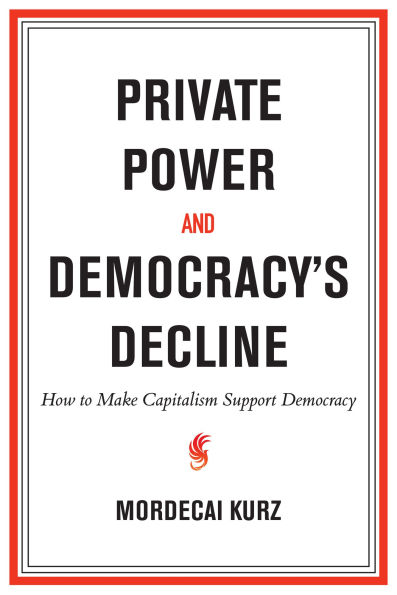
Private Power and Democracy's Decline: How to Make Capitalism Support Democracy
288Related collections and offers
20.99
Pre Order

Product Details
| ISBN-13: | 9780262053549 |
|---|---|
| Publisher: | MIT Press |
| Publication date: | 05/12/2026 |
| Sold by: | Penguin Random House Publisher Services |
| Format: | eBook |
| Pages: | 288 |
About the Author
From the B&N Reads Blog