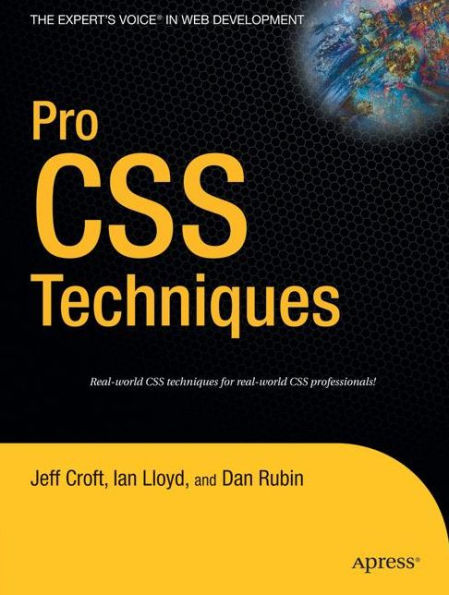
Pro CSS Techniques

( 1 )

Overview

Pro CSS Techniques is the ultimate CSS book for the modern web developer. If you’ve already got web design and development basics under your belt, but want to take your knowledge to the next level and unleash the full power of CSS in your web sites, then this is the book for you. It is a collection of proven CSS techniques that you can use daily to get the most out of the time you spend on your projects, from start to finish.

Every topic is presented in an informative tutorial ...

See more details below
Paperback
$31.76
BN.com price
(Save 20%)$39.99 List Price
Other sellers (Paperback)
  • All (15) from $1.99   
  • New (6) from $19.80   
  • Used (9) from $1.99   
Sending request ...

Overview

Pro CSS Techniques is the ultimate CSS book for the modern web developer. If you’ve already got web design and development basics under your belt, but want to take your knowledge to the next level and unleash the full power of CSS in your web sites, then this is the book for you. It is a collection of proven CSS techniques that you can use daily to get the most out of the time you spend on your projects, from start to finish.

Every topic is presented in an informative tutorial style, with each point backed up by several real-world examples and case studies. The authors cover all the essential areas of CSS development, like browser support (including IE7), hacks and filters, code management, advanced layouts and styling, typography, and much more. CSS levels 1, 2, and 3 are given a full treatment. The book also includes several reference sections that allow you to look up details quickly and easily.

The book aims to help you in four areas: maintainability, compatibility, reusability, and practicality. You’ll be able to keep your code organized and easy to maintain, avoiding browser issues before they crop up (or hacking around them when absolutely necessary). You’ll learn to get the most out of your styles with inheritance, and by using techniques you can build on. And you’ll learn to use what works in the real world, without getting too caught up in ideals, because you can always optimize later.
Read More Show Less

Product Details

  • ISBN-13: 9781590597323
  • Publisher: Apress
  • Publication date: 11/22/2006
  • Series: Expert's Voice Series
  • Edition number: 1
  • Pages: 408
  • Product dimensions: 9.25 (w) x 7.50 (h) x 0.84 (d)

Meet the Author

Music, design, typography, web standards, South Florida beaches. What could these things possibly have in common? Dan Rubin, that's what—er, who. From vocal coaching and performing to graphic design and (almost literally) everything in between, Dan does his best to spread his talent as thin and as far as he possibly can while still leaving time for a good cup of tea and the occasional nap. His passion for all things creative and artistic isn't a solely selfish endeavor either—you don't have to hang around too long before you'll find him waxing educational about a cappella jazz and barbershop harmony, interface design, usability, web standards, and which typeface was on the bus ad that just whizzed by at 60mph. Dan has been known to write the occasional entry on his blog, superfluousbanter.org (you might even find a podcast or two if you poke around enough), and his professional work can be found at his agency's site, webgraph.com.

Ian Lloydruns Accessify.com, a site dedicated to promoting web accessibility and providing tools for web developers. His personal site, Blog Standard Stuff, ironically, has nothing to do with standards for blogs (it's a play on words), although there is an occasional standards-related gem to be found there. Ian works full-time for Nationwide Building Society, where he tries his hardest to influence standards-based design ("to varying degrees!"). He is a member of the Web Standards Project, contributing to the Accessibility Task Force. Web standards and accessibility aside, he enjoys writing about his trips abroad and recently took a "year out" from work and all things web (but then ended up writing more in his year off than he ever has). He finds most of his time being taken up by a demanding old lady (relax, it's only his old Volkswagen camper van). Ian wrote his first book for SitePoint, titled Build Your First Web Site the Right Way with HTML and CSS, in which he teaches web standards-based design to the complete beginner.

Jeff Croft is a web and graphic designer focused on web standards-based development living and working Lawrence, Kansas. As the senior designer at World Online, Jeff works on such award-winning standards-based sites as Lawrence.com and LJworld.com. Jeff also runs a popular blog and personal site at JeffCroft.com, where he writes about many topics, including modern web and graphic design. In addition to his work with World Online, Jeff has also worked at two major universities in an effort to bring web standards to the education sector, and completed many freelance and contract jobs for varying clients. When he's not hunched over a computer, Jeff enjoys photography, music, film, television, and a good night out on the town.

Read More Show Less

Customer Reviews

Average Rating 5
( 1 )
Rating Distribution

5 Star

(1)

4 Star

(0)

3 Star

(0)

2 Star

(0)

1 Star

(0)

Your Rating:

Your Name: Create a Pen Name or

Barnes & Noble.com Review Rules

Our reader reviews allow you to share your comments on titles you liked, or didn't, with others. By submitting an online review, you are representing to Barnes & Noble.com that all information contained in your review is original and accurate in all respects, and that the submission of such content by you and the posting of such content by Barnes & Noble.com does not and will not violate the rights of any third party. Please follow the rules below to help ensure that your review can be posted.

Reviews by Our Customers Under the Age of 13

We highly value and respect everyone's opinion concerning the titles we offer. However, we cannot allow persons under the age of 13 to have accounts at BN.com or to post customer reviews. Please see our Terms of Use for more details.

What to exclude from your review:

Please do not write about reviews, commentary, or information posted on the product page. If you see any errors in the information on the product page, please send us an email.

Reviews should not contain any of the following:

  • - HTML tags, profanity, obscenities, vulgarities, or comments that defame anyone
  • - Time-sensitive information such as tour dates, signings, lectures, etc.
  • - Single-word reviews. Other people will read your review to discover why you liked or didn't like the title. Be descriptive.
  • - Comments focusing on the author or that may ruin the ending for others
  • - Phone numbers, addresses, URLs
  • - Pricing and availability information or alternative ordering information
  • - Advertisements or commercial solicitation

Reminder:

  • - By submitting a review, you grant to Barnes & Noble.com and its sublicensees the royalty-free, perpetual, irrevocable right and license to use the review in accordance with the Barnes & Noble.com Terms of Use.
  • - Barnes & Noble.com reserves the right not to post any review -- particularly those that do not follow the terms and conditions of these Rules. Barnes & Noble.com also reserves the right to remove any review at any time without notice.
  • - See Terms of Use for other conditions and disclaimers.
Search for Products You'd Like to Recommend

Recommend other products that relate to your review. Just search for them below and share!

Create a Pen Name

Your Pen Name is your unique identity on BN.com. It will appear on the reviews you write and other website activities. Your Pen Name cannot be edited, changed or deleted once submitted.

 
Your Pen Name can be any combination of alphanumeric characters (plus - and _), and must be at least two characters long.

Continue Anonymously
Sort by: Showing 1 Customer Reviews
  • Anonymous

    Posted December 23, 2006

    Simple-Talk.com Review of Pro CSS Techniques

    As a developer, I¿ve had to endure my fair share of designers lecturing on the virtues of Cascading Style Sheets (CSS) and maintaining a strict divide between content elements and their visual layout. It¿s a noble pursuit, but for a developer with little design experience the task of getting a page to look just the way you want using CSS can be a difficult and frustrating undertaking that quickly regresses back to the form I know best: using table after table for layouts and haphazardly slapping style strings into various elements until the page comes out looking right. In other words, the approach designers hate. Instead of abiding in my ignorance of CSS, I decided to pick up a copy of Pro CSS Techniques by Jeff Croft, Ian Lloyd, and Dan Rubin. It¿s an intermediate to advanced-level book on CSS that assumes you have some basic knowledge of CSS. If you feel comfortable using styles directly in your HTML, then you¿ll be comfortable reading through this book. The authors did a great job of covering the basics enough to inform you if you need it, but not dwelling on it to the point of boredom if you do not. They also did a great job of explaining the ¿how¿ and ¿why¿ behind some of the most confusing aspects of CSS, which is why I definitely recommend picking up a copy. Pro CSS Techniques starts out with a great introduction to Semantic HTML, the concept that HTML should only define what is on the page, not what it should look like. It also discusses why you need to write Semantic HTML if you want to use CSS effectively. After understanding this concept in more detail, I understand why I ran into so many walls trying to use CSS to style my pages: I was fighting an uphill battle against the layout and style information that was already in my HTML document. After outlining some of the theory behind CSS, the authors discuss the CSS language and syntax. If you are novice with CSS, this will bring you up to speed very quickly. The section discussing CSS selectors was invaluable. I¿ve read a number of online tutorials for CSS and none of them ever got into the detail offered by this book. And if you¿ve ever wondered about the ¿Cascading¿ part of Cascading Style Sheets, then you¿ll find a complete overview about the intricacies of that as well. You will also find an entire chapter containing valuable information on how the various browsers handle CSS and how to get your pages looking consistent across those browsers without hacks. And when a traditional approach won¿t work, you can turn to the chapter entirely dedicated to CSS Hacks that discusses what they are, what they do, when to use them, when to avoid them, and how to use them in your CSS. As you work with CSS, you can use the book as a guide because it breaks out common tasks into individual chapters. You can easily thumb through to the applicable section as you build the layout, create common page elements (headers, footers, navigation, breadcrumbs, sidebars, etc), style text, tables, forms, and lists. I remember the first time I saw a bulleted list turned into a graphical menu and I attributed it to dark magic. Now I know how it was really done. And let¿s not forget my favorite chapter, ¿Everything Falls Apart¿, which describes most of my experience with CSS up to now. It covers what to do when things aren¿t working, and their solutions are much more elegant than returning to nested table layouts and forgoing the principals of CSS. I usually like to know what¿s in a book, so there¿s a chapter listing in case you¿re curious -- Chapter 1 - The Promise of CSS - Chapter 2 - The Language of Style Sheets - Chapter 3 - Specificity and the Cascade - Chapter 4 - The Browsers - Chapter 5 - Managing CSS Files - Chapter 6 - Hacks and Workarounds - Chapter 7 - CSS Layouts - Chapter 8 - Creating Common Page Elements - Chapter 9 - Typography - Chapter 10 - Styling Tables - Chapter 11 - Styling Forms - Chapter 12 - Styling Lists

    Was this review helpful? Yes  No   Report this review
Sort by: Showing 1 Customer Reviews

If you find inappropriate content, please report it to Barnes & Noble
Why is this product inappropriate?
Comments (optional)