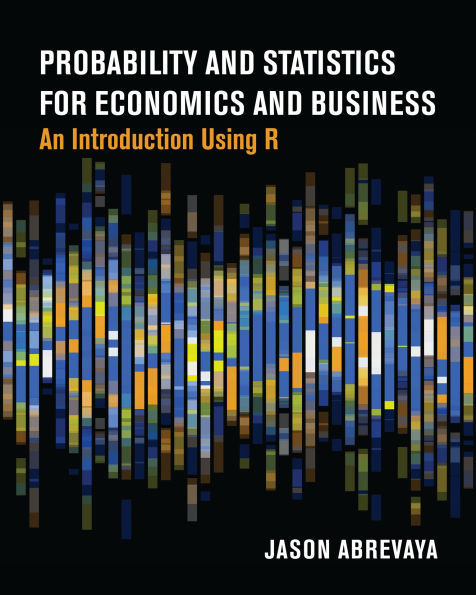
Probability and Statistics for Economics and Business: An Introduction Using R
A modern introduction to probability and statistics for economics and business undergraduates, using the R programming language.

Designed for an introductory course in probability and statistics for economics and business undergraduates, this comprehensive textbook introduces students to the R statistical programming language. While covering the standard topics found in traditional textbooks, Jason Abrevaya takes a modern approach that directly integrates R, highlights the use of simulation methods, and provides a general treatment of statistical inference for asymptotically normal estimators. Coverage emphasizes concepts that are useful to economists and data analysts, including general statistical-inference results that apply well beyond averages and variances. The book offers a higher level of mathematical rigor than traditional business statistics textbooks to prepare students for future coursework and for a professional climate where employers increasingly emphasize competence in data science and statistics.

  • Introduces students to the R statistical programming language
  • Uses real-world examples and datasets related to economics and business
  • Provides extensive coverage of simulation methods
  • Focuses on large-sample (asymptotic) results
  • Is classroom-tested at Emory University, the University of Texas at Austin, Princeton University, and elsewhere
  • Suits undergraduate and graduate students in business, economics, data science, and statistics with knowledge of calculus
  • Offers companion website and extensive instructor resources
1147054197
Probability and Statistics for Economics and Business: An Introduction Using R
A modern introduction to probability and statistics for economics and business undergraduates, using the R programming language.

Designed for an introductory course in probability and statistics for economics and business undergraduates, this comprehensive textbook introduces students to the R statistical programming language. While covering the standard topics found in traditional textbooks, Jason Abrevaya takes a modern approach that directly integrates R, highlights the use of simulation methods, and provides a general treatment of statistical inference for asymptotically normal estimators. Coverage emphasizes concepts that are useful to economists and data analysts, including general statistical-inference results that apply well beyond averages and variances. The book offers a higher level of mathematical rigor than traditional business statistics textbooks to prepare students for future coursework and for a professional climate where employers increasingly emphasize competence in data science and statistics.

  • Introduces students to the R statistical programming language
  • Uses real-world examples and datasets related to economics and business
  • Provides extensive coverage of simulation methods
  • Focuses on large-sample (asymptotic) results
  • Is classroom-tested at Emory University, the University of Texas at Austin, Princeton University, and elsewhere
  • Suits undergraduate and graduate students in business, economics, data science, and statistics with knowledge of calculus
  • Offers companion website and extensive instructor resources
130.0 Out Of Stock
Probability and Statistics for Economics and Business: An Introduction Using R

Probability and Statistics for Economics and Business: An Introduction Using R

by Jason Abrevaya
Probability and Statistics for Economics and Business: An Introduction Using R

Probability and Statistics for Economics and Business: An Introduction Using R

by Jason Abrevaya

Paperback

$130.00 
  • SHIP THIS ITEM
    Temporarily Out of Stock Online
  • PICK UP IN STORE

    Your local store may have stock of this item.

Related collections and offers


Overview

A modern introduction to probability and statistics for economics and business undergraduates, using the R programming language.

Designed for an introductory course in probability and statistics for economics and business undergraduates, this comprehensive textbook introduces students to the R statistical programming language. While covering the standard topics found in traditional textbooks, Jason Abrevaya takes a modern approach that directly integrates R, highlights the use of simulation methods, and provides a general treatment of statistical inference for asymptotically normal estimators. Coverage emphasizes concepts that are useful to economists and data analysts, including general statistical-inference results that apply well beyond averages and variances. The book offers a higher level of mathematical rigor than traditional business statistics textbooks to prepare students for future coursework and for a professional climate where employers increasingly emphasize competence in data science and statistics.

  • Introduces students to the R statistical programming language
  • Uses real-world examples and datasets related to economics and business
  • Provides extensive coverage of simulation methods
  • Focuses on large-sample (asymptotic) results
  • Is classroom-tested at Emory University, the University of Texas at Austin, Princeton University, and elsewhere
  • Suits undergraduate and graduate students in business, economics, data science, and statistics with knowledge of calculus
  • Offers companion website and extensive instructor resources

Product Details

ISBN-13: 9780262553360
Publisher: MIT Press
Publication date: 11/25/2025
Pages: 680
Product dimensions: 8.06(w) x 10.00(h) x 1.19(d)

About the Author

Jason Abrevaya is Professor of Economics at the University of Texas at Austin and is the holder of the Murray S. Johnson Chair in Economics. He has served on editorial boards for several leading econometrics journals, including the Journal of Econometrics, the Journal of Applied Econometrics, and the Journal of Business and Economic Statistics, and was a founding coeditor of the Journal of Econometric Methods.

Table of Contents

Preface ix
Acknowledgments xv
1 The basics of R 1
1.1 Installing R 1
1.2 Arithmetic operations and mathematical functions 2
1.3 Variables and data types 4
1.4 Vectors 9
1.5 Output 18
1.6 Programming 18
1.7 Writing functions 22
1.8 Data frames and file input 24
1.9 Missing values 29
1.10 R packages 30
Exercises 32
2 Introduction to probability theory 37
2.1 Experiments and sample spaces 39
2.2 Events 42
2.3 What is a probability? 45
2.4 Properties of probabilities 51
Exercises 55
3 Conditional probabilities and independence 59
3.1 Definition and properties of conditional probabilities 59
3.2 Multiplication rule and Bayes’ Theorem 60
3.3 Probability tables 63
3.4 Independence 66
3.5 Examples with an infinite number of outcomes 70
Exercises 72
4 Combinatorics (counting methods) 77
4.1 Product rule and sum rule 77
4.2 Permutations and combinations 78
4.3 Probabilities for equally likely choices 81
Exercises 83
5 Economic data and sampling 89
5.1 Types of data 89
5.2 Types of variables 91
5.3 The population and sampling 93
Exercises 96
6 Descriptive statistics and visuals: univariate data 99
6.1 Dataset examples 99
6.2 Categorical data: sample proportions and bar charts 102
6.3 Numerical data: histograms 104
6.4 Numerical data: measures of location 110
6.5 Numerical data: measures of dispersion 116
6.6 Modal outcomes 126
6.7 Linear transformations of univariate data 128
6.8 Time-series plots 133
Exercises 136
7 Descriptive statistics and visuals: bivariate data 143
7.1 Categorical variables 143
7.2 Numerical data: scatter plots, sample covariance and correlation 151
7.3 Correlation is not causation 172
Exercises 173
8 Discrete random variables 179
8.1 Using sample proportions to calculate descriptive statistics 179
8.2 Random variables and discrete random variables 180
8.3 Population descriptive statistics 188
8.4 Multiple discrete random variables 191
8.5 Linear transformations 202
8.6 Linear combination of multiple random variables 204
8.7 Expected values of functions of discrete random variables 207
Exercises 208
9 Models of discrete random variables 215
9.1 Bernoulli random variable 215
9.2 Binomial random variable 216
9.3 Geometric random variable 222
9.4 Negative binomial random variable 224
9.5 Poisson random variable 227
Exercises 230
10 Continuous random variables 237
10.1 Continuous random variables vs. discrete random variables 237
10.2 Probability density function 238
10.3 Cumulative distribution function 243
10.4 Population descriptive statistics 249
10.5 Linear transformations of one random variable 256
10.6 Multiple continuous random variables 258
10.7 Linear transformations and combinations of multiple random variables 268
10.8 Expected values of functions of continuous random variables 273
10.9 Strictly increasing transformations of random variables 275
10.10 Random variables with discrete and continuous outcomes 277
Exercises 278
11 Models of continuous random variables 285
11.1 Normal random variable 285
11.2 Log-normal random variable 297
11.3 Chi-square random variable 301
11.4 Exponential random variable 303
11.5 Mixture of normal random variables 307
Exercises 309
12 Sampling distributions: exact 315
12.1 Sampling distribution of the sample mean 317
12.2 Sampling distribution of the sample variance 322
12.3 Sampling distribution of other statistics 328
Exercises 332
13 Sampling distributions: asymptotic 337
13.1 Asymptotic distribution of the sample mean 337
13.2 Asymptotic distribution of the sample variance 345
13.3 Asymptotic distribution of other statistics 348
Exercises 354
14 Estimation and confidence intervals 359
14.1 Estimation and properties of estimators 359
14.2 Finite-sample confidence intervals: population mean of i.i.d. normal random variables 363
14.3 Asymptotic confidence intervals: population mean of i.i.d. random variables 372
14.4 Asymptotic confidence intervals: parameters with asymptotically normal estimators 377
14.5 Functions of consistent estimators 392
14.6 Asymptotic predictive intervals for continuous random variables 393
Exercises 394
15 The bootstrap 401
15.1 Bootstrap sampling 402
15.2 Bootstrap sampling distribution 405
15.3 Bootstrap standard errors and bootstrap confidence intervals 406
Exercises 414
16 Hypothesis testing 417
16.1 Finite-sample hypothesis testing: population mean of i.i.d. normal random variables 418
16.2 Asymptotic hypothesis testing: parameters with asymptotically normal estimators 429
16.3 Statistical significance versus practical significance 437
16.4 Hypothesis testing for multiple hypotheses: the Wald test 438
Appendix: Details for the Wald test 444
Exercises 450
17 Simple linear regression 455
17.1 The simple linear regression model 455
17.2 The least-squares estimator 460
17.3 Fitted values, estimated residuals, and regression fit 468
17.4 Asymptotic normality and statistical inference 477
17.5 Causality and prediction 487
Exercises 490
18 Multiple linear regression 497
18.1 The multiple linear regression model 497
18.2 The least-squares estimator 499
18.3 Standard errors and confidence intervals 509
18.4 Inference for linear combinations of regression parameters 513
18.5 Hypothesis testing 515
18.6 Modeling approaches and explanatory variables 518
18.7 Log-transformed outcome variable 528
18.8 Asymptotic predictive intervals 530
18.9 Linear probability model 535
Exercises 539
References 544
From the B&N Reads Blog

Customer Reviews