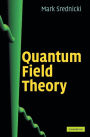


Quantum Field Theory / Edition 1

Hardcover (Print)
Rent
Rent from BN.com
$43.82
(Save 50%)
Est. Return Date: 07/19/2013
Buy New
Buy New from BN.com
$78.00
(Save 11%)
Used and New from Other Sellers
from $36.00
Usually ships in 1-2 business days
(Save 59%)
Other sellers (Hardcover)
  • All (29) from $36.00   
  • New (17) from $54.55   
  • Used (12) from $36.00   

Overview

Quantum field theory is the basic mathematical framework that is used to describe elementary particles. This textbook provides a complete and essential introduction to the subject. Assuming only an undergraduate knowledge of quantum mechanics and special relativity, this book is ideal for graduate students beginning the study of elementary particles. The step-by-step presentation begins with basic concepts illustrated by simple examples, and proceeds through historically important results to thorough treatments of modern topics such as the renormalization group, spinor-helicity methods for quark and gluon scattering, magnetic monopoles, instantons, supersymmetry, and the unification of forces. The book is written in a modular format, with each chapter as self-contained as possible, and with the necessary prerequisite material clearly identified. It is based on a year-long course given by the author and contains extensive problems, with password protected solutions available to lecturers at www.cambridge.org/9780521864497.
Read More Show Less

Editorial Reviews

From the Publisher
"This accessible and conceptually structured introduction to quantum field theory will be of value not only to beginning students but also to practicing physicists interested in learning or reviewing specific topics. The book is organized in a modular fashion, which makes it easy to extract the basic information relevant to the reader's area(s) of interest. The material is presented in an intuitively clear and informal style. Foundational topics such as path integrals and Lorentz representations are included early in the exposition, as appropriate for a modern course; later material includes a detailed description of the Standard Model and other advanced topics such as instantons, supersymetry, and unification, which are essential knowledge for working particle physicists, but which are not treated in most other field theory texts."
Washington Taylor, Massachusetts Institute of Technology

"Over the years I have used parts of Srednicki's book to teach field theory to physics graduate students not specializing in particle physics. This is a vast subject, with many outstanding textbooks. Among these, Srednicki's stands out for its pedagogy. The subject is built logically, rather than historically. The exposition walks the line between getting the idea across and not shying away from a serious calculation. Path integrals enter early, and renormalization theory is pursued from the very start...By the end of the course the student should understand both beta functions and the Standard Model, and be able to carry through a calculation when a perturbative calculation is called for."
Predrag Cvitanovic, Georgia Institute of Technology

"This book should become a favorite of quantum field theory students and instructors. The approach is systematic and comprehensive, but the friendly and encouraging voice of the author comes through loud and clear to make the subject feel accessible. Many interesting examples are worked out in pedagogical detail."
Ann Nelson, University of Washington

"I expect that this will be the textbook of choice for many quantum field theory courses. The presentation is straightforward and readable, with the author's easy-going 'voice' coming through in his writing. The organization into a large number of short chapters, with the prerequisites for each chapter clearly marked, makes the book flexible and easy to teach from or to read independently. A large and varied collection of special topics is available, depending on the interests of the instructor and the student."
Joseph Polchinski, University of California, Santa Barbara

"This is an extraordinary book, a real gem. After a cursory glance, all will have the clear impression that this is a "revolutionary" book. In my opinion, this is simply the best QFT textbook ever written... it is absolutely invaluable."
Giuseppe Nardelli, Mathematical Reviews

Read More Show Less

Product Details

  • ISBN-13: 9780521864497
  • Publisher: Cambridge University Press
  • Publication date: 1/31/2007
  • Edition description: New Edition
  • Edition number: 1
  • Pages: 664
  • Sales rank: 865,338
  • Product dimensions: 6.85 (w) x 9.72 (h) x 1.46 (d)

Meet the Author

Mark Srednicki is Professor of Physics at the University of California, Santa Barbara. He gained his undergraduate degree from Cornell University in 1977, and received a PhD from Stanford University in 1980. Professor Srednicki has held postdoctoral positions at Princeton University and the European Organization for Nuclear Research (CERN).
Read More Show Less

Table of Contents

Preface for students; Preface for instructors; Acknowledgements; Part I. Spin Zero: 1. Attempts at relativistic quantum mechanics; 2. Lorentz invariance; 3. Canonical quantization of scalar fields; 4. The spin-statistics theorem; 5. The LSZ reduction formula; 6. Path integrals in quantum mechanics; 7. The path integral for the harmonic oscillator; 8. The path integral for free field theory; 9. The path integral for interacting field theory; 10. Scattering amplitudes and the Feynman rules; 11. Cross sections and decay rates; 12. Dimensional analysis with ?=c=1; 13. The Lehmann-Källén form; 14. Loop corrections to the propagator; 15. The one-loop correction in Lehmann-Källén form; 16. Loop corrections to the vertex; 17. Other 1PI vertices; 18. Higher-order corrections and renormalizability; 19. Perturbation theory to all orders; 20. Two-particle elastic scattering at one loop; 21. The quantum action; 22. Continuous symmetries and conserved currents; 23. Discrete symmetries: P, T, C, and Z; 24. Nonabelian symmetries; 25. Unstable particles and resonances; 26. Infrared divergences; 27. Other renormalization schemes; 28. The renormalization group; 29. Effective field theory; 30. Spontaneous symmetry breaking; 31. Broken symmetry and loop corrections; 32. Spontaneous breaking of continuous symmetries; Part II. Spin One Half: 33. Representations of the Lorentz Group; 34. Left- and right-handed spinor fields; 35. Manipulating spinor indices; 36. Lagrangians for spinor fields; 37. Canonical quantization of spinor fields I; 38. Spinor technology; 39. Canonical quantization of spinor fields II; 40. Parity, time reversal, and charge conjugation; 41. LSZ reduction for spin-one-half particles; 42. The free fermion propagator; 43. The path integral for fermion fields; 44. Formal development of fermionic path integrals; 45. The Feynman rules for Dirac fields; 46. Spin sums; 47. Gamma matrix technology; 48. Spin-averaged cross sections; 49. The Feynman rules for majorana fields; 50. Massless particles and spinor helicity; 51. Loop corrections in Yukawa theory; 52. Beta functions in Yukawa theory; 53. Functional determinants; Part III. Spin One: 54. Maxwell's equations; 55. Electrodynamics in coulomb gauge; 56. LSZ reduction for photons; 57. The path integral for photons; 58. Spinor electrodynamics; 59. Scattering in spinor electrodynamics; 60. Spinor helicity for spinor electrodynamics; 61. Scalar electrodynamics; 62. Loop corrections in spinor electrodynamics; 63. The vertex function in spinor electrodynamics; 64. The magnetic moment of the electron; 65. Loop corrections in scalar electrodynamics; 66. Beta functions in quantum electrodynamics; 67. Ward identities in quantum electrodynamics I; 68. Ward identities in quantum electrodynamics II; 69. Nonabelian gauge theory; 70. Group representations; 71. The path integral for nonabelian gauge theory; 72. The Feynman rules for nonabelian gauge theory; 73. The beta function for nonabelian gauge theory; 74. BRST symmetry; 75. Chiral gauge theories and anomalies; 76. Anomalies in global symmetries; 77. Anomalies and the path integral for fermions; 78. Background field gauge; 79. Gervais-Neveu gauge; 80. The Feynman rules for N x N matrix fields; 81. Scattering in quantum chromodynamics; 82. Wilson loops, lattice theory, and confinement; 83. Chiral symmetry breaking; 84. Spontaneous breaking of gauge symmetries; 85. Spontaneously broken abelian gauge theory; 86. Spontaneously broken nonabelian gauge theory; 87. The standard model: Gauge and Higgs sector; 88. The standard model: Lepton sector; 89. The standard model: Quark sector; 90. Electroweak interactions of hadrons; 91. Neutrino masses; 92. Solitons and monopoles; 93. Instantons and theta vacua; 94. Quarks and theta vacua; 95. Supersymmetry; 96. The minimal supersymmetric standard model; 97. Grand unification; Bibliography.
Read More Show Less

Customer Reviews

Be the first to write a review
( 0 )
Rating Distribution

5 Star

(0)

4 Star

(0)

3 Star

(0)

2 Star

(0)

1 Star

(0)

Your Rating:

Your Name: Create a Pen Name or

Barnes & Noble.com Review Rules

Our reader reviews allow you to share your comments on titles you liked, or didn't, with others. By submitting an online review, you are representing to Barnes & Noble.com that all information contained in your review is original and accurate in all respects, and that the submission of such content by you and the posting of such content by Barnes & Noble.com does not and will not violate the rights of any third party. Please follow the rules below to help ensure that your review can be posted.

Reviews by Our Customers Under the Age of 13

We highly value and respect everyone's opinion concerning the titles we offer. However, we cannot allow persons under the age of 13 to have accounts at BN.com or to post customer reviews. Please see our Terms of Use for more details.

What to exclude from your review:

Please do not write about reviews, commentary, or information posted on the product page. If you see any errors in the information on the product page, please send us an email.

Reviews should not contain any of the following:

  • - HTML tags, profanity, obscenities, vulgarities, or comments that defame anyone
  • - Time-sensitive information such as tour dates, signings, lectures, etc.
  • - Single-word reviews. Other people will read your review to discover why you liked or didn't like the title. Be descriptive.
  • - Comments focusing on the author or that may ruin the ending for others
  • - Phone numbers, addresses, URLs
  • - Pricing and availability information or alternative ordering information
  • - Advertisements or commercial solicitation

Reminder:

  • - By submitting a review, you grant to Barnes & Noble.com and its sublicensees the royalty-free, perpetual, irrevocable right and license to use the review in accordance with the Barnes & Noble.com Terms of Use.
  • - Barnes & Noble.com reserves the right not to post any review -- particularly those that do not follow the terms and conditions of these Rules. Barnes & Noble.com also reserves the right to remove any review at any time without notice.
  • - See Terms of Use for other conditions and disclaimers.
Search for Products You'd Like to Recommend

Recommend other products that relate to your review. Just search for them below and share!

Create a Pen Name

Your Pen Name is your unique identity on BN.com. It will appear on the reviews you write and other website activities. Your Pen Name cannot be edited, changed or deleted once submitted.

 
Your Pen Name can be any combination of alphanumeric characters (plus - and _), and must be at least two characters long.

Continue Anonymously

    If you find inappropriate content, please report it to Barnes & Noble
    Why is this product inappropriate?
    Comments (optional)


