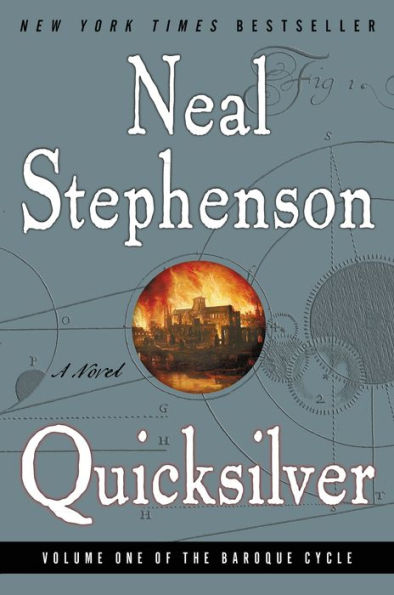
Quicksilver (Baroque Cycle Series #1)

( 117 )

Pick Up in Store

Reserve and pick up in 60 minutes at your local store

Paperback (Reprint)
$11.75
BN.com price
$15.99 List Price (Save 27%)
Marketplace (New and Used)
from
$0.01
$15.99 List Price (Save 100%)
All (141)  
Used (121)  
New (20)  
Close
Sort by
Page 1 of 15
Showing 1 – 10 of 141 (15 pages)
$0.01
(Save 100%)
Seller since 2012

Feedback rating:

(17)

Condition:

New — never opened or used in original packaging.

Like New — packaging may have been opened. A "Like New" item is suitable to give as a gift.

Very Good — may have minor signs of wear on packaging but item works perfectly and has no damage.

Good — item is in good condition but packaging may have signs of shelf wear/aging or torn packaging. All specific defects should be noted in the Comments section associated with each item.

Acceptable — item is in working order but may show signs of wear such as scratches or torn packaging. All specific defects should be noted in the Comments section associated with each item.

Used — An item that has been opened and may show signs of wear. All specific defects should be noted in the Comments section associated with each item.

Refurbished — A used item that has been renewed or updated and verified to be in proper working condition. Not necessarily completed by the original manufacturer.

Acceptable
100% Money Back Guarantee. Shows definite wear, and perhaps considerable marking on inside. Shipped to over one million happy customers. Your purchase benefits world literacy!

Ships from: Mishawaka, IN

Usually ships in 1-2 business days

  • Standard, 48 States
$0.01
(Save 100%)
Seller since 2009

Feedback rating:

(22568)

Condition: Good
Giving great service since 2004: Buy from the Best! 4,000,000 items shipped to delighted customers. We have 1,000,000 unique items ready to ship! Find your Great Buy today!

Ships from: Lakewood, WA

Usually ships in 1-2 business days

  • Canadian
  • International
  • Standard, 48 States
  • Standard (AK, HI)
  • Express, 48 States
  • Express (AK, HI)
$0.01
(Save 100%)
Seller since 2009

Feedback rating:

(18248)

Condition: Good
Buy from the best: 4,000,000 items shipped to delighted customers. We have 1,000,000 unique items ready to ship today!

Ships from: Lakewood, WA

Usually ships in 1-2 business days

  • Canadian
  • International
  • Standard, 48 States
  • Standard (AK, HI)
  • Express, 48 States
  • Express (AK, HI)
$0.01
(Save 100%)
Seller since 2006

Feedback rating:

(3584)

Condition: Good
Some wear on book from reading, some spine creases, wear on binding and pages, we guarantee all purchases and ship all items via USPS mail.

Ships from: Sumas, WA

Usually ships in 1-2 business days

  • Standard, 48 States
  • Standard (AK, HI)
$0.01
(Save 100%)
Seller since 2009

Feedback rating:

(22568)

Condition: Good
Giving great service since 2004: Buy from the Best! 4,000,000 items shipped to delighted customers. We have 1,000,000 unique items ready to ship! Find your Great Buy today!

Ships from: Lakewood, WA

Usually ships in 1-2 business days

  • Canadian
  • International
  • Standard, 48 States
  • Standard (AK, HI)
  • Express, 48 States
  • Express (AK, HI)
$0.99
(Save 94%)
Seller since 2008

Feedback rating:

(315)

Condition: Acceptable
2004 Paperback Fair Pages yellowed. Acceptable condition. CHARITY SALE! 100% of the proceeds benefit the literacy and educational efforts of Books for America.

Ships from: Fairfax, VA

Usually ships in 1-2 business days

  • Canadian
  • International
  • Standard, 48 States
  • Standard (AK, HI)
  • Express, 48 States
  • Express (AK, HI)
$0.99
(Save 94%)
Seller since 2012

Feedback rating:

(119)

Condition: Good
2004 Paperback The cover may contain minor wear, and the corners may have some light degree of damage. If there are any notes present, they would only be penciled and only ... visible on a few pages. There are no ink markings of any kind, but there may be a remainder-mark on the outside edge of the pages. Proceeds benefit non-profit Goodwill Industries of San Francisco, San Mateo and Marin Counties. We create solutions to poverty through the businesses we operate. Your purchase creates jobs and transforms liv. Read more Show Less

Ships from: San Francisco, CA

Usually ships in 1-2 business days

  • Canadian
  • International
  • Standard, 48 States
  • Standard (AK, HI)
  • Express, 48 States
  • Express (AK, HI)
$0.99
(Save 94%)
Seller since 2012

Feedback rating:

(119)

Condition: Good
2004 Paperback Book cover slightly dirty. Book shows some wear The cover may contain minor wear, and the corners may have some light degree of damage. If there are any notes ... present, they would only be penciled and only visible on a few pages. There are no ink markings of any kind, but there may be a remainder-mark on the outside edge of the pages. Proceeds benefit non-profit Goodwill Industries of San Francisco, San Mateo and Marin Counties. We create solutions to poverty through the businesses we operate. Read more Show Less

Ships from: San Francisco, CA

Usually ships in 1-2 business days

  • Canadian
  • International
  • Standard, 48 States
  • Standard (AK, HI)
  • Express, 48 States
  • Express (AK, HI)
$0.99
(Save 94%)
Seller since 2009

Feedback rating:

(1248)

Condition: Good
PAPERBACK Good 0060593083 100% Customer Satisfaction Guaranteed. Over 500, 000 Satisfied Customers Served!

Ships from: Fort Wayne, IN

Usually ships in 1-2 business days

  • Canadian
  • International
  • Standard, 48 States
  • Standard (AK, HI)
  • Express, 48 States
  • Express (AK, HI)
$1.00
(Save 94%)
Seller since 2009

Feedback rating:

(2447)

Condition: Good
A used copy. Pages are somewhat worn. Cover worn. Worn edges and corners. Binding solid and tight.

Ships from: Kent, WA

Usually ships in 1-2 business days

  • Standard, 48 States
  • Standard (AK, HI)
Page 1 of 15
Showing 1 – 10 of 141 (15 pages)
Close
Sort by
NOOK Book (eBook)
$9.99
BN.com price

Available on NOOK devices and apps

  • Nook Devices
  • NOOK
  • NOOK Color
  • NOOK Tablet
  • Tablet/Phone
  • NOOK for iPad
  • NOOK for iPhone
  • NOOK for Android
  • NOOK for Android (Tablet)
  • NOOK Kids for iPad
  • PC/Mac
  • NOOK Study
  • NOOK for PC
  • NOOK for Mac

Want a NOOK? Explore Now

All Available Formats + Editions

Marketplace From
BN.com
 

Overview

Neal Stephenson is one of America's most collectible authors. The ever-growing number of his devoted readers has created a huge demand for signed and first trade editions of his works.

With Quicksilver: The Deluxe Limited Edition, William Morrow presents the first limited edition ever published of Neal Stephenson's work. Limited to a single edition of just 1,000 copies, the book is a beautifully designed example of the art of bookbinding. Each volume will be numbered and signed by Neal Stephenson. Collectors and readers alike will welcome the chance to add this handsome volume to their Neal Stephenson collection.

  • Limited to an edition of 1,000 copies-never to be reprinted.
  • Completely redesigned from the trade hardcover in a larger format-7" x 10".
  • Each book numbered and signed by the author.
  • Each volume hand-bound in Japanese silk.
  • Each volume housed in a handsome slipcase featuring a die-cut aperture for the Quicksilver icon and covered in the same Japanese silk. The slipcase will also feature a silk ribbon pull for easy removal.
  • Matching signed limited editions of the second and third volumes of Stephenson's Baroque Cycle will be published by William Morrow at six-month intervals.

Only 1,000 copies of this limited edition of Neal Stephenson's Quicksilver were printed. Each is oversize, bound in leather, numbered, and signed by the author.

Editorial Reviews

From Barnes & Noble
The Barnes & Noble Review
If you love a rip-roaring yarn you’ll actually learn something from...if you devoured The DaVinci Code or The Name of the Rose or An Instance of the Fingerpost...if you’ve ever marveled at the ideas of Neal Stephenson in books like Snow Crash...have we got a treat for you. Quicksilver is here.

Stephenson has resurrected one of the most extraordinary eras in human history: the late 17th and early 18th century, when modern science (then called “natural philosophy”) stirred to its feet, and made its first powerful strides; when secret codes, secret knowledge, and alchemy were the order of the day; when Protestants and Catholics warred over the true faith, and the forces of Islam laid siege to Vienna...

Here are: Isaac Newton and Gottfried Wilhelm Leibniz, the simultaneous, disputing co-creators of calculus, and Benjamin Franklin as a boy, slick beyond his years. Here are Barbary pirates and vagabonds making their way in King Louis XIV’s court at Versailles. Here, too, are binary systems, hexadecimals, and memes.

And, for those who’ve read Stephenson’s Cryptonomicon, here are the forebears of some of that book’s characters. For example, “Half-Cocked” Jack Shaftoe, King of the Vagabonds, and a distant ancestor of U.S. marine raider Bobby Shaftoe. And, at the heart of the book, Dr. Daniel Waterhouse, generations removed from the Lawrence Pritchard Waterhouse who helped Alan Turing decode Nazi ciphers in Cryptonomicon.

It took an extraordinary storyteller (and researcher!) to create Quicksilver, one who’s been compared with everyone from Thomas Pynchon to Tom Clancy to William Gibson to Hemingway. (Incredibly, Stephenson, an early leader of the cyberpunk movement, wrote the first draft of this book with a fountain pen!)

If you’re as captivated by this parallel universe as we think you’ll be, there’s good news. Quicksilver is the first in Stephenson’s Baroque Cycle, with two more books to follow: The Confusion and The System of the World.

Each story stands entirely on its own (unlike, say, The Lord of the Rings). So you don’t have to read all three. But we bet you will. Bill Camarda

Bill Camarda is a consultant, writer, and web/multimedia content developer. His 15 books include Special Edition Using Word 2000 and Upgrading & Fixing Networks for Dummies, Second Edition.

The New York Times
Stephenson clearly never intended Quicksilver to be one of those meticulously accurate historical novels that capture ways of thought of times gone by. Instead, it explores the philosophical concerns of today...At its best, the novel does this through thrillingly clever, suspenseful and amusing plot twists.—Polly Shulman
The Washington Post
A book of immense ambition, learning and scope, Quicksilver is often brilliant and occasionally astonishing in its evocation of a remarkable time and place—Europe in the age of Newton, Pepys and Locke, to name just a few of the myriad characters who flock across its pages.—Elizabeth Hand
Publishers Weekly
Stephenson's very long historical novel, the first volume of a projected trilogy, finds Enoch Root, the Wandering Jew/alchemist from 1999's Cryptonomicon, arriving in 1713 Boston to collect Daniel Waterhouse and take him back to Europe. Waterhouse, an experimenter in early computational systems and an old pal of Isaac Newton, is needed to mediate the fight for precedence between Newton and scientist and philosopher Gottfried Wilhelm Leibniz, both of whom independently invented the calculus. Their escalating feud threatens to revert science to pre-empirical times. Root believes Waterhouse, as a close friend to both mathematicians, has the ability to calm the neurotic Newton's nerves and make peace with Leibniz. As Waterhouse sails back to Europe (and eludes capture by the pirate Blackbeard), he reminisces about Newton and the birth of England's scientific revolution during the 1600s. While the Waterhouse story line lets readers see luminaries like Robert Hooke and Isaac Newton at work, a concurrent plot line follows vagabond Jack Shaftoe (an ancestor of a Cryptonomicon character, as is Waterhouse), on his journey across 17th-century continental Europe. Jack meets Eliza, a young English woman who has escaped from a Turkish harem, where she spent her teenage years. The resourceful Eliza eventually rises and achieves revenge against the slave merchant who sold her to the Turks. Stephenson, once best known for his techno-geek SF novel Snow Crash, skillfully reimagines empiricists Newton, Hooke and Leibniz, and creatively retells the birth of the scientific revolution. He has a strong feel for history and a knack for bringing settings to life. Expect high interest in this title, as much for its size and ambition, which make it a publishing event, as for its sales potential-which is high. Agent, Liz Darhansoff. 13-city author tour. (On sale Sept. 23) FYI: The second volume in the Baroque Cycle, The Confusion, is scheduled to hit stores next April, followed by The System of the World in September 2004. Copyright 2003 Reed Business Information.
Library Journal
The first installment of the best-selling author's multivolume epic. Simultaneous with the HarperPerennial trade paperback. Copyright 2004 Reed Business Information.
Kirkus Reviews
First in a trilogy about vagabonds and alchemists in Baroque Age Europe. You should never-never-accuse Stephenson of not doing his homework, not least because it's not true, but also because he might then feel compelled to footnote, and then his already-sizable tomes will approach encyclopedic length. The meandering, dense narrative in this case proves one thing: he needs an editor. And that editor needs a machete. This is a thick knot of story that spans America and Europe during the late-17th and early-18th centuries. The first and final thirds concern the explosive leaps in scientific knowledge, impossibly complex political intrigue, and bitter Protestant-Catholic fighting that characterized Western Europe, especially England, during this time. These sections star Daniel Waterhouse, fledgling member of the Royal Society, a semi-secret cabal of cutting-edge scientists and alchemists, as well as learned individuals such as Samuel Pepys and Isaac Newton. Sandwiched in between is a roustabout adventure that hopscotches all over the continent, from the Turkish siege of Vienna to the burgeoning capitalist mecca of Amsterdam. Principal among these events are Jack Shaftoe (distant ancestor of a character from Cryptonomicon, 1999), a none-too-bright mercenary with a penchant for barely escaping hideous death, and the clever Eliza, rescued from a Turkish harem by Jack, and quickly set on a path of ambitious social-climbing among the French nobility. Stephenson mostly does away with plot and contents himself with letting his characters jape and amble about the place, engage in erudite, pages-long discussions on alchemy, slavery, or religion, running into fascinating people, and staging a smashingaction sequence every now and again to keep everyone awake. An incorrigible showoff, Stephenson doesn't know when to stop, but that's a trifle compared to his awe-inspiring ambition and cheeky sense of humor. Author tour

Product Details

  • ISBN-13: 9780060593087
  • Publisher: HarperCollins Publishers
  • Publication date: 9/21/2004
  • Edition description: Reprint
  • Pages: 960
  • Sales rank: 92,817
  • Series: Baroque Cycle Series, #1
  • Product dimensions: 5.31 (w) x 8.00 (h) x 1.53 (d)

Meet the Author

Neal  Stephenson
Neal Stephenson

Neal Stephenson is the author of Anathem; the three-volume historical epic the Baroque Cycle (Quicksilver, The Confusion, and The System of the World); Cryptonomicon; The Diamond Age; Snow Crash, which was named one of Time magazine's top one hundred all-time best English-language novels; and Zodiac. He lives in Seattle, Washington.

Biography

In Neal Stephenson's 1992 novel Snow Crash, human beings can immerse themselves in a computer-generated universe, and computer viruses can infect human bodies. This blurring of the boundaries between silicon and flesh seems characteristic of Stephenson, a writer whose interests in technology and engineering are inseparable from his skills as a storyteller.

Here is a novelist who talks about the "data management problem" of writing a historical novel, and who apologizes for not responding to fan mail by explaining that he has an "irremediable numerical imbalance between outgoing and incoming bandwidth."

Indeed, Stephenson seems to have a computer metaphor for almost every aspect of the writing life, even when he's not using a computer to write. He wrote the manuscript for Quicksilver in longhand, using a fountain pen. With this slower method of putting words to paper, he explained in an interview with Tech Central Station, "It's like when you're writing, there's a kind of buffer in your head where the next sentence sits while you're outputting the last one."

"Paper," Stephenson adds, is "a really good technology."

As the author of Snow Crash, Stephenson became a cult hero to cyberpunk fans and an inspiration to Silicon Valley start-ups. His Metaverse was the Internet as cutting-edge carnival, a freewheeling digital universe where a pizza-delivery driver could become a samurai warrior. "This is cyberpunk as it ought to be, and almost never is," wrote David Barrett in New Scientist.

Stephenson followed Snow Crash with The Diamond Age, which Publishers Weekly described as "simultaneously SF, fantasy and a masterful political thriller." Stephenson then broke out of the science fiction genre with Cryptonomicon, a 928-page doorstop of a book that drew comparisons to Pynchon's Gravity's Rainbow. Cryptonomicon interweaves two cryptography-themed plots, one set in the 1990s and the other during World War II. "What cyberculture needs right now is not another science-fiction novel but its first great historical novel, and Cryptonomicon is it: an intimate genealogical portrait of the 20th century's computer geeks, great and small, and of the technosocial landscape they have more and less knowingly shaped," wrote Julian Dibbell in The Village Voice.

Hefty though it is, Cryptonomicon is a quick read compared to Stephenson's Baroque Cycle, which begins with Quicksilver and continues in two more volumes, The Confusion and The System of the World.

In Quicksilver, a historical novel set in the 17th century, Stephenson explores many of the roots of modern science, mixing meditations on calculus, chemistry and cryptography with a cast of oddball characters (and many of the real-life historical figures, including Isaac Newton, turn out to be very odd indeed).

"At first it feels like Stephenson is flaunting how much time he spent at the library, but the lure of the next wisecracking history lesson becomes the most compelling reason to keep going," wrote Slate reviewer Paul Boutin.

So how did Stephenson manage all that historical data?

"I started with a bunch of notebooks, just composition books, in which I would write notes down in chronological order as I read a particular book, or what have you," he explained in an interview on his publisher's Web site.

"Those are always there, and I can go back to them and look stuff up even when it's otherwise lost. Then, I've got timelines and timetables showing what happens when in the story. I've spent a while monkeying around with three ring binders, in which I glue pages here and there trying to figure out how to sequence things. It's a big mess. It's a big pile of stationery. Many trips to the office supply store, and many failed attempts. But in the end, as long as you can keep it in your head, that's the easiest way to manage something like this. You can move things around inside your head more easily than you can shuffle papers or cross things out on a page and rewrite them."

The three-pound processor inside the author's head, as it turns out, is a really good technology.

Good To Know

Stephenson comes from a family of scientists: His father is a professor of electrical engineering, and his mother worked in a biochemistry lab. Both his grandfathers were science professors. Stephenson himself majored in geography at Boston University, because the geography department "had the coolest computers."

Stephenson co-wrote two political thrillers, Interface and The Cobweb, under the pseudonym Stephen Bury with his uncle George Jewsbury (whose own nom de plume is J. Frederick George). "The whole idea was that 'Stephen Bury' would be a successful thriller writer and subsidize my pathetic career under the name Neal Stephenson," he told Locus magazine. "It ended up going the other way. I would guess most of the people who have bought the Stephen Bury books have done so because they know I've written them. It just goes to show there's no point in trying to plan your career."

In the Beginning... Was the Command Line, Stephenson's book-length essay on computer operating systems, complains that graphical user interfaces distort the user's understanding of computer operations. On his current Web site, Stephenson dubs the essay "badly obsolete" and notes: "For the last couple of years I have been a Mac OX user almost exclusively."

    1. Also Known As:
      Stephen Bury (co-author pseudonym, with J. Frederick George)
    2. Hometown:
      Seattle, Washington
    1. Date of Birth:
      October 31, 1959
    2. Place of Birth:
      Fort Meade, Maryland
    1. Education:
      B.A., Boston University, 1981
    2. Website:

Read an Excerpt

The Baroque Cycle v. 1: Quicksilver

Book 1: Quicksilver

Those who assume hypotheses as first principles of their speculations . . .may indeed form an ingenious romance, but a romance it will still be.

&#151Roger Cotes, preface to Sir Isaac Newton's Principia Mathematica, second edition, 1713

Boston Common October 12, 1713, 10:33:52 a.m.

Enoch rounds the corner just as the executioner raises the noose above the woman's head. The crowd on the Common stop praying and sobbing for just as long as Jack Ketch stands there, elbows locked, for all the world like a carpenter heaving a ridge-beam into place. The rope clutches a disk of blue New England sky. The Puritans gaze at it and, to all appearances, think. Enoch the Red reins in his borrowed horse as it nears the edge of the crowd, and sees that the executioner's purpose is not to let them inspect his knotwork, but to give them all a narrow&#151and, to a Puritan, tantalizing&#151glimpse of the portal through which they all must pass one day.

Boston's a dollop of hills in a spoon of marshes. The road up the spoon-handle is barred by a wall, with the usual gallows outside of it, and victims, or parts of them, strung up or nailed to the city gates. Enoch has just come that way, and reckoned he had seen the last of such things&#151that thenceforth it would all be churches and taverns. But the dead men outside the gate were common robbers, killed for earthly crimes. What is happening now in the Common is of a more Sacramental nature. .

The noose lies on the woman's grey head like a crown. The executioner pushes it down. Her head forces it open like an infant's dilating the birth canal. When it finds the widest part it drops suddenly onto her shoulders. Her knees pimple the front of her apron and her skirts telescope into the platform as she makes to collapse. The executioner hugs her with one arm, like a dancing-master, to keep her upright, and adjusts the knot while an official reads the death warrant. This is as bland as a lease. The crowd scratches and shuffles. There are none of the diversions of a London hanging: no catcalls, jugglers, or pickpockets. Down at the other end of the Common, a squadron of lobsterbacks drills and marches round the base of a hummock with a stone powder-house planted in its top. An Irish sergeant bellows&#151bored but indignant&#151in a voice that carries forever on the wind, like the smell of smoke. .

He's not come to watch witch-hangings, but now that Enoch's blundered into one it would be bad form to leave. There is a drum-roll, and then a sudden awkward silence. He judges it very far from the worst hanging he's ever seen&#151no kicking or writhing, no breaking of ropes or unraveling of knots&#151all in all, an unusually competent piece of work. .

He hadn't really known what to expect of America. But people here seem to do things&#151hangings included&#151with a blunt, blank efficiency that's admirable and disappointing at the same time. Like jumping fish, they go about difficult matters with bloodless ease. As if they were all born knowing things that other people must absorb, along with faery-tales and superstitions, from their families and villages. Maybe it is because most of them came over on ships. .

As they are cutting the limp witch down, a gust tumbles over the Common from the North. On Sir Isaac Newton's temperature scale, where freezing is zero and the heat of the human body is twelve, it is probably four or five. If Herr Fahrenheit were here with one of his new quicksilver-filled, sealed-tube thermometers, he would probably observe something in the fifties. But this sort of wind, coming as it does from the North, in the autumn, is more chilling than any mere instrument can tell. It reminds everyone here that, if they don't want to be dead in a few months' time, they have firewood to stack and chinks to caulk. The wind is noticed by a hoarse preacher at the base of the gallows, who takes it to be Satan himself, come to carry the witch's soul to hell, and who is not slow to share this opinion with his flock. The preacher is staring Enoch in the eye as he testifies. .

Enoch feels the heightened, chafing self-consciousness that is the precursor to fear. What's to prevent them from trying and hanging him as a witch? .

How must he look to these people? A man of indefinable age but evidently broad experience, with silver hair queued down to the small of his back, a copper-red beard, pale gray eyes, and skin weathered and marred like a blacksmith's ox-hide apron. Dressed in a long traveling-cloak, a walking-staff and an outmoded rapier strapped 'longside the saddle of a notably fine black horse. Two pistols in his waistband, prominent enough that Indians, highwaymen, and French raiders can clearly see them from ambuscades (he'd like to move them out of view, but reaching for them at this moment seems like a bad idea). Saddlebags (should they be searched) filled with instruments, asks of quicksilver and stranger matters&#151some, as they'd learn, quite dangerous&#151books in Hebrew, Greek, and Latin pocked with the occult symbols of Alchemists and Kabalists. Things could go badly for him in Boston. .

But the crowd takes the preacher's ranting not as a call to arms but a signal to turn and disperse, muttering. The redcoats discharge their muskets with deep hissing booms, like handfuls of sand hurled against a kettledrum. Enoch dismounts into the midst of the colonists. He sweeps the robe round him, concealing the pistols, pulls the hood back from his head, and amounts to just another weary pilgrim. He does not meet any man's eye but scans their faces sidelong, and is surprised by a general lack of self-righteousness. .

"God willing," one man says, "that'll be the last one." .

"Do you mean, sir, the last witch?" Enoch asks.

"I mean, sir, the last hanging."

Flowing like water round the bases of the steep hills, they migrate across a burying ground on the south edge of the common, already full of lost Englishmen, and follow the witch's corpse down the street. The houses are mostly of wood, and so are the churches. Spaniards would have built a single great cathedral here, of stone, with gold on the inside, but the colonists cannot agree on anything and so it is more like Amsterdam: small churches on every block, some barely distinguishable from barns, each no doubt preaching that all of the others have it wrong. But at least they can muster a consensus to kill a witch. She is borne into a new burying ground, which for some reason they have situated hard by the granary. Enoch is at a loss to know whether this juxtaposition&#151that is, storing their Dead, and their Staff of Life, in the same place&#151is some sort of Message from the city's elders, or simple bad taste.

Enoch, who has seen more than one city burn, recognizes the scars of a great fire along this main street. Houses and churches are being rebuilt with brick or stone. He comes to what must be the greatest intersection in the town, where this road from the city gate crosses a very broad street that runs straight down to salt water, and continues on a long wharf that projects far out into the harbor, thrusting across a ruined rampart of stones and logs: the rubble of a disused sea-wall. The long wharf is ridged with barracks. It reaches far enough out into the harbor that one of the Navy's very largest men-of-war is able to moor at its end. Turning his head the other way he sees artillery mounted up on a hillside, and blue-coated gunners tending to a vatlike mortar, ready to lob iron bombs onto the decks of any French or Spanish galleons that might trespass on the bay.

So, drawing a mental line from the dead criminals at the city gate, to the powderhouse on the Common, to the witch-gallows, and finally to the harbor defenses, he has got one Cartesian number-line&#151what Leibniz would call the Ordinate&#151plotted out: he understands what people are afraid of in Boston, and how the churchmen and the generals keep the place in hand. But it remains to be seen what can be plotted in the space above and below. The hills of Boston are skirted by endless flat marshes that fade, slow as twilight, into Harbor or River, providing blank empty planes on which men with ropes and rulers can construct whatever strange curves they phant'sy.

Enoch knows where to find the Origin of this coordinate system, because he has talked to ship's masters who have visited Boston. He goes down to where the long wharf grips the shore. Among fine stone sea-merchants' houses, there is a brick-red door with a bunch of grapes dangling above it. Enoch goes through that door and finds himself in a good tavern. Men with swords and expensive clothes turn round to look at him. Slavers, merchants of rum and molasses and tea and tobacco, and captains of the ships that carry those things. It could be any place in the world, for the same tavern is in London, Cadiz, Smyrna and Manila, and the same men are in it. None of them cares, supposing they even know, that witches are being hanged five minutes' walk away. He is much more comfortable in here than out there; but he has not come to be comfortable. The particular sea-captain he's looking for&#151van Hoek&#151is not here. He backs out before the tavern keeper can tempt him.

Back in America and among Puritans, he enters into narrower streets, and heads north, leading his horse over a rickety wooden bridge thrown over a little mill-creek. Flotillas of shavings from some carpenter's block-plane sail down the stream like ships going off to war. Underneath them the weak current nudges turds and bits of slaughtered animals down towards the harbor. It smells accordingly. No denying there is a tallow chandlery not far upwind, where beast-grease not fit for eating is made into candles and soap.

Table of Contents

First Chapter

Quicksilver
Volume One of The Baroque Cycle
The Baroque Cycle v. 1: Quicksilver
Book 1: Quicksilver


Those who assume hypotheses as first principles of their speculations . . .may indeed form an ingenious romance, but a romance it will still be.


-- Roger Cotes,
preface to Sir Isaac Newton's
Principia Mathematica,
second edition, 1713


Boston Common
October 12, 1713, 10:33:52 a.m.


Enoch rounds the corner just as the executioner raises the noose above the woman's head. The crowd on the Common stop praying and sobbing for just as long as Jack Ketch stands there, elbows locked, for all the world like a carpenter heaving a ridge-beam into place. The rope clutches a disk of blue New England sky. The Puritans gaze at it and, to all appearances, think. Enoch the Red reins in his borrowed horse as it nears the edge of the crowd, and sees that the executioner's purpose is not to let them inspect his knotwork, but to give them all a narrow -- and, to a Puritan, tantalizing -- glimpse of the portal through which they all must pass one day.

Boston's a dollop of hills in a spoon of marshes. The road up the spoon-handle is barred by a wall, with the usual gallows outside of it, and victims, or parts of them, strung up or nailed to the city gates. Enoch has just come that way, and reckoned he had seen the last of such things -- that thenceforth it would all be churches and taverns. But the dead men outside the gate were common robbers, killed for earthly crimes. What is happening now in the Common is of a more Sacramental nature.

The noose lies on the woman's grey head like a crown. The executioner pushes it down. Her head forces it open like an infant's dilating the birth canal. When it finds the widest part it drops suddenly onto her shoulders. Her knees pimple the front of her apron and her skirts telescope into the platform as she makes to collapse. The executioner hugs her with one arm, like a dancing-master, to keep her upright, and adjusts the knot while an official reads the death warrant. This is as bland as a lease. The crowd scratches and shuffles. There are none of the diversions of a London hanging: no catcalls, jugglers, or pickpockets. Down at the other end of the Common, a squadron of lobsterbacks drills and marches round the base of a hummock with a stone powder-house planted in its top. An Irish sergeant bellows -- bored but indignant -- in a voice that carries forever on the wind, like the smell of smoke.

He's not come to watch witch-hangings, but now that Enoch's blundered into one it would be bad form to leave. There is a drum-roll, and then a sudden awkward silence. He judges it very far from the worst hanging he's ever seen -- no kicking or writhing, no breaking of ropes or unraveling of knots -- all in all, an unusually competent piece of work.

He hadn't really known what to expect of America. But people here seem to do things -- hangings included -- with a blunt, blank efficiency that's admirable and disappointing at the same time. Like jumping fish, they go about difficult matters with bloodless ease. As if they were all born knowing things that other people must absorb, along with faery-tales and superstitions, from their families and villages. Maybe it is because most of them came over on ships.

As they are cutting the limp witch down, a gust tumbles over the Common from the North. On Sir Isaac Newton's temperature scale, where freezing is zero and the heat of the human body is twelve, it is probably four or five. If Herr Fahrenheit were here with one of his new quicksilver-filled, sealed-tube thermometers, he would probably observe something in the fifties. But this sort of wind, coming as it does from the North, in the autumn, is more chilling than any mere instrument can tell. It reminds everyone here that, if they don't want to be dead in a few months' time, they have firewood to stack and chinks to caulk. The wind is noticed by a hoarse preacher at the base of the gallows, who takes it to be Satan himself, come to carry the witch's soul to hell, and who is not slow to share this opinion with his flock. The preacher is staring Enoch in the eye as he testifies.

Enoch feels the heightened, chafing self-consciousness that is the precursor to fear. What's to prevent them from trying and hanging him as a witch?

How must he look to these people? A man of indefinable age but evidently broad experience, with silver hair queued down to the small of his back, a copper-red beard, pale gray eyes, and skin weathered and marred like a blacksmith's ox-hide apron. Dressed in a long traveling-cloak, a walking-staff and an outmoded rapier strapped 'longside the saddle of a notably fine black horse. Two pistols in his waistband, prominent enough that Indians, highwaymen, and French raiders can clearly see them from ambuscades (he'd like to move them out of view, but reaching for them at this moment seems like a bad idea). Saddlebags (should they be searched) filled with instruments, asks of quicksilver and stranger matters -- some, as they'd learn, quite dangerous -- books in Hebrew, Greek, and Latin pocked with the occult symbols of Alchemists and Kabalists. Things could go badly for him in Boston.

But the crowd takes the preacher's ranting not as a call to arms but a signal to turn and disperse, muttering. The redcoats discharge their muskets with deep hissing booms, like handfuls of sand hurled against a kettledrum. Enoch dismounts into the midst of the colonists. He sweeps the robe round him, concealing the pistols, pulls the hood back from his head, and amounts to just another weary pilgrim. He does not meet any man's eye but scans their faces sidelong, and is surprised by a general lack of self-righteousness.

"God willing," one man says, "that'll be the last one."

"Do you mean, sir, the last witch?" Enoch asks.

"I mean, sir, the last hanging."

Flowing like water round the bases of the steep hills, they migrate across a burying ground on the south edge of the common, already full of lost Englishmen, and follow the witch's corpse down the street. The houses are mostly of wood, and so are the churches. Spaniards would have built a single great cathedral here, of stone, with gold on the inside, but the colonists cannot agree on anything and so it is more like Amsterdam: small churches on every block, some barely distinguishable from barns, each no doubt preaching that all of the others have it wrong. But at least they can muster a consensus to kill a witch. She is borne into a new burying ground, which for some reason they have situated hard by the granary. Enoch is at a loss to know whether this juxtaposition -- that is, storing their Dead, and their Staff of Life, in the same place -- is some sort of Message from the city's elders, or simple bad taste.

Enoch, who has seen more than one city burn, recognizes the scars of a great fire along this main street. Houses and churches are being rebuilt with brick or stone. He comes to what must be the greatest intersection in the town, where this road from the city gate crosses a very broad street that runs straight down to salt water, and continues on a long wharf that projects far out into the harbor, thrusting across a ruined rampart of stones and logs: the rubble of a disused sea-wall. The long wharf is ridged with barracks. It reaches far enough out into the harbor that one of the Navy's very largest men-of-war is able to moor at its end. Turning his head the other way he sees artillery mounted up on a hillside, and blue-coated gunners tending to a vatlike mortar, ready to lob iron bombs onto the decks of any French or Spanish galleons that might trespass on the bay.

So, drawing a mental line from the dead criminals at the city gate, to the powderhouse on the Common, to the witch-gallows, and finally to the harbor defenses, he has got one Cartesian number-line -- what Leibniz would call the Ordinate -- plotted out: he understands what people are afraid of in Boston, and how the churchmen and the generals keep the place in hand. But it remains to be seen what can be plotted in the space above and below. The hills of Boston are skirted by endless flat marshes that fade, slow as twilight, into Harbor or River, providing blank empty planes on which men with ropes and rulers can construct whatever strange curves they phant'sy.

Enoch knows where to find the Origin of this coordinate system, because he has talked to ship's masters who have visited Boston. He goes down to where the long wharf grips the shore. Among fine stone sea-merchants' houses, there is a brick-red door with a bunch of grapes dangling above it. Enoch goes through that door and finds himself in a good tavern. Men with swords and expensive clothes turn round to look at him. Slavers, merchants of rum and molasses and tea and tobacco, and captains of the ships that carry those things. It could be any place in the world, for the same tavern is in London, Cadiz, Smyrna and Manila, and the same men are in it. None of them cares, supposing they even know, that witches are being hanged five minutes' walk away. He is much more comfortable in here than out there; but he has not come to be comfortable. The particular sea-captain he's looking for -- van Hoek -- is not here. He backs out before the tavern keeper can tempt him.

Back in America and among Puritans, he enters into narrower streets, and heads north, leading his horse over a rickety wooden bridge thrown over a little mill-creek. Flotillas of shavings from some carpenter's block-plane sail down the stream like ships going off to war. Underneath them the weak current nudges turds and bits of slaughtered animals down towards the harbor. It smells accordingly. No denying there is a tallow chandlery not far upwind, where beast-grease not fit for eating is made into candles and soap.

The foregoing is excerpted from Quicksilverby Neal Stephenson. All rights reserved. No part of this book may be used or reproduced without written permission from HarperCollins Publishers, 10 East 53rd Street, New York, NY 10022

Quicksilver
Volume One of The Baroque Cycle
. Copyright © by Neal Stephenson. Reprinted by permission of HarperCollins Publishers, Inc. All rights reserved. Available now wherever books are sold.

Customer Reviews

Average Rating 4
( 117 )

Rating Distribution

5 Star

(60)

4 Star

(28)

3 Star

(13)

2 Star

(8)

1 Star

(8)

Your Rating:

Your Name: Create a Pen Name or Leave Anonymously

Barnes & Noble.com Review Rules

Our reader reviews allow you to share your comments on titles you liked, or didn't, with others. By submitting an online review, you are representing to Barnes & Noble.com that all information contained in your review is original and accurate in all respects, and that the submission of such content by you and the posting of such content by Barnes & Noble.com does not and will not violate the rights of any third party. Please follow the rules below to help ensure that your review can be posted.

Reviews by Our Customers Under the Age of 13

We highly value and respect everyone's opinion concerning the titles we offer. However, we cannot allow persons under the age of 13 to have accounts at BN.com or to post customer reviews. Please see our Terms of Use for more details.

What to exclude from your review:

Please do not write about reviews, commentary, or information posted on the product page. If you see any errors in the information on the product page, please send us an email.

Reviews should not contain any of the following:

  • - HTML tags, profanity, obscenities, vulgarities, or comments that defame anyone
  • - Time-sensitive information such as tour dates, signings, lectures, etc.
  • - Single-word reviews. Other people will read your review to discover why you liked or didn't like the title. Be descriptive.
  • - Comments focusing on the author or that may ruin the ending for others
  • - Phone numbers, addresses, URLs
  • - Pricing and availability information or alternative ordering information
  • - Advertisements or commercial solicitation

Reminder:

  • - By submitting a review, you grant to Barnes & Noble.com and its sublicensees the royalty-free, perpetual, irrevocable right and license to use the review in accordance with the Barnes & Noble.com Terms of Use.
  • - Barnes & Noble.com reserves the right not to post any review -- particularly those that do not follow the terms and conditions of these Rules. Barnes & Noble.com also reserves the right to remove any review at any time without notice.
  • - See Terms of Use for other conditions and disclaimers.
Search for Products You'd Like to Recommend

Recommend other products that relate to your review. Just search for them below and share!

Create a Pen Name

Your Pen Name is your unique identiy on BN.com. It will appear on the reviews you write and other website activities. Your Pen Name cannot be edited, changed or deleted once submitted.

Your Pen Name can be any combination of alphanumeric characters (plus - and _), and must be at least two characters long.

Continue Anonymously

We're sorry, but penname is already taken.

Please select one of the following:
Your Pen Name can be any combination of alphanumeric characters (plus - and _), and must be at least two characters long.

Continue Anonymously

penname is available!

By visiting the BN.com website or marking a purchase on BN.com, a User is deemed to have accepted the Terms of Use.

Continue Anonymously

Welcome, penname

You have successfully created your Pen Name. Start enjoying the benefits of the BN.com Community today.

See All Sort by: Showing 1 – 20 of 117 Customer Reviews
  • Anonymous

    Posted December 1, 2006

    people who rate this below a 4 don't get it.

    Thusfar all the 'complaints' regarding this book are that it's too long, the dialog is too stiff, and that there's no plot. History doesn't have a plot. Life doesn't have a plot. This book is a portrait of what life was like in the 1600's. It's not a neatly packaged story with a clear beginning and ending. Think of the Baroque Cycle books as a history lesson with personality. If you don't like history, or don't care about how aspects of our lives came to pass, then this isn't the book for you. As for the 'passivity' of the characters in the story... in order to maintain the historical integrity of real world events the *fictional characters* kinda need to be passive. Daniel Waterhouse doesn't do anything of consequence because Daniel Waterhouse didn't really exist... what would you have him do? Invent something? Cure something? Kill someone? Daniel Waterhouse is the camera-man through which we can watch Neal Stephenson's retelling of real-world history. If you want pure fiction, look elsewhere. This is a masterfully disguised history lesson.

    4 out of 4 people found this review helpful.

    Was this review helpful? Yes  No   Report this review
  • Anonymous

    Posted February 28, 2005

    Stephenson has done much better

    As a Stephenson fan, I opened this book with high hopes. Alas, they were quickly dashed. He shovels up mountainous descriptions of landscapes and architecture and period costumery, religious and political and scientific intrigues, but all to no purpose in advancing the action. A second flaw is that he pastes much of this description into dialogue form, making conversations between the characters stilted and artificial. Stephenson is undeniably brilliant; but he needs to cut more and write tighter. What might have been a decent 400-page story unfortunately balloons to 900+ pages.

    1 out of 1 people found this review helpful.

    Was this review helpful? Yes  No   Report this review
  • Posted February 7, 2012

    Startling

    The author brings to life what may well be the most important decades of western civilisation

    Was this review helpful? Yes  No   Report this review
  • Anonymous

    Posted December 10, 2011

    Wow

    A must read!

    Was this review helpful? Yes  No   Report this review
  • Posted October 24, 2011

    Warning

    If you're not into 17th century European history, this may not be for you.It took me a couple weeks to wade through this monster,and to what end? This is time I will not get back. Parts of it were humorous and interesting, but too many of its 1093 pages were just boring. I DO NOT RECOMMEND THIS!

    Was this review helpful? Yes  No   Report this review
  • Anonymous

    Posted September 20, 2011

    Gives me a headache just looking at the cover.

    I tried to read this book many years ago. As much as I loved Cryptonomicon I did not like Quicksilver. I finally had to give up. Years later it still bothers me. I am, however, going to put "REAMDE" on my wish list and give Neal Stephenson another try. Cryptonomicon was that good.

    Was this review helpful? Yes  No   Report this review
  • Posted April 28, 2011

    more from this reviewer

    On my all-time top 10 list

    Although this is fictional and staged during one of the greatest periods of scienctific discovery, it is not science fiction. The many historical characters act and perform as they did in their exciting times. Questioning everything, from science to religion to financial systems to governmental forms, the delightfully real and fictional characters live each day to learn, educating the reader at the same time. Lest this 1000 page volume 1 of the Baroque Trilogy sound daunting, rest assured that the creative inclusion of lovable scoundrels keep you laughing and wondering what mess is around the next corner. A sure bet for avid readers with scientific, financial, historical, or philosophical interests.

    Was this review helpful? Yes  No   Report this review
  • Posted April 3, 2011

    inflappably incredible

    this and its two sequels are the a great way to escape into a past that might have been with a touch here and there of 'hmmm' and a lot more hilarity. Go Neal Go

    Was this review helpful? Yes  No   Report this review
  • Anonymous

    Posted December 20, 2009

    Not that good

    I read to about pg 700 and decided that there wasnt much story to it. I dont recommend it to anyone that wants and interesting, climatic book. The characters aren't that great and are forced into just about everything, even though it is historically accurate.

    Was this review helpful? Yes  No   Report this review
  • Anonymous

    Posted March 23, 2008

    Interesting alternate to alternate history

    Modification to actual events in the process of delivering a subtle message about current events is difficult writing. Stephenson seems to be able to do this without much effort-thought provoking, but not a hard sell.

    Was this review helpful? Yes  No   Report this review
  • Anonymous

    Posted April 22, 2005

    A Fantastic Epic

    It seems fair to say that this book would not have made a good movie. The plot has an infinite number of tangents, the pacing is meticulous, the dialogue and descriptions are mercilessly overwhelming, and the multitudes of characters, family trees, and titles of nobility are so extensive could easily go mad, or at least frustrated. That said, as a book¿no, as a novel¿better yet, as an epic, this is easily one of the greatest and most entertaining pieces of historical literature ever written. Far from being just a instructive illustration on seventeenth century Europe (a task which it fulfills accurately and entirely), this first volume of the Baroque Cycle is infused with the type of humor and wit that manages to poke fun at every misfortune of the social lives of its subjects, from the failures and absurdities of government, to the trials on the quest for knowledge, even to the universal paradox of dealing with women (especially concerning Shaftoe¿s infatuation with Eliza). While at times it can feel a little heavy and even mentally draining, Stephenson¿s prose presents even familiar subjects in a surprisingly inventive manner, managing to depict the times with instances of jargon and empiricism without losing the author¿s colloquial and always humorous tone. Be warned, this is no light read. Not to say that it is boring, for it is far from it. Rather, the book is so incredibly dense that even at their vast length, cramming close to a century¿s worth of European history into each volume must¿ve been a daunting task. For those who wish for a standard novel, complete with its formulaic plot, conflicts, climax, solution, etc., stay away. This book isn¿t that. It¿s more than that. Each of it¿s close to 1,000 pages is rich in humor, most of which is so subtle that failing to notice defeats the author¿s purpose: to present a single yet interesting period in history in the most entertaining and enjoyable fashion. You may feel intimidated and overwhelmed at first, but stay with it. Your high school history class was never this exciting.

    Was this review helpful? Yes  No   Report this review
  • Anonymous

    Posted December 3, 2004

    Alright

    This was okay...it gets kind of tedious but it is ok if you have a lot of free time. I think it isn't a complete waste of time, but it isn't all that great. I think all of N. Stephenson's other books were really good, though.

    Was this review helpful? Yes  No   Report this review
  • Anonymous

    Posted October 9, 2004

    i'm cycling away!

    never have i struggled so long and so fruitlessly to finish any book. the thought of two more to go makes my blood run cold. how can someone write over 2700 pages in which nothing exactly happens? the main character wanders through his scenes, observing and reporting on the action, but never exactly participating in anything that's going on. he's present at some remarkable events, but none of them seem to make any particular impression on him, or us. people spend pages telling you what happened elsewhere, although we don't get to go there to actually see for ourselves. if daniel waterhouse gets any more passive he won't have the energy to breathe. eliza is completely unbelievable. jack shaftoe, for whom i harbored hopes, as he at least seemed to have some energy beyond talking, talking, talking is irrational. i loved cryptonomicon, and i looked forward so eagerly to this trilogy. yes, it was an interesting time in history - if you like long discussions on obscure scientific topics and lots of stuffy englishmen jockeying for positions that don't seem to have much worth. do we ever get to know any of the great scientific minds that are supposedly the focus? well, no. why, why, why? i have to give up - there are books out there where things actually happen, they happen to the characters in the book, who are involving and interesting. it's like being locked in a room with zelig!

    Was this review helpful? Yes  No   Report this review
  • Anonymous

    Posted October 11, 2004

    Rambling

    Unless you enjoy long rambling descriptions and stilted dialogue, I would recommend going with another choice (e.g. any other Stephenson novel). Stephenson's dialogue is normally sharp and quick with descriptions that convey everything with a satirical overtone. This is forced and sheer drudgery to wade through. I barely finished the first volume (and losing the struggle to complete the second) and only then by reading other works to relieve the montony. I am a huge fan of the author's in general, but very disappointed with this effort. A note for the editors: sometimes less really _is_ more.

    Was this review helpful? Yes  No   Report this review
  • Anonymous

    Posted April 21, 2004

    More Great Stuff from Stephenson

    Very good book if you like historical fiction; might even draw you into the genre if you're not a fan already! I do kind of long for the older, high-tech stuff Neal used to write (and new guy John Robert Marlow writes now; see novel called NANO).

    Was this review helpful? Yes  No   Report this review
  • Anonymous

    Posted May 20, 2004

    Massively Entertaining Scope

    Daniel Waterhouse is summoned to return to Europe from Massachusetts to resolve a dispute between prominent mathematicians Isaac Newton and Gottfried Wilhelm Leibniz. During his voyage, which is interrupted by pirates, he works on a chronicle of his past, which is set against a rich tapestry of religious, political and scientific revolutions. Daniel evolves from a young Puritan roommate of Isaac Newton to courtier and natural philosopher of the Royal Society. While Daniel follows the great scientific minds of the era, Jack Shaftoe, vagabond extraordinaire, careens through colorful misadventures all over Europe. He rescues the bright and beautiful Turkish slave Eliza from the siege of Vienna. Together, they travel across Europe to Amsterdam, home to budding financial markets. Eliza's quest for fortune and revenge on her enslaver lead her deep into political plots and catapult her to Paris where she captures the attention of the King. Jack moves on in his adventures and attracts a different kind of attention altogether. As the fortunes of kings and countries rise and fall, the paths of our intrepid characters twist and cross over the vast scope of history. Quicksilver is not science fiction in the classic sense - do not expect aliens, futuristic technology or time-travel. Quicksilver is historical fiction that takes place in the 17th and 18th centuries. Large portions of the book cover the birth of modern science and math. Other broad subjects encompass European political intrigue, war and the development of financial markets. But this is no dry, tame history - this is alive and kicking. Having read Stephenson's book Cryptonomicon adds an extra dimension of interest to reading Quicksilver, since the main characters are ancestors of the characters in Cryptonomicon. The one exception is Enoch Root who appears in both books and is apparently ageless. Quicksilver does not have a neat resolution, and contains a large amount of set up material - it is very obviously the first book in the trilogy. It is also massive, and with two more massive books to follow, you need to be prepared to devote a serious amount of time to this series. Nobody can deny that Stephenson is wordy, but for such a long book, there weren't too many places where I found my attention wandering. Stephenson keeps things moving along even during some fairly detailed explanations of science or politics. He also plays around with different styles of writing, such as writing a chapter as if it was a period play. It gives a feel for the times as well as varying the pace. The three lead characters balance each other out nicely. Daniel can be a very passive character, which contrasts with Eliza's plotting and scheming. Just when the going gets too heavy, Jack provides physical action and comic relief. The main trio interact with an enormous cast of characters and one of the things I like best about Stephenson's writing is that he takes time to make even his secondary characters interesting.

    Was this review helpful? Yes  No   Report this review
  • Anonymous

    Posted March 18, 2004

    Take it piece by piece.

    I am reading this book for the second time. Realizing I'd read it too fast the first time around, I now will read just a section of this book in the morning and a bit at night (just like it says roughly 500 pages in) and meditate on what I read through my days. During the first reading I constantly forgot where and when and with whom I was. Now, I'm merely nibbling away and understanding much more. The dramatis personae is enormous! if you have trouble with this book then remember: the most important part is the chapter headings and times. If you read sectionally you will understand it better. It takes focus to make this book come to life as Neal intended. It's by no means a 'page-turner'--you should be a little lost.

    Was this review helpful? Yes  No   Report this review
  • Anonymous

    Posted February 12, 2004

    STAY WITH IT! IT'S WORTH IT!

    To all those who are discouraged by the book's length (hell, its weight)STAY WITH IT. History hasn't been this much fun in a long time. Hey! We read King's entended version of The Stand, didn't we? We read A Hundred Years of Solitude, didn't we? We stayed the course for the Rondevous with Rama series, despite its weak ending, didn't we. My god, we waited 12 years for Jean Auel's last book, didn't we!? Stephenson's next two are already scheduled for release. Stay the course. It's just going to be more fun.

    Was this review helpful? Yes  No   Report this review
  • Anonymous

    Posted March 9, 2004

    Tedious and not worth the read

    God only knows but I have tried to work my way page by page but it takes way too much effort to attain the now and again plums of insight or imagery that the author does provide. The conversations role on and on literally sometimes about the most trivial of facts. Sorry, but this is a novel for those who want to go to sleep while reading.

    Was this review helpful? Yes  No   Report this review
  • Anonymous

    Posted March 5, 2004

    Just take your time

    For the most part A long, rambling series of plotless events. But very enjoyable if you like this period of history. As usual Stephenson draws a vivid picture of the world he creates. In the end I could feel Daniel¿s pain.

    Was this review helpful? Yes  No   Report this review
See All Sort by: Showing 1 – 20 of 117 Customer Reviews

If you find inappropriate content, please report it to Barnes & Noble
Why is this product inappropriate?
Comments (optional)
500 character limit