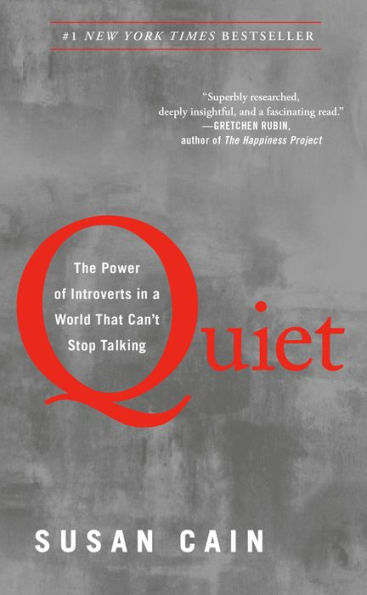
Quiet: The Power of Introverts in a World That Can't Stop Talking

( 39 )

Pick Up in Store

Reserve and pick up in 60 minutes at your local store

Hardcover
$15.55
BN.com price
$26.00 List Price (Save 40%)
Marketplace (New and Used)
from
$12.44
$26.00 List Price (Save 52%)
Usually ships within 1-2 business days
All (24)  
Used (5)  
New (19)  
Close
Sort by
Page 1 of 3
Showing 1 – 10 of 24 (3 pages)
$12.44
(Save 52%)
Seller since 2012

Feedback rating:

(7)

Condition:

New — never opened or used in original packaging.

Like New — packaging may have been opened. A "Like New" item is suitable to give as a gift.

Very Good — may have minor signs of wear on packaging but item works perfectly and has no damage.

Good — item is in good condition but packaging may have signs of shelf wear/aging or torn packaging. All specific defects should be noted in the Comments section associated with each item.

Acceptable — item is in working order but may show signs of wear such as scratches or torn packaging. All specific defects should be noted in the Comments section associated with each item.

Used — An item that has been opened and may show signs of wear. All specific defects should be noted in the Comments section associated with each item.

Refurbished — A used item that has been renewed or updated and verified to be in proper working condition. Not necessarily completed by the original manufacturer.

New

Ships from: Dayton, OH

Usually ships in 1-2 business days

  • Standard, 48 States
$12.45
(Save 52%)
Seller since 2012

Feedback rating:

(4)

Condition: New
Ships SAME or NEXT business day. We DO NOT Ship to APO/FPO, Po Box addr. Choose EXPEDITED shipping and receive in 2-5 business days within the United States. See our member ... profile for customer support contact info. We have an easy return policy. Read more Show Less

Ships from: Wilmette, IL

Usually ships in 1-2 business days

  • Standard, 48 States
  • Standard (AK, HI)
  • Express, 48 States
  • Express (AK, HI)
$12.45
(Save 52%)
Seller since 2012

Feedback rating:

(0)

Condition: New

Ships from: HERMOSA BEACH, CA

Usually ships in 1-2 business days

  • Standard, 48 States
  • Express, 48 States
$12.49
(Save 52%)
Seller since 2010

Feedback rating:

(1086)

Condition: Like New
2012 Hardcover Fine Retail Edition! May have remainder mark. We ship daily Monday-Friday.

Ships from: Powder Springs, GA

Usually ships in 1-2 business days

  • Canadian
  • International
  • Standard, 48 States
  • Standard (AK, HI)
  • Express, 48 States
  • Express (AK, HI)
$12.70
(Save 51%)
Seller since 2010

Feedback rating:

(1086)

Condition: New
2012 Hardcover New Retail Edition! We ship daily Monday-Friday.

Ships from: Powder Springs, GA

Usually ships in 1-2 business days

  • Canadian
  • International
  • Standard, 48 States
  • Standard (AK, HI)
  • Express, 48 States
  • Express (AK, HI)
$12.75
(Save 51%)
Seller since 2012

Feedback rating:

(4)

Condition: New
Ships SAME or NEXT business day. We DO NOT Ship to APO/FPO, Po Box addr. Choose EXPEDITED shipping and receive in 2-5 business days within the United States. See our member ... profile for customer support contact info. We have an easy return policy. Read more Show Less

Ships from: Wilmette, IL

Usually ships in 1-2 business days

  • Standard, 48 States
  • Standard (AK, HI)
  • Express, 48 States
  • Express (AK, HI)
$13.99
(Save 46%)
Seller since 2012

Feedback rating:

(0)

Condition: New

Ships from: CANTON, NC

Usually ships in 1-2 business days

  • Standard, 48 States
  • Express, 48 States
$14.97
(Save 42%)
Seller since 2009

Feedback rating:

(173)

Condition: New
2012 Hardcover New Ships quickly.

Ships from: West Palm Beach, FL

Usually ships in 1-2 business days

  • Canadian
  • International
  • Standard, 48 States
  • Standard (AK, HI)
  • Express, 48 States
  • Express (AK, HI)
$16.46
(Save 37%)
Seller since 2007

Feedback rating:

(21382)

Condition: New
BRAND NEW

Ships from: Avenel, NJ

Usually ships in 1-2 business days

  • Canadian
  • International
  • Standard, 48 States
  • Standard (AK, HI)
$16.80
(Save 35%)
Seller since 2012

Feedback rating:

(876)

Condition: New
BRAND NEW - 100% GUARANTEED! Fast shipping

Ships from: Bayonne, NJ

Usually ships in 1-2 business days

  • Standard, 48 States
  • Standard (AK, HI)
Page 1 of 3
Showing 1 – 10 of 24 (3 pages)
Close
Sort by
NOOK Book (eBook)
$12.99
BN.com price

Available on NOOK devices and apps

  • Nook Devices
  • NOOK
  • NOOK Color
  • NOOK Tablet
  • Tablet/Phone
  • NOOK for iPad
  • NOOK for iPhone
  • NOOK for Android
  • NOOK for Android (Tablet)
  • NOOK Kids for iPad
  • PC/Mac
  • NOOK Study
  • NOOK for PC
  • NOOK for Mac

Need a NOOK? Explore Now

Overview

At least one-third of the people we know are introverts. They are the ones who prefer listening to speaking, reading to partying; who innovate and create but dislike self-promotion; who favor working on their own over brainstorming in teams. Although they are often labeled "quiet," it is to introverts that we owe many of the great contributions to society—from van Gogh’s sunflowers to the invention of the personal computer.

Passionately argued, impressively researched, and filled with indelible stories of real people, Quiet shows how dramatically we undervalue introverts, and how much we lose in doing so. Taking the reader on a journey from Dale Carnegie’s birthplace to Harvard Business School, from a Tony Robbins seminar to an evangelical megachurch, Susan Cain charts the rise of the Extrovert Ideal in the twentieth century and explores its far-reaching effects. She talks to Asian-American students who feel alienated from the brash, backslapping atmosphere of American schools. She questions the dominant values of American business culture, where forced collaboration can stand in the way of innovation, and where the leadership potential of introverts is often overlooked. And she draws on cutting-edge research in psychology and neuroscience to reveal the surprising differences between extroverts and introverts.

Perhaps most inspiring, she introduces us to successful introverts—from a witty, high-octane public speaker who recharges in solitude after his talks, to a record-breaking salesman who quietly taps into the power of questions. Finally, she offers invaluable advice on everything from how to better negotiate differences in introvert-extrovert relationships to how to empower an introverted child to when it makes sense to be a "pretend extrovert."

This extraordinary book has the power to permanently change how we see introverts and, equally important, how introverts see themselves.

  • Quiet
    Quiet

Editorial Reviews

Publishers Weekly
While American culture and business tend to be dominated by extroverts, business consultant Cain explores and champions the one-third to one-half of the population who are introverts. She defines the term broadly, including “solitude-seeking” and “contemplative,” but also “sensitive,” “humble,” and “risk-averse.” Such individuals, she claims (though with insufficient evidence), are “disproportionately represented among the ranks of the spectacularly creative.” Yet the American school and workplace make it difficult for those who draw strength from solitary musing by over-emphasizing teamwork and what she calls “the new Groupthink.” Cain gives excellent portraits of a number of introverts and shatters misconceptions. For example, she notes, introverts can negotiate as well as, or better than, alpha males and females because they can take a firm stand “without inflaming counterpart’s ego.” Cain provides tips to parents and teachers of children who are introverted or seem socially awkward and isolated. She suggests, for instance, exposing them gradually to new experiences that are otherwise overstimulating. Cain consistently holds the reader’s interest by presenting individual profiles, looking at places dominated by extroverts (Harvard Business School) and introverts (a West Coast retreat center), and reporting on the latest studies. Her diligence, research, and passion for this important topic has richly paid off. (Jan.)
Library Journal
The introvert/extrovert dichotomy is easily stereotyped in psychological literature: extroverts are buoyant and loud, introverts are shy and nerdy. Here, former corporate lawyer and negotiations consultant Cain gives a more nuanced portrait of introversion. Introverts are by nature more pensive, quiet, and solitary, but they can also act extroverted for the pursuit of their passions. Cain describes and explicates the introvert personality by citing much research (at times so much that readers may be confused about what she is explaining) and going undercover, at one point immersing herself at a Harvard Business School student center and, in a very amusing chapter, at a Tony Robbins seminar, among other case studies. Cain's conclusion is that the introversion or extroversion personality trait is not as simple as an on/off switch but a much more complex expression of a personality. VERDICT This book is a pleasure to read and will make introverts and extroverts alike think twice about the best ways to be themselves and interact with differing personality types. Recommended to all readers.—Maryse Breton, Bibliothèque et Archives nationales du Québec, Montreal
Kirkus Reviews
An enlightened Wall Street survivor exhorts wallflowers everywhere to embrace their solitude-seeking souls and fully appreciate the power of the lone wolf. Could up to one-half of a nation obsessed with Jersey Shore narcissism and American Idol fame really be inhabited by reserved, sensitive types? According to Cain, yes--and we better start valuing their insight. Extroverts have their place, but things can quickly go haywire when we start confusing assertiveness with competence--the economic meltdown on Wall Street was the most stunning recent example. Had there been a few more conscientious, contemplative introverts in the boardroom (and had they made themselves heard), Cain writes, the country's fortunes would now be decidedly different. But today's prevailing susceptibility to "reward sensitivity," as embodied by alpha-dog Wall Street types, wasn't always the norm. Cain provides fascinating insight into how the United States shifted from an introvert-leaning "cult of character" to an extrovert-leaning "cult of personality" ruled by the larger-than-life Tony Robbinses of the world. Readers will learn that the tendency for some to be reserved is actually hardwired, and as every evolutionary biologist will tell you, innate characteristics are there for a reason--to help humans survive and thrive. The author also boldly tackles introverts themselves, as well as the ambivalence many often feel about being relegated to the corner. "Stick to your guns," writes fellow introvert Cain. The author's insights are so rich that she could pen two separate books: one about parenting an introverted child, and another about how to make an introvert/extrovert relationship work. An intriguing and potentially life-altering examination of the human psyche that is sure to benefit both introverts and extroverts alike.

Product Details

  • ISBN-13: 9780307352149
  • Publisher: Crown Publishing Group
  • Publication date: 1/24/2012
  • Pages: 352
  • Sales rank: 42
  • Product dimensions: 6.50 (w) x 9.74 (h) x 1.19 (d)

Meet the Author

SUSAN CAIN is a writer whose work on introversion and shyness has appeared in the New York Times, Time, O Magazine, and PsychologyToday.com. She has taught negotiation skills at corporations, law firms, and universities and practiced corporate law for seven years. Recently she was selected to speak at the TED2012 conference in Long Beach, California. An honors graduate of Princeton and Harvard Law School, Susan lives in the Hudson River Valley with her husband and two sons.

Read an Excerpt

Quiet

The Power of Introverts in a World That Can't Stop Talking
By Susan Cain

Crown

Copyright © 2012 Susan Cain
All right reserved.

ISBN: 9780307352149

Today we make room for a remarkably narrow range of personality styles. We’re told that to be great is to be bold, to be happy is to be sociable. We see ourselves as a nation of extroverts—which means that we’ve lost sight of who we really are. Depending on which study you consult, one third to one half of Americans are introverts—in other words, one out of every two or three people you know. (Given that the United States is among the most extroverted of nations, the number must be at least as high in other parts of the world.) If you’re not an introvert yourself, you are surely raising, managing, married to, or coupled with one.

If these statistics surprise you, that’s probably because so many people pretend to be extroverts. Closet introverts pass undetected on playgrounds, in high school locker rooms, and in the corridors of corporate America. Some fool even themselves, until some life event—a layoff, an empty nest, an inheritance that frees them to spend time as they like— jolts them into taking stock of their true natures. You have only to raise the subject of this book with your friends and acquaintances to find that the most unlikely people consider themselves introverts.

It makes sense that so many introverts hide even from themselves. We live with a value system that I call the Extrovert Ideal—the omnipresent belief that the ideal self is gregarious, alpha, and comfortable in the spotlight. The archetypal extrovert prefers action to contemplation, risk- taking to heed-taking, certainty to doubt. He favors quick decisions, even at the risk of being wrong. She works well in teams and socializes in groups. We like to think that we value individuality, but all too often we admire one type of individual—the kind who’s comfortable “putting himself out there.” Sure, we allow technologically gifted loners who launch companies in garages to have any personality they please, but they are the exceptions, not the rule, and our tolerance extends mainly to those who get fabulously wealthy or hold the promise of doing so.

Introversion—along with its cousins sensitivity, seriousness, and shyness—is now a second- class personality trait, somewhere between a disappointment and a pathology. Introverts living under the Extrovert Ideal are like women in a man’s world, discounted because of a trait that goes to the core of who they are. Extroversion is an enormously appealing personality style, but we’ve turned it into an oppressive standard to which most of us feel we must conform.

The Extrovert Ideal has been documented in many studies, though this research has never been grouped under a single name. Talkative people, for example, are rated as smarter, better- looking, more interesting, and more desirable as friends. Velocity of speech counts as well as volume: we rank fast talkers as more competent and likable than slow ones. The same dynamics apply in groups, where research shows that the voluble are considered smarter than the reticent—even though there’s zero correlation between the gift of gab and good ideas. Even the word introvert is stigmatized—one informal study, by psychologist Laurie Helgoe, found that introverts described their own physical appearance in vivid language ( “green- blue eyes,” “exotic,” “high cheekbones”), but when asked to describe generic introverts they drew a bland and distasteful picture (“ungainly,” “neutral colors,” “skin problems”).

But we make a grave mistake to embrace the Extrovert Ideal so unthinkingly. Some of our greatest ideas, art, and inventions—from the theory of evolution to van Gogh’s sunflowers to the personal computer— came from quiet and cerebral people who knew how to tune in to their inner worlds and the treasures to be found there.

Copyright © 2012 by Susan Cain. From the book QUIET: The Power Of Introverts in a World That Can’t Stop Talking by Susan Cain, published by Crown, a division of Random House, Inc.  Reprinted with permission.


Continues...

Excerpted from Quiet by Susan Cain Copyright © 2012 by Susan Cain. Excerpted by permission of Crown, a division of Random House, Inc.
All rights reserved. No part of this excerpt may be reproduced or reprinted without permission in writing from the publisher.
Excerpts are provided by Dial-A-Book Inc. solely for the personal use of visitors to this web site.

Interviews & Essays

SUSAN CAIN ON QUIET FOR BARNES AND NOBLE (followed with a Quiz and Q & A afterward)

Are you an introvert yourself? And if so, how are you handling the tremendous publicity?

Yup, I'm an introvert — and this can make my jam-packed publicity schedule a challenge. There was one day where I gave 21 radio and TV interviews!

But the publicity is also a great gift. I am so passionate about this book that my excitement helps me transcend my normal dislike of the spotlight. I also draw inspiration from the introverted leaders I profiled in QUIET. From Rosa Parks to Eleanor Roosevelt to Gandhi, many of the transformative leaders of the 20th century were shy or quiet people who achieved what they did because they cared so much about their cause. I think that we can all draw strength from their examples.

Who do you see as your ideal reader? Just self-described introverts, or business folks and educators who may be stifling creativity with their insistence on "GroupThink"?

First and foremost, I want to reach introverts whose psyches may have been buffeted by living in a world that favors extroverts. I've received thousands of notes from readers who say that after reading the book they are letting go of a lifetime of guilt and shame. I'm so grateful when readers take the time to write and tell me this, because that has always been my important goal.

But I also hope that QUIET will inspire educators, managers, and clergypeople to rethink some of their standard practices. Our schools, workplaces, and religious institutions are increasingly organized in hyper-stimulating ways that favor groupwork and an extoverted approach. This leads to a colossal waste of talent, energy, and happiness. This is a great problem for introverts, but really it's a problem for us all.

Join the conversation with Susan Cain at her blog, thepowerofintroverts.com.

Quiz:
Are you an introvert?

Take this quiz to find out where you fall on the introvert-extrovert spectrum. Answer each question True or False, choosing the answer that applies to you more often than not.

1. ______ I prefer one-on-one conversations to group activities.
2. ______ I often prefer to express myself in writing.
3. ______ I enjoy solitude.
4. ______ I seem to care about wealth, fame, and status less than my peers.
5. ______ People tell me that I'm a good listener.
6. ______ I'm not a big risk-taker.
7. ______ I enjoy work that allows me to "dive in" with few interruptions.
8. ______ I like to celebrate birthdays on a small scale, with only one or two close friends or family members.
9. ______ People describe me as "soft-spoken" or "mellow."
10. ______ I prefer not to show or discuss my work with others until it's finished.
11. ______ I tend to think before I speak.
12. ______ I often let calls go through to voice-mail.

The more often you answered True, the more introverted you are. If you found yourself with a roughly equal number of True and False answers, then you may be an be an ambivert—yes, there really is such a word. Note: This is an informal quiz, excerpted from Quiet, based on characteristics of introversion commonly accepted by contemporary researchers.

Q & A with Susan Cain, Author of Quiet: The Power of Introverts in a World That Can't Stop Talking

Q: Why did you write the book?
A: For the same reason that Betty Friedan published The Feminine Mystique in 1963. Introverts are to extroverts what women were to men at that time—second-class citizens with gigantic amounts of untapped talent. Our schools, workplaces, and religious institutions are designed for extroverts, and many introverts believe that there is something wrong with them and that they should try to "pass" as extroverts. The bias against introversion leads to a colossal waste of talent, energy, and, ultimately, happiness.

Q: What personal significance does the subject have for you?
A: When I was in my twenties, I started practicing corporate law on Wall Street. At first I thought I was taking on an enormous challenge, because in my mind, the successful lawyer was comfortable in the spotlight, whereas I was introverted and occasionally shy. But I soon realized that my nature had a lot of advantages: I was good at building loyal alliances, one-on-one, behind the scenes; I could close my door, concentrate, and get the work done well; and like many introverts, I tended to ask a lot of questions and listen intently to the answers, which is an invaluable tool in negotiation. I started to realize that there's a lot more going on here than the cultural stereotype of the introvert-as-unfortunate would have you believe. I had to know more, so I spent the past five years researching the powers of introversion.

Q: Was there ever a time when American society valued introverts more highly?
A: In the nation's earlier years it was easier for introverts to earn respect. America once embodied what the cultural historian Warren Susman called a "Culture of Character," which valued inner strength, integrity, and the good deeds you performed when no one was looking. You could cut an impressive figure by being quiet, reserved, and dignified. Abraham Lincoln was revered as a man who did not "offend by superiority," as Emerson put it.

Q: You discuss how we can better embrace introverts in the workplace. Can you explain?
A: Introverts thrive in environments that are not overstimulating—surroundings in which they can think (deeply) before they speak. This has many implications. Here are two to consider: (1) Introverts perform best in quiet, private workspaces—but unfortunately we're trending in precisely the opposite direction, toward open-plan offices. (2) If you want to get the best of all your employees' brains, don't simply throw them into a meeting and assume you're hearing everyone's ideas. You're not; you're hearing from the most vocally assertive people. Ask people to put their ideas in writing before the meeting, and make sure you give everyone time to speak.

Q: Quiet offers some terrific insights for the parents of introverted children. What environment do introverted kids need in order to thrive, whether it's at home or at school?
A: The best thing parents and teachers can do for introverted kids is to treasure them for who they are, and encourage their passions. This means: (1) Giving them the space they need. If they need to recharge alone in their room after school instead of plunging into extracurricular activities, that's okay. (2) Letting them master new skills at their own pace. If they're not learning to swim in group settings, for example, teach them privately. (3) Not calling them "shy"—they'll believe the label and experience their nervousness as a fixed trait rather than an emotion they can learn to control.

Q: What are the advantages to being an introvert?
A: There are too many to list in this short space, but here are two seemingly contradictory qualities that benefit introverts: introverts like to be alone—and introverts enjoy being cooperative. Studies suggest that many of the most creative people are introverts, and this is partly because of their capacity for quiet. Introverts are careful, reflective thinkers who can tolerate the solitude that idea-generation requires. On the other hand, implementing good ideas requires cooperation, and introverts are more likely to prefer cooperative environments, while extroverts favor competitive ones.

Customer Reviews
Average Rating 4
( 39 )

Rating Distribution

  • ( 22 )
  • ( 9 )
  • ( 4 )
  • ( 3 )
  • ( 1 )
If you've bought this product, tell the world how you liked it.
Write a Review
See All Sort by: Showing 1 – 20 of 39 Customer Reviews
  • Posted October 20, 2011

    Fabulous

    As an introvert myself, this book drew me in just from the title, and I can truly say this is a fascinating study of what being an introvert means.
    With a mixture of anecdotes and scientific research, Cain explores how introverts function, what makes us act the way we do, and why in this day and age it is such a difficult thing to be respected as someone who is different. Most of us have faced all of the things she mentions, from teachers who think that there is something wrong with children who prefer to read than play, to the minutia like making small talk that can drain some of us of all energy. She does a fantastic job of explaining why we function in this manner, and she manages to show us that we are not wrong in the way we act; we are just different.
    The narrative is always interesting, keeping the reader engaged all the way through the book. Although this is a serious research book, it never bores, on the contrary, it is hard to put down. There is a wonderful section on how to take care and nurture an introverted child, which can be a challenge since most of society is geared towards extroverts.
    Introverts need different things, and modern life refuses to provide those things, with its constant rewards for those who speak the loudest, whether they have the right answer or not. If you are an introvert, or if you know an introvert, this is a great read. I highly, highly recommend it.

    92 out of 93 people found this review helpful.

    Was this review helpful? Yes  No   Report this review
  • Anonymous

    Posted January 25, 2012

    I want another copy! (Maybe even two!)

    I purchased the Nookbook version this morning. I finished the Introduction and I am ordering another copy (the Book book). I am going to give the extra copy to my best friend. It reads beautifully! I am planning on reading it out loud to my non-bookreading husband who has always struggled with shyness (which is related to introversion). As I read I realized I was an introvert surrounded by introverts trying to pretend I wasn't one. And worse, I realized I have always tried to force my children to be extroverts in such an extrovert centered culture. Now if I have only read the introduction and have figured all this out, imagine what you will know after reading the entire book! I also want to help raise the rating of a good book that was pulled down by a single disgruntled person and one star.

    37 out of 37 people found this review helpful.

    Was this review helpful? Yes  No   Report this review
  • Anonymous

    Posted January 25, 2012

    Good Book

    This is for the stupid person who wrote a review with a low rating because they had not read the book!!! So you brought the rating down with no valid information at all. If you have no actual input, don't write a review.

    27 out of 33 people found this review helpful.

    Was this review helpful? Yes  No   Report this review
  • Posted January 27, 2012

    I Also Recommend:

    Introverts are thinkers and enjoy alone time rather than wasting valuable time "chit chatting" about nothing.

    The author of “Quiet” is an admitted introvert. She did a wonderful job countering misconceptions about introversion. As an introvert myself I have always felt inferior at school and work compared to my very talkative and outgoing peers. Introverts are not people with a personality flaw. They are people who recharge their batteries by being alone while extroverts recharge theirs by socializing. Introverts are thinkers, sensitive, serious, thoughtful, and reserved people. While they appear quiet and repelling, their minds are actually racing with creative ideas and planning their next exciting project rather than wasting time with idle small talk. Some of the most famous and renown people in history were introverts.

    25 out of 25 people found this review helpful.

    Was this review helpful? Yes  No   Report this review
  • Anonymous

    Posted January 25, 2012

    Great Read

    For the person who gave it 1 star even though they took no time to read or research it, you should probably find better ways to spend your time. This is a website where people purchase and discuss works of literature that people worked very hard on. As this book was released yesterday, it comes as no surprise that you have no yet recieved it if you ordered it. This is a wonderful book on a subject that is very near and dear to my heart. I hoghly recommnended for ant shy adult who has felt overwhelmed by our ever increasing fast paced society.

    22 out of 25 people found this review helpful.

    Was this review helpful? Yes  No   Report this review
  • Anonymous

    Posted January 31, 2012

    Amazing

    This book amazed me. After so many years of hearing "come out of your shell, be more assertive, socialize more, ect.", it was stunning to be told I am, in fact, ok how I am. Even normal. I don't normally write reviews but I feel like this book deserved the highest praise.

    16 out of 16 people found this review helpful.

    Was this review helpful? Yes  No   Report this review
  • Anonymous

    Posted February 2, 2012

    Well researched, worth reading

    Insightful analysis of how American culture went from admiring Character (attributes such as thoughtfulness and honesty) to admiring Personality ( traits of salesmanship and extroversion). I disagree with very little of what I've read, and my points of disagreement are mainly that the author occasionally pushes too hard to make a point or ties a corollation too tightly together when other factors may be present. Highly recommended for quiet people who prefer a more contemplative life than the noisy, shallow party that is American popular culture.

    9 out of 9 people found this review helpful.

    Was this review helpful? Yes  No   Report this review
  • Posted February 4, 2012

    Kritters Ramblings

    After reading this book, I feel I must say, Yes, I admit I am an extrovert and I like it. I have moments where I need to take a break from it all and hibernate, but in my heart, I love to be out and around people. I am surrounded by introverts on a daily basis and maybe I don't quite understand what makes them tick and what they need on a daily basis.

    This book not only shows what introverts need in relationships, but also at the workplace. The final chapter is a complete source for parents and teachers on how to interact with introverted children. I think the author does a great job of making valid points and using interesting research to back up and explain each point. Although this is non-fiction and has a little bit of an academic approach, it reads much easier than a textbook and is a worthy read.

    I would recommend this book to both introverts and extroverts. I think the extroverts need to learn how to adapt around introverts, while the introverts need to find the confidence in their own personality traits.

    6 out of 8 people found this review helpful.

    Was this review helpful? Yes  No   Report this review
  • Anonymous

    Posted February 10, 2012

    Amazing!

    This book is extremely insightful. I found it to answer many of the questions I have trekked to answer myself for 55+ years. I have been validated! My introverted personality trait is for real; I am not anti-social. Quite the opposite. I love people; just in smaller doses when possible. My extrovert persona is something I have used my free will to develop for the people and career I love. I still, however, am bored with small talk but no longer feel I am a defect.

    5 out of 5 people found this review helpful.

    Was this review helpful? Yes  No   Report this review
  • Anonymous

    Posted February 5, 2012

    Great book

    I loved this book. I loved it on a personal level because no one ever stops to talk about these things in a public way. I love that Cain has brought attention to introversion and managed to make the case that it isn't actually a bad thing. It's educational; especially for parents who don't understand their children. It's probably a must read for all parents who have a least one "shy" or "bookish" child. It's also a must read for anyone who ever thought they didn't fit in because they would rather read a good book then go on a pub crawl.

    3 out of 3 people found this review helpful.

    Was this review helpful? Yes  No   Report this review
  • Anonymous

    Posted February 14, 2012

    Great Book

    I need to have my husband (an extrovert) read this to help understand why I am the way I am. I feel like now I can admit I am an extrovert and not feel bad about it. Thank you Susan.

    1 out of 1 people found this review helpful.

    Was this review helpful? Yes  No   Report this review
  • Anonymous

    Posted February 9, 2012

    Helping Me Understand My Husband

    My husband is an introvert and I am not... I've learned through the years who he is and what his action's mean, but this book has helped me understand his personality even more!

    It has also made me reflect on my day to day life... the people I come in contact with... and rethink what someone's actions might mean.

    1 out of 2 people found this review helpful.

    Was this review helpful? Yes  No   Report this review
  • Anonymous

    Posted February 3, 2012

    Leonardo da Vinci

    Was an introvert :)

    1 out of 8 people found this review helpful.

    Was this review helpful? Yes  No   Report this review
  • Anonymous

    Posted February 14, 2012

    jxhchck

    Cjvjf

    0 out of 7 people found this review helpful.

    Was this review helpful? Yes  No   Report this review
  • Anonymous

    Posted February 13, 2012

    Anyn

    Huh bye

    0 out of 8 people found this review helpful.

    Was this review helpful? Yes  No   Report this review
  • Anonymous

    Posted February 13, 2012

    Justin

    14

    0 out of 9 people found this review helpful.

    Was this review helpful? Yes  No   Report this review
  • Anonymous

    Posted February 13, 2012

    a

    Sounds weird relationship

    0 out of 8 people found this review helpful.

    Was this review helpful? Yes  No   Report this review
  • Anonymous

    Posted February 18, 2012

    No text was provided for this review.

  • Anonymous

    Posted February 5, 2012

    No text was provided for this review.

  • Anonymous

    Posted February 21, 2012

    No text was provided for this review.

See All Sort by: Showing 1 – 20 of 39 Customer Reviews

If you find inappropriate content, please report it to Barnes & Noble
Why is this product inappropriate?
Comments (optional)
500 character limit