
For more than seventy years, Penguin has been the leading publisher of classic literature in the English-speaking world. With more than 1,700 titles, Penguin Classics represents a global bookshelf of the best works throughout history and across genres and disciplines. Readers trust the series to provide authoritative texts enhanced by introductions and notes by distinguished scholars and contemporary authors, as well as up-to-date translations by award-winning translators.
For more than seventy years, Penguin has been the leading publisher of classic literature in the English-speaking world. With more than 1,700 titles, Penguin Classics represents a global bookshelf of the best works throughout history and across genres and disciplines. Readers trust the series to provide authoritative texts enhanced by introductions and notes by distinguished scholars and contemporary authors, as well as up-to-date translations by award-winning translators.

Rebecca of Sunnybrook Farm
272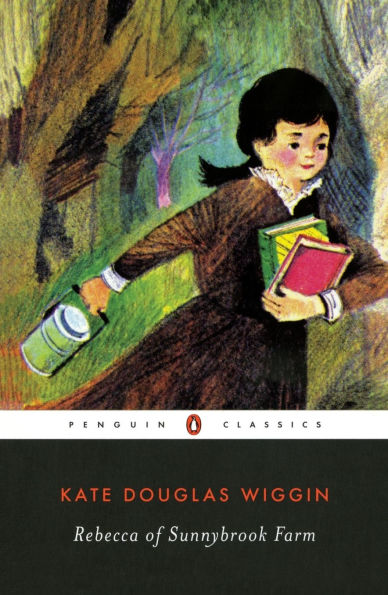
Rebecca of Sunnybrook Farm
272Paperback(Reprint)
-
SHIP THIS ITEMIn stock. Ships in 1-2 days.PICK UP IN STORE
Your local store may have stock of this item.
Available within 2 business hours
Related collections and offers
Overview
For more than seventy years, Penguin has been the leading publisher of classic literature in the English-speaking world. With more than 1,700 titles, Penguin Classics represents a global bookshelf of the best works throughout history and across genres and disciplines. Readers trust the series to provide authoritative texts enhanced by introductions and notes by distinguished scholars and contemporary authors, as well as up-to-date translations by award-winning translators.

Product Details
| ISBN-13: | 9780143039204 |
|---|---|
| Publisher: | Penguin Publishing Group |
| Publication date: | 05/31/2005 |
| Edition description: | Reprint |
| Pages: | 272 |
| Product dimensions: | 5.11(w) x 7.71(h) x 0.60(d) |
| Age Range: | 10 - 17 Years |
About the Author
Shawn Thomson is a doctoral candidate in English at the University of Kansas.
Read an Excerpt
Rebecca of Sunnybrook Farm
Chapter 1
"We Are Seven"
The old stagecoach was rumbling along the dusty road that runs from Maplewood to Riverboro. The day was as warm as midsummer, though it was only the middle of May, and Mr. Jeremiah Cobb was favoring the horses as much as possible, yet never losing sight of the fact that he carried the mail. The hills were many, and the reins lay loosely in his hands as he lolled back in his seat and extended one foot and leg luxuriously over the dashboard. His brimmed hat of worn felt was well pulled over his eyes, and he revolved a quid of tobacco in his left cheek.
There was one passenger in the coach—a small dark-haired person in a glossy buff calico dress. She was so slender and so stiffly starched that she slid from space to space on the leather cushions, though she braced herself against the middle seat with her feet and extended her cotton-gloved hands on each side, in order to maintain some sort of balance. Whenever the wheels sank farther than usual into a rut or jolted suddenly over a stone, she bounded involuntarily into the air, came down again,pushed back her funny little straw hat, and picked up or settled more firmly a small pink sunshade, which seemed to be her chief responsibility—unless we except a bead purse, into which she looked whenever the condition of the roads would permit, finding great apparent satisfaction in that its precious contents neither disappeared nor grew less. Mr. Cobb guessed nothing of these harassing details of travel, his business being to carry people to their destinations, not necessarily to make them comfortable on the way. Indeed, he had forgotten the very existence of this one unnoteworthy little passenger.
When he was about to leave the post office in Maplewood that morning, a woman had alighted from a wagon and, coming up to him, inquired whether this were the Riverboro stage and if he were Mr. Cobb. Being answered in the affirmative, she nodded to a child who was eagerly waiting for the answer and who ran towards her as if she feared to be a moment too late. The child might have been ten or eleven years old perhaps, but whatever the number of her summers, she had an air of being small for her age. Her mother helped her into the stagecoach, deposited a bundle and a bouquet of lilacs beside her, superintended the "roping on" behind of an old hair trunk, and finally paid the fare, counting out the silver with great care.
"I want you should take her to my sisters in Riverboro," she said. "Do you know Mirandy and Jane Sawyer? They live in the brick house."
Lord bless your soul, he knew 'em as well as if he'd made 'em!
"Well, she's going there, and they're expecting her. Will you keep an eye on her please? If she can get out anywhere and get with folks, or get anybody in to keep her company, she'll do it. Good-bye, Rebecca; try not to get into any mischief, and sit quiet, so you'll look neat an' nice when you get there. Don't be any trouble to Mr. Cobb ... You see, she's kind of excited ... We came on the cars from Temperance yesterday, slept all night at mycousin's, and drove from her house—eight miles it is—this morning."
"Good-bye, Mother, don't worry; you know it isn't as if I hadn't traveled before."
The woman gave a short sardonic laugh and said in an explanatory way to Mr. Cobb, "She's been to Wareham and stayed overnight; that isn't much to be journey-proud on!"
"It was traveling, Mother," said the child eagerly and willfully. "It was leaving the farm, and putting up lunch in a basket, and a little riding and a little steam cars, and we carried our nightgowns."
"Don't tell the whole village about it, if we did," said the mother, interrupting the reminiscences of this experienced voyager. "Haven't I told you before," she whispered, in a last attempt at discipline, "that you shouldn't talk about nightgowns and stockings and—things like that, in a loud tone of voice, and especially when there's menfolks 'round?"
"I know, Mother, I know, and I won't. All I want to say is"—here Mr. Cobb gave a cluck, slapped the reins, and the horses started sedately on their daily task—"all I want to say is that it is a journey when"—the stage was really under way 'now, and Rebecca had to put her head out of the window over the door in order to finish her sentence—"it is a journey when you carry a nightgown!"
The objectionable word, uttered in a high treble, floated back to the offended ears of Mrs. Randall, who watched the stage out of sight, gathered up her packages from the bench at the store door, and stepped into the wagon that had been standing at the hitching post. As she turned the horse's head towards home, she rose to her feet for a moment and, shading her eyes with her hand, looked at a cloud of dust in the dim distance.
Mirandy'll have her hands full, I guess, she said to herself, but I shouldn't wonder if it would be the making of Rebecca.
All this had been half an hour ago, and then sun, theheat, the dust, the contemplation of errands to be done in the great metropolis of Milltown had lulled Mr. Cobb's never-active mind into complete oblivion as to his promise of keeping an eye on Rebecca.
Suddenly he heard a small voice above the rattle and rumble of the wheels and the creaking of the harness. At first he thought it was a cricket, a tree toad, or a bird, but having determined the direction from which it came, he turned his head over his shoulder and saw a small shape hanging as far out of the window as safety would allow. A long black braid of hair swung with the motion of the coach; the child held her hat in one hand and with the other made ineffectual attempts to stab the driver with her microscopic sunshade.
"Please let me speak!" she called.
Mr. Cobb drew up the horses obediently.
"Does it cost any more to ride up there with you?" she asked. "It's so slippery and shiny down here, and the stage is so much too big for me, that I rattle 'round in it till I'm 'most black and blue. And the windows are so small I can only see pieces of things, and I've 'most broken my neck stretching 'round to find out whether my trunk has fallen off the back. It's my mother's trunk, and she's very choice of it."
Mr. Cobb waited until this flow of conversation, or more properly speaking this flood of criticism, had ceased and then said jocularly: "You can come up if you want to; there ain't no extry charge to sit side o' me." Whereupon he helped her out, "boosted" her up to the front seat, and resumed his own place.
Rebecca sat down carefully, smoothing her dress under her with painstaking precision and putting her sunshade under its extended folds between the driver and herself. This done, she pushed back her hat, pulled up her darned white cotton gloves, and said delightedly: "Oh, this is better! This is like traveling! I am a real passenger now, and down there I felt like our setting hen when we shut her up in a coop. I hope we have a long, long ways to go?"
"Oh, we've only just started on it," Mr. Cobb responded genially; "it's more'n two hours."
"Only two hours." She sighed. "That will be half past one; Mother will be at Cousin Ann's, the children at home will have had their dinner, and Hannah cleared all away. I have some lunch, because Mother said it would be a bad beginning to get to the brick house hungry and have Aunt Mirandy have to get me something to eat the first thing ... . It's a good growing day, isn't it?"
"It is, certain; too hot, 'most. Why don't you put up your parasol?"
She extended her dress still farther over the article in question as she said, "Oh, dear, no! I never put it up when the sun shines; pink fades awfully, you know, and I only carry it to meetin' cloudy Sundays; sometimes the sun comes out all of a sudden, and I have a dreadful time covering it up; it's the dearest thing in life to me, but it's an awful care."
At this moment the thought gradually permeated Mr. Jeremiah Cobb's slow-moving mind that the bird perched by his side was a bird of very different feather from those to which he was accustomed in his daily drives. He put the whip back in its socket, took his foot from the dashboard, pushed his hat back, blew his quid of tobacco into the road, and having thus cleared his mental decks for action, he took his first good look at the passenger, a look which she met with a grave, childlike stare of friendly curiosity.
The buff calico was faded, but scrupulously clean, and starched within an inch of its life. From the little standing ruffle at the neck the child's slender throat rose very brown and thin, and the head looked small to bear the weight of dark hair that hung in a thick braid to her waist. She wore an odd little visored cap of white leghorn, which may have been either the latest thing in children's hats or some bit of ancient finery furbished up for the occasion. It was trimmed with a twist of buff ribbon and a cluster of black and orange porcupine quills, which hung or bristled stiffly over one ear, giving her the quaintest and most unusualappearance. Her face was without color and sharp in outline. As to features, she must have had the usual number, though Mr. Cobb's attention never proceeded so far as nose, forehead, or chin, being caught on the way and held fast by the eyes. Rebecca's eyes were like faith—"the substance of things hoped for, the evidence of things not seen." Under her delicately etched brows they glowed like two stars, their dancing light half hidden in lustrous darkness. Their glance was eager and full of interest, yet never satisfied; their steadfast gaze was brilliant and mysterious and had the effect of looking directly through the obvious to something beyond, in the object, in the landscape, in you. They had never been accounted for, Rebecca's eyes. The schoolteacher and the minister at Temperance had tried and failed; the young artist who came for the summer to sketch the red barn, the ruined mill, and the bridge ended by giving up all these local beauties and devoting herself to the face of a child—a small, plain face illuminated by a pair of eyes carrying such messages, such suggestions, such hints of sleeping power and insight that one never tired of looking into their shining depths or of fancying that what one saw there was the reflection of one's own thought.
Mr. Cobb made none of these generalizations; his remark to his wife that night was simply to the effect that whenever the child looked at him, she knocked him galley-west.
"Miss Ross, a lady that paints, give me the sunshade," said Rebecca when she had exchanged looks with Mr. Cobb and learned his face by heart. "Did you notice the pinked double ruffle and the white tip and handle? They're ivory. The handle is scarred, you see. That's because Fanny sucked and chewed it in meeting when I wasn't looking. I've never felt the same to Fanny since."
"Is Fanny your sister?"
"She's one of them."
"How many are there of you?"
"Seven. There's verses written about seven children:
Quick was the little Maid's reply,
O master! we are seven!
I learned it to speak in school, but the scholars were hateful and laughed. Hannah is the oldest. I come next, then John, then Jenny, then Mark, then Fanny, then Mira."
"Well, that is a big family!"
"Far too big, everybody says," replied Rebecca with an unexpected and thoroughly grown-up candor that induced Mr. Cobb to murmur, "I swan!" and insert more tobacco in his left cheek.
"They're dear, but such a bother, and cost so much to feed, you see," she rippled on. "Hannah and I haven't done anything but put babies to bed at night and take them up in the morning for years and years. But it's finished, that's one comfort, and we'll have a lovely time when we're all grown up and the mortgage is paid off."
"All finished? Oh, you mean you've come away?"
"No, I mean they're all over and done with; our family's finished. Mother says so, and she always keeps her promises. There hasn't been any since Mira, and she's three. She was born the day Father died. Aunt Miranda wanted Hannah to come to Riverboro instead of me, but Mother couldn't spare her; she takes hold of housework better than I do, Hannah does. I told Mother last night if there was likely to be any more children while I was away I'd have to be sent for, for when there's a baby, it always takes Hannah and me both, for Mother has the cooking and the farm."
"Oh, you live on a farm, do ye? Where is it? Near to where you got on?"
"Near? Why, it must be thousands of miles! We came from Temperance in the cars. Then we drove a long ways to Cousin Ann's and went to bed. Then we got up and drove ever so far to Maplewood, where the stage was. Our farm is away off from everywheres, but our school and meetinghouse is at Temperance, and that's only two miles. Sitting up here with you is 'most as good as climbing themeetinghouse steeple. I know a boy who's been up on our steeple. He said the people and cows looked like flies. We haven't met any people yet, but I'm kind of disappointed in the cows; they don't look so little as I hoped they would; still"—brightening—"they don't look quite as big as if we were downside of them, do they? Boys always do the nice splendid things, and girls can only do the nasty dull ones that get left over. They can't climb so high, or go so far, or stay out so late, or run so fast, or anything."
Mr. Cobb wiped his mouth on the back of his hand and gasped. He had a feeling that he was being hurried from peak to peak of a mountain range without time to take a good breath in between.
"I can't seem to locate your farm," he said, "though I've been to Temperance and used to live up that way. What's your folks' name?"
"Randall. My mother's name is Aurelia Randall; our names are Hannah Lucy Randall, Rebecca Rowena Randall, John Halifax Randall, Jenny Lind Randall; Marquis Randall, Fanny Ellsler Randall, and Miranda Randall. Mother named half of us and Father the other half, but we didn't come out even, so they both thought it would be nice to name Mira after Aunt Miranda in Riverboro; they hoped it might do some good, but it didn't, and now we call her Mira. We are all named after somebody in particular. Hannah is 'Hannah at the Window Binding Shoes,' and I am taken out of Ivanhoe; John Halifax was a gentleman in a book; Mark is after his uncle Marquis de Lafayette, that died a twin. (Twins very often don't live to grow up, and triplets almost never—did you know that, Mr. Cobb?) We don't call him Marquis, only Mark. Jenny is named for a singer, and Fanny for a beautiful dancer, but Mother says they're both misfits, for Jenny can't carry a tune and Fanny's kind of stiff-legged. Mother would like to call them Jane and Frances and give up their middle names, but she says it wouldn't be fair to Father. She says we must always stand up for Father, because everything was against him, and he wouldn't have died if he hadn'thad such bad luck. I think that's all there is to tell about us," she finished seriously.
"Land o' Liberty! I should think it was enough," ejaculated Mr. Cobb. "There wa'n't many names left when your mother got through choosin'! You've got a powerful good memory! I guess it ain't no trouble for you to learn your lessons, is it?"
"Not much; the trouble is to get the shoes to go and learn 'em. These are spandy new I've got on, and they have to last six months. Mother always says to save my shoes. There don't seem to be any way of saving shoes but taking 'em off and going barefoot, but I can't do that in Riverboro without shaming Aunt Mirandy. I'm going to school right along now when I'm living with Aunt Mirandy, and in two years I'm going to the seminary in Wareham; Mother says it ought to be the making of me! I'm going to be a painter like Miss Ross when I get through school. At any rate, that's what I think I'm going to be. Mother thinks I'd better teach."
"Your farm ain't the old Hobbs place, is it?"
"No, it's just Randall's farm. At least that's what Mother calls it. I call it Sunnybrook Farm."
"I guess it don't make no difference what you call it so long as you know where it is," remarked Mr. Cobb sententiously.
Rebecca turned the full light of her eyes upon him reproachfully, almost severely, as she answered: "Oh, don't say that and be like all the rest! It does make a difference what you call things. When I say Randall's farm, do you see how it looks?"
"No, I can't say I do," responded Mr. Cobb uneasily.
"Now when I say Sunnybrook Farm, what does it make you think of?"
Mr. Cobb felt like a fish removed from his native element and left panting on the sand; there was no evading the awful responsibility of a reply, for Rebecca's eyes were searchlights that pierced the fiction of his brain and perceived the bald spot on the back of his head.
"I s'pose there's a brook somewheres near it," he said timorously.
Rebecca looked disappointed but not quite disheartened. "That's pretty good," she said encouragingly. "You're warm but not hot; there's a brook, but not a common brook. It has young trees and baby bushes on each side of it, and it's a shallow chattering little brook with a white sandy bottom and lots of little shiny pebbles. Whenever there's a bit of sunshine, the brook catches it, and it's always full of sparkles the livelong day. Don't your stomach feel hollow? Mine does! I was so 'fraid I'd miss the stage I couldn't eat any breakfast."
"You'd better have your lunch then. I don't eat nothin' till I get to Milltown; then I get a piece o' pie and cup o' coffee."
"I wish I could see Milltown. I suppose it's bigger and grander even than Wareham; more like Paris? Miss Ross told me about Paris; she bought my pink sunshade there and my bead purse. You see how it opens with a snap? I've twenty cents in it, and it's got to last three months, for stamps and paper and ink. Mother says Aunt Mirandy won't want to buy things like those when she's feeding and clothing me and paying for my schoolbooks."
"Paris ain't no great," said Mr. Cobb disparagingly. "It's the dullest place in the state o' Maine. I've druv there many a time."
Again Rebecca was obliged to reprove Mr. Cobb, tacitly and quietly, but nonetheless surely, though the reproof was dealt with one glance, quickly sent and as quickly withdrawn.
"Paris is the capital of France, and you have to go to it on a boat," she said instructively. "It's in my geography, and it says: 'The French are a gay and polite people, fond of dancing and light wines.' I asked the teacher what light wines were, and he thought it was something like new cider or maybe ginger pop. I can see Paris as plain as day by just shutting my eyes. The beautiful ladies are always gaily dancing around with pink sunshades and beadpurses, and the grand gentlemen are politely dancing and drinking ginger pop. But you can see Milltown 'most every day with your eyes wide open," Rebecca said wistfully.
"Milltown ain't no great neither," replied Mr. Cobb, with the air of having visited all the cities of the earth and found them as naught. "Now you watch me heave this newspaper right onto Miz' Brown's doorstep."
Piff! And the packet landed exactly as it was intended, on the cornhusk mat in front of the screen door.
"Oh, how splendid that was!" cried Rebecca with enthusiasm. "Just like the knife thrower Mark saw at the circus. I wish there was a long, long row of houses each with a cornhusk mat and a screen door in the middle and a newspaper to throw on every one!"
"I might fail on some of 'em, you know," said Mr. Cobb, beaming with modest pride. "If your Aunt Mirandy' ll let you, I'll take you down to Milltown someday this summer when the stage ain't full."
A thrill of delicious excitement ran through Rebecca's frame, from her new shoes up, up to the leghorn cap, and down the black braid. She pressed Mr. Cobb's knee ardently and said in a voice choking with tears of joy and astonishment, "Oh, it can't be true, it can't; to think I should see Milltown. It's like having a fairy godmother who asks you your wish and then gives it to you! Did you ever read 'Cinderella,' or 'The Yellow Dwarf,' or 'The Enchanted Frog,' or 'The Fair One with Golden Locks'?"
"No," said Mr. Cobb cautiously, after a moment's reflection. "I don't seem to think I ever did read jest those partic'lar ones. Where'd you get a chance at so much readin'?"
"Oh, I've read lots of books," answered Rebecca casually. "Father's and Miss Ross's and all the dif'rent schoolteachers', and all in the Sunday school library. I've read The Lamplighter, and Scottish Chiefs, and Ivanhoe and The Heir of Redclyffe, and Cora, the Doctor's Wife, and David Copperfield, and The Gold of Chickaree, and Plutarch'sLives, and Thaddeus of Warsaw, and Pilgrim's Progress, and lots more. What have you read?"
"I've never happened to read those partic'lar books, but land, I've read a sight in my time! Nowadays I'm so drove I get along with the almanac, the Weekly Argus, and the Maine State Agriculturist ... . There's the river again; this is the last long hill, and when we get to the top of it, we'll see the chimbleys of Riverboro in the distance. 'Tain't fur. I live 'bout half a mile beyond the brick house myself."
Rebecca's hand stirred nervously in her lap, and she moved in her seat. "I didn't think I was going to be afraid," she said almost under her breath, "but I guess I am, just a little mite—when you say it's coming so near."
"Would you go back?" asked Mr. Cobb curiously.
She flashed him an intrepid look and then said proudly, "I'd never go back—I might be frightened, but I'd be ashamed to run. Going to Aunt Mirandy's is like going down the cellar in the dark. There might be ogres and giants under the stars, but as I tell Hannah, there might be elves and fairies and enchanted frogs! ... Is there a main street in the village, like that in Wareham?"
"I s'pose you might call it a main street, an' your aunt Sawyer lives on it, but there ain't no stores nor mills, an' it's an awful one-horse village! You have to go 'cross the river an' get to our side if you want to see anything goin' on."
"I'm almost sorry"—she sighed—"because it would be so grand to drive down a real main street, sitting high up like this behind two splendid horses, with my pink sunshade up, and everybody in town wondering who the bunch of lilacs and the hair trunk belongs to. It would be just like the beautiful lady in the parade. Last summer the circus came to Temperance, and they had a procession in the morning. Mother let us all walk in and wheel Mira in the baby carriage, because we couldn't afford to go to the circus in the afternoon. And there were lovely horses and animals in cages, and clowns on horseback, and at the very end came a little red and gold chariot drawn by two ponies,and in it, sitting on a velvet cushion, was the snake charmer, all dressed in satin and spangles. She was so beautiful beyond compare, Mr. Cobb, that you had to swallow lumps in your throat when you looked at her, and little cold feelings crept up and down your back. Don't you know how I mean? Didn't you ever see anybody that made you feel like that?"
Mr. Cobb was more distinctly uncomfortable at this moment than he had been at any one time during the eventful morning, but he evaded the point dexterously by saying, "There ain't no harm, as I can see, in our makin' the grand entry in the biggest style we can. I'll take the whip out, set up straight, an' drive fast; you hold your bo'quet in your lap, an' open your little red parasol, an' we'll jest make the natives stare!"
The child's face was radiant for a moment, but the glow faded just as quickly as she said, "I forgot—Mother put me inside, and maybe she'd want me to be there when I got to Aunt Mirandy's. Maybe I'd be more genteel inside, and then I wouldn't have to be jumped down and my clothes fly up but could open the door and step down like a lady passenger. Would you please stop a minute, Mr. Cobb, and let me change?"
The stage driver good-naturedly pulled up his horses, lifted the excited little creature down, opened the door, and helped her in, putting the lilacs and the pink sunshade beside her.
"We've had a great trip," he said, "and we've got real well acquainted, haven't we? ... You won't forget about Milltown?"
"Never!" she exclaimed fervently. "And you're sure you won't either?"
"Never! Cross my heart!" vowed Mr. Cobb solemnly as he remounted his perch.
And as the stage rumbled down the village street between the green maples, those who looked from their windows saw a little brown elf in buff calico sitting primly on the back seat holding a great bouquet tightly in one handand a pink parasol in the other. Had they been farsighted enough, they might have seen, when the stage turned into the side dooryard of the old brick house, a calico yoke rising and falling tempestuously over the beating heart beneath, the red color coming and going in two pale cheeks, and a mist of tears swimming in two brilliant dark eyes.
Rebecca's journey had ended.
"There's the stage turnin' into the Sawyer girls' dooryard," said Mrs. Perkins to her husband. "That must be the niece from up Temperance way. It seems they wrote to Aurelia and invited Hannah, the oldest, but Aurelia said she could spare Rebecca better, if 'twas all the same to Mirandy an' Jane, so it's Rebecca that's come. She'll be good comp'ny for our Emma Jane, but I don't believe they'll keep her three months! She looks black as an Injun what I can see of her, black and kind of up-an'-comin'. They used to say that one o' the Randalls married a Spanish woman, somebody that was teachin' music and languages at a boardin' school. Lorenzo was dark-complected, you remember, and this child is too. Well, I don't know as Spanish blood is any real disgrace, not if it's a good ways back and the woman was respectable."
All new material copyright © 1999 by Tom Doherty Associates, Inc.
Table of Contents
| Introduction | ix | |
| 1. | "We are Seven" | 1 |
| 2. | Rebecca's Relations | 18 |
| 3. | A Difference in Hearts | 25 |
| 4. | Rebecca's Point of view | 35 |
| 5. | Wisdom's Ways | 41 |
| 6. | Sunshine in a Shady Place | 53 |
| 7. | Riverboro Secrets | 62 |
| 8. | Color of Rose | 71 |
| 9. | Ashes of Roses | 77 |
| 10. | Rainbow Bridges | 85 |
| 11. | "The Stirring of the Powers" | 93 |
| 12. | "See the Pale Martyr" | 101 |
| 13. | Snow-White; Rose-Red | 114 |
| 14. | Mr. Aladdin | 121 |
| 15. | The Banquet Lamp | 130 |
| 16. | Seasons of Growth | 139 |
| 17. | Gray Days and Gold | 150 |
| 18. | Rebecca Represents the Family | 158 |
| 19. | Deacon Israel's Successor | 167 |
| 20. | A Change of Heart | 176 |
| 21. | The Sky Line Widens | 185 |
| 22. | Clover Blossoms and Sunflowers | 196 |
| 23. | The Hill Difficulty | 209 |
| 24. | Aladdin Rubs His Lamp | 216 |
| 25. | Roses of Joy | 225 |
| 26. | "Over the Teacups" | 237 |
| 27. | "The Vision Splendid" | 246 |
| 28. | "Th' Inevitable Yoke" | 255 |
| 29. | Mother and Daughter | 266 |
| 30. | Good-By, Sunnybrook! | 274 |
| 31. | Aunt Miranda's Apology | 281 |
| About Kate Douglas Wiggin | 287 |