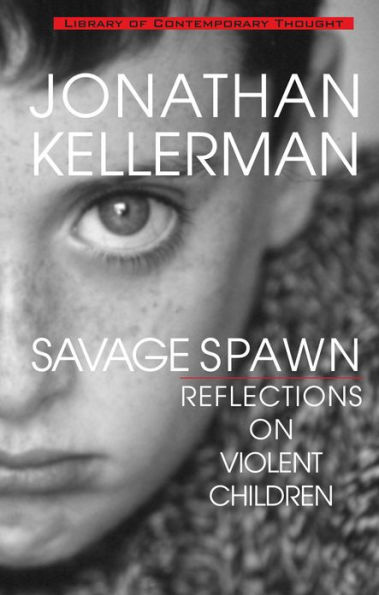
Savage Spawn: Reflections on Violent Children [NOOK Book]

NOOK Book (eBook - EBook)
$9.99
BN.com price

Available on NOOK devices and apps

  • Nook Devices
  • NOOK
  • NOOK Color
  • NOOK Tablet
  • Tablet/Phone
  • NOOK for iPad
  • NOOK for iPhone
  • NOOK for Android
  • NOOK for Android (Tablet)
  • NOOK Kids for iPad
  • PC/Mac
  • NOOK Study
  • NOOK for PC
  • NOOK for Mac

Need a NOOK? Explore Now

Overview

"Ethically and morally, kids are works in progress. Throw in psychopathy and you've got a soul that will never be complete."

In this powerful, disturbing book, bestselling author and noted child psychologist Jonathan Kellerman shines a penetrating light on antisocial youth--kids who kill without remorse--asserting that "psychopathic tendencies begin very early in life, as young as three, and they endure." Criticizing our quick impulse to blame violent movies or a "morally bankrupt" society, Kellerman convinces us that it is the kids themselves who need to be examined. Carefully.

How do children become cold-blooded killers? Kellerman warns that today's ...

See more details below

Overview

"Ethically and morally, kids are works in progress. Throw in psychopathy and you've got a soul that will never be complete."

In this powerful, disturbing book, bestselling author and noted child psychologist Jonathan Kellerman shines a penetrating light on antisocial youth--kids who kill without remorse--asserting that "psychopathic tendencies begin very early in life, as young as three, and they endure." Criticizing our quick impulse to blame violent movies or a "morally bankrupt" society, Kellerman convinces us that it is the kids themselves who need to be examined. Carefully.

How do children become cold-blooded killers? Kellerman warns that today's aggressive bully is tomorrow's Mafia don, cult leader, or genocidal dictator. Violently psychopathic youths possess an overriding need for power, control, and stimulation, and all display a complete lack of regard for the humanity of others. He examines the origins of psychopathy and the ever-shifting debate between nurture and nature, offering some controversial solutions to dealing with homicidal tendencies in children.

As timely as today's headlines, more gripping than fiction, Savage Spawn is a provocative look at the links between society and biology, children and violence. Kellerman's sobering message will remain with you long after the last page is turned.

Editorial Reviews

Publishers Weekly
Novelist Kellerman, a child psychologist who often uses the fictional character of Dr. Alex Delaware as his foil, here tackles the hot topic of violent children in a nonfiction format--part of the ongoing Library of Contemporary Thought series. Using the recent school shootings in Oregon, Arkansas and Colorado as a hook, he vents his own views on "childhood criminality as a social destructor." Relying on personal case histories, he provides a general profile for kiddie psychopaths. Mostly boys, from all kinds of backgrounds, these habitually violent kids are marked by their bravado and lack of conscience. In short, they're cold-blooded monsters who, when given access to guns, become deadly threats. Kellerman's personal views can be shrill, even alarmist, as he rails against such ills as "Marxist-derived social science norms," yet this novelist-on-a-soapbox diatribe plays convincingly in Gilliland's forceful reading, like an artfully constructed public speech. Based on the 1999 Ballantine paperback. (July) Copyright 1999 Cahners Business Information.

Product Details

  • ISBN-13: 9780345463661
  • Publisher: Random House Publishing Group
  • Publication date: 4/1/2003
  • Sold by: Random House
  • Format: eBook
  • Edition description: EBook
  • Sales rank: 75,664
  • File size: 236 KB
  • Items ship to U.S, APO/FPO and U.S. Protectorate addresses.

Meet the Author

Jonathan Kellerman
Jonathan Kellerman
Child psychologist-turned-novelist Jonathan Kellerman uses his knowledge of the psyche's weaknesses to create chilling crime novels, many starring detective (and former child psychologist, natch) Alex Delaware and cop friend Milo Sturgis.

Biography

"I like to say that as a psychologist I was concerned with the rules of human behavior," Jonathan Kellerman has said. "As a novelist, I'm concerned with the exceptions." Both roles are evident in Kellerman's string of bestselling psychological thrillers, in which he probes the hidden corners of the human psyche with a clinician's expertise and a novelist's dark imagination.

Kellerman worked for years as a child psychologist, but his first love was writing, which he started doing at the age of nine. After reading Ross MacDonald's Lew Archer novels, however, Kellerman found his voice as a writer -- and his calling as a suspense novelist. His first published novel, When the Bough Breaks, featured a child psychologist, Dr. Alex Delaware, who helps solve a murder case in which the only apparent witness is a traumatized seven-year-old girl. The book was an instant hit; as New York's Newsday raved, "[T]his knockout of an entertainment is the kind of book which establishes a career in one stroke."

Kellerman has since written a slew more Alex Delaware thrillers; not surprisingly, the series hero shares much of Kellerman's own background. The books often center on problems of family psychopathology—something Kellerman had ample chance to observe in his day job. The Delaware novels have also chronicled the shifting social and cultural landscape of Los Angeles, where Kellerman lives with his wife (who is also a health care practitioner-turned-novelist) and their four children.

A prolific author who averages one book a year, Kellerman dislikes the suggestion that he simply cranks them out. He has a disciplined work schedule, and sits down to write in his office five days a week, whether he feels "inspired" or not. "I sit down and start typing. I think it's important to deromanticize the process and not to get puffed up about one's abilities," he said in a 1998 chat on Barnes & Noble.com. "Writing fiction's the greatest job in the world, but it's still a job. All the successful novelists I know share two qualities: talent and a good work ethic."

And he does plenty of research, drawing on medical databases and current journals as well as his own experience as a practicing psychologist. Then there are the field trips: before writing Monster, Kellerman spent time at a state hospital for the criminally insane.

Kellerman has taken periodic breaks from his Alex Delaware series to produce highly successful stand-alone novels that he claims have helped him to gain some needed distance from the series characters. It's a testament to Kellerman's storytelling powers that the series books and the stand-alones have both gone over well with readers; clearly, Kellerman's appeal lies more in his dexterity than in his reliance on a formula. "Often mystery writers can either plot like devils or create believable characters," wrote one USA Today reviewer. "Kellerman stands out because he can do both. Masterfully."

Good To Know

Some outtakes from our interview with Jonathan Kellerman:
"I am the proud husband of a brilliant novelist, Faye Kellerman. I am the proud father of a brilliant novelist, Jesse Kellerman. And three lovely, gifted daughters, one of whom, Aliza, may turn out to be one of the greatest novelists/poets of this century. "

"My first job was selling newspapers on a corner, age 12. Then I delivered liquor, age 16 -- the most engaging part of that gig was schlepping cartons of bottles up stairways in building without elevators. Adding insult to injury, tips generally ranged from a dime to a quarter. And, I was too young to sample the wares. Subsequent jobs included guitar teacher, freelance musician, newspaper cartoonist, Sunday School teacher, youth leader, research/teaching assistant. All of that simplified when I was 24 and earned a Ph.D. in psychology. Another great job. Then novelist? Oh, my, an embarrassment of riches. Thank you, thank you, thank you, kind readers. I'm the luckiest guy in the world.

"I paint, I play the guitar, I like to hang out with intelligent people whose thought processes aren't by stereotype, punditry, political correctness, etc. But enough about me. The important thing is The Book."

More fun facts:
After Kellerman called his literary agent to say that his wife, Faye, had written a novel, the agent reluctantly agreed to take a look ("Later, he told me his eyes rolled all the way back in his head," Kellerman said in an online chat). Two weeks later, a publisher snapped up Faye Kellerman's first book, The Ritual Bath. Faye Kellerman has since written many more mysteries featuring L.A. cop Peter Decker and his wife Rina Lazarus, including the bestsellers Justice and Jupiter's Bones.

When Kellerman wrote When the Bough Breaks in 1981, crime novels featuring gay characters were nearly nonexistent, so Alex Delaware's gay detective friend, Milo Sturgis, was a rarity. Kellerman admits it can be difficult for a straight writer to portray a gay character, but says the feedback he's gotten from readers -- gay and straight -- has been mostly positive.

In his spare time, Kellerman is a musician who collects vintage guitars. He once placed the winning online auction bid for a guitar signed by Don Henley and his bandmates from the Eagles; proceeds from the sale were donated to the Jewish Federation of Greater Dallas.

In addition to his novels, Kellerman has written two children's books and three nonfiction books, including Savage Spawn, about the backgrounds and behaviors of child psychopaths.

But for a 1986 television adaptation of When the Bough Breaks, none of Kellerman's work has yet made it to screen. "I wish I could say that Hollywood's beating a path to my door," he said in a Barnes & Noble.com chat in 1998, "but the powers-that-be at the studios don't seem to feel that my books lend themselves to film adaptation. The most frequent problem cited is too much complexity."

    1. Hometown:
      Beverly Hills, California
    1. Date of Birth:
      August 9, 1949
    2. Place of Birth:
      New York, New York
    1. Education:
      B.A. in psychology, University of California-Los Angeles; Ph.D., University of Southern California, 1974
    2. Website:

Read an Excerpt

An Idea That Wouldn't Go Away

I know the exact day I decided to write this book.

I love writing novels, am obsessive about writing novels, resent anything that gets in the way of writing novels. Sometimes this single-mindedness conflicts with a cranky, highly opinionated disposition, most evident during the early morning hours, that presses me to vent spleen in print. Fortunately, a combination of deep breathing, strong coffee, and solitude usually prevails, and yet another page is added to the mountain of unwritten letters to the editor and op-ed pieces moldering in some dark corner at the back of my skull.

Thursday, March 26, 1998, was different. My novel in progress was nearly completed, but I wanted nothing to do with it.

The day before, Mitchell Johnson and Andrew Golden of Jonesboro, Arkansas, had dressed in camouflage garb, stolen a van, filled it with a tent, a sleeping bag, tools, food, and enormous quantities of ammunition and stolen weapons. Thus equipped, they drove to nearby Westside Middle School, where they set off the fire alarm. As the bells clanged, Johnson and Golden ran for cover behind a wooden ridge, waited for students and teachers to emerge, then unleashed a fusillade. Four little girls and a teacher were killed. Ten other children and a teacher were wounded. A motive was suggested: Mitchell Johnson had been jilted by a girl. No rationale was offered for Andrew Golden's behavior. Both Johnson and Golden had warned other children they were going to kill someone. Both had troubled pasts, but no one took them seriously.

One hundred thirty-four spent shells were found at the crime scene, ranging from rat shot to .357 Magnum bullets. In Andrew Golden's pockets were 312 more shells. Johnson and Golden's arsenal consisted of a .30-06 Remington rifle, a Ruger .44 Magnum rifle, a Universal .30 carbine, a Davis Industry .38 special two-shot, an FIE .380 handgun, a Ruger Security Six .357 revolver, a Remington model 742 .30-06 rifle, a Smith & Wesson .38 pistol, a Double Deuce Buddie two-shot derringer, a Charter Arms .38 special pistol, a Star .380 semiautomatic, six knives, and two speed loaders.

At the time of the attack, Mitchell Johnson was thirteen years old, Andrew Golden eleven.

The Jonesboro massacre wasn't the first of its type--several other school slaughters carried out by youths had occurred within recent months. Nor would it be the last. Two months later to the day, fifteen-year-old Kipland Kinkel, of Springfield, Oregon, would slay his parents in the family home, steal the family car, drive to Thurston High School, enter the cafeteria, and spray the room with bullets from a semiautomatic rifle, killing two students and wounding twenty-two others. Inadequately searched by the police, Kinkel would be taken into custody with a knife strapped to his leg and, soon after, would attempt to escape by stabbing a cop.

Childhood violence is by no means confined to the bloody rampages of small-town white boys. Drive-by shootings committed by urban gangbangers, usually members of racial and ethnic minorities, proceed with regularity, never attracting the level of media attention and pontification elicited by the Johnsons, Goldens, and Kinkels of our time. A bit of covert racism, perhaps? We don't expect it of white kids?

Nevertheless, something about the horror perpetrated by Mitchell Johnson and Andrew Golden seemed especially nauseating: to be so young and yet kill with such a finely honed sense of premeditation.

To be so cold.

I'd been trained as a child clinical psychologist, worked for two decades at a major urban hospital and as a private practitioner, had witnessed plenty of psychopathology firsthand. But on March 26, 1998, my education and experience seemed pathetically inadequate. I struggled to make sense of the rampage. Was there anything I'd learned about human development that could come close to explaining calculated slaughter carried out by a fresh-faced pair who hadn't even nudged puberty?

Mitchell Johnson and Drew Golden's bloody adventure kept me up all night. On Thursday morning I was feeling pretty ragged and no more enlightened. I retired to my office, closed the door, turned off the phone, did a lot of thinking, reviewed dozens of books and scores of scholarly articles, meandered mentally through hundreds of case histories, and thought some more. Then I sat down, composed an essay, and sent it to Glen Nishimura, op-ed editor at USA Today, where it was published the following morning.

Late in the afternoon of the twenty-sixth, before I heard back from Nishimura, I received a phone call from my literary agent, Barney Karpfinger. Well aware of my reluctance to interrupt my fiction writing, he wondered nonetheless if I'd consider a nonfiction project: Peter Gethers, vice president and editor at large at Random House, had created a series titled The Library of Contemporary Thought, a collection of short books, issued monthly, authored by established writers on topics that resonated for them personally. My name had come up: Would I be willing to contribute a volume on childhood violence?

"Barney," I said, "I've already started."

Customer Reviews
Average Rating 4
( 10 )

Rating Distribution

  • ( 5 )
  • ( 1 )
  • ( 2 )
  • ( 2 )
  • ( 0 )
If you've bought this product, tell the world how you liked it.
Write a Review
Sort by: Showing all of 10 Customer Reviews
  • Posted December 24, 2011

    Looking GOOD !

    Have just started but really intriguing....

    Was this review helpful? Yes  No   Report this review
  • Posted July 18, 2009

    more from this reviewer

    I Also Recommend:

    Kellerman's non-fiction out shines his fiction.

    I have ben reading Jonathan Kellerman as a fiction writer for several years, always enjoying his work. When I found he had published non-fiction as well I was eager to read it, especially as a medical professional. I found 'Savage Spawn' to be quite compelling, and not at all boring or long winded as many non-fiction works of the medical/psychological type seem to be. Kellerman's years of fiction work have obviously helped him to present facts in an entertaining yet enlightening style. Such a delicate issue of childhood/teenage violence and psychosis is a topic mastered in this book. I recommend it to those prepared to learn about the tragic realities of youthful mental illness, not for general audiences...

    Was this review helpful? Yes  No   Report this review
  • Anonymous

    Posted May 11, 2006

    Very Interesting

    This is a book that will educate but that you can enjoy reading. A tremendous amount of information in a small book. Good for research.

    Was this review helpful? Yes  No   Report this review
  • Anonymous

    Posted February 12, 2011

    No text was provided for this review.

  • Anonymous

    Posted May 22, 2011

    No text was provided for this review.

  • Anonymous

    Posted June 4, 2010

    No text was provided for this review.

  • Anonymous

    Posted December 22, 2011

    No text was provided for this review.

  • Anonymous

    Posted September 7, 2010

    No text was provided for this review.

  • Anonymous

    Posted February 19, 2011

    No text was provided for this review.

  • Anonymous

    Posted April 3, 2010

    No text was provided for this review.

Sort by: Showing all of 10 Customer Reviews

If you find inappropriate content, please report it to Barnes & Noble
Why is this product inappropriate?
Comments (optional)
500 character limit