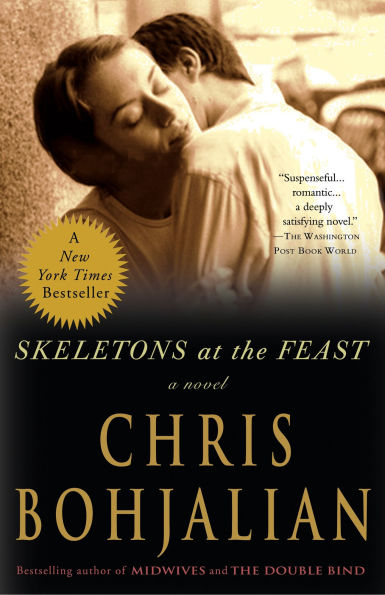
Skeletons at the Feast

( 168 )

Pick Up in Store

Reserve and pick up in 60 minutes at your local store

Paperback
$12.98
BN.com price
$14.95 List Price (Save 13%)
Marketplace (New and Used)
from
$0.01
$14.95 List Price (Save 100%)
All (126)  
Used (108)  
New (18)  
Close
Sort by
Page 1 of 13
Showing 1 – 10 of 126 (13 pages)
$0.01
(Save 100%)
Seller since 2009

Feedback rating:

(22568)

Condition:

New — never opened or used in original packaging.

Like New — packaging may have been opened. A "Like New" item is suitable to give as a gift.

Very Good — may have minor signs of wear on packaging but item works perfectly and has no damage.

Good — item is in good condition but packaging may have signs of shelf wear/aging or torn packaging. All specific defects should be noted in the Comments section associated with each item.

Acceptable — item is in working order but may show signs of wear such as scratches or torn packaging. All specific defects should be noted in the Comments section associated with each item.

Used — An item that has been opened and may show signs of wear. All specific defects should be noted in the Comments section associated with each item.

Refurbished — A used item that has been renewed or updated and verified to be in proper working condition. Not necessarily completed by the original manufacturer.

Good
Giving great service since 2004: Buy from the Best! 4,000,000 items shipped to delighted customers. We have 1,000,000 unique items ready to ship! Find your Great Buy today!

Ships from: Lakewood, WA

Usually ships in 1-2 business days

  • Canadian
  • International
  • Standard, 48 States
  • Standard (AK, HI)
  • Express, 48 States
  • Express (AK, HI)
$0.01
(Save 100%)
Seller since 2009

Feedback rating:

(22568)

Condition: Good
Giving great service since 2004: Buy from the Best! 4,000,000 items shipped to delighted customers. We have 1,000,000 unique items ready to ship! Find your Great Buy today!

Ships from: Lakewood, WA

Usually ships in 1-2 business days

  • Canadian
  • International
  • Standard, 48 States
  • Standard (AK, HI)
  • Express, 48 States
  • Express (AK, HI)
$0.25
(Save 98%)
Seller since 2012

Feedback rating:

(81)

Condition: Good
Very minimal damage to the cover no holes or tears, only minimal scuff marks minimal wear binding majority of pages undamaged minimal creases or tears. Book may have writing, ... underlining, highlighting, wear to cover and corners, notes in margins, writing Read more Show Less

Ships from: Indianapolis, IN

Usually ships in 1-2 business days

  • Canadian
  • International
  • Standard, 48 States
  • Standard (AK, HI)
  • Express, 48 States
  • Express (AK, HI)
$0.99
(Save 93%)
Seller since 2012

Feedback rating:

(119)

Condition: Good
2009 Paperback The cover may contain minor wear, and the corners may have some light degree of damage. If there are any notes present, they would only be penciled and only ... visible on a few pages. There are no ink markings of any kind, but there may be a remainder-mark on the outside edge of the pages. Proceeds benefit non-profit Goodwill Industries of San Francisco, San Mateo and Marin Counties. We create solutions to poverty through the businesses we operate. Your purchase creates jobs and transforms liv. Read more Show Less

Ships from: San Francisco, CA

Usually ships in 1-2 business days

  • Canadian
  • International
  • Standard, 48 States
  • Standard (AK, HI)
  • Express, 48 States
  • Express (AK, HI)
$0.99
(Save 93%)
Seller since 2007

Feedback rating:

(11921)

Condition: Very Good
2009 Paperback Item is in very good condition.

Ships from: Wilmington, MA

Usually ships in 1-2 business days

  • Canadian
  • International
  • Standard, 48 States
  • Standard (AK, HI)
  • Express, 48 States
  • Express (AK, HI)
$0.99
(Save 93%)
Seller since 2011

Feedback rating:

(225)

Condition: Acceptable
2009 Paperback Fair The book is clean but may have markings or highlights througout.

Ships from: St Paul, MN

Usually ships in 1-2 business days

  • Canadian
  • International
  • Standard, 48 States
  • Standard (AK, HI)
  • Express, 48 States
  • Express (AK, HI)
$0.99
(Save 93%)
Seller since 2005

Feedback rating:

(1228)

Condition: Good
2009 Paperback Good Possible defects such as light shelving wear may exist. May have minor creasing, writing, stickers and/or residue. COAS Books, A Bookstore for Everyone. Buy ... with confidence-Satisfaction Guaranteed! Read more Show Less

Ships from: Las Cruces, NM

Usually ships in 1-2 business days

  • Canadian
  • International
  • Standard, 48 States
  • Standard (AK, HI)
  • Express, 48 States
  • Express (AK, HI)
$0.99
(Save 93%)
Seller since 2009

Feedback rating:

(625)

Condition: Good
Good

Ships from: Washington, DC

Usually ships in 1-2 business days

  • Canadian
  • International
  • Standard, 48 States
  • Standard (AK, HI)
  • Express, 48 States
  • Express (AK, HI)
$0.99
(Save 93%)
Seller since 2005

Feedback rating:

(20386)

Condition: Very Good
2009-02-10 Trade Paperback Very Good Trade paperback (US). Glued binding. 379 p. Contains: Illustrations.

Ships from: Sparks, NV

Usually ships in 1-2 business days

  • Canadian
  • International
  • Standard, 48 States
  • Standard (AK, HI)
  • Express, 48 States
  • Express (AK, HI)
$1.98
(Save 87%)
Seller since 2010

Feedback rating:

(120)

Condition: Acceptable
2009 Paperback Acceptable Has Shelf Wear, but GOOD for age and is still readable! ! ! . Also has some small sections of moisture but still very readable Cover shows more shelf ... wear than pages We pack all of our items with a special protective bubble mailer. Your item deserves better than just a cheap plastic bag! Read more Show Less

Ships from: Cocoa, FL

Usually ships in 1-2 business days

  • Canadian
  • International
  • Standard, 48 States
  • Standard (AK, HI)
  • Express, 48 States
  • Express (AK, HI)
Page 1 of 13
Showing 1 – 10 of 126 (13 pages)
Close
Sort by
NOOK Book (eBook)
$11.99
BN.com price

Available on NOOK devices and apps

  • Nook Devices
  • NOOK
  • NOOK Color
  • NOOK Tablet
  • Tablet/Phone
  • NOOK for iPad
  • NOOK for iPhone
  • NOOK for Android
  • NOOK for Android (Tablet)
  • NOOK Kids for iPad
  • PC/Mac
  • NOOK Study
  • NOOK for PC
  • NOOK for Mac

Want a NOOK? Explore Now

Overview

A masterful love story set against a backdrop of epic history and unforgettable courage

In the waning months of World War II, a small group of people begin the longest journey of their lives.

At the center is eighteen-year-old Anna, the daughter of Prussian aristocrats, and her first love, a twenty-year-old Scottish prisoner of war named Callum. With his boyish good looks and his dedication to her family, he has captured Anna’s heart. But he is the enemy, and their love must remain a closely guarded secret. Only Manfred, a twenty-six-year-old Wehrmacht corporal, knows the truth. And Manfred, who is not what he seems to be, is reluctantly taken with Anna, just as she finds herself drawn uncomfortably to him.

As these unlikely allies work their way west, their flight will test both Anna’s and Callum’s love, as well as their friendship with Manfred–and will forever bind the young trio together.

Includes special bonus material: Chris Bohjalian responds to questions from book groups and readers

Editorial Reviews

From Barnes & Noble
In his previous novel, The Double Bind, Oprah's Book Club honoree Chris Bohjalian commandeered characters from The Great Gatsby to create another seductive West Egg treasure. In Skeletons at the Feast, he draws on an unpublished World War II diary to accomplish an equally ambitious transformation. The fiction re-creates the fitful westward flight of a Prussian aristocrat, her children, and their Scottish POW servant in the waning months of the war. As this unlikely group desperately flees the advancing Russian troops, they befriend an even more unlikely protector: a young Jew who somehow had escaped from an Auschwitz-bound train. Bohjalian counterpoints this tense trek with a parallel narrative about hundreds of Jewish women struggling to survive a pitiless forced march from a death camp. Gripping details; unforgettable snapshots of the horrors of war.
Margot Livesey
Bohjalian's sense of character and place, his skillful plotting and his clear grasp of this confusing period of history make for a deeply satisfying novel, one that asks readers to consider, and reconsider, how they would rise to the challenge of terrible deprivation and agonizing moral choices.
—The Washington Post
Publishers Weekly

Bohjalian's rousing tale of three young Jews-Anna, Callum and Uri-who must trek from Warsaw to reach Allied lines is stunningly vivid. Whether it is the troubled lovers whose relationship is put to the test given the disquiet and unrest that abounds throughout much of Europe, or the mysterious stranger who guides them through it all, Mark Bramhall has no trouble stepping into character and giving his listeners a blazing experience. Bramhall reads with a sturdy tone, steeped in anger and sadness, a perfect fit for Bohjalian's poignant tale. Giving a voice to nameless victims of the Holocaust, Bramhall's reading is haunting and memorable. A Shaye Areheart hardcover (Reviews, Feb. 4). (May)

Copyright © Reed Business Information, a division of Reed Elsevier Inc. All rights reserved.
Library Journal

Bohjalian (The Double Bind) leaves his traditional Vermont milieu for this wellcrafted, deeply moving historical novel in which he traces the last months of World War II Germany through various lives, masterfully describing landscape and struggle. Narrator Mark Bramhall (An Atomic Romance) easily moves among accents and between genders. Bohjalian fans will applaud; highly recommended. [Also available from Random House Audio as a retail ed. unabridged CD (ISBN 9780739366233) (9780739366240)
—Joyce Kessel

Kirkus Reviews
Love in a time of war, 1945-1948. Though occasionally groaning under the weight of its mighty themes-man's-inhumanity-to-man, the-horror-the-horror, hope-rising-from-rubble-sheer storytelling here ultimately wins out, trumping the novel's self-consciously mythic ambitions. It features a desperate trio: Anna Emmerich, Prussian aristocrat with "[h]air the color of corn silk," her strapping lover, Callum Finnella, Scottish POW, and the mysterious Manfred, Wehrmacht corporal. Bohjalian (The Double Bind, 2007, etc.) brings them together for an epic romance based on a true-life World War II diary. Callum and Anna, her family in tow, are fleeing Russian invaders, crossing the iced-over Vistula as the Reich nears its bitter end. In their death throes, the Nazis have erupted into spasmodic violence-"live babies held by their ankles and swung like scythes into stone walls while their mothers were forced to watch . . . " Turns out Manfred's not an actual fascist but the underground alias of Uri Singer, a Jewish refugee masquerading, exchanging his yellow Star of David for a "Nuremberg eagle made of bronze." Outwitting the SA, who'd crammed him and his kin onto an Auschwitz-bound train, Uri had made a run for it, leaping from the boxcar. So, too, had Callum arrived dramatically into Anna's life, jumping from an airplane machine-gunned behind enemy lines, then being captured, and finally farmed out to the Emmerichs as a forced laborer. The three lives intersect as the tale winds through savaged cities. Bohjalian is especially good at conveying the surreal "beauty," the misshapen lyricism, of the war-torn landscape: "Even the stone church had collapsed upon itself . . . the once imposing pipes of theorgan reshaped by heat and flame into giant copper-colored mushrooms."From harrowing to inspiring. Agent: Jane Gelfman/Gelfman Schneider

Product Details

  • ISBN-13: 9780307394965
  • Publisher: Crown Publishing Group
  • Publication date: 2/10/2009
  • Pages: 400
  • Sales rank: 94,497
  • Product dimensions: 5.10 (w) x 7.90 (h) x 1.00 (d)

Meet the Author

Chris Bohjalian
Chris Bohjalian

CHRIS BOHJALIAN is the critically acclaimed author of eleven novels, including Midwives (an Oprah's Book Club Selection and a Publishers Weekly Best Book), Before You Know Kindness, and the 2007 blockbuster The Double Bind.

Biography

It was March 1986 when Chris Bohjalian made a decision that would have an incalculable impact on his writing. He and his wife had just hailed a taxi home to Brooklyn after a party in Manhattan's East Village when they suddenly found themselves on a wild and terrifying 45-minute ride. The crazed cabbie, speeding through red lights and ignoring stop signs, ultimately dropped the shaken couple off... in front of a crack house being stormed by the police. It was then that Bohjalian and his wife decided that the time had come to flee the city for pastoral Vermont. This incident and the couple's subsequent move to New England not only inspired a series of columns titled "Idyll Banter" (later compiled into a book of the same name), but a string of books that would cause Bohjalian to be hailed as one of the most humane, original, and beloved writers of his time.

While Bohjalian's Manhattan murder mystery A Killing in the Real World was a somewhat quiet debut, follow-up novels (many of which are set in his adopted state) have established him as a writer to watch. A stickler for research, he fills his plotlines with rich, historically accurate details. But he never loses sight of what really draws readers into a story: multi-dimensional characters they can relate to.

The selection of his 1997 novel Midwives for Oprah's Book Club established Bohjalian as a force to be reckoned with, igniting a string of critically acclaimed crowd pleasers. His literary thriller The Double Bind was a Barnes & Noble Recommends pick in 2007.

Good To Know

Bohjalian's fascination with the works of F. Scott Fitzgerald extends beyond the author's prominent influence on The Double Bind. In an interview with Loaded Shelf.com, Bohjalian estimated that he owns "at least 42 different editions of books by or about F. Scott Fitzgerald."

. Two of Chris Bojalian's novels have been adapted into critically acclaimed TV movies. An adaptation of Past the Bleachers with Richard Dean Anderson was made in 1995, and a version of Midwives starring Sissy Spacek and Peter Coyote debuted in 2001.

In our interview with Bohjalian, he shared some fascinating and fun facts about himself:

"I was the heaviest child, by far, in my second-grade class. My mother had to buy my pants for me at a store called the "Husky Boys Shop," and still she had to hem the cuffs up around my knees. I hope this experience, traumatizing as it was, made me at least marginally more sensitive to people around me."

"I have a friend with Down syndrome, a teenage boy who is capable of remembering the librettos from entire musicals the first or second time he hears them. The two of us belt them out together whenever we're driving anywhere in a car.

"I am a pretty avid bicyclist. The other day I was biking alone on a thin path in the woods near Franconia Notch, New Hampshire, and suddenly before me I saw three bears. At first I saw only two, and initially I thought they were cats. Then I thought they were dogs. Finally, just as I was approaching them and they started to scurry off the path and into the thick brush, I understood they were bears. Bear cubs, to be precise. Which is exactly when their mother, no more than five or six feet to my left, reared up on her hind legs, her very furry paws and very sharp claws raised above her head in a gesture that an optimist might consider a wave and guy on a bike might consider something a tad more threatening. Because she was standing on a slight incline, I was eye level with her stomach -- an eventual destination that seemed frighteningly plausible. I have never biked so fast in my life in the woods. I may never have biked so fast in my life on a paved road."

"I do have hobbies -- I garden and bike, for example -- but there's nothing in the world that gives me even a fraction of the pleasure that I derive from hanging around with my wife and daughter."

    1. Hometown:
      Lincoln, Vermont
    1. Date of Birth:
      August 12, 1961
    2. Place of Birth:
      White Plains, New York
    1. Education:
      Amherst College
    2. Website:

Read an Excerpt

Skeletons at the Feast
By Chris Bohjalian Shaye Areheart Books

Copyright © 2008 Chris Bohjalian
All right reserved.

ISBN: 978-0-307-39495-8


Chapter One

usually, it was only when one of the local soldiers was home on leave that Anna and her girlfriends ever saw the sorts of young men with whom, in different times, they might have danced. And, as the war had dragged on, the pool of marriage prospects-in Anna's mind, often enough that meant merely her older brother Werner's acquaintances-dried up completely. The soldiers were either missing or disfigured or dead.

But then came the POWs. Seven of them, sent from the prison camp to help with the harvest.

And a week after the POWs arrived at Kaminheim, when the corn was almost completely harvested and everyone was about to begin to gather the sugar beets and the apples, there came four naval officers in search of a plow. They were planning to mark a groove through the estate that would be the start of an antitank trench. When it was complete, the trench would span the length of the district, bisecting some farms, skirting the edges of others. Meanwhile, different officers were visiting neighboring estates as well, and the Emmerichs were told that at some point in the coming month hundreds of foreigners and old men would follow them, and descend on the estate to actually construct the trench.

And while the very idea of an antitank trench was alarming, the presence of all thosehandsome young men-the Germans, the Brits, and that one very young Scot-made it a burden Anna was willing to shoulder. This was true, at least in part, because she didn't honestly believe the fighting would ever come this far west. It couldn't. Even the naval officers said this was a mere precaution. And so she would flirt with the Brits during the day in the fields, where she would work, too, and dance with the naval officers in the evenings in the manor house's small but elegant ballroom. Mutti would play the piano, joined after that first night by Callum Finella on Uncle Felix's accordion, while her father-though distracted by the news from the east-would look on benignly. Sometimes Theo would put his toy cavalrymen away and watch as well, appalled in the manner of any ten-year-old boy that these brave and accomplished soldiers wanted to waste their time with the likes of his sister and her friends. He followed the men around like a puppy.

Helmut did, too. But Helmut actually would work with the officers as long as their father allowed him away from the harvest, helping them to find their way around the endless acres of Kaminheim, and thus mark out the optimum design and placement of the trench. Then, after dinner, he would dance with Anna's friends-girls who, previously, he had insisted were too puerile to be interesting. Seeing them now through the eyes of the navy men, however, he was suddenly discovering their charms.

Certainly Anna worried about her older brother, Werner, who had already been wounded once in this war and was fighting somewhere to the south. But she had rarely spent any time with men as interesting as this eclectic group who had descended upon their farm that autumn. She and Helmut had learned to speak English in school, though she had taken her studies far more seriously than her brother, which meant that she alone in the assemblage could speak easily to everybody-the POWs during the day and the naval officers at night-and appreciate how erudite and experienced everyone was. At least, she thought, in comparison to her. She was, on occasion, left almost dizzy as she swiveled among conversations and translated asides and remarks. And the longer stories? She felt like a star-struck child. When she was in grade school she had met English families the winter her family had gone skiing in Switzerland, but by 1944 she remembered little more than a very large man in a very poor bear costume, and the way she and the English children together had endured his clownish shenanigans because all of the parents had thought the fellow was wildly entertaining. But since the war had begun, she hadn't been west of Berlin. In the early years, they had still taken summer holidays on the beaches of the Baltic or ventured to Danzig for concerts, but lately even those trips had ceased completely. Two of their POWs, however, had seen the pyramids; another had been to America; and Callum-the youngest of the group, the tallest of the group, and the only one from Scotland-had been born in India, where his father had been a colonial official, and had traveled extensively throughout Bengali and Burma and Madras as a little boy.

Even the German naval officers were more interesting than any of the country boys-or men-she had met in her district. They, too, had seen places in Europe and Africa she'd only read about in books.

Initially, she had worried that there might be unpleasant sparks when the Germans and the Brits crossed paths, especially on the first morning when the naval officers would be marking out a segment of the antitank trench in the very same beet fields where the POWs were working. But the two groups of men had largely ignored each other.

It was the next day, when she was working alongside the prisoners in the apple orchard, that one of the POWs-that exuberant young giant named Callum-segued from the usual flirtatious banter to which she had grown accustomed and had come to expect from him, to guarded innuendos about Adolf Hitler and then (even more problematic, in some ways) to questions about the work camps.

"You're such a nice girl, Anna, and so sharp," he said, as the two of them stood together beside a particularly wiry tree, resting for a moment midmorning. There was a military policeman who must have been somebody's grandfather standing guard a hundred meters away, but he was so old he probably wouldn't have heard a word they were saying if they had been standing directly beside him. "And your family is much more hospitable than necessary-given the circumstances and all." The POWs were sleeping in the bunkhouse that the farmhands had used before they had either run off or been commandeered by the Reich for work in the mines and the munitions factories.

"Thank you," she said simply. She was unsure where this conversation was going, but that opening, that apparent surprise that she was such a nice girl, had her slightly wary. She'd been laughing with Callum for days, and the thought crossed her mind that perhaps she had misjudged him. Grown too comfortable-too friendly-with him. With all the POWs.

"So, I was wondering," he continued, his voice nonchalant. "What do you think your Hitler is doing with the Jews?"

"My Hitler? You make him sound like one of my horses," she said, aware that she was not answering his question.

"I didn't mean that. I meant ..."

"What did you mean?"

"I had a mate in Scotland who was Jewish, a chum I played soccer with. We were friends, our parents were friends. He had family somewhere in Germany. And they just disappeared. There was talk of them trying to come to Edinburgh, but they couldn't get out. Eventually, the letters just dried up. Stopped coming. Then, at the stalag this summer, I met two chaps from Wales who had been in intelligence. And they said-"

She cut him off: "At school, they told me not to ask when I inquired. They told me I didn't know what I was talking about."

"But you asked?"

Aware that she couldn't help but sound oversensitive, she answered, "Maybe it would surprise you, but I do have a brain behind my eyes. Yes, I asked."

"It wouldn't surprise me a bit," he said, smiling.

"I asked them where the Jews were going," she continued. "Before the war, my parents had friends in Danzig who were Jewish. That's where my father went to university: Danzig. He grew up on a farm in another part of Prussia, but for a time he considered becoming a lawyer. But he's a very scientific man. And he likes working the earth too much. Anyway, he has never understood the Nazis' obsession with Jews. Never. My mother? It's different for her: She's lived her whole life here. She, too, thinks it's ridiculous, but she has always been a little oblivious of anything that doesn't involve the farm or this corner of the country."

"They're both party members, right?"

She nodded. "My father wouldn't have the contracts he has if he weren't a member of the party. Even I know that."

"Tell me, then: These friends. Your parents' Jewish friends. Where are they now?"

"One, I know, was my father's banker. I don't know his name, but he took very good care of Father and Mutti on their honeymoon. The inflation was so horrible that suddenly they couldn't pay their bills and Father's stocks were worth nothing. Somehow, the banker solved everything for them and they had a perfectly lovely holiday after that."

"What do you think became of him?"

"He and Father lost touch. But I can tell you this: My father wrote letters on his family's behalf to different people. I don't know who or what the letters were supposed to accomplish. But he wrote letters for other friends, too. And for a few weeks in the summer of 1940, my parents had some Jewish friends who lived with us: a younger couple and their baby. A little baby girl. She was adorable. They had lost their apartment in Danzig. I was thirteen and I always wanted to babysit, but the mother wouldn't let the child out of her sight." She could have gone on, but it was a memory she tried not to think about. There had been some talk about hiding the family-and hiding was indeed the word her parents had used-but so many people in the village had been aware of the Emmerichs' visitors from Danzig that the couple had refused her mother and father's offer of sanctuary and simply disappeared into the fog one August morning.

"I'm badgering you," he said. "I'm sorry. I didn't mean to. I have a habit of talking too much. You might have noticed."

"You're inquisitive," she said, unable to mask the small tremor she heard in her voice. The truth was, she didn't want to be having this conversation. She knew she wouldn't dare discuss these sorts of things on one of the streets in the village or in a city. One never knew who might be listening or how they might be connected to the party. And, suddenly, she felt an odd spike of defensiveness. "But you tell me: How am I supposed to know where everyone is in the midst of a war?"

"Well," he said evenly. "You can keep track of the Jews because of the stars on their clothes. You've seen them."

"Yes, of course I have. I've seen them in Danzig and I've seen them in Berlin."

"Lately?"

"I haven't been to Berlin lately. Or Danzig."

He used a handkerchief to wipe the perspiration away from his temples. The hair there was a bay that reminded her of Balga, her favorite horse. "The folks who will be coming to build the antitank trench," he began, and she could tell that he was choosing his words with great care. "You know, actually digging where those navy blokes are leaving the plow marks? They're the lucky ones."

"They'll be more prisoners like you."

"Maybe. But I think they're going to come instead from those work camps. Not the prison camps. It will take hundreds of people just to dig through your farm. And, besides, it's one thing to put a group of us soldiers to work harvesting apples and corn and sugar beets. Trust me, this is luxurious compared to life in the stalag, and we are all deeply appreciative of your family's kindness. But it's quite another to make us dig antitank trenches. The Red Cross and the folks who penned the Geneva convention wouldn't exactly approve."

"So, the workers will be the criminals from the camps? Communists and Gypsies. Why should that trouble me?"

"And Jews. That's my point, Anna. They're in those camps for no other reason than because they're Jewish."

"What?"

"The Jews have been sent to the camps."

"No," she said. "No. That's not true."

"I'm sorry, Anna. But it is."

"The Jews have just been resettled," she continued, repeating what she had been told at school and at her meetings with other teen girls in the Bund Deutscher Mädel whenever she had asked the question, but until that moment had never said aloud herself. Somehow, verbalizing the idea made it seem ludicrous. She certainly didn't add what so many of her teachers or BDM leaders had added over the years: They have to be resettled because they are not Aryan. They are inferior in every imaginable way, they are worse than the Russians and the Poles. Most have nothing that resembles an Aryan conscience, and they are interested in nothing but their money and mezuzahs and diamonds. Many are evil; all are conniving.

"And doesn't even resettlement seem, I don't know, a trifle uncivilized-even if it really is what's occurring?" he went on. "Think of that little family that was with you when you were thirteen. Why do you think there was talk of hiding them? I mean, suppose my government in England just decided to 'resettle' the Catholics-to take away their homes, their animals, their possessions, and then just send them away?"

Another prisoner, the balding mason named Wally, passed by with one of the wicker baskets they used for the apples and gave Callum a look that Anna recognized instantly as the universal sign to shut up. His head was cocked slightly and his eyes were wide. Callum ignored him and continued, "Those intelligence chaps from Wales. They told us about another camp. One further east in Poland. They had heard rumors-"

"I've heard rumors. We've all heard rumors. I've listened to your propaganda on the radio."

"You listen to the BBC? That's illegal, Anna, you know that," he told her, his voice mocking her good-naturedly.

"Everyone listens. And you know that."

Wally dumped his apples in one of the shipping crates in the back of a wagon and started to say something, his mouth opening into an anxiety-ridden O, but then stopped himself and returned to the trees where he was working, shaking his head in bewilderment.

"Besides," she said, angry now, "what am I supposed to do? Am I supposed to go have tea with the führer and advise him on policy?" He paused, seeming to think about this, unsure what to say. She decided to press her advantage. "You would be in serious trouble, you know, if I told anyone what you were saying."

"Indeed I would. I am putting my trust completely at your discretion."

"Why?"

"Because you are very pretty and very smart, and until I was sent here I hadn't spoken to a girl who was either in a very, very long time."

"Spare me," she said, but she couldn't help being flattered. "I've gone just as long without the company of boys. They're all off fighting somewhere."

"Ah, but then your navy men arrived," he said, and she realized he was actually a little jealous of them. He seemed about to say more when Wally returned, this time accompanied by the Yorkshire schoolteacher named Arthur Frost. "Come along, Callum," Arthur said firmly, "those apples won't pick themselves. No more dillydallying."

Callum nodded agreeably and left, turning back to Anna once to bring his index and middle finger to the tip of his lips. At the time, she thought he was shushing her; later, she would conclude he had in fact blown her a kiss.

theo moved two of his toy cavalrymen to the front of his column, and then had them ride to the river that Anna had helped him paint a year ago now on a piece of barn board. The board was at least a meter and a half square and he could carry it by himself-but just barely. Helmut had found it and his father had sanded it flat. In addition to the river, he and Anna had also painted trees and wooden fences on it, and a long trench winding its way down one of the sides, all as if seen from a low-flying airplane. He had wanted to add barbed wire near the trench, but Anna had convinced him that it would reduce the number of conflicts he could reenact by limiting his scenarios to the Great War. The trench, she had suggested, could be a streambed that had dried up in the summer if he wanted to stage a battle from the nineteenth century.

"Or," he had suggested helpfully at the time, "one of the firefights Werner has been in."

"That's right," she had said, but he had been able to tell by the pause and the way her voice had quivered just the tiniest bit that for some reason she was troubled by the idea of him using his lead soldiers to reenact battles along the eastern front. He hadn't really expected at the time that he would, because he had only a pair of toy tanks, and battles these days demanded lots and lots of armor. Moreover, his two tanks were of a different scale than his lead soldiers. They were from another collection and they were barely the height of his fighting men, which meant that he rarely used them.

(Continues...)


Excerpted from Skeletons at the Feast by Chris Bohjalian Copyright © 2008 by Chris Bohjalian. Excerpted by permission.
All rights reserved. No part of this excerpt may be reproduced or reprinted without permission in writing from the publisher.
Excerpts are provided by Dial-A-Book Inc. solely for the personal use of visitors to this web site.

Introduction

A Note to the Reader

In order to provide reading groups with the most informed and thought-provoking questions possible, it is necessary to reveal important aspects of the plot of this book–as well as the ending.

If you have not finished reading
Skeletons at the Feast, we respectfully suggest that you may want to wait before reviewing this guide.


In the chaotic months before the final collapse of the Third Reich, the Germans living in the eastern part of Hitler’s empire fled their homes to escape the onslaught of the Soviet Army. If these refugees didn’t know the specifics of the atrocities their people had committed on Russian soil –and, in fact, were still committing in concentration camps across Poland and Germany–they nonetheless understood that the Russians were going to be merciless.

It is this world that Chris Bohjalian brings vividly and powerfully to life in Skeletons at the Feast. A Prussian aristocrat struggles west with her beautiful daughter, her young son, and a Scottish prisoner of war. Meanwhile, a female Jewish prisoner struggles to survive first the horrors of a concentration camp and then a forced march west in the ice and snow of a German winter. And a Jewish man who has leapt from a train bound for a death camp learns to do whatever he must to survive.

This reader’s guide is intended as a starting point for your discussion of the novel.

Foreward

1. Do you know–or are you yourself–a veteran of World War II? Discuss what you know of the war and any reminiscences that veterans may have shared.

2. Both of Anna’s parents are members of the Nazi Party–though it is clear that they are not die-hard believers. Living on their farm in rural Prussia, they are largely sheltered from the atrocities perpetrated against the Jews. As Germans, do you think they share responsibility for the Nazis’ actions even if they didn’t know the full extent of what was happening? Why did they join the party? Did they have a choice? Consider Helmut’s teacher who questions the boy about his father’s loyalty to Hitler and the consequences of resisting. If failure to join meant death for you, what would you have done?

3. A group of POWs is brought to the Emmerich family’s farm to help with the harvest, including a Scot named Callum Finella. He and Anna fall in love. What brings them together? Does the kindness of the Emmerich family, and Callum’s love for their only daughter, change his view of the German people as a whole?

4. We meet Uri on the train to Auschwitz. What kind of man is he? How does he behave on the train? Imagine yourself in those deplorable conditions. Do you think you would seize the opportunity for freedom and jump as Uri did, leaving behind your family to an uncertain future?

5. While arguing with Anna about what is really happening to Jews, Callum says, “Suppose my government in England just decided to ‘resettle’ the Catholics–to take away their homes, their animals, their possessions, and just send them away?” What ifthis was happening where you live? What actions would you be willing to take to protect your friends and neighbors? At what point would the risks have been too great?

6. To survive, Uri impersonates a German soldier, stealing papers and uniforms from soldiers he either kills or finds dead. Discuss the events that lead up to his first killing of a Nazi. Discuss his reaction to what he has done (page 59). Do you believe his actions were warranted?

7. Although the world is essentially collapsing around them, Anna and Callum fall in love, Theo cries over leaving his beloved horse behind, and Mutti carefully drapes the furniture in sheets to protect it before they flee their home ahead of the Russians. What do these simple, ordinary actions reveal about them as people? About the human capacity for hope?

8. Theo is only a child but he feels lacking in comparison to his older brothers Werner and Helmut, both off fighting in the war. What kind of child is he? Does he fit in with his peers? Why doesn’t Theo tell his mother about his foot? What does this reveal about him? Does Theo change over the course of the novel?

9. Describe Cecile. What kind of woman is she? What keeps her going in spite of the cruelty and degradation she suffers every day? How is she different from her friend Jeanne? Do you think you would act more like Cecile or Jeanne in the same circumstances?

10. In Chapter Eight, Helmut and his father, Rolf, try to convince Uncle Karl to leave his home along with the Emmerichs. He refuses, keeping his daughter, daughter-in-law, and grandson with him in spite of the danger. Why won’t he evacuate? Why won’t he let the women and the child leave? On page 118 he refers to them and their way of life as “skeletons at the feast.” What does he mean by this?

11. Describe the circumstances that bring Uri and the Emmerichs together. Why does he choose to stay with them after running alone for so long? How does he feel about them initially? How do his feelings for them change?

12. On page 178, Callum is thinking about bringing Anna home with him to Scotland after the war. How does he think she will be received? Why is he troubled?

13. During their long march from the prison camp to the factory, Jeanne and another prisoner find soldiers’ rations and eat them. They do not wake Cecile to share them with her. Why? In the same circumstances, what would you have done?

14. Given the odds of success, would you have been brave enough to attempt to escape with Cecile and her friends?

15. Describe Mutti. What was she like at the beginning of the war? At the end? What does she view as her primary responsibility? On pages 291—293, she remembers burying the young German pilot whose plane crashed in her park. Why was burying him–and the enemy Russian soldiers–important to her?

16. How does Anna change as the novel progresses? Why does she feel the need for personal forgiveness at the end? Is she right to feel guilty?

17. Discuss the importance of hope in survival. Which character is the most hopeful? Which character is the most defeated? What moments at the end of the novel symbolize hope most poignantly?

18. Discuss the legacy that Mutti’s generation left for Anna’s. As a nation, what kind of legacy are we leaving for our children?

Interviews & Essays

Skeletons at the Feast
Chris Bohjalian

The Back Story

Like most of my novels, the idea for Skeletons at the Feast emerged from the minutiae of everyday life. There was a little girl in my daughter’s kindergarten class here in Vermont, and one day her father, Gerd Krahn, asked me if I would look at his German grandmother’s unpublished diary. His mother, Heidi, had just finished translating it into English and adding to it the recollections of other family members. This was back in 1998.

Usually, this sort of request is a novelist’s worst nightmare: Most family histories are dull as toast and badly written. But Gerd is a very good friend of mine, and so I was happy to read the diary that his East Prussian grandmother, Eva Henatsch, kept from 1920 through 1945.

Much of the diary focused upon the day-to-day activities of helping to manage a sizable estate in a remote, still rural corner of Europe. But then there were the passages that chronicled 1945 and Eva’s family’s arduous trek west ahead of the Soviet Army – a journey that was always grueling and often terrifying. I was fascinated. But I still didn’t anticipate that it would ever inspire me to embark upon a novel.

Eight years later, however, in 2006, I read Max Hastings’s history of the last year of the war in Germany, Armageddon, and I was struck by how often the anecdotes in Hastings’s nonfiction account mirrored moments in that diary. Apparently, the horrors in Henatsch’s diary were not unique. But nor were the moments of idiosyncratic human connection – such as the occasional friendships (and even romances) that grew between Allied prisoners of war who were sent to the farms in East Prussia to help with the harvest and the teenage German farm girls there. It was thus almost out of intellectual curiosity that I asked Gerd if I could revisit his grandmother’s diary. It was on that second reading that I began to imagine a novel and started to research the period.

And while I did a great deal of secondary research, much of my learning came from my interviews with Germans who were alive in the period and my interviews with Holocaust survivors – including one woman who endured the sort of horrific winter death march that the character Cecile experiences. Everyone seemed to have stories that were as astonishing as they were wrenching.

My sense is that the last six months of the Second World War in Poland and the eastern edges of Germany had to have been one of the most brutal periods in human history – which is why, perhaps, I was drawn to it as a novelist. People behaved in ways that are almost unimaginable outside of fiction and the stakes could not possibly have been higher. The magnitude of the carnage is inconceivable. There were concentration camps that were still functioning; there were the starving, desperately ill prisoners from other camps whom the Nazis were marching west in the cold; there were the Russian soldiers dying in monumental numbers since a part of the Russian military strategy was simply attrition; there were the German soldiers fighting like cornered wolves because they knew they didn’t dare surrender after the atrocities their army had committed across the Soviet Union; and then there were the terrified German civilians – women and children and old people – plodding west ahead of the advancing Russian army.

The scope of the crucible is always brought home to me by one single moment: The sinking of the Wilhelm Gustloff on January 30, 1945. The former cruise ship was the very last vessel to leave the surrounded East Prussian port of Gotenhafen, and so over 10,000 frantic evacuees fought their way aboard. (Think for a moment of those images we’ve all seen of the last helicopters leaving Saigon in 1975 as the North Vietnamese were arriving – then move that chaos to a port and multiply it a thousand times over.) The ship was quickly sunk by a Russian submarine, and over 9,500 people went to the bottom of the Baltic – or six times the number of people who died on the Titanic.

When I had written my first complete draft of the novel, I had the manuscript read by historians and holocaust survivors – and, of course, by the Krahn family.

Now, it’s important to note that although characters in Skeletons at the Feast endure some of the same trials as Eva Henatsch and her remarkable family, Irmgard Emmerich – Mutti in my novel – is not Eva. Nor is Anna Emmerich, my principal heroine, a recreation of Eva’s daughter, Heidi. I hope the fictional Mutti and Anna have a semblance of Eva's and Heidi’s monumental courage and resiliency and compassion, but they are nonetheless fictional constructs.

Finally, although Skeletons at the Feast differs from my earlier work in that it’s set in a particular historical moment, it still shares some specific universalities: It’s about ordinary people coping with trials they had never before imagined; with young people coming of age in moments of seemingly unbearable stress; and, I hope, with the sorts of moral ambiguity that give us all pause and force us to examine our values.

Reading Group Guide

1. Do you know–or are you yourself–a veteran of World War II? Discuss what you know of the war and any reminiscences that veterans may have shared.

2. Both of Anna’s parents are members of the Nazi Party–though it is clear that they are not die-hard believers. Living on their farm in rural Prussia, they are largely sheltered from the atrocities perpetrated against the Jews. As Germans, do you think they share responsibility for the Nazis’ actions even if they didn’t know the full extent of what was happening? Why did they join the party? Did they have a choice? Consider Helmut’s teacher who questions the boy about his father’s loyalty to Hitler and the consequences of resisting. If failure to join meant death for you, what would you have done?

3. A group of POWs is brought to the Emmerich family’s farm to help with the harvest, including a Scot named Callum Finella. He and Anna fall in love. What brings them together? Does the kindness of the Emmerich family, and Callum’s love for their only daughter, change his view of the German people as a whole?

4. We meet Uri on the train to Auschwitz. What kind of man is he? How does he behave on the train? Imagine yourself in those deplorable conditions. Do you think you would seize the opportunity for freedom and jump as Uri did, leaving behind your family to an uncertain future?

5. While arguing with Anna about what is really happening to Jews, Callum says, “Suppose my government in England just decided to ‘resettle’ the Catholics–to take away their homes, their animals, their possessions, and just send them away?” What if this was happening where you live? What actions would you be willing to take to protect your friends and neighbors? At what point would the risks have been too great?

6. To survive, Uri impersonates a German soldier, stealing papers and uniforms from soldiers he either kills or finds dead. Discuss the events that lead up to his first killing of a Nazi. Discuss his reaction to what he has done (page 59). Do you believe his actions were warranted?

7. Although the world is essentially collapsing around them, Anna and Callum fall in love, Theo cries over leaving his beloved horse behind, and Mutti carefully drapes the furniture in sheets to protect it before they flee their home ahead of the Russians. What do these simple, ordinary actions reveal about them as people? About the human capacity for hope?

8. Theo is only a child but he feels lacking in comparison to his older brothers Werner and Helmut, both off fighting in the war. What kind of child is he? Does he fit in with his peers? Why doesn’t Theo tell his mother about his foot? What does this reveal about him? Does Theo change over the course of the novel?

9. Describe Cecile. What kind of woman is she? What keeps her going in spite of the cruelty and degradation she suffers every day? How is she different from her friend Jeanne? Do you think you would act more like Cecile or Jeanne in the same circumstances?

10. In Chapter Eight, Helmut and his father, Rolf, try to convince Uncle Karl to leave his home along with the Emmerichs. He refuses, keeping his daughter, daughter-in-law, and grandson with him in spite of the danger. Why won’t he evacuate? Why won’t he let the women and the child leave? On page 118 he refers to them and their way of life as “skeletons at the feast.” What does he mean by this?

11. Describe the circumstances that bring Uri and the Emmerichs together. Why does he choose to stay with them after running alone for so long? How does he feel about them initially? How do his feelings for them change?

12. On page 178, Callum is thinking about bringing Anna home with him to Scotland after the war. How does he think she will be received? Why is he troubled?

13. During their long march from the prison camp to the factory, Jeanne and another prisoner find soldiers’ rations and eat them. They do not wake Cecile to share them with her. Why? In the same circumstances, what would you have done?

14. Given the odds of success, would you have been brave enough to attempt to escape with Cecile and her friends?

15. Describe Mutti. What was she like at the beginning of the war? At the end? What does she view as her primary responsibility? On pages 291—293, she remembers burying the young German pilot whose plane crashed in her park. Why was burying him–and the enemy Russian soldiers–important to her?

16. How does Anna change as the novel progresses? Why does she feel the need for personal forgiveness at the end? Is she right to feel guilty?

17. Discuss the importance of hope in survival. Which character is the most hopeful? Which character is the most defeated? What moments at the end of the novel symbolize hope most poignantly?

18. Discuss the legacy that Mutti’s generation left for Anna’s. As a nation, what kind of legacy are we leaving for our children?

Customer Reviews

Average Rating 4
( 168 )

Rating Distribution

5 Star

(81)

4 Star

(54)

3 Star

(18)

2 Star

(9)

1 Star

(6)

Your Rating:

Your Name: Create a Pen Name or Leave Anonymously

Barnes & Noble.com Review Rules

Our reader reviews allow you to share your comments on titles you liked, or didn't, with others. By submitting an online review, you are representing to Barnes & Noble.com that all information contained in your review is original and accurate in all respects, and that the submission of such content by you and the posting of such content by Barnes & Noble.com does not and will not violate the rights of any third party. Please follow the rules below to help ensure that your review can be posted.

Reviews by Our Customers Under the Age of 13

We highly value and respect everyone's opinion concerning the titles we offer. However, we cannot allow persons under the age of 13 to have accounts at BN.com or to post customer reviews. Please see our Terms of Use for more details.

What to exclude from your review:

Please do not write about reviews, commentary, or information posted on the product page. If you see any errors in the information on the product page, please send us an email.

Reviews should not contain any of the following:

  • - HTML tags, profanity, obscenities, vulgarities, or comments that defame anyone
  • - Time-sensitive information such as tour dates, signings, lectures, etc.
  • - Single-word reviews. Other people will read your review to discover why you liked or didn't like the title. Be descriptive.
  • - Comments focusing on the author or that may ruin the ending for others
  • - Phone numbers, addresses, URLs
  • - Pricing and availability information or alternative ordering information
  • - Advertisements or commercial solicitation

Reminder:

  • - By submitting a review, you grant to Barnes & Noble.com and its sublicensees the royalty-free, perpetual, irrevocable right and license to use the review in accordance with the Barnes & Noble.com Terms of Use.
  • - Barnes & Noble.com reserves the right not to post any review -- particularly those that do not follow the terms and conditions of these Rules. Barnes & Noble.com also reserves the right to remove any review at any time without notice.
  • - See Terms of Use for other conditions and disclaimers.
Search for Products You'd Like to Recommend

Recommend other products that relate to your review. Just search for them below and share!

Create a Pen Name

Your Pen Name is your unique identiy on BN.com. It will appear on the reviews you write and other website activities. Your Pen Name cannot be edited, changed or deleted once submitted.

Your Pen Name can be any combination of alphanumeric characters (plus - and _), and must be at least two characters long.

Continue Anonymously

We're sorry, but penname is already taken.

Please select one of the following:
Your Pen Name can be any combination of alphanumeric characters (plus - and _), and must be at least two characters long.

Continue Anonymously

penname is available!

By visiting the BN.com website or marking a purchase on BN.com, a User is deemed to have accepted the Terms of Use.

Continue Anonymously

Welcome, penname

You have successfully created your Pen Name. Start enjoying the benefits of the BN.com Community today.

See All Sort by: Showing 1 – 20 of 168 Customer Reviews
  • Posted December 8, 2008

    It was all so true

    I was born in Cologne Germany in 1939. When I was 5 years old we were evacuated to Sachseny in East Gemrnay.
    After a wile there, we were urged to flee towards the West because the Russians were coming closer and everyone knew what they would do to women and female children.....

    I was part of the people on the street and also dodged the low flying English planes. We went from farmhouse to farmhouse to ask for food and for baby buggies for the younger children, of which I was one.

    Chris Bohjalian ia a wonderful writer. He brought out feelings I thought long forgotten.

    Thank you Chris.

    6 out of 8 people found this review helpful.

    Was this review helpful? Yes  No   Report this review
  • Posted December 9, 2008

    more from this reviewer

    an excellent character driven historical thriller

    In ice cold January of 1945, Germans living near the Polish border know the Russians are coming and expect a brutal retaliatory occupation they also assume the western allies led by America will be less harsh on them. Most know the war is lost even if Hitler and his Third Reich insist they are winning. Thus there is a mass exodus heading west just in front of the Russian army marching through Poland.--------------------- Not all can escape. For instance, aristocrat Prussian Rolf Emmerich, who neither the war nor the Nazis had touched his family¿s upper class lifestyle until now, and his two oldest sons are conscripted and sent to fight his wife takes their other children and accompanied by a Scottish POW flee for France. They meet Jew Uri Singer, who escaped from a train bound for Auschwitz. Jewish women also head west having escaped a death camp only most die on the death march to France. All know the Russians match the Nazis in brutality and none want to be caught in between either force.-------------------- Apparently based on a Prussian woman¿s 1945 diary, SKELETONS AT THE FEAST is an excellent character driven historical thriller. The story line is loaded with people trying to survive on a desperate trek in which the death of faith in Europe is a by-product of the horrors of war. Readers will feel the hopelessness of all and yet like a tiny glimmer of light in a totally darkened universe, the spirit remains strong not to give in to this despondency. Chris Bohjalian provides an incredible vivid look at a horrific journey to avoid the ruthless Russians in which hope is almost as dead as faith, but little things like love and caring sustain those fleeing, who are fortunate that at that time they remained ignorant of the atrocities the Nazis did to the Russians and the death camps that knowledge might have snuffed out their last iota of compassion for one another in a world otherwise gone mad.-------------- Harriet Klausner

    2 out of 6 people found this review helpful.

    Was this review helpful? Yes  No   Report this review
  • Posted April 20, 2009

    more from this reviewer

    I Also Recommend:

    SKELETON OF THE FEAST Chris Bohjalian

    This is a fantastic book. I could not put it down once I began reading.
    The story is both romantic, thrilling, honest, exciting and believable. The main character is Anna, daughter of a Prussian farmer, and her family's escape from Nazis and Russians. Other characters of equal importance are: her mother, younger brother, older brothers, father, Callum, a Scottish POW, Uri, an escaped Jewish man who takes many others identies, Joan, his sister, and the girls from a concentration camp. This is their stories of trying to reach freedom and safety. Along the way is much sadness and unbelievable atrocities. This story is definitely NOT what we were taught in high school about WW II. I highly recommend this book to everyone, especially readers who enjoy historical fiction.

    1 out of 1 people found this review helpful.

    Was this review helpful? Yes  No   Report this review
  • Anonymous

    Posted March 16, 2009

    I Also Recommend:

    Predictable and Disappointing

    I should know better than to buy into the publisher's review. An epic love story this was not.

    Of course, this subject matter is going to be depressing, and to some degree predictable, given that we have historic fact to draw upon. However, I was, perhaps, expecting a different perspective or twist in the plot from this author.

    As the journey of this rag tag group plodded on through Germany, so I plodded on through the pages, horrific atrocity after atrocity making me more miserable by the page.

    Obviously, I was not expecting this to be a joyous, romantic romp, but I was expecting infinitely more than this book held.

    1 out of 2 people found this review helpful.

    Was this review helpful? Yes  No   Report this review
  • Posted February 16, 2009

    Disappointing

    I was honestly really disappointed, upset and a little annoyed with this novel. I tried to read novels by this author before but was not able to adjust to this writer's particular writing style and couldn't connect to its story contents. However, after reading great reviews of this novel I decided to give it one more try. Unfortunately, I was not changed in my opinion and was disappointed. The story follows the journey of three sets of characters in the time of World War II- a young Jewish woman struggling to survive a Jewish work camp, a young Jewish man who escapes a train bound to the death camps and survives by impersonating Russian and German soldiers, and a German aristocratic family who escapes the Russian army. Collectively, in the end these characters meet and their stories intertwine. I found myself trying hard in the beginning to adapt to the author's writing style, and found myself dragging throughout the novel perhaps until the middle of the story. The ending was quick, short and abrupt which was upsetting because it felt like the writer built up the entire story just to end it in a short way. The story content and the treatment of the characters in the novel was biased and not equal. The Russian army was treated like a bunch of barbarians who raped, killed and wrecked havoc on the German civilians and the rest of Europe (which is a bit exaggerated in this novel). The German civilians were treated as poor beings stuck in the middle of their crazy leader's ways and were really innocent of all charges. Not enough emphasis was placed on the Jewish characters of this novel but was lightly touched upon. I found this novel a real disappointment and don't know why readers liked it. It should not be taken as the only novel to be read on this period of history. Very upsetting!

    1 out of 2 people found this review helpful.

    Was this review helpful? Yes  No   Report this review
  • Anonymous

    Posted January 14, 2009

    I Also Recommend:

    An Amazing Story

    Not many books capture my attention as this one did. The plot was amazing and I felt myself finishing the book quickly in order to see what happens up until the last sentence. I have recommended this book to all my family and friends.

    1 out of 1 people found this review helpful.

    Was this review helpful? Yes  No   Report this review
  • Posted December 10, 2008

    I Also Recommend:

    an absolute must read

    Even if you're not a history buff - World War II is fascinating - the struggles and endurance people went through during that time, it almost doesn't seem real. This is a great snapshot of life during the war, from many perspectives. The plot and characters will draw you in and you won't want to put the book down. the story flows beautifully. A must.

    1 out of 1 people found this review helpful.

    Was this review helpful? Yes  No   Report this review
  • Anonymous

    Posted November 23, 2008

    Gripping World War II Novel

    I loved it, start to finish. This story of survival was very moving and had me in tears in a few spots. Great read; I would love to see it on the big screen!

    1 out of 1 people found this review helpful.

    Was this review helpful? Yes  No   Report this review
  • Anonymous

    Posted July 29, 2008

    it got me...

    i personally thought this was a great book. i am studying germany its culture history etc and i absolutely loved this book! all i know is i hate reading... hated reading... now im hooked! ha. but it truely was a wonderful book. i completely fell in love and cried for and cheered for Uri ... his character truely captured my attention.

    1 out of 1 people found this review helpful.

    Was this review helpful? Yes  No   Report this review
  • Anonymous

    Posted July 30, 2008

    Moving love and history

    This book was totally different then the usual story line by this author, but the love stories between man and woman, mother and child-are priceless. The German WWII perspective was also interesting and kept the pages turning and turning.

    1 out of 1 people found this review helpful.

    Was this review helpful? Yes  No   Report this review
  • Anonymous

    Posted May 11, 2008

    Chris Bohjalian's Best Novel Yet

    Chris Bohjalian has proven himself to be one of the greatest novelists of our time. I have read all of his books and have greatly enjoyed each and every one. Each book seems to be better than those before and those were great. Up until now, Chris has kept his books in familiar Vermont territory and mostly in the present day. However, in this unforgettable novel he changes not only the location but the era as well. He makes a transition from his wonderful Vermont novels with local flavor to a most extraordinary historic novel. From the beginning I had difficulty putting the book down and completed it in less than 24 hours. Some of the descriptions are horrific and at first I had a little trouble reading them, but then realized the author had to tell it like it was. The barbaric Russian soldiers and the brutal Nazis, the concentration camps and the death marches, and the procession of countless families heading west just ahead of the Russian troops â¿¿ all of this really happened and needs to be told and retold... The characters become friends and one is sad when the book ends. I highly recommend this book to everyone â¿¿ man and woman alike

    1 out of 1 people found this review helpful.

    Was this review helpful? Yes  No   Report this review
  • Anonymous

    Posted May 24, 2012

    Compelling


    A very compelling story. Well told. I would highly recommend

    Was this review helpful? Yes  No   Report this review
  • Posted May 20, 2012

    Difficult Historical Territory

    I liked this book. It is rare to find a book told from a German's perspective during WWII. I liked the characters, but at times I had a hard time keeping up with who was thinking or talking. It seemed the mother's voice and thought blended in with the daughter's, and I had to go back to figure out who indeed was speaking.

    I would hope for a little more in the romance department. There was a lot more death and destruction (which is historically accurate), but it would have been nice to see the paratropper and Anna's love blossom a little more. It seemed more of a back story.

    Overall, I would recommend the book. I like this author. He has a distinct style. I have read some of his other books and will read another starting tonight.

    Was this review helpful? Yes  No   Report this review
  • Posted May 15, 2012

    more from this reviewer

    As someone who has an interest for history, I'm very appreciativ

    As someone who has an interest for history, I'm very appreciative of this book. As someone who simply likes reading, I had a great experience reading it. Skeletons at the Feast shows a perspective of World War Two not often considered. It's the perspective of rural Germans, who are both affected by Hitler's nationalist propaganda, yet unaware of just how evil their nation has become. The characters are real, conflicted, and believable. Their situation is a piece of history not often discussed, and for this I have a lot of respect for the author. This book has a lot to teach in more ways than one. It's filled with historical context and information, while at the same time having a crucial message. It forces us to apply this very important piece of history to today's world, mainly asking the question of: "what legacy is our generation leaving for the next?".

    While the book is intellectually inspiring, it is also recommended to anyone simply looking for a good read. While the book does take a toll on emotions (there are sad parts!), it's easy to follow, and the flow of the author's writing is pretty good. If you're wanting to get into a good drama (especially one which reflects the history of many people), than I highly recommend this book! I also think this would be an amazing, and very important book to bring to any book clubs looking for their next read.

    Was this review helpful? Yes  No   Report this review
  • Anonymous

    Posted February 28, 2012

    Good WWII Historical Fiction

    Very readable book. A nice change from other books by the author. I also enjoyed Midwives.

    Was this review helpful? Yes  No   Report this review
  • Anonymous

    Posted January 8, 2012

    excellent

    wonderful story. heartbreaking at times but such a good read.

    Was this review helpful? Yes  No   Report this review
  • Posted September 11, 2011

    more from this reviewer

    Wonderful

    This is one of the best novels I have ever read. I highly recommend it.

    Was this review helpful? Yes  No   Report this review
  • Posted August 22, 2011

    Not as good as I was hoping for.

    The first half of the book was slow going. I did get involved with the characters and wanted to find out what happened to them. This is not an epic love story. I did appreciate the descriptions of what was happening even down to what the horses were going through on this terrible journey. The second half flowed better and I was glad when I finally finished the book.

    Was this review helpful? Yes  No   Report this review
  • Posted August 18, 2011

    So-so

    My book club read this novel, and I felt like it was overrated. The characters seemed really flat to me, though the backdrop of war was interesting...

    Was this review helpful? Yes  No   Report this review
  • Posted January 18, 2011

    I Also Recommend:

    A really good read!

    I always find it so hard to come across a good book. This definately fit the bill. Although the ending left me a little dissapointed, this is absolutely one of my favorite books.

    Was this review helpful? Yes  No   Report this review
See All Sort by: Showing 1 – 20 of 168 Customer Reviews

If you find inappropriate content, please report it to Barnes & Noble
Why is this product inappropriate?
Comments (optional)
500 character limit