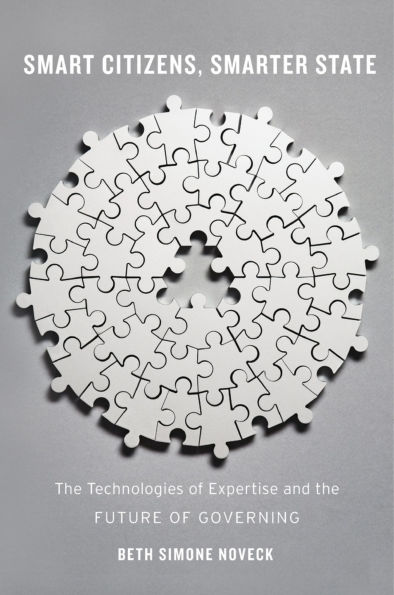
Smart Citizens, Smarter State: The Technologies of Expertise and the Future of Governing

Government “of the people, by the people, for the people” expresses an ideal that resonates in all democracies. Yet poll after poll reveals deep distrust of institutions that seem to have left “the people” out of the governing equation. Government bureaucracies that are supposed to solve critical problems on their own are a troublesome outgrowth of the professionalization of public life in the industrial age. They are especially ill-suited to confronting today’s complex challenges.

Offering a far-reaching program for innovation, Smart Citizens, Smarter State suggests that public decisionmaking could be more effective and legitimate if government were smarter—if our institutions knew how to use technology to leverage citizens’ expertise. Just as individuals use only part of their brainpower to solve most problems, governing institutions make far too little use of the skills and experience of those inside and outside of government with scientific credentials, practical skills, and ground-level street smarts. New tools—what Beth Simone Noveck calls technologies of expertise—are making it possible to match the supply of citizen expertise to the demand for it in government.

Drawing on a wide range of academic disciplines and practical examples from her work as an adviser to governments on institutional innovation, Noveck explores how to create more open and collaborative institutions. In so doing, she puts forward a profound new vision for participatory democracy rooted not in the paltry act of occasional voting or the serendipity of crowdsourcing but in people’s knowledge and know-how.
1121336374
Smart Citizens, Smarter State: The Technologies of Expertise and the Future of Governing

Government “of the people, by the people, for the people” expresses an ideal that resonates in all democracies. Yet poll after poll reveals deep distrust of institutions that seem to have left “the people” out of the governing equation. Government bureaucracies that are supposed to solve critical problems on their own are a troublesome outgrowth of the professionalization of public life in the industrial age. They are especially ill-suited to confronting today’s complex challenges.

Offering a far-reaching program for innovation, Smart Citizens, Smarter State suggests that public decisionmaking could be more effective and legitimate if government were smarter—if our institutions knew how to use technology to leverage citizens’ expertise. Just as individuals use only part of their brainpower to solve most problems, governing institutions make far too little use of the skills and experience of those inside and outside of government with scientific credentials, practical skills, and ground-level street smarts. New tools—what Beth Simone Noveck calls technologies of expertise—are making it possible to match the supply of citizen expertise to the demand for it in government.

Drawing on a wide range of academic disciplines and practical examples from her work as an adviser to governments on institutional innovation, Noveck explores how to create more open and collaborative institutions. In so doing, she puts forward a profound new vision for participatory democracy rooted not in the paltry act of occasional voting or the serendipity of crowdsourcing but in people’s knowledge and know-how.

42.0 In Stock
Smart Citizens, Smarter State: The Technologies of Expertise and the Future of Governing

Smart Citizens, Smarter State: The Technologies of Expertise and the Future of Governing

by Beth Simone Noveck
Smart Citizens, Smarter State: The Technologies of Expertise and the Future of Governing

Smart Citizens, Smarter State: The Technologies of Expertise and the Future of Governing

by Beth Simone Noveck

eBook

$42.00 

Available on Compatible NOOK devices, the free NOOK App and in My Digital Library.
WANT A NOOK?  Explore Now

Related collections and offers


Overview

Government “of the people, by the people, for the people” expresses an ideal that resonates in all democracies. Yet poll after poll reveals deep distrust of institutions that seem to have left “the people” out of the governing equation. Government bureaucracies that are supposed to solve critical problems on their own are a troublesome outgrowth of the professionalization of public life in the industrial age. They are especially ill-suited to confronting today’s complex challenges.

Offering a far-reaching program for innovation, Smart Citizens, Smarter State suggests that public decisionmaking could be more effective and legitimate if government were smarter—if our institutions knew how to use technology to leverage citizens’ expertise. Just as individuals use only part of their brainpower to solve most problems, governing institutions make far too little use of the skills and experience of those inside and outside of government with scientific credentials, practical skills, and ground-level street smarts. New tools—what Beth Simone Noveck calls technologies of expertise—are making it possible to match the supply of citizen expertise to the demand for it in government.

Drawing on a wide range of academic disciplines and practical examples from her work as an adviser to governments on institutional innovation, Noveck explores how to create more open and collaborative institutions. In so doing, she puts forward a profound new vision for participatory democracy rooted not in the paltry act of occasional voting or the serendipity of crowdsourcing but in people’s knowledge and know-how.


Product Details

ISBN-13: 9780674915459
Publisher: Harvard University Press
Publication date: 11/02/2015
Sold by: Barnes & Noble
Format: eBook
Pages: 368
File size: 805 KB

About the Author

Beth Simone Noveck is Jerry Hultin Global Network Professor at the New York University Tandon School of Engineering and a Visiting Professor at the MIT Media Lab. She directs the Governance Lab.

Table of Contents

Cover

Title

Copyright

Dedication

Contents

Preface

Chapter 1. From Open Government to Smarter Governance

The Potential Benefits of Open Government

The Failure of Open Government

The Limits of Participatory Bureaucracy

The Limits of the Open Call

Why Closed-Door Governing Remains Rational

The Consequences of Our Failure to Innovate

Why Smarter Governance May Be the Answer

Chapter 2. The Rise of Professional Government

The Roots of Professionalism

The Standardization of Methods and Measurement

The University as Professional Training Ground

The Demise of the Amateur in Public Life

How Professionalism Subverts Participation

Chapter 3. The Limits of Democratic Theory

Citizen Illiteracy

Deliberative Pathology

Participatory Inefficiency

The Challenge of Deliberative Fundamentalism

Chapter 4. The Technologies of Expertise

Why We Need Expertise

Four Ways Technology Is Changing Expertise

Making Expertise Visible

Automatic and Manual Sources of Data

From Certification to Badging

Quantifying Expertise Differently

Chapter 5. Experimenting with Smarter Governance

Testing Innovations in How We Make Policy

The ExpertNet Consultation

Experimentation at the FDA

Deficits in Regulatory Review

Improving Device Review with Targeting

How Profiles Measures Expertise

Smarter Governance in Practice: The Experts.gov Experiment

The Research Agenda for Smarter Governance: Identifying Who Participates

Testing How They Participate

Experiments with Incentives and Motivation

Experiments with Institutional Readiness

Chapter 6. Why Smarter Governance May Be Illegal

Origins of the Federal Advisory System

The Paperwork Reduction Act

How Government Gets Expertise Today

Chapter 7. Bringing Smarter Governance to Life

A Twenty-First Century Brain Trust

From Public to Private

Building a Directory of Directories

Matching Supply with Demand

Experiments with the Brain Trust

The Obstacle Presented by FACA

Working around FACA

Why FACA Must Go

Designing a New Legal Framework for the Contemporary Brain Trust

Chapter 8. Smarter Citizenship

Expertise Is Too Weak

Expertise Is Too Strong

Expertise Is Too Modern

How Smarter Governance Transforms Citizenship

How Smarter Governance Transforms Institutions

Conclusion: The Daedalus Project

Notes

Acknowledgments

Index

From the B&N Reads Blog

Customer Reviews