
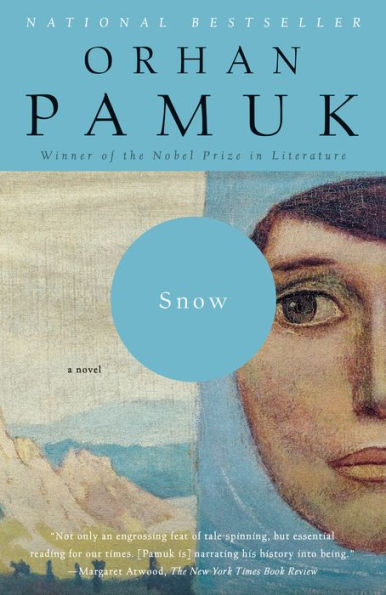
An exiled poet named Ka returns to Turkey and travels to the forlorn city of Kars. His ostensible purpose is to report on a wave of suicides among religious girls forbidden to wear their head-scarves. But Ka is also drawn by his memories of the radiant Ipek, now recently divorced.
Amid blanketing snowfall and universal suspicion, Ka finds himself pursued by figures ranging from Ipek’s ex-husband to a charismatic terrorist. A lost gift returns with ecstatic suddenness. A theatrical evening climaxes in a massacre. And finding god may be the prelude to losing everything else.
An exiled poet named Ka returns to Turkey and travels to the forlorn city of Kars. His ostensible purpose is to report on a wave of suicides among religious girls forbidden to wear their head-scarves. But Ka is also drawn by his memories of the radiant Ipek, now recently divorced.
Amid blanketing snowfall and universal suspicion, Ka finds himself pursued by figures ranging from Ipek’s ex-husband to a charismatic terrorist. A lost gift returns with ecstatic suddenness. A theatrical evening climaxes in a massacre. And finding god may be the prelude to losing everything else.

Paperback(Reprint)
-
SHIP THIS ITEMIn stock. Ships in 1-2 days.PICK UP IN STORE
Your local store may have stock of this item.
Available within 2 business hours
Related collections and offers
Overview
An exiled poet named Ka returns to Turkey and travels to the forlorn city of Kars. His ostensible purpose is to report on a wave of suicides among religious girls forbidden to wear their head-scarves. But Ka is also drawn by his memories of the radiant Ipek, now recently divorced.
Amid blanketing snowfall and universal suspicion, Ka finds himself pursued by figures ranging from Ipek’s ex-husband to a charismatic terrorist. A lost gift returns with ecstatic suddenness. A theatrical evening climaxes in a massacre. And finding god may be the prelude to losing everything else.

Product Details
| ISBN-13: | 9780375706868 |
|---|---|
| Publisher: | Knopf Doubleday Publishing Group |
| Publication date: | 07/19/2005 |
| Series: | Vintage International |
| Edition description: | Reprint |
| Pages: | 480 |
| Product dimensions: | 5.18(w) x 8.01(h) x 1.03(d) |
About the Author
Read an Excerpt
The silence of snow, thought the man sitting just behind the bus driver. If this were the beginning of a poem, he would have called the thing he felt inside him the silence of snow.
He’d boarded the bus from Erzurum to Kars with only seconds to spare. He’d just come into the station on a bus from Istanbul—a snowy, stormy, two-day journey—and was rushing up and down the dirty wet corridors with his bag in tow, looking for his connection, when someone told him the bus for Kars was leaving immediately.
He’d managed to find it, an ancient Magirus, but the conductor had just shut the luggage compartment and, being “in a hurry,” refused to open it again. That’s why our traveler had taken his bag on board with him; the big dark-red Bally valise was now wedged between his legs. He was sitting next to the window and wearing a thick charcoal coat he’d bought at a Frankfurt Kaufhof five years earlier. We should note straightaway that this soft, downy beauty of a coat would cause him shame and disquiet during the days he was to spend in Kars, while also furnishing a sense of security.
As soon as the bus set off, our traveler glued his eyes to the window next to him; perhaps hoping to see something new, he peered into the wretched little shops and bakeries and broken-down coffeehouses that lined the streets of Erzurum’s outlying suburbs, and as he did it began to snow. It was heavier and thicker than the snow he’d seen between Istanbul and Erzurum. If he hadn’t been so tired, if he’d paid a bit more attention to the snowflakes swirling out of the sky like feathers, he might have realized that he was traveling straight into a blizzard; he might have seen at the start that he was setting out on a journey that would change his life forever and chosen to turn back.
But the thought didn’t even cross his mind. As evening fell, he lost himself in the light still lingering in the sky above; in the snowflakes whirling ever more wildly in the wind he saw nothing of the impending blizzard but rather a promise, a sign pointing the way back to the happiness and purity he had known, once, as a child. Our traveler had spent his years of happiness and childhood in Istanbul; he’d returned a week ago, for the first time in twelve years, to attend his mother’s funeral, and having stayed there four days he decided to take this trip to Kars. Years later, he would still recall the extraordinary beauty of the snow that night; the happiness it brought him was far greater than any he’d known in Istanbul. He was a poet and, as he himself had written—in an early poem still largely unknown to Turkish readers—it snows only once in our dreams.
As he watched the snow fall outside his window, as slowly and silently as the snow in a dream, the traveler fell into a long-desired, long-awaited reverie; cleansed by memories of innocence and childhood, he succumbed to optimism and dared to believe himself at home in this world. Soon afterward, he felt something else that he had not known for quite a long time and fell asleep in his seat.
Let us take advantage of this lull to whisper a few biographical details. Although he had spent the last twelve years in political exile in Germany, our traveler had never been very much involved in politics. His real passion, his only thought, was for poetry. He was forty-two years old and single, never married. Although it might be hard to tell as he curled up in his seat, he was tall for a Turk, with brown hair and a pale complexion that had become even paler during this journey. He was shy and enjoyed being alone. Had he known what would happen soon after he fell asleep—with the swaying of the bus his head would come to lean first on his neighbor’s shoulder and then on the man's chest—he would have been very much ashamed. For the traveler we see leaning on his neighbor is an honest and well-meaning man and full of melancholy, like those Chekhov characters so laden with virtues that they never know success in life. We’ll have a lot to say about melancholy later on. But as he is not likely to remain asleep for very long in that awkward position, suffice it for now to say that the traveler’s name is Kerim Alakusoglu, that he doesn’t like this name but prefers to be called Ka (from his initials), and that I’ll be doing the same in this book. Even as a schoolboy, our hero stubbornly insisted on writing Ka on his homework and exam papers; he signed Ka on university registration forms; and he took every opportunity to defend his right to continue to do so, even if it meant conflict with teachers and government officials. His mother, his family, and his friends all called him Ka, and, having also published some poetry collections under this name, he enjoyed a small enigmatic fame as Ka, both in Turkey and in Turkish circles in Germany.
That’s all we have time for at present. As the bus driver wished his passengers a safe journey as we departed Erzurum station, let me just add these words: “May your road be open, dear Ka.” But I don't wish to deceive you. I’m an old friend of Ka’s, and I begin this story knowing everything that will happen to him during his time in Kars.
After leaving Horasan, the bus turned north, heading directly for Kars. As it climbed the winding road, the driver had to slam on the brakes to avoid a horse and carriage that had sprung up out of nowhere on one of the hairpin bends, and Ka woke up. Fear had already fostered a strong fellow feeling among the passengers; before long, Ka too felt at one with them. Even though he was sitting just behind the bus driver, Ka was soon behaving like the passengers behind him: Whenever the bus slowed to negotiate a bend in the road or avoid going over the edge of a cliff, he stood up to get a better view; when the zealous passenger who’d committed himself to helping the driver by wiping the condensation from the windshield missed a corner, Ka would point it out with his forefinger (which contribution went unnoticed); and when the blizzard got so bad that the wipers could no longer keep the snow from piling up on the windshield, Ka joined the driver in trying to guess where the road was.
Once caked with snow, the road signs were impossible to read. When the snowstorm began to rage in earnest, the driver turned off his brights and dimmed the lights inside the bus, hoping to conjure up the road out of the semidarkness. The passengers fell into a fearful silence with their eyes on the scene outside: the snow-covered streets of destitute villages, the dimly lit, ramshackle one-story houses, the roads to farther villages that were already closed, and the ravines barely visible beyond the streetlamps. If they spoke, it was in whispers.
So it was in the gentlest of whispers that Ka’s neighbor, the man onto whose shoulder Ka had fallen asleep earlier, asked him why he was traveling to Kars. It was easy to see that Ka was not a local.
“I’m a journalist,” Ka whispered in reply. This was a lie. “I’m interested in the municipal elections—and also the young women who’ve been committing suicide.” This was true.
“When the mayor of Kars was murdered, every newspaper in Istanbul ran the story,” Ka’s neighbor replied. “And it’s the same for the women who’ve been committing suicide.” It was hard for Ka to know whether it was pride or shame he heard in the man’s voice. Three days later, standing in the snow on Halitpasa Avenue with tears streaming from his eyes, Ka was to see this slim handsome villager again.
During the desultory conversation that continued on and off for the rest of the bus journey, Ka found out that the man had just taken his mother to Erzurum because the hospital in Kars wasn’t good enough, that he was a livestock dealer who served the villages in the Kars vicinity, that he’d been through hard times but hadn’t become a rebel, and that—for mysterious reasons he did not disclose to Ka—he was sorry not for himself but for his country and was happy to see that a well-read, educated gentleman like Ka had taken the trouble to travel all the way from Istanbul to find out more about his city’s problems. There was something so noble in the plainness of his speech and the pride of his bearing that Ka felt respect for him.
His very presence was calming. Not once during twelve years in Germany had Ka known such inner peace; it had been a long time since he had had the fleeting pleasure of empathizing with someone weaker than himself. He remembered trying to see the world through the eyes of a man who could feel love and compassion. As he did the same now, he no longer felt so fearful of the relentless blizzard. He knew they were not destined to roll off a cliff. The bus would be late, but it would reach its destination.
When, at ten o’clock at night, three hours behind schedule, the bus began its crawl through the snow-covered streets of Kars, Ka couldn’t recognize the city at all. He couldn’t even see the railroad station, where he’d arrived twenty years earlier by steam engine, nor could he see any sign of the hotel to which his driver had taken him that day (following a full tour of the city): the Hotel Republic, “a telephone in every room.” It was as if everything had been erased, lost beneath the snow. He saw a hint of the old days in the horse-drawn carriages here and there, waiting in garages, but the city itself looked much poorer and sadder than he remembered. Through the frozen windows of the bus, Ka saw the same concrete apartments that had sprung up all over Turkey during the past ten years, and the same Plexiglas panels; he also saw banners emblazoned with campaign slogans strung above every street.
He stepped off the bus. As his foot sank into the soft blanket of snow, a sharp blast of cold air shot up past the cuffs of his trousers. He’d booked a room at the Snow Palace Hotel. When he went to ask the conductor where it was, he thought two of the faces among the travelers waiting for their luggage looked familiar, but with the snow falling so thick and fast he couldn’t work out who they were.
He saw them again in the Green Pastures Café, where he went after setting into his hotel: a tired and careworn but still handsome and eye-catching man with a fat but animated woman who seemed to be his lifelong companion. Ka had seen them perform in Istanbul in the seventies, when they were leading lights of the revolutionary theater world. The man’s name was Sunay Zaim. As he watched the couple, he let his mind wander and was eventually able to work out that the woman reminded him of a classmate from primary school. There were a number of other men at their table, and they all had the deathly pallor that speaks of a life on the stage; what, he wondered, was a small theater company doing in this forgotten city on a snowy night in February? Before leaving the restaurant, which twenty years ago had been full of government officials in coats and ties, Ka thought he saw one of the heroes of the seventies’ militant left sitting at another table. But it was as if a blanket of snow had settled over his memories of this man, just as it had settled over the restaurant and the failing, gasping city itself.
Were the streets empty because of the snow, or were these frozen pavements always so desolate? As he walked he took careful notice of the writing on the walls—the election posters, the advertisements for schools and restaurants, and the new posters that the city officials hoped would end the suicide epidemic: human beings are god’s masterpieces, and suicide is blasphemy. Through the frozen windows of a half-empty teahouse, Ka saw a group of men huddled around a television set. It cheered him just a little to see, still standing, these old stone Russian houses that in his memory had made Kars such a special place.
The Snow Palace Hotel was one of those elegant Baltic buildings. It was two stories high, with long narrow windows that looked out onto a courtyard and an arch that led out to the street. The arch was 110 years old and high enough for horse-drawn carriages to pass through with ease; Ka felt a shiver of excitement as he walked under it, but he was too tired to ask himself why. Let’s just say it had something to do with one of Ka’s reasons for coming to Kars.
Three days earlier, Ka had paid a visit to the Istanbul offices of the Republican to see a friend from his youth. It was this friend, Taner, who had told him about the municipal elections coming up and how—just as in the city of Batman—an extraordinary number of girls in Kars had succumbed to a suicide epidemic. Taner went on to say that if Ka wanted to write about this subject and see what Turkey was really like after his twelve-year absence, he should think of going to Kars; with no one else available for this assignment, he could provide Ka with a current press card; what’s more, he said, Ka might be interested to know that their old classmate Ipek was now living in Kars. Although separated from her husband, Muhtar, she’d stayed on in the city and was living with her father and sister in the Snow Palace Hotel. As Ka listened to Taner, who wrote political commentaries for the Republican, he remembered how beautiful Ipek was.
Cavit, the hotel clerk, sat in the high-ceilinged lobby watching television. He handed Ka the key, and Ka went up to the second floor to Room 203; having shut the door behind him, he felt calmer. After careful self-examination, he concluded that, notwithstanding the fears that had plagued him throughout his journey, neither his heart nor his mind were troubled by the possibility that Ipek might be here in the hotel. After a lifetime in which every experience of love was touched by shame and suffering, the prospect of falling in love filled Ka with an intense, almost instinctive dread.
In the middle of the night, before getting into bed, Ka padded across the room in his pajamas, parted the curtains, and watched the thick, heavy snowflakes falling without end.
CHAPTER TWO
Our City Is a Peaceful Place
The Outlying Districts
Veiling as it did the dirt, the mud, and the darkness, the snow would continue to speak to Ka of purity, but after his first day in Kars it no longer promised innocence. The snow here was tiring, irritating, terrorizing. It had snowed all night. It continued snowing all morning, while Ka walked the streets playing the intrepid reporter—visiting coffeehouses packed with unemployed Kurds, interviewing voters, taking notes—and it was still snowing later, when he climbed the steep and frozen streets to interview the former mayor and the governor’s assistant and the families of the girls who had committed suicide. But it no longer took him back to the white-covered streets of his childhood; no longer did he think, as he had done as a child standing at the windows of the sturdy houses of Nisantas, that he was peering into a fairy tale; no longer was he returned to a place where he could enjoy the middle-class life he missed too much even to visit in his dreams. Instead, the snow spoke to him of hopelessness and misery.
Early that morning, before the city woke up and before he had let the snow get the better of him, he took a brisk walk through the shantytown below Atatürk Boulevard to the poorest part of Kars, to the district known as Kalealt. The scenes he saw as he hurried under the ice-covered branches of the plane trees and the oleanders—the old decrepit Russian buildings with stovepipes sticking out of every window, the thousand-year-old Armenian church towering over the wood depots and the electric generators, the pack of dogs barking at every passerby from a five-hundred-year-old stone bridge as snow fell into the half-frozen black waters of the river below, the thin ribbons of smoke rising out of the tiny shanty houses of Kalealtõ sitting lifeless under their blanket of snow—made him feel so melancholy that tears welled in his eyes. On the opposite bank were two children, a girl and a boy who’d been sent out early to buy bread, and as they danced along, tossing the warm loaves back and forth or clutching them to their chests, they looked so happy that Ka could not help smil- ing. It wasn’t the poverty or the helplessness that disturbed him; it was the thing he would see again and again during the days to come—in the empty windows of photography shops, in the frozen windows of the crowded teahouses where the city’s unemployed passed the time playing cards, and in the city’s empty snow-covered squares. These sights spoke of a strange and powerful loneliness. It was as if he were in a place that the whole world had forgotten, as if it were snowing at the end of the world.
Ka’s luck stayed with him all morning, and when people asked him who he was they wanted to shake his hand; they treated him like a famous journalist from Istanbul; all of them, from the governor’s assistant to the poorest man, opened their doors and spoke to him. He was introduced to the city by Serdar Bey, the publisher of Border City News (circulation three hundred and twenty), who sometimes sent local news items to the Republican in Istanbul (mostly they didn’t print them). Ka had been told to visit “our local correspondent” first thing in the morning, as soon as he left the hotel, and no sooner had he found this old journalist ensconced in his office than he realized this man knew everything there was to know in Kars. It was Serdar Bey who was the first to ask him the question he would hear again hundreds of times during his three-day stay.
“Welcome to our border city, sir. But what are you here for?”
Ka explained that he had come to cover the municipal elections and also perhaps to write about the suicide girls.
“As in Batman, the stories about the suicide girls have been exaggerated,” the journalist replied. “Let’s go over to meet Kasm Bey, the assistant chief of police. They should know you’ve arrived—just in case.”
That all newcomers, even journalists, should pay a visit to the police was a provincial custom dating back to the forties. Because he was a political exile who had just returned to the country after an absence of many years, and because, even though no one had mentioned it, he sensed the presence of Kurdish separatist guerillas (PKK) in the city, Ka made no objection.
They set off into the blizzard, cutting through a fruit market and continuing past the stores of spare parts and hardware on Kâzam Karabekir Avenue, past teahouses where gloomy unemployed men sat watching television and the falling snow, past dairy shops displaying huge wheels of yellow cheese; it took them fifteen minutes to cut a diagonal across the city.
Along the way, Serdar Bey stopped to show Ka the place where the old mayor had been assassinated. According to one rumor, he’d been shot over a simple municipal dispute: the demolition of an illegal balcony. They’d caught the assailant after three days in the village to which he’d escaped; when they found him hiding in a barn, he was still carrying the weapon. But there had been so much gossip during those three days before his capture, no one wanted to believe that this was indeed the culprit: the simplicity of the motivation was disappointing.
The Kars police headquarters was in a long three-story building on Faikbey Avenue, where the old stone buildings that had once belonged to wealthy Russians and Armenians now housed mostly government offices. As they sat waiting for the assistant chief of police, Serdar Bey pointed out the high ornate ceilings and explained that between 1877 and 1918, during the Russian occupation of the city, this forty-room mansion was first home to a rich Armenian and later a Russian hospital.
Kasam Bey, the beer-bellied assistant chief of police, came into the corridor and ushered them into his room. Ka could see at once that they were in the company of a man who did not read national newspapers like the Republican, considering them left-wing, that he was not particularly impressed to see Serdar Bey praising anyone simply for being a poet, but that he feared and respected him as the owner of the leading local paper. After Serdar Bey had finished speaking, the police chief turned to Ka. “Do you want protection?”
“Pardon?”
“I’m only suggesting one plainclothes policeman. To set your mind at ease.”
“Do I really need it?” asked Ka, in the agitated voice of a man whose doctor has just told him he should start walking with a cane.
“Our city is a peaceful place. We’ve caught all the terrorists who were driving us apart. But I’d still recommend it, just in case.”
“If Kars is a peaceful place, then I don’t need protection,” said Ka. He was secretly hoping that the assistant chief of police would take this opportunity to reassure him once again that Kars was a peaceful place, but Kasam Bey did not repeat his statement.
They headed north to Kalealti and Bayrampasa, the poorest neighborhoods. The houses here were shanties made of stone, brick, and corrugated aluminum siding. With the snow continuing to fall, they made their way from house to house: Serdar Bey would knock on a door, and if a woman answered he would ask to see the man of the house, and if Serdar Bey recognized him he would say in a voice inspiring confidence that his friend, a famous journalist, had come to Kars all the way from Istanbul to report on the elections and also to find out more about the city—to write, for example, about why so many women were committing suicide—and if these citizens could share their concerns, they would be doing a good thing for Kars. A few were very friendly, perhaps because they thought Ka and Serdar Bey might be candidates bearing tins of sunflower oil, boxes of soaps, or parcels full of cookies and pasta. If they decided to invite the two men in out of curiosity or simple hospitality, the next thing they did was to tell Ka not to be afraid of the dogs. Some opened their doors fearfully, assuming, after so many years of police intimidation, that this was yet another search, and even once they had realized that these men were not from the state, they would remain shrouded in silence. As for the families of the girls who had committed suicide (in a short time, Ka had heard about six incidents), they each insisted that their daughters had given them no cause for alarm, leaving them all shocked and grieved by what had happened.
They sat on old divans and crooked chairs in tiny icy rooms with earthen floors covered by machine-made carpets, and every time they moved from one house to the next, the number of dwellings seemed to have multiplied. Each time they went outside they had to make their way past children kicking broken plastic cars, one-armed dolls, or empty bottles and boxes of tea and medicine back and forth across the way. As they sat next to stoves that gave out no heat unless stirred continuously, and electric heaters that ran off illegal power lines, and silent television sets that no one ever turned off, they heard about the never-ending woes of Kars.
They listened to mothers who were in tears because their sons were out of work or in jail, and to bathhouse attendants who worked twelve-hour shifts in the hamam without earning enough to support a family of eight, and to unemployed men who were no longer sure they could afford to go the teahouse because of the high price of a glass of tea. These people complained and complained about the unemployment rate, their bad luck, the city council, and the government, tracing their every problem to the nation and the state. As they traveled from house to house, listening to these tales of hardship, a moment arrived when, in spite of the white light coming in through the windows, Ka came to feel as if they had entered a shadow world. The rooms were so dark he could barely make out the shape of the furniture, so when he was compelled to look at the snow outside, it blinded him—it was as if a curtain of tulle had fallen before his eyes, as if he had retreated into the silence of snow to escape from these stories of misery and poverty.
The suicide stories he heard that day were the worst; they would haunt him for the rest of his life. It wasn’t the elements of poverty or helplessness that Ka found so shocking. Neither was it the constant beatings to which these girls were subjected, or the insensitivity of fathers who wouldn’t even let them go outside, or the constant surveillance of jealous husbands. The thing that shocked and frightened Ka was the way these girls had killed themselves: abruptly, without ritual or warning, in the midst of their everyday routines.
There was one sixteen-year-old girl, for example, who had been forced into an engagement with an elderly teahouse owner; she had eaten her evening meal with her mother, father, three siblings, and paternal grandmother, just as she had done every evening; after she and her sisters had cleared the table with the usual amount of giggling and tussling, she went from the kitchen into the garden to fetch the dessert, and from there she climbed through the window into her parents’ bedroom, where she shot herself with a hunting rifle. The grandmother, who heard the gunshot, ran upstairs to find the girl supposed to be in the kitchen lying dead on the floor in her parents’ bedroom in a pool of blood; this old woman could not understand how her girl had managed to get from the kitchen to the bedroom, let alone why she would have committed suicide. There was another sixteen-year-old who, following the usual evening scuffle with her two siblings over what to watch on television and who would hold the remote control, and after her father came in to settle the matter by giving her two hard whacks, went straight to her room and, finding a big bottle of a veterinary medicine, Mortalin, knocked it back like a bottle of soda. Another girl, who had married happily at the age of fifteen, had given birth six months ago; now, terrorized by the beatings given her by her depressed and unemployed husband, she locked herself in the kitchen after the daily quarrel. Her husband guessed what she was up to, but she had already prepared the rope and the hook in the ceiling, so before he could break down the door she had hanged herself.
It fascinated Ka, the desperate speed with which these girls had plunged from life into death. The care they had taken—the hooks put into the ceiling, the loaded rifles, the medicine bottles transferred from pantry to bedroom—suggested suicidal thoughts they’d carried around with them for a long time.
The first such suicide had come from the city of Batman, a hundred kilometers from Kars. All over the world, men are three or four times more likely to kill themselves than women; it was a young civil servant in the National Office of Statistics in Ankara who had first noticed that in Batman the number of female cases was three times greater than the number for males and four times greater than the world average for females. But when a friend of his at the Republican published this analysis in “News in Brief,” no one in Turkey took any notice. A number of correspondents for French and German newspapers, however, did pick up on the item, and only after they had gone to Batman and published stories in the European press did the Turkish press begin to take an interest: at this point, quite a few Turkish reporters paid visits to the city.
According to officials, the press interest had served only to push more girls over the edge. The deputy governor of Kars, a squirrel-faced man with a brush mustache, told Ka that the local suicides had not reached the same statistical level as those in Batman, and he had no objection “at present” to Ka’s speaking to the families, but he asked Ka to refrain from using the word suicide too often when speaking to these people and to take care not to exaggerate the story when he wrote it up in the Republican. A committee of suicide experts—including psychologists, police officers, judges, and officials from the Department of Religious Affairs—was already preparing to decamp from Batman to Kars; as a preliminary measure the Department of Religious Affairs had plastered the city with its suicide is blasphemy posters, and the governor’s office was to distribute a pamphlet with the slogan as its title. Still, the deputy governor worried that these measures might produce the result opposite from the one intended—not just because girls hearing of others committing suicide might be inspired to do the same, but also because quite a few might do it out of exasperation with the constant lecturing from husbands, fathers, preachers, and the state.
“What is certain is that these girls were driven to suicide because they were extremely unhappy. We’re not in any doubt about that,” the deputy governor told Ka. “But if unhappiness were a genuine reason for suicide, half the women in Turkey would be killing themselves.” He suggested that these women might be offended if they had to listen to a chorus of male voices remonstrating “Don’t commit suicide!” This, he told Ka proudly, was why he had written to Ankara asking that the antisuicide propaganda committee include at least one woman.
The idea that suicide might spread contagiously like the plague had first been suggested after a girl traveled all the way from Batman to Kars just to kill herself. Her family now refused to let Ka and Serdar Bey into the house, but the girl’s maternal uncle agreed to speak with them outside. Smoking a cigarette, seated under the oleander trees of a snow-covered garden in the Atatürk district, he told her story. His niece had married two years earlier; forced to do housework from morning till night, she had also endured the incessant scolding of her mother-in-law for failing to conceive a child. But this alone would not have been enough to drive the girl to suicide; it was clear that she had got the idea from the other women killing themselves in Batman. Certainly the dear departed girl had seemed perfectly happy on visiting with her family here in Kars, so it was all the more shocking when—on the very morning she was due to return to Batman—they found a letter in her bed saying that she had taken two boxes of sleeping pills.
One month after the suicide idea had, as it were, infected Kars, this girl’s sixteen-year-old cousin committed the first copycat suicide. With the uncle’s coaxing, and having got Ka to promise that he would include the full story in his report, her tearful parents explained that the girl had been driven to suicide after her teacher accused her of not being a virgin. Once the rumor had spread all over Kars, the girl’s fiancé called off the engagement, and the other young suitors—still coming to the house to ask for this beautiful girl’s hand despite the betrothal—stopped coming too. At that point, the girl’s maternal grandmother had started to say, “Oh, well, looks like you’re never going to find a husband.” Then one evening, as the whole family was watching a wedding scene on television and her father, drunk at the time, started crying, the girl stole her grandmother’s sleeping pills and, having swallowed them all, went to sleep (not only the idea of suicide but also the method having proved contagious). When the autopsy revealed that the girl had actually been a virgin, her father blamed not just the teacher for spreading the lie but also his relative’s daughter for coming from Batman to kill herself. And so, out of a wish to dispel the baseless rumors about their child’s chastity and to expose the teacher who had started the malicious lie, the family decided to tell Ka the full story.
Ka thought it strangely depressing that the suicide girls had had to struggle to find a private moment to kill themselves. Even after swallowing their pills, even as they lay quietly dying, they’d had to share their rooms with others. Ka had grown up in Nisantas reading Western literature, and in his own fantasies of suicide he had always thought it important to have a great deal of time and space; at the very least you needed a room you could stay in for days without any knocking on the door. In his fantasies, suicide was a solemn ceremony with sleeping pills and whiskey, a final act performed alone and of one’s own free will; in fact, every time he had ever imagined doing away with himself, it was the indispensable loneliness of it that scared him off. For that reason, he had to admit, he had never been seriously suicidal.
The only suicide who had delivered him back to that loneliness was the covered girl who had killed herself almost six weeks ago. This suicide was one of the famous “head-scarf girls.” When the authorities had outlawed the wearing of head scarves in educational institutions across the country, many women refused to comply; the noncompliant young women at the Institute of Education in Kars had been barred first from the classrooms and then, following an edict from Ankara, from the entire campus. Among the families Ka met, that of the head-scarf girl was the most well off; the distraught father owned a little grocery store. Offering Ka a Coca-Cola from the store refrigerator, he explained that his daughter had discussed her plans with both family and friends. As for the question of the head scarf, clearly her mother, who wore one, had set the example—with the blessing of the whole family—but the real pressure had come from those of her school friends running the campaign against the banishment of covered women from the Institute. Certainly it was they who taught her to think of the head scarf as a symbol of “political Islam.” And so despite her parents’ express wish that she remove her head scarf, the girl refused, thus ensuring that she herself would be removed, by the police and on many occasions, from the halls of the Institute of Education. When she saw some of her friends giving up and uncovering their heads, and others forgoing their head scarves to wear wigs instead, the girl began to tell her father and her friends that life had no meaning and she no longer wanted to live. But as the state-run Department of Religious Affairs and the Islamists had joined forces by now to condemn suicide as one of the greatest sins, and there were posters and pamphlets all over Kars proclaiming the same truth, no one expected a girl of such piety to take her own life. It seems that the girl, Teslime, had spent her last evening silently watching the television show called Marianna. After making tea and serving it to her parents, she went to her room and readied herself for her prayers, washing her mouth, her feet, and her hands. When she had finished her ablutions, she knelt down on her prayer rug and lost herself for some time in thought, and then in prayer, before tying her head scarf to the lamp hook from which she hanged herself.
Reading Group Guide
NATIONAL BESTSELLER
“Not only an engrossing feat of tale-spinning, but essential reading for our times.” —Margaret Atwood, The New York Times Book Review
The introduction, discussion questions, suggestions for further reading, and author biography that follow are intended to enhance your group’s conversation about Orhan Pamuk’s brilliant novel Snow, which is at once a political thriller, a romance, and an examination of the profound religious and political dilemmas that beset the people of modern Turkey.
1.
Almost immediately after the novel opens, the narrator speaks in first person directly to the reader and concludes his interjection of Ka’s “biographical details” with the statement: “I don’t wish to deceive you. I’m an old friend of Ka’s, and I begin this story knowing everything that will happen to him during his time in Kars” [p. 5]. Later, during his report of Ka’s conversation with Necip, the narrator says of Necip, “With a childishness that amazed Ka, he opened his large green eyes, one of which would be shattered in fifty-one minutes” [p. 134]. With these direct statements of the narrator’s foreknowledge, what happens to the fictional conventions of plot and suspense? How does learning that the narrator’s name is Orhan, and that he’s written something called The Black Book [p. 425], affect the reader’s reception of the story?
2.
Ka’s mood at the beginning of the story is dreamlike and nostalgic: “As slowly and silently as the snow in a dream, the traveler fell into a long-desired, long-awaited reverie; cleansed by memories of innocence and childhood, he succumbed to optimism and dared to believe himself at home in this world” [p. 4]. Does Ka remain in this state of optimism and seeming innocence throughout his stay in Kars? As an exile, he is moved by a sense of returning home; does he make a mistake by believing himself at home enough to become involved in the affairs of Kars?
3.
While Ka and Ipek are having coffee in the New Life Pastry Shop, they witness the murder of the director of the Institute of Education. Discuss the conversation between the Institute director and the young man who has been sent to assassinate him [pp. 38–48]. What are the elements that make the scene so effective?
4.
The brief history of Kars on pages 19–21 describes a place at the crossroads of “two empires now defunct,” which has seen “endless wars, rebellions, massacres, and atrocity.” Despite Kemal Atatürk’s westernizing ideology (reinforced brutally by the military), Kars is sunk in poverty and hopelessness; its bourgeoisie has fled. Muhtar says, “The city of Kars and the people in it—it was as if they weren’t real. Everyone wanted to die or to leave. . . . It was as if I’d been erased from history, banished from civilization” [p. 53]. How has the town’s history shaped its inhabitants’ ideas about themselves and their future?
5.
Ka’s conversations with Muhtar, Blue, the boys from the religious high school, Sheikh Efendi, and Kadife [chapters 6, 8, 9, 11,13] explore the gap between traditional Islam and Western secularism. How do these conversations affect Ka’s sense of his spiritual condition? How strongly does he need to identify himself as a secular intellectual, and why is the possibility of his own belief in God, which he admits to, so unsettling to him?
6.
Karl Marx said, “Hegel remarks somewhere that history tends to repeat itself. He forgot to add: the first time as tragedy, the second time as farce” [The Eighteenth Brumiare of Louis Bonaparte]. In the novel’s most farcical and tragic moments, theatrical impresario Sunay Zaim and his allies the military police stage their own intervention in the history of Kars. Does Pamuk, in these episodes so central to the story, seem to share Marx’s pessimism?
7.
Blue tells a story from the ancient epic Shehname: “Once upon a time, millions of people knew it by heart. . . . But now, because we’ve fallen under the spell of the West, we’ve forgotten our own stories” [p. 78]. What does he imply when he asks Ka, “Is this story so beautiful that a man could kill for it?” [p. 79]
8.
At least three different perspectives are given on the suicide girls. The deputy governor tells Ka, “What is certain is that these girls were driven to suicide because they were extremely unhappy. . . . But if unhappiness were a genuine reason for suicide, half the women in Turkey would be killing themselves” [p. 14]; Ipek says, “The men give themselves to religion, and the women kill themselves” [p. 35]. Kadife argues that women commit suicide to save their pride [p. 112]. Does the novel provide an answer to the mystery of why women are killing themselves?
9.
Speaking with Muhtar, Ka says, “If I were an author and Ka were a character in a book, I’d say, ‘Snow reminds Ka of God!’ But I’m not sure it would be accurate. What brings me close to God is the silence of snow” [p. 60]. Why does the snow make Ka think of God? How do Ka’s thoughts about his own religious beliefs change throughout the novel?
10.
In getting involved with the various factions in Kars, does Ka act on his own behalf, or as the pawn of others? Is he actually, and knowingly, a double agent? As the plot progresses and Ka is moving back and forth between rival groups, what becomes most confusing? Does the reader’s experience mirror Ka’s spiritual and moral bewilderment?
11.
When he travels to Kars, Ka enters another world: “Raised in Istanbul amid the middle-class comforts of Nisantas . . . Ka knew nothing of poverty; it was something beyond the house, in another world” [p. 18]. In the meeting at the Hotel Asia, a Kurdish boy says, “I’ve always dreamed of the day when I’d have a chance to share my ideas with the world. . . . All I’d want them to print in that Frankfurt paper is this: We’re not stupid, we’re just poor! And we have a right to want to insist on this distinction” [p. 275]. Later, Orhan asks, “How much can we ever know about love and pain in another’s heart? How much can we hope to understand those who have suffered deeper anguish, greater deprivation, and more crushing disappointments than we ourselves have known?” [p. 259] Why are these statements so central to the problems of empathy and ethics presented in the novel?
12.
Does the epigraph from Dostoevsky—“Well then, eliminate the people, curtail them, force them to be silent. Because the European enlightenment is more important than people”—sum up the West’s arrogant approach to fundamentalist political movements? How is it relevant to the events in Kars?
13.
Everyone in Kars watches television constantly; they even use the television to watch the coup as it takes place just outside their doors. Given the deliberately theatrical nature of the coup, the uncertainty as to whether the soldiers’ bullets are real, and Sunay’s death onstage during the second performance, what does Pamuk suggest about the relationship between history and fiction, reality and illusion?
14.
Does Ipek love Ka, or does she still love Blue? Does she betray Ka by not going to Frankfurt with him [pp. 388–90]? In an unsent letter, Ka wrote to Ipek, “I carry the scars of my unbearable suffering on every inch of my body. Sometimes I think it’s not just you I’ve lost, but that I’ve lost everything in the world” [p. 260]. Was it foolish of Ka to think that he would be able to have the happiness that love provides? Why does Ipek decide not to go to Germany with him?
15.
“Once a six-pronged snowflake crystallizes, it takes between eight and ten minutes for it to fall through the sky, lose its original shape, and vanish. . . . Ka decided that snowflakes have much in common with people. It was a snowflake that inspired ‘I, Ka’” [pp. 375–76]. The poems that Ka writes in his green notebook while in Kars (kar means “snow”) align with the points on a snowflake. These poems, however, are never recorded in the novel. How seriously should a reader take Ka’s efforts as a poet? What is the significance of the fact that the poems are not available to the reader, but instead we have a novel called Snow?
16.
In several of his novels, Pamuk has created characters who are doubles or alter egos. Here he gives us Ka and the narrator as well as Necip and Fazil. Late in the story, the narrator follows Ka’s trail on a reading tour through various German cities; he wished “to do exactly as Ka had done on his own tour seven weeks earlier. . . . I would wander through the cold empty city and pretend I was Ka walking the same streets to escape the painful memories of Ipek ” [p. 378–379]. Upon following Ka’s trail to Kars, he notes, “I shouldn’t want my readers to imagine that I was trying to become his posthumous shadow” [p. 380]. What do these statements imply?
17.
How is Kadife different from her sister Ipek? What motivates her to go onstage and bare her head in Sunay’s play? Is she a devout Muslim, or is wearing the headscarf simply a costume necessary for her love affair with Blue?
18.
Reexamine Necip’s story [pp. 104–7] once you’ve reached the end of the novel. Has Necip’s tale foreseen the revelations about the narrator and his love for Ipek, as well as Fazil’s marriage to Kadife? How does Necip live on after his death? How does Ka?
Orhan Pamuk Reader’s Companion
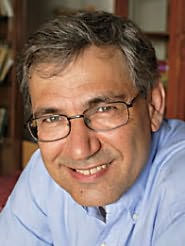
Orhan Pamuk was awarded the Nobel Prize for Literature in 2006, the first Turkish author to receive the award. He is the overall bestselling author in his homeland and his books have been published in more than fifty languages. This guide is designed to help you explore Pamuk’s world and writings, whether your group chooses to read all of his works or to focus on his acclaimed novels or engaging nonfiction titles.
Born in Istanbul in 1952, Pamuk grew up in a well-to-do, Western-oriented family. As a child he attended private schools and dreamed of becoming an artist. He began his studies at Istanbul Technical University in architecture, but at the age of twenty-two switched to journalism, taking the first step in his career as a writer. Pamuk’s first novel, Cevdet Bey and His Sons, the story of three generations of a Turkish family, was published in Turkey in 1982. The White Castle, the first of his novels to be translated into English, takes place in seventeenth-century Constantinople (as Istanbul was then called) and explores the meeting between East and West, a theme that recurs throughout Pamuk’s writing career. The White Castle also introduced a deeper, more personal interest, one that imbues in his works of fiction and nonfiction alike: the relationship between dreams and reality, memory and imagination.
In his early years as a writer, Pamuk spent five years in residence at Columbia University, where he now holds a position as a visiting professor. In the autobiographical profile he wrote for the Nobel Prize committee, Pamuk reflected on his time as a visiting scholar at Columbia and the influence that had on his evolution as a writer: “I was thirty-three years old . . . and asking myself hard questions about who I was, and about my history. . . . During my time in New York, my longing for Istanbul mixed with my fascination for the wonders of Ottoman, Persian, Arab, and Islamic culture” (copyright © The Nobel Foundation, 2006). For much of those five years, Pamuk devoted himself to writing The Black Book, a strikingly original novel that weaves multiple voices and beguiling stories about Istanbul, past and present, into a modern-day detective story.
In his next novel, The New Life, Pamuk once again transformed the conventions of mystery into an intellectual adventure, creating a world in which a mysterious book, a fleeting romance, and conspiracies real and imagined wreak havoc on a university student’s life and his sense of identity. Set in the sixteenth century, My Name Is Red revisits Turkey’s rich and complex Ottoman past in a fascinating tale about the impact of Western art and aesthetics on an Islamic society that stifled individual creativity and strictly prohibited the creation of representational paintings.
As Pamuk’s fame grew throughout the 1990s, journalists in Turkey and abroad looked to him for elucidation on the political situation in his homeland and its relations with the West. Troubled by the changes occurring in Turkey, Pamuk wrote Snow, his first overtly political novel. A thought-provoking, witty, and balanced portrait of the rise of political Islamism, Snow was widely read and discussed in Turkey and became an international bestseller. The Museum of Innocence, Pamuk’s newest work of fiction, examines the nature of romantic attachment and the mysterious allure of collecting as it traces a wealthy man’s lifetime obsession with the lower-class woman he had loved and abandoned as a young man.
Collected essays, articles, and autobiographical sketches
Now in his late fifties, Orhan Pamuk lives in Istanbul in the same apartment building he grew up in. His deep attachment to the city is beautifully captured in Istanbul: Memories and the City, a combination of childhood memoir and journey into Istanbul life through his own eyes and those of painters and writers (including European visitors like the German artist Antoine-Ignace Melling and the French writers Gérard de Nerval and Gustave Flaubert); enhanced with photographs, it illuminates the personal and artistic influences on his work. Other Colors showcases the range and dpth of Pamuk’s interests. There are short, lyrical pieces about his personal life collected under the apt and intriguing title “Living and Worrying”; critical essays on literary figures such as Dostoevsky, Camus, Nabokov, Vargas Llosa, and Rushdie, along with assessments of several of his own novels; and commentaries on a wide variety of political and cultural matters. A captivating collection, Other Colors provides fresh insights into the mind and imagination of one of today’s most notable writers.
A political drama and the recognition of Pamuk’s contributions to literature
In an interview with a Swiss newspaper in February 2005, Pamuk denounced the Ottoman massacre of millions Armenians in 1915 and the slaughter of thirty thousand Kurds in Turkey during the 1990s. His comments caused a furor in Turkey: several newspapers launched campaigns against him and he was officially charged with the crime of “publicly denigrating Turkish identity.” Facing death threats, Pamuk moved abroad. He returned to face a trial and the possibility of three years of imprisonment; the charges were dropped on a technicality in January 2006. The incident reverberated internationally, highlighting the conflict between anti-European nationalism in Turkey and the government’s campaign to join the European Union. It exposed, as well, the simmering distrust of—and sometimes blatant hostility toward—Muslim populations in the United States and Europe.
In awarding Orhan Pamuk the Nobel Prize for Literature in 2006, the Swedish Academy said, “In the quest for the melancholic soul of his native city, [Pamuk] has discovered new symbols for the clash and interlacing of cultures.” Pamuk’s Nobel Prize acceptance speech, “My Father’s Suitcase” (Other Colors, pages 403–17), offers a more personal explanation of why he became a writer and what he hopes to accomplish:
It was only by writing books that I came to a fuller understanding of the problems of authenticity (as in My Name Is Red and The Black Book) and the problems of life on the periphery (as in Snow and Istanbul). For me, to be a writer is to acknowledge the secret wounds that we carry inside us. . . . My confidence comes from the belief that all human beings resemble one other, that others carry wounds like mine—that they will therefore understand. All true literature rises from this childish, hopeful certainty that all people resemble one another.
For discussion
1. Have Pamuk’s books changed your perceptions of Turkey? What insights do they offer into the country’s history and place in the world?
2. Have his books given you a deeper understanding of the Muslim world? Have they altered your opinion about the current situation in the Middle East and other parts of the world where Islam is the dominant religion? Have you become more or less sympathetic?
3. Pamuk’s novels range over a wide span of time, from the sixteenth century (My Name Is Red) to the present day (Snow). Compare your reactions to the historical novels and the contemporary works. Which do you prefer and why?
4. In these books what impact do the tensions between Eastern and Western beliefs and customs have on individual lives, on the relations between classes and ethnic groups, or on political debates? What competing ideologies (or ways of thinking) affect the characters’ behavior and emotional responses? Consider the ethical, religious, and social dilemmas individuals face and how they resolve them.
5. Snow is prefaced by epigraphs from Robert Browning, Stendahl, Dostoevsky, and Joseph Conrad. How does each of them apply not only to Snow, but also to the other Pamuk books you have read? Citing specific passages, how would you characterize the author’s feelings about Western attitudes toward the Muslim world?
6. What role do perceptions—or misperceptions—about Islamic law and religious customs play in the assumptions Westerners make about Muslims? Are there current controversies in the United States or Europe that support your view?
7. Do Pamuk’s depictions of the relationships between men and women conform to your impressions of romance, marriage, and family life in a Muslim society? How are women presented in the historical novels? In what ways do the women in the novels set in the present (or in the recent past) embody both traditional female roles and the new opportunities they have to express their opinions and act on their beliefs?
8. Istanbul opens with an essay about Pamuk’s feelings as a child that “somewhere in the streets of Istanbul . . . there lived another Orhan so much like me that he could pass for my own twin, even my double” (page 3). Many reviewers, including John Updike, Christopher Lehmann-Haupt, and Charles McGrath, have written about what McGrath calls “an enduring Pamuk preoccupation: the idea of doubleness or split identity” (New York Times, October 13, 2006). Can you find examples of doubleness in the books you have read, and if so, what do these add to the story? What insights do they reveal about Pamuk’s own sense of identity?
9. What techniques does Pamuk use to bring his characters, real and fictional, to life? How do his descriptions of settings, manners, and other everyday details enhance the portraits he creates? What use does he make of humor, exaggeration, and other stylistic flourishes in his depictions of particular situations, conversations, musings, and arguments?
10. Pamuk employs many of the literary devices associated with postmodern and experimental fiction. (McGrath, for example, notes his use of “narratives within narratives, texts that come alive, labyrinths of signs and symbols . . .”). In what ways do his books echo Italo Calvino’s allegorical fantasies? What do they share with the writings of Jorge Luis Borges and other magical realists? What aspects of his literary style can be traced to earlier masters of innovative fiction like Kafka and Nabokov?
11. In an essay on the Peruvian writer Mario Vargas Llosa in Other Colors, Pamuk writes, “It is clear . . . that there is a sort of narrative novel that is particular to the countries of the Third World. Its originality has less to do with the writer’s location than with the fact that he knows he is writing far from the world’s literary centers and he feels this distance inside himself” (page 168). Discuss how this manifests itself in Pamuk’s own works, as well as the works of Vargas Llosa and other authors writing from the Third World. Are there creative advantages to living and writing “far from the world’s literary centers”?
12. Pamuk writes in Istanbul of authors who left their homelands—Conrad, Nabokov, Naipaul: “Their imaginations were fed by exile, a nourishment drawn not through roots, but through rootlessness” (page 6). If you have read the works of these writers, or other authors in exile, do you agree that their books reflect—in style or in content—the effects of living in a new, foreign culture? To what extent is Pamuk’s writing rooted in the storytelling traditions of Eastern cultures? In what ways does it show the influence of his early exposure to Western literature, his participation in international literary circles, and his longtime association with American academia?
13. Despite the many differences between the societies Pamuk describes and our own, why do his characters and their behavior resonant with contemporary English-speaking readers? Are there aspects of Turkish mores that make it difficult to sympathize or engage with the characters in the novels? Do these factors also influence your reactions to his autobiographical pieces, literary criticism, and cultural observations in both Other Colors and Istanbul?
14. How does Pamuk’s personal history, as well as the plots of some novels, mirror the complicated history of Turkey? Consider such topics as: the decline and dissolution of the once powerful Ottoman Empire; the sweeping changes initiated by Atatürk in the 1920s; the conflicting desires to preserve Turkey’s distinctive heritage and to become more active in the global community; and the rise of fundamentalist Islam throughout Middle East today.
15. In discussing the importance of novels, Pamuk says, “Modern societies, tribes, and nations do their deepest thinking about themselves by reading novels; through reading novels, they are able to argue about who they are” (Other Colors, page 233). Do you agree? What can novels provide that nonfiction books and other media do not?
Suggestions for further reading
Paul Auster, The New York Trilogy; Jorge Luis Borges, Collected Fictions; Italo Calvino, Invisible Cities; Kiran Desai, The Inheritance of Loss; Fyodor Dostoevsky, Notes from Underground; Umberto Eco, Foucault’s Pendulum; Franz Kafka, The Castle; James Joyce, A Portrait of the Artist as a Young Man; Milan Kundera, Immortality; Naguib Mahfouz, The Cairo Trilogy; Gabriel García Marquez, Love in the Time of Cholera; Vladimir Nabokov, Ada; V. S. Naipaul, A Bend in the River; Marcel Proust, Remembrance of Things Past
Pamuk’s works are available in Vintage paperback editions (listed here in order of their first translation into English): The White Castle; The New Life; My Name Is Red; The Black Book; Snow; Istanbul; Other Colors; The Museum of Innocence
(For a complete list of available reading group guides, and to sign up for the Reading Group Center enewsletter, visit www.readinggroupcenter.com)