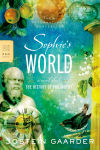
Sophie's World: A Novel about the History of Philosophy

( 99 )

Pick Up in Store

Reserve and pick up in 60 minutes at your local store

Paperback (First Edition)
$10.98
BN.com price
$13.00 List Price (Save 16%)
Marketplace (New and Used)
from
$3.32
$13.00 List Price (Save 74%)
Usually ships within 1-2 business days
All (39)  
Used (20)  
New (19)  
Close
Sort by
Page 1 of 4
Showing 1 – 10 of 39 (4 pages)
$3.32
(Save 74%)
Seller since 2010

Feedback rating:

(532)

Condition:

New — never opened or used in original packaging.

Like New — packaging may have been opened. A "Like New" item is suitable to give as a gift.

Very Good — may have minor signs of wear on packaging but item works perfectly and has no damage.

Good — item is in good condition but packaging may have signs of shelf wear/aging or torn packaging. All specific defects should be noted in the Comments section associated with each item.

Acceptable — item is in working order but may show signs of wear such as scratches or torn packaging. All specific defects should be noted in the Comments section associated with each item.

Used — An item that has been opened and may show signs of wear. All specific defects should be noted in the Comments section associated with each item.

Refurbished — A used item that has been renewed or updated and verified to be in proper working condition. Not necessarily completed by the original manufacturer.

Good
Ships same or next business day with delivery confirmation. Good condition. May or may not contain highlighting. Expedited shipping available.

Ships from: MARION, IN

Usually ships in 1-2 business days

  • Standard, 48 States
  • Standard (AK, HI)
  • Express, 48 States
  • Express (AK, HI)
$4.75
(Save 63%)
Seller since 2012

Feedback rating:

(888)

Condition: Very Good
" *****We Ship FAST. Usually within 24 hours. FREE Tracking/Confirmation.*****"

Ships from: Garden Grove, CA

Usually ships in 1-2 business days

  • Standard, 48 States
  • Standard (AK, HI)
  • Express, 48 States
  • Express (AK, HI)
$4.85
(Save 63%)
Seller since 2010

Feedback rating:

(207)

Condition: Good
0374530718 Good Condition. Has a tear. Has writing/highlighting. Five star seller - Ships Quickly - Buy with confidence!

Ships from: Blue Jay, CA

Usually ships in 1-2 business days

  • Canadian
  • International
  • Standard, 48 States
  • Standard (AK, HI)
  • Express, 48 States
  • Express (AK, HI)
$5.07
(Save 61%)
Seller since 2005

Feedback rating:

(45317)

Condition: Very Good
SHIPS FAST! via UPS(AK/HI Priority Mail) within 24 hrs/ used sticker/some hilite

Ships from: Columbia, MO

Usually ships in 1-2 business days

  • Standard, 48 States
  • Standard (AK, HI)
  • Express, 48 States
  • Express (AK, HI)
$6.10
(Save 53%)
Seller since 2009

Feedback rating:

(23)

Condition: Good
2007 Paperback Good Satisfaction Guaranteed! PLEASE NOTE: Used books may not include CDs, software, online access codes or other peripherals. Used items have varying degrees ... of wear, highlighting, etc. and may not include supplements such as infotrac, CD-ROMS or other web access codes. We always ship best available copy. Orders are processed Monday thru Friday. Please contact with any specific questions. Read more Show Less

Ships from: San Marcos, TX

Usually ships in 1-2 business days

  • Canadian
  • International
  • Standard, 48 States
  • Standard (AK, HI)
  • Express, 48 States
  • Express (AK, HI)
$6.50
(Save 50%)
Seller since 2007

Feedback rating:

(2436)

Condition: Good
2007 Paperback Good

Ships from: east moriches, NY

Usually ships in 1-2 business days

  • Canadian
  • International
  • Standard, 48 States
  • Standard (AK, HI)
  • Express, 48 States
  • Express (AK, HI)
$7.07
(Save 46%)
Seller since 2008

Feedback rating:

(11733)

Condition: New
Absolutely Brand New & In Stock. 100% 30-Day Money Back. Direct from our warehouse. 5+ million customers served-In business since 1997. Happy Customers is Our #1 Goal. Toll Free ... Support. 4 to 14 business day Delivery Time by US Post Office. Read more Show Less

Ships from: Oldsmar, FL

Usually ships in 1-2 business days

  • Standard, 48 States
  • Standard (AK, HI)
$7.25
(Save 44%)
Seller since 2005

Feedback rating:

(660)

Condition: Good
01-01-2007 Softcover Some wear from use. Good used book. Slight lean to spine.

Ships from: Orange, CA

Usually ships in 1-2 business days

  • Canadian
  • International
  • Standard, 48 States
  • Standard (AK, HI)
  • Express, 48 States
  • Express (AK, HI)
$7.47
(Save 43%)
Seller since 2008

Feedback rating:

(12864)

Condition: Like New
Brand New, Perfect Condition, Please allow 4-14 business days for delivery. 100% Money Back Guarantee, Over 1,000,000 customers served.

Ships from: South Bend, IN

Usually ships in 1-2 business days

  • Canadian
  • International
  • Standard, 48 States
  • Standard (AK, HI)
$7.64
(Save 41%)
Seller since 2005

Feedback rating:

(1769)

Condition: Like New
2007 Trade paperback Fine. Remainder Mark. Never opened. {FP} Trade paperback (US). Glued binding. 518 p. Fsg Classics. Intended for a young adult/teenage audience.

Ships from: Pennington, NJ

Usually ships in 1-2 business days

  • Canadian
  • International
  • Standard, 48 States
  • Standard (AK, HI)
  • Express, 48 States
  • Express (AK, HI)
Page 1 of 4
Showing 1 – 10 of 39 (4 pages)
Close
Sort by
NOOK Book (eBook - First Edition)
$9.99
BN.com price

Available on NOOK devices and apps

  • Nook Devices
  • NOOK
  • NOOK Color
  • NOOK Tablet
  • Tablet/Phone
  • NOOK for iPad
  • NOOK for iPhone
  • NOOK for Android
  • NOOK for Android (Tablet)
  • NOOK Kids for iPad
  • PC/Mac
  • NOOK Study
  • NOOK for PC
  • NOOK for Mac

Need a NOOK? Explore Now

Overview

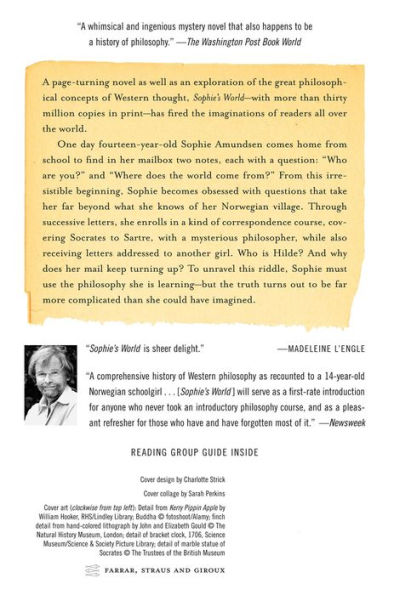
A page-turning novel as well as an exploration of the great philosophical concepts of Western thought, Sophie's World-with more than thirty million copies in print-has fired the imaginations of readers all over the world.

One day fourteen-year-old Sophie Amundsen comes home from school to find in her mailbox two notes, each with a question: "Who are you?" and "Where does the world come from?" From this irresistible beginning, Sophie becomes obsessed with questions that take her far beyond what she knows of her Norwegian village. Through successive letters, she enrolls in a kind of correspondence course, covering Socrates to Sartre, with a mysterious philosopher, while also receiving letters addressed to another girl. Who is Hilde? And why does her mail keep turning up? To unravel this riddle. Sophie must use the philosophy she is learning-but the truth turns out to be far more complicated than she could have imagined.

A passionate plea to rediscover our capacity for amazement, Sophie's World is more than a mere mystery. It is also the first novel to present a complete--and entertaining--history of philosophy. "A literary surprise success such as has not been seen since Umberto Eco's learned cloister-thriller The Name of the Rose."

  • Sophie's World
    Sophie's World

Editorial Reviews

Publishers Weekly
This long, dense novel, a bestseller in the author's native Norway, offers a summary history of philosophy embedded in a philosophical mystery disguised as a children's book-but only sophisticated young adults would be remotely interested. Sophie Amundsen is about to turn 15 when she receives a letter from one Alberto Knox, a philosopher who undertakes to educate her in his craft. Sections in which we read the text of Knox's lessons to Sophie about the pre-Socratics, Plato and St. Augustine alternate with those in which we find out about Sophie's life with her well-meaning mother. Soon, though, Sophie begins receiving other, stranger missives addressed to one Hilde Moller Knag from her absent father, Albert. As Alberto Knox's lessons approach this century, he and Sophie come to suspect that they are merely characters in a novel written by Albert for his daughter. Teacher and pupil hatch a plot to understand and possibly escape from their situation; and from there, matters get only weirder. Norwegian philosophy professor Gaarder's notion of making a history of philosophy accessible is a good one. Unfortunately, it's occasionally undermined by the dry language he uses to describe the works of various thinkers and by an idiosyncratic bias that gives one paragraph to Nietzsche but dozens to Sartre, breezing right by Wittgenstein and the most influential philosophy of this century, logical positivism. Many readers, regardless of their age, may be tempted to skip over the lessons, which aren't well integrated with the more interesting and unusual metafictional story line. Author tour. (Sept.)
From The Critics
This novel has already been a best seller in Scandinavia and Germany, and though it is markedly different from the prototypical American best seller, it should also do well here. The framework of the story is the receipt by a 14-year-old girl of mysterious letters that present her with a history of Western philosophy, from the pre-Socratics through Jean-Paul Sartre. After reading them, Sophie is prompted to ask questions and to think analytically. She also tries to discover their source and other manifestations, such as the puzzling postcards a Norwegian UN soldier in Lebanon sends to his nearly 15-year-old daughter. Adults and mature teens will appreciate the mystery as well as the philosophy lessons found in this first novel by a Norwegian high school philosophy teacher. Recommended for most collections.-Ann Irvine, Montgomery Cty. P.L., Md.
From Barnes & Noble
Designed for young readers, this novel is an entertaining story about a young girl who attempts to unravel a puzzling mystery by applying the theories of various philosophers--from Berkeley to Kant. A delightful introduction to the history of philosophy. This copy refers to a book club edition.

Product Details

  • ISBN-13: 9780374530716
  • Publisher: Farrar, Straus and Giroux
  • Publication date: 3/6/2007
  • Edition description: First Edition
  • Pages: 544
  • Sales rank: 29,044
  • Series: FSG Classics Series
  • Product dimensions: 8.26 (w) x 5.32 (h) x 0.94 (d)

Meet the Author

Jostein Gaarder was born in Oslo, Norway, in 1952. He taught high-school philosophy for several years before publishing a collection of short stories in 1986 and, shortly thereafter, his first two novels, The Solitaire Mystery and Sophie’s World, and several others since then. He lives in Oslo with his family.

Read an Excerpt

The Garden of Eden

. . . at some point something must

have come from nothing . . .

Sophie Amundsen was on her way home from school. She had walked the first part of the way with Joanna. They had been discussing robots. Joanna thought the human brain was like an advanced computer. Sophie was not certain she agreed. Surely a person was more than a piece of hardware?

When they got to the supermarket they went their separate ways. Sophie lived on the outskirts of a sprawling suburb and had almost twice as far to go to school as Joanna. There were no other houses beyond her garden, which made it seem as if her house lay at the end of the world. This was where the woods began.

She turned the corner into Clover Close. At the end of the road there was a sharp bend, known as Captain's Bend. People seldom went that way except on the weekend.

It was early May. In some of the gardens the fruit trees were encircled with dense clusters of daffodils. The birches were already in pale green leaf.

It was extraordinary how everything burst forth at this time of year! What made this great mass of green vegetation come welling up from the dead earth as soon as it got warm and the last traces of snow disappeared?

As Sophie opened her garden gate, she looked in the mailbox. There was usually a lot of junk mail and a few big envelopes for her mother, a pile to dump on the kitchen table before she went up to her room to start her homework.

From time to time there would be a few letters from the bank for her father, but then he was not a normal father. Sophie's father was the captain of a big oil tanker, and was away for most of the year. During the few weeks at a time when he was at home, he would shuffle around the house making it nice and cozy for Sophie and her mother. But when he was at sea he could seem very distant.

There was only one letter in the mailbox—and it was for Sophie. The white envelope read: "Sophie Amundsen, 3 Clover Close." That was all; it did not say whom it was from. There was no stamp on it either.

As soon as Sophie had closed the gate behind her she opened the envelope. It contained only a slip of paper no bigger than the envelope. It read: Who are you?

Nothing else, only the three words, written by hand, and followed by a large question mark.

She looked at the envelope again. The letter was definitely for her. Who could have dropped it in the mailbox?

Sophie let herself quickly into the red house. As always, her cat, Sherekan, managed to slink out of the bushes, jump onto the front step, and slip in through the door before she closed it behind her.

Whenever Sophie's mother was in a bad mood, she would call the house they lived in a menagerie. A menagerie was a collection of animals. Sophie certainly had one and was quite happy with it. It had begun with the three goldfish, Goldtop, Red Ridinghood, and Black Jack. Next she got two budgerigars called Smitt and Smule, then Govinda the tortoise, and finally the marmalade cat Sherekan. They had all been given to her to make up for the fact that her mother never got home from work until late in the afternoon and her father was away so much, sailing all over the world.

Sophie slung her schoolbag on the floor and put a bowl of cat food out for Sherekan. Then she sat down on a kitchen stool with the mysterious letter in her hand.

Who are you?

She had no idea. She was Sophie Amundsen, of course, but who was that? She had not really figured that out—yet.

What if she had been given a different name? Anne Knutsen, for instance. Would she then have been someone else?

She suddenly remembered that Dad had originally wanted her to be called Lillemor. Sophie tried to imagine herself shaking hands and introducing herself as Lillemor Amundsen, but it seemed all wrong. It was someone else who kept introducing herself.

She jumped up and went into the bathroom with the strange letter in her hand. She stood in front of the mirror and stared into her own eyes.

"I am Sophie Amundsen," she said.

The girl in the mirror did not react with as much as a twitch. Whatever Sophie did, she did exactly the same. Sophie tried to beat her reflection to it with a lightning movement but the other girl was just as fast.

"Who are you?" Sophie asked.

She received no response to this either, but felt a momentary confusion as to whether it was she or her reflection who had asked the question.

Sophie pressed her index finger to the nose in the mirror and said, "You are me."

As she got no answer to this, she turned the sentence around and said, "I am you."

Sophie Amundsen was often dissatisfied with her appearance. She was frequently told that she had beautiful almond-shaped eyes, but that was probably just something people said because her nose was too small and her mouth was a bit too big. And her ears were much too close to her eyes. Worst of all was her straight hair, which it was impossible to do anything with. Sometimes her father would stroke her hair and call her "the girl with the flaxen hair," after a piece of music by Claude Debussy. It was all right for him, he was not condemned to living with this straight hair. Neither mousse nor styling gel had the slightest effect on Sophie's hair. Sometimes she thought she was so ugly that she wondered if she was malformed at birth. Her mother always went on about her difficult labor. But was that really what determined how you looked?

Wasn't it odd that she didn't know who she was? And wasn't it unreasonable that she hadn't been allowed to have any say in what she would look like? Her looks had just been dumped on her. She could choose her own friends, but she certainly hadn't chosen herself. She had not even chosen to be a human being.

What was a human being?

Sophie looked up at the girl in the mirror again.

"I think I'll go upstairs and do my biology homework," she said, almost apologetically. Once she was out in the hall, she thought, No, I'd rather go out in the garden.

"Kitty, kitty, kitty!"

Sophie chased the cat out onto the doorstep and closed the front door behind her.

As she stood outside on the gravel path with the mysterious letter in her hand, the strangest feeling came over her. She felt like a doll that had suddenly been brought to life by the wave of a magic wand.

Wasn't it extraordinary to be in the world right now, wandering around in a wonderful adventure!

Sherekan sprang lightly across the gravel and slid into a dense clump of red-currant bushes. A live cat, vibrant with energy from its white whiskers to the twitching tail at the end of its sleek body. It was here in the garden too, but hardly aware of it in the same way as Sophie.

As Sophie started to think about being alive, she began to realize that she would not be alive forever. I am in the world now, she thought, but one day I shall be gone.

Was there a life after death? This was another question the cat was blissfully unaware of.

It was not long since Sophie's grandmother had died. For more than six months Sophie had missed her every single day. How unfair that life had to end!

Sophie stood on the gravel path, thinking. She tried to think extra hard about being alive so as to forget that she would not be alive forever. But it was impossible. As soon as she concentrated on being alive now, the thought of dying also came into her mind. The same thing happened the other way around: only by conjuring up an intense feeling of one day being dead could she appreciate how terribly good it was to be alive. It was like two sides of a coin that she kept turning over and over. And the bigger and clearer one side of the coin became, the bigger and clearer the other side became too.

You can't experience being alive without realizing that you have to die, she thought. But it's just as impossible to realize you have to die without thinking how incredibly amazing it is to be alive.

Sophie remembered Granny saying something like that the day the doctor told her she was ill. "I never realized how rich life was until now," she had said.

How tragic that most people had to get ill before they understood what a gift it was to be alive. Or else they had to find a mysterious letter in the mailbox!

Perhaps she should go and see if any more letters had arrived. Sophie hurried to the gate and looked inside the green mailbox. She was startled to find that it contained another white envelope, exactly like the first. But the mailbox had definitely been empty when she took the first envelope! This envelope had her name on it as well. She tore it open and fished out a note the same size as the first one.

Where does the world come from? it said.

I don't know, Sophie thought. Surely nobody really knows. And yet—Sophie thought it was a fair question. For the first time in her life she felt it wasn't right to live in the world without at least inquiring where it came from.

The mysterious letters had made Sophie's head spin. She decided to go and sit in the den.

The den was Sophie's top-secret hiding place. It was where she went when she was terribly angry, terribly miserable, or terribly happy. Today she was simply confused.

The red house was surrounded by a large garden with lots of flowerbeds, fruit bushes, fruit trees of different kinds, a spacious lawn with a glider and a little gazebo that Granddad had built for Granny when she lost their first child a few weeks after it was born. The child's name was Marie. On her gravestone were the words: "Little Marie to us came, greeted us, and left again."

Down in a corner of the garden behind all the raspberry bushes was a dense thicket where neither flowers nor berries would grow. Actually, it was an old hedge that had once marked the boundary to the woods, but because nobody had trimmed it for the last twenty years it had grown into a tangled and impenetrable mass. Granny used to say the hedge made it harder for the foxes to take the chickens during the war, when the chickens had free range of the garden.

To everyone but Sophie, the old hedge was just as useless as the rabbit hutches at the other end of the garden. But that was only because they hadn't discovered Sophie's secret.

Sophie had known about the little hole in the hedge for as long as she could remember. When she crawled through it she came into a large cavity between the bushes. It was like a little house. She knew nobody would find her there.

Clutching the two envelopes in her hand, Sophie ran through the garden, crouched down on all fours, and wormed her way through the hedge. The den was almost high enough for her to stand upright, but today she sat down on a clump of gnarled roots. From there she could look out through tiny peepholes between the twigs and leaves. Although none of the holes was bigger than a small coin, she had a good view of the whole garden. When she was little she used to think it was fun to watch her mother and father searching for her among the trees.

Sophie had always thought the garden was a world of its own. Each time she heard about the Garden of Eden in the Bible it reminded her of sitting here in the den, surveying her own little paradise.

Where does the world come from?

She hadn't the faintest idea. Sophie knew that the world was only a small planet in space. But where did space come from?

It was possible that space had always existed, in which case she would not also need to figure out where it came from. But could anything have always existed? Something deep down inside her protested at the idea. Surely everything that exists must have had a beginning? So space must sometime have been created out of something else.

But if space had come from something else, then that something else must also have come from something. Sophie felt she was only deferring the problem. At some point, something must have come from nothing. But was that possible? Wasn't that just as impossible as the idea that the world had always existed?

They had learned at school that God created the world. Sophie tried to console herself with the thought that this was probably the best solution to the whole problem. But then she started to think again. She could accept that God had created space, but what about God himself? Had he created himself out of nothing? Again there was something deep down inside her that protested. Even though God could create all kinds of things, he could hardly create himself before he had a "self" to create with. So there was only one possibility left: God had always existed. But she had already rejected that possibility! Everything that existed had to have a beginning.

Oh, drat!

She opened the two envelopes again.

Who are you?

Where does the world come from?

What annoying questions! And anyway where did the letters come from? That was just as mysterious, almost.

Who had jolted Sophie out of her everyday existence and suddenly brought her face to face with the great riddles of the universe?

For the third time Sophie went to the mailbox. The mailman had just delivered the day's mail. Sophie fished out a bulky pile of junk mail, periodicals, and a couple of letters for her mother. There was also a postcard of a tropical beach. She turned the card over. It had a Norwegian stamp on it and was postmarked "UN Battalion." Could it be from Dad? But wasn't he in a completely different place? It wasn't his handwriting either.

Sophie felt her pulse quicken a little as she saw who the postcard was addressed to: "Hilde Møller Knag, c/o Sophie Amundsen, 3 Clover Close . . ." The rest of the address was correct. The card read:

Dear Hilde,

Happy 15th birthday! As I'm sure you'll understand, I want to give you a present that will help you grow. Forgive me for sending the card c/o Sophie. It was the easiest way.

Love from Dad.

Sophie raced back to the house and into the kitchen. Her mind was in a turmoil. Who was this "Hilde," whose fifteenth birthday was just a month before her own?

Sophie got out the telephone book. There were a lot of people called Møller, and quite a few called Knag. But there was nobody in the entire directory called Møller Knag.

She examined the mysterious card again. It certainly seemed genuine enough; it had a stamp and a postmark.

Why would a father send a birthday card to Sophie's address when it was quite obviously intended to go somewhere else? What kind of father would cheat his own daughter of a birthday card by purposely sending it astray? How could it be "the easiest way"? And above all, how was she supposed to trace this Hilde person?

So now Sophie had another problem to worry about. She tried to get her thoughts in order:

This afternoon, in the space of two short hours, she had been presented with three problems. The first problem was who had put the two white envelopes in her mailbox. The second was the difficult questions these letters contained. The third problem was who Hilde Møller Knag could be, and why Sophie had been sent her birthday card. She was sure that the three problems were interconnected in some way. They had to be, because until today she had lived a perfectly ordinary life.

Excerpted from Sophie's World: A Novel About the History of Philosophy by Jostein Gaarder. Translation copyright © 1994 by Paulette Møller. Originally published in Norwegian under the title Sofies verden, copyright © 1991 by H. Aschehoug & Co. (W. Nygaard), Oslo. Originally published in English in 1994 in the United States by Farrar, Straus and Giroux. This paperback edition published in March 2007 by Farrar, Straus and Giroux, LLC. All rights reserved.

Table of Contents

Acknowledgments xiii

The Garden of Eden: at some point something must have come from nothing 3

The Top Hat: the only thing we require to be good philosophers is the faculty of wonder 12

The Myths: a precarious balance between the forces of good and evil 23

The Natural Philosophers: nothing can come from nothing 30

Democritus: the most ingenious toy in the world 43

Fate: the "fortune-teller" is trying to foresee something that is really quite unforeseeable 49

Socrates: wisest is she who knows she does not know 58

Athens: several tall buildings had risen from the ruins 73

Plato: a longing to return to the realm of the soul 79

The Major's Cabin: the girl in the mirror winked with both eyes 94

Aristotle: a meticulous organizer who wanted to clarify our concepts 104

Hellenism: a spark from the fire 120

The Postcards: I'm imposing a severe censorship on myself 138

Two Cultures: the only way to avoid floating in a vacuum 147

The Middle Ages: going only part of the way is not the same as going the wrong way 162

The Renaissance: O divine lineage in mortal guise 185

The Baroque: such stuff as dreams are made on 213

Descartes: he wanted to clear all the rubble off the site 230

Spinoza: God is not a puppeteer 244

Locke: as bare and empty as a blackboard before the teacher arrives 253

Hume: commit it then to the flames 263

Berkeley: like a giddy planet round a burning sun 278

Berkeley: like a giddy planet round a burning sun 278

Bjerkely: an old magic mirror Great-grandmother had bought from a Gypsy woman 283

The Enlightenment: from the way needles are made to the way cannons are founded 299

Kant: the starry heavens above me and the moral law within me 318

Romanticism: the path of mystery leads inwards 338

Hegel: the reasonable is that which is viable 356

Kierkegaard: Europe is on the road to bankruptcy 368

Marx: a spectre is haunting Europe 381

Darwin: a ship sailing through life with a cargo of genes 399

Freud: the odious egoistic impulse that had emerged in her 423

Our Own Time: man is condemned to be free 441

The Garden Party: a white crow 465

Counterpoint: two or more melodies sounding together 479

The Big Bang: we too are stardust 498

Index 509

Reading Group Guide 519

Reading Group Guide

A New York Times and #1 International Bestseller

“Sophie’s World is sheer delight. How I wish I’d had it during my college freshman survey of philosophy!” —Madeleine L’Engle

“First, think of a beginner’s guide to philosophy, written by a schoolteacher . . . Next, imagine a fantasy novel—something like a modern-day version of Through the Looking Glass. Meld these disparate genres, and what do you get? Well, what you get is an improbable international bestseller . . . A runaway hit [and a] tour de force.” —Time

“Brilliant . . . Unlike any other novel in this or other years.” —The Boston Sunday Globe

“Extraordinary . . . The book will serve as a first-rate introduction for anyone who never took an introductory philosophy course, and as a pleasant refresher for those who have.” —Newsweek

“Remarkable . . . A whimsical and ingenious mystery novel that also happens to be a history of philosophy.” —The Washington Post Book World

About This Guide

The questions and discussion topics that follow are designed to enhance your reading of Jostein Gaarder’s classic bestseller, Sophie’s World. We hope they will enrich your experience of this irresistible tale of mystery, philosophy, fantasy, and exuberant living.

Introduction

With more than thirty million copies in print, Sophie’s World is an exciting, entirely innovative novel that thrives on its contradictions. It is a page-turning adventure as well as a history of Western philosophy—from the discourse of ancient Greece to debates about the Big Bang. Yet it is also a refreshingly contemporary coming-of-age novel with echoes of science fiction.

The games begin when fourteen-year-old Sophie Amundsen finds two notes in her mailbox. One note asks, “Who are you?” The other asks, “Where does the world come from?” From here, with the aid of a devoted but mysterious instructor, Sophie sets off on a fantastic philosophical saga that will take her far beyond her small Norwegian hometown. Letters give way to lectures, questions give way to quests, and the dimensions of Sophie’s world (as well as our own) grow ever wider, deeper, and richer.

Questions and Topics for Discussion

1. The first chapter’s title, “The Garden of Eden,” underscores the concept of beginnings and origins. How did you first respond to the initial two questions, “Who are you?” and “Where does the world come from?” Did your answers change by the time you reached the end of the novel?

2. When Sophie first starts receiving letters from the philosophy teacher, she finds that each one is slightly damp, having “two little holes in it.” Thinking of Sophie’s World as a mystery novel, what other “clues” did you encounter over the course of the book? Were you able to use them to solve any riddles?

3. As Sophie watched the video tape in secret, what was your understanding of how Alberto Knox was able to bring ancient Athens back to life? What distinctions are made in the novel between reality and the surreal? How do such distinctions play out in your own life?

4. How did you react to Aristotle’s views on women? In your opinion, which of the thinkers in Gaarder’s history provided admirable answers to questions about gender? What did you make of the fact that a vast majority of the authorities in the novel are men?

5. In the “Middle Ages” chapter, Alberto says, “We can say that Aquinas christianized Aristotle in the same way that St. Augustine christianized Plato.” What was the result as these great medieval thinkers applied the teachings of Christ to ancient philosophy?

6. “You could say,” Alberto tells Sophie, “that a process started in the Renaissance finally brought people to the moon. Or for that matter to Hiroshima or Chernobyl.” What is this “process”? What is the relationship between philosophy, religion, economics, and science? How much of contemporary life is the result of Renaissance ideals?

7. “Bjerkely” marks the transition from Sophie’s to Hilde’s point of view. Both of the heroines in Sophie’s World are going through phases of rapid physical, intellectual, and emotional development. How do their lives, personalities, and philosophies compare? What makes Berkeley/Bjerkely an appropriate backdrop for putting such dualities in the spotlight?

8. What parallel does Hilde’s father build between the French Enlightenment and the United Nations? How does this parallel compare to the UN analogies in the “Kierkegaard” chapter? In what other ways does philosophy reverberate throughout current international politics?

9. Explain the “red-tinted glasses” experiment employed in the “Kant” chapter. What does Sophie discover about rationalists and empiricists along the way? How do these questions of perspective apply to issues in your own life?

10. In the “Romanticism” chapter, Alberto quotes a character from Henrik Ibsen’s Peer Gynt as saying, “One cannot die in the middle of Act Five.” What is your interpretation of this line? What do the poets and the other philosophers discussed in this chapter say about the nature of life and identity?

11. “In a sense,” Alberto tells Sophie, “Freud demonstrated that there is an artist in everyone.” Is this point of view valid? Compared to other notions proposed throughout the book, were Freud’s the most radical or the most mundane?

12. Discuss the concept of theaters and role-playing as they unfold in the novel. Do you agree with Alberto’s assertion that “the Baroque period gave birth to modern theater”? What were the playwrights involved in the “theater of the absurd” trying to say? How did their motivations compare to those of Shakespeare and his contemporaries?

13. In the “Big Bang” chapter, we find that stargazing is actually a form of time travel. How do these concepts of time shape the novel’s closing scenes?

14. More than once in these pages, the child’s perspective is mentioned as a paradigm for how philosophers should think or perceive. Though they are at an age when they are beginning to leave childhood behind, do Sophie and Hilde possess greater wisdom than their elders?

15. Sophie’s World encompasses numerous time periods, cultures, discoveries, and belief systems. How many of the novel’s terms and references were you already familiar with? Which aspects did you most want to research further?

16. Ultimately, what is a “philosophical project”? Does reading a novel—or any book—constitute a philosophical project? Does language limit or spur philosophical exercise? Can philosophy be learned?

Jostein Gaarder, an award-winning novelist and short-fiction writer, was born in 1952 in Oslo, Norway. He taught high school philosophy for eleven years before becoming a full-time writer. He lives with his family in Oslo and is also the author of The Solitaire Mystery.

Customer Reviews
Average Rating 4
( 99 )

Rating Distribution

If you've bought this product, tell the world how you liked it.
Write a Review
See All Sort by: Showing 1 – 20 of 99 Customer Reviews
  • Anonymous

    Posted August 31, 2008

    I could read it again and again..

    The author knows just how to take the reader into these worlds within worlds and places you inside of each character where you feel every piece of the story as if you were living it yourself. I recommend this book to everyone.

    2 out of 2 people found this review helpful.

    Was this review helpful? Yes  No   Report this review
  • Posted May 17, 2010

    Something to think about

    I was assigned this book to read for my philosophical psychology class and thus, assumed I would be in for a long, dry read. I was pleasantly surprised, however, to find that the story is actually quite entertaining with several plot twists that leave you guessing until the very end. The author has a very clever way of teaching you philosophical lessons right along with the character, provoking new thoughts and ideas without making it seem instructional. By the end of the book, you will most definitely have some new ideas as to who you are, where you come from, and what it all means. Or at least, you'll be thinking about it.

    1 out of 1 people found this review helpful.

    Was this review helpful? Yes  No   Report this review
  • Posted March 27, 2010

    Excellent book!!!!

    I teach teenage girls and they all love this book. They can all relate to sophie and are learning concepts that they would never go near if they were presented to them in its original form. I have inner city kids talking about philosophy and history and they think its fun! This is a brilliant work!!!

    1 out of 1 people found this review helpful.

    Was this review helpful? Yes  No   Report this review
  • Posted March 21, 2010

    A fantastic book!

    I read this book a few weeks ago, and I loved it. It was thrilling, yet very informational, with a bit of mystery to it. It kept me on the edge of my seat the whole time I was reading. I thought that it was very interesting to learn about the philosophers and how they percieved the world around them. I highly reccommend this book to someone who wants a thought provoking read. It is good for discussion too.

    1 out of 1 people found this review helpful.

    Was this review helpful? Yes  No   Report this review
  • Posted December 19, 2009

    more from this reviewer

    Just Another School Book

    I started this book a few days ago and it feels more like a textbook for Philosophy rather than an actual novel. As if I want to read about Philosophy embedded in a story... No, it's pretty much the whole story. I feel like I'm in school again. Don't buy this book, s'il vous plait.

    1 out of 2 people found this review helpful.

    Was this review helpful? Yes  No   Report this review
  • Anonymous

    Posted November 3, 2007

    Philosophy explained in a fun way

    When I read this book I gained great knowledge about philosophy and it's history. This book is a must read to all who want to gain knowledge of philosophy and/or if they themselves want to be philosophers. The sypnosis of this book is very easy and straight to the point.

    1 out of 1 people found this review helpful.

    Was this review helpful? Yes  No   Report this review
  • Anonymous

    Posted July 5, 2002

    Skip it

    I had to read this book for my Advanced World History class. I thought it was horrible. Well, at least the story part was. The philosophy part was pretty interesting. The story was just really simple and undeveloped and just became weird about 2/3's of the way through the book. If you're looking for something to read for leisure, skip it. If you're looking for information on philosophy, skip it- you would be better off just reading a textbook- once you take away the story, that's all this book is.

    1 out of 1 people found this review helpful.

    Was this review helpful? Yes  No   Report this review
  • Anonymous

    Posted December 18, 2000

    Philosophy can be Fun

    This book is the best history and summary of philosophy I have read! It should be read by every student in High Schools, so they would have a better grounding and understanding of the history of philosophy. I highly recommend this book.

    1 out of 1 people found this review helpful.

    Was this review helpful? Yes  No   Report this review
  • Anonymous

    Posted November 11, 2000

    An Interesting Book

    This is a good book about philosophy and it is confusing one.We thanks to Yrd.Doc.Dr.Nilgun Ariturk who makes us read.

    1 out of 1 people found this review helpful.

    Was this review helpful? Yes  No   Report this review
  • Posted January 14, 2011

    more from this reviewer

    Loved the book

    I read it in my senior year of high school. I wasn't to sure of reading it at first. But when i started reading it i couldn't put the book down. I learned more about philosophy from this book then from my college philosophy class. It is an interesting book to read. I looked ever where to find the book and now i am glad that i found it.

    Was this review helpful? Yes  No   Report this review
  • Anonymous

    Posted April 16, 2009

    yawn

    honestly, this book was a huge bore. i couldn't wait until it was over.
    the premise seemed really cool when i read the back but it was a total dissapointment. if you absolutely must read it, get it out of the library. it's not worth the money.

    0 out of 1 people found this review helpful.

    Was this review helpful? Yes  No   Report this review
  • Anonymous

    Posted May 6, 2008

    A reviewer

    It has a good plotline, and a great read for history geeks. Near the end of the book, it became much harder to comprehend, and the chapter, 'Garden Party' was entirely disturbing to me. But as a read for pleasure, I absolutely recommend it.

    Was this review helpful? Yes  No   Report this review
  • Anonymous

    Posted May 15, 2008

    Makes you take into consideration different perspectives

    For me reading this book was just a way to gain knowledge about humans, their beliefs, and how differently we all perceive or can perceive the world. And in that respect this book was definitely tops, however despite the continual facts and commentaries made on philosophy I must say that the end of this book, while fitting to the subject in question was hard to follow and a little disappointing. Yet for some reason I can't shake the insurmountable knowledge packed into this story while still following a plot line.

    Was this review helpful? Yes  No   Report this review
  • Anonymous

    Posted March 22, 2008

    a little exhausting

    after reading the back of the book, i decided to buy it, because it seemed really simple and straightforward. but after reading for awhile, it got a bit exhausting trying to remember all the facts and dates and people thrown out at you. it was more or less a crash course in philosophy rather than a relaxing read, at least in my opinion.

    Was this review helpful? Yes  No   Report this review
  • Anonymous

    Posted September 13, 2007

    Read in high school and it stuck.

    I read this book in high school my senior year and the ideas presented in the book stuck. I'm a junior in college now and just the other day I though about something from the book when I was just observing a young child in amazement as she stared at some fishes in a fish tank. This book helps you see things from different perspectives. It is a very exciting read and I highly recommend it.

    Was this review helpful? Yes  No   Report this review
  • Anonymous

    Posted June 5, 2007

    Awesome novel!

    This book is an awesome novel to read for insight into philosophy and introduction to philosophy. From the moment I started reading this book I never wanted to put it down. From Socrates to Plato the author explains how and what the philosophers believed in. It was both insightful and intellectual to me and will be to the reader.

    Was this review helpful? Yes  No   Report this review
  • Anonymous

    Posted August 1, 2007

    odd

    I'm giving this book three stars because it wasn't bad but it wasn't good either.I enjoyed Sophie and Alberto in the first half of the book, but when Hilde was introduced things went a little crazy. It felt like the author gave up on telling a well developed story about half way through. I enjoyed Sophie's puzzling over the philospical questions more than I did Alberto's. I've always been interested in history, but this was just dry and I skipped through Alberto's letters. Perhaps it's as Hilde says, 'she would have to read the story again one or two more times'. But I must say, this book got me writing again if only because the tone it was written in is one where the reader is drawn in and lulled into a kind of trance.

    Was this review helpful? Yes  No   Report this review
  • Anonymous

    Posted February 1, 2007

    Wonderful book

    This is a very good book to introduce you to philosophy. In studying philosophy, it's imperative to learn the history and the basic beliefs of well-known past philosophers, and this book provides that. Once you've read Sophie's World, if you want to read more on the subject, find philosophers mentioned in the book who interest you and read their works. If you already know a lot about the basics, I suggest finding a different book, because this barely begins to scratch the surface. The story with Sophie and Alberto, though it did attempt to tie in with the philosophy within the chapter, was often Gaarder's interpretation of the philosophy, and while I was reading the book for the second time, I often found personal opinion regarding the philosophies. If you're just getting into philosophy, this book may help you sort out what your personal philosophy may be, but take care that Gaarder's interpretation doesn't influence you too much.

    Was this review helpful? Yes  No   Report this review
  • Anonymous

    Posted February 1, 2006

    The Fresh Perspective of a Teenage Girl

    In the novel Sophie¿s World, by Jostein Gaarder, a teenage girl named Sophie discovers that there is more to life in Norway than pet animals and the latest history test. She soon recieves a blessing in the form of mysterious letters from an unknown man who wishes to teach her philosophy. As she begins her journey through the course, Sophie discovers the way to find herself and the completely new ways to look at life. This fascinating novel by Gaarder is an excellent way to make your first dive into the thought-provoking subject that is philosophy, or a superb way to refresh your memory on the subject. Gaarder combines the narrative of an easy-going teenage girl easily with the history and major points in the time line of philosophy to make this novel an excellent read. The courses in philosophy are easy to understand because of the division of the materials into small segments that are just the right length to get your brain moving. The materials covered in the novel make you stop and think What if the world was this way, or how would life be like.... In reading this book, you also find yourself thinking more of others and the community, for that matter, because you know have several different ways to look at life. Some people might be worried about reading this novel because of conflicts between their religion and the concepts of philosophy. However, I believe that in reading this novel, you can better understand the views of some non-religious and some religious philosophers and better understand the views from which other people stand today. However, I feel as if I must warn you: This novel is not for the light reader. This 500-something page book, while incredible in writing and content, takes more time and effort to read than the latest mystery novel or romantic epic. However, I still enthusiastically suggest this novel to anyone who has considered and I also highly suggest that you recommend it to you intellectual you happen to meet.

    Was this review helpful? Yes  No   Report this review
  • Anonymous

    Posted September 29, 2005

    Excellent introduction to the history of philosophy

    Anyone interested in reading about the journey of philosophy from the days of the natural philosophers and the magnificent trio of Socrates, Plato and Aristotle through the Middle Ages into the epochs of Renaissance, Baroque, Enlightenment and Romanticism till the present day must pick up a copy of this book by Jostein Gaarder. In this book, we make this journey through the history of philosophy with a young Norwegian girl named Sophie Amundsen and her mysterious philosophy teacher Alberto Knox. It is a hard to put down book where the evolution of philosophical thinking has been chronicled in a very simple and lucid manner. Through her teacher, Sophie learns about philosphers like Descartes (cogito ergo sum - I think therefore I am), and Kant ('It's a moral necessity to have faith in the existence of God') among others.

    Was this review helpful? Yes  No   Report this review
See All Sort by: Showing 1 – 20 of 99 Customer Reviews

If you find inappropriate content, please report it to Barnes & Noble
Why is this product inappropriate?
Comments (optional)
500 character limit