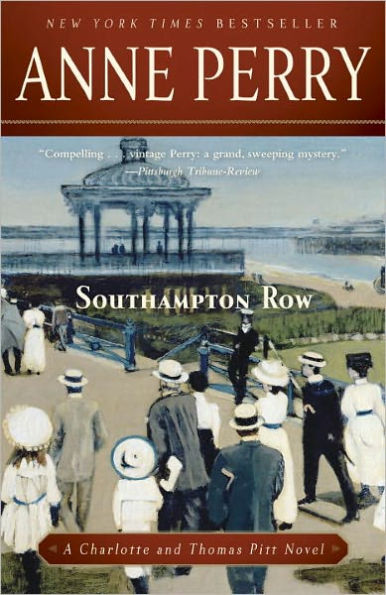
Southampton Row (Thomas and Charlotte Pitt Series #22) [NOOK Book]

NOOK Book (eBook)
$11.99
BN.com price

Available on NOOK devices and apps

  • Nook Devices
  • NOOK
  • NOOK Color
  • NOOK Tablet
  • Tablet/Phone
  • NOOK for iPad
  • NOOK for iPhone
  • NOOK for Android
  • NOOK for Android (Tablet)
  • NOOK Kids for iPad
  • PC/Mac
  • NOOK Study
  • NOOK for PC
  • NOOK for Mac

Need a NOOK? Explore Now

Overview

NEW YORK TIMES BESTSELLER

In Victorian England, a divisive election is fast approaching. Passions are so enflamed that Thomas Pitt, shrewd mainstay of the London police, has been ordered not to solve a crime but to prevent a national disaster. The aristocratic Tory candidate—and Pitt’s archenemy—is Charles Voisey. The Liberal candidate is Aubrey Serracold, whose wife’s dalliance with spiritualism threatens his chances. Indeed, she is one of the participants in a late-night séance that becomes the swan song of a stylish clairvoyant who is found brutally murdered the next morning in her house on Southampton Row. Meanwhile, Pitt’s wife, Charlotte, and...
See more details below

All Available Formats + Editions

Marketplace From
BN.com
See more formats + editions

Overview

NEW YORK TIMES BESTSELLER

In Victorian England, a divisive election is fast approaching. Passions are so enflamed that Thomas Pitt, shrewd mainstay of the London police, has been ordered not to solve a crime but to prevent a national disaster. The aristocratic Tory candidate—and Pitt’s archenemy—is Charles Voisey. The Liberal candidate is Aubrey Serracold, whose wife’s dalliance with spiritualism threatens his chances. Indeed, she is one of the participants in a late-night séance that becomes the swan song of a stylish clairvoyant who is found brutally murdered the next morning in her house on Southampton Row. Meanwhile, Pitt’s wife, Charlotte, and their children are enjoying a country vacation—unaware that they, too, are deeply endangered by the same fanatical forces hovering over the steadfast Pitt.

Editorial Reviews

From Barnes & Noble
Once again Thomas and Charlotte Pitt find themselves pitted against Charles Voissey, the ruthless manipulator who plagued them in the The Whitechapel Conspiracy. This time Voissey is running for a London Parliament seat as a Tory, opposed by Aubrey Serracold, a good-intentioned but vulnerable socialist. The savage murder of notorious clairvoyant Maude Lamont exposes Serracold to unforeseen scandal. To save the election, Pitt and Inspector Samuel Tellman must solve the crime quickly.
Publishers Weekly
HNewcomers to Perry's series about Victorian police officer Thomas Pitt might be baffled by all the backstory from 2001's The Whitechapel Conspiracy in this 22nd entry, but loyal fans should hit the ground reading. Bounced from his beloved job as superintendent at the Bow Street cop shop in the political backlash of the plot against Queen Victoria that he and his aristocratic wife, Charlotte, uncovered in that last book, Pitt not only has to work for the sneaky Victor Narraway of Special Branch but must also give up a much-deserved vacation with his family to look into the murder of a society spiritualist in London's Southampton Row. It seems that Charles Voisey, head of a secret society called the Inner Circle and the man whom the Pitts stopped from coming this close to turning England into a republic (with himself as president), is now running for Parliament as a Tory against a promising Liberal candidate, Aubrey Serracold. Voisey shouldn't stand a chance unless Serracold's wife, one of the murdered medium's clients, really did knock her off. Since Charlotte spends virtually all of the book on Dartmoor, her place in the investigation is ably filled by her sister, Emily, married to another up-and-coming Liberal. As ever, excellent craftsmanship sets this series in the front rank of historical mysteries. (Mar. 1) Forecast: A 15-city author tour, national print and radio advertising as well as a sample chapter in the mass market edition of The Whitechapel Conspiracy (Jan.) should help ensure another run up bestseller lists. Copyright 2001 Cahners Business Information.
From The Critics
In The Whitechapel Conspiracy, the previous Thomas Pitt mystery, Charles Voisey came dangerously close to overthrowing the British crown and government. Head of a secret society, the Inner Circle, Voisey is now running for Parliament, and Superintendent Pitt is again charged with stopping him. But first Pitt must investigate the murder of medium Maude Lamont, one of whose last clients was Rose Serracold, wife of Voisey's opponent. Who killed the spiritualist and why? Did Rose do it, or is someone trying to frame her? Because Pitt's aristocratic wife, Charlotte, is on holiday, his sister-in-law, Emily, wife of an MP, steps in to help. Perry's enthralling tales are equally fine as mysteries and explorations of the minutiae of Victorian culture. Michael Page reads ably with a mid-Atlantic accent, but he cannot compare with David McCallum's wonderful renditions of earlier volumes in the series. Nevertheless, highly recommended.-Michael Adams, CUNY Graduate Ctr. Copyright 2002 Cahners Business Information.

Product Details

  • ISBN-13: 9780345455024
  • Publisher: Random House Publishing Group
  • Publication date: 2/26/2002
  • Sold by: Random House
  • Format: eBook
  • Sales rank: 58,692
  • Series: Thomas and Charlotte Pitt Series, #22
  • File size: 273 KB
  • Items ship to U.S, APO/FPO and U.S. Protectorate addresses.

Meet the Author

Anne Perry
Anne Perry
Anne Perry is the bestselling author of two acclaimed mystery series set in Victorian England, as well holiday novels and historical fiction set during World War I.

Biography

Born in London in October 1938, Anne Perry was plagued with health problems as a young child. So severe were her illnesses that at age eight she was sent to the Bahamas to live with family friends in the hopes that the warmer climate would improve her health. She returned to her family as a young teenager, but sickness and frequent moves had interrupted her formal education to the extent that she was finally forced to leave school altogether. With the encouragement of her supportive parents, she was able to "fill in the gaps" with voracious reading, and her lack of formal schooling has never held her back.

Although Perry held down many jobs—working at various times as a retail clerk, stewardess, limousine dispatcher, and insurance underwriter—the only thing she ever seriously wanted to do in life was to write. (In her '20s, she started putting together the first draft of Tathea, a fantasy that would not see print until 1999.) At the suggestion of her stepfather, she began writing mysteries set in Victorian London; and in 1979, one of her manuscripts was accepted for publication. The book was The Cater Street Hangman, an ingenious crime novel that introduced a clever, extremely untidy police inspector named Thomas Pitt. In this way an intriguing mystery series was born…along with a successful writing career.

In addition to the Thomas and Charlotte Pitt novels, Perry crafts darker, more layered Victorian mysteries around the character of London police detective William Monk, whose memory has been impaired by a coach accident. (Monk debuted in 1990's The Face of a Stranger.) She also writes historical novels set during the First World War (No Graves as Yet, Shoulder the Sky, etc.) and holiday-themed mysteries (A Christmas Journey, A Christmas Secret, etc), and her short stories have been included in several anthologies.

Good To Know

Some fun and fascinating outtakes from our interview with Anne Perry:

The first time I made any money telling a story I was four and a half years old—golden hair, blue eyes, a pink smocked dress, and neat little socks and shoes. I walked home from school (it was safe then) with my lunchtime sixpence unspent. A large boy, perhaps 12 or 13, stopped me. He was carrying a stick and threatened to hit me if I didn't give him my sixpence. I told him a long, sad story about how poor we were—no food at home, not even enough money for shoes! He gave me his half crown—five times sixpence! It's appalling! I didn't think of it as lying, just escaping with my sixpence. How on earth he could have believed me I have no idea. Perhaps that is the knack of a good story—let your imagination go wild, pile on the emotions—believe it yourself, evidence to the contrary be damned. I am not really proud of that particular example!

I used to live next door to people who had a tame dove. They had rescued it when it broke its wing. The wing healed, but it never learned to fly again. I used to walk a mile or so around the village with the dove. Its little legs were only an inch or two long, so it got tired, then it would ride on my head. Naturally I talked to it. It was a very nice bird. I got some funny looks. Strangers even asked me if I knew there was a bird on my head! Who the heck did they think I was talking to? Of course I knew there was a bird on my head. I'm not stupid—just a writer, and entitled to be a little different. I'm also English, so that gives me a second excuse!

On the other hand I'm not totally scatty. I like maths, and I used to love quadratic equations. One of the most exciting things that happened to me was when someone explained non-Euclidean geometry to me, and I suddenly saw the infinite possibilities in lateral thinking! How could I have been so blind before?

Here are some things I like—and one thing I don't:

  • I love wild places, beech trees, bluebell woods, light on water—whether the light is sunlight, moonlight, or lamplight; and whether the water is ocean, rain, snow, river, mist, or even a puddle.

  • I love the setting sun in autumn over the cornstooks.

  • I love to eat raspberries, pink grapefruit, crusty bread dipped in olive oil.

  • I love gardens where you seem to walk from "room to room," with rambling roses and vines climbing into the trees and sudden vistas when you turn corners.

  • I love white swans and the wild geese flying overhead.

  • I dislike rigidity, prejudice, ill-temper, and perhaps above all, self-righteousness.

  • I love laughter, mercy, courage, hope. I think that probably makes me pretty much like most people. But that isn't bad.
      1. Also Known As:
        Juliet Hulme
      2. Hometown:
        Portmahomack, Ross-shire, U.K
      1. Date of Birth:
        October 28, 1938
      2. Place of Birth:
        Blackheath, London England

    Read an Excerpt

    CHAPTER ONE

    "I'm sorry," Assistant Commissioner Cornwallis said quietly, his face a mask of guilt and unhappiness. "I did everything I could, made every argument, moral and legal. But I can't fight the Inner Circle."

    Pitt was stunned. He stood in the middle of the office with the sunlight splashing across the floor and the noise of horses' hooves, wheels on the cobbles and the shouts of drivers barely muffled beyond the window. Pleasure boats plied up and down the Thames on the hot June day. After the Whitechapel conspiracy he had been reinstated as superintendent of the Bow Street police station. Queen Victoria herself had thanked him for his courage and loyalty. Now, Cornwallis was dismissing him again! "They can't," Pitt protested. "Her Majesty herself."

    Cornwallis's eyes did not waver, but they were filled with misery. "They can. They have more power than you or I will ever know. The Queen will hear what they want her to. If we take it to her, believe me, you will have nothing left, not even Special Branch. Narraway will be glad to have you back." The words seemed forced from him, harsh in his throat. "Take it, Pitt. For your own sake, and your family's. It is the best you'll get. And you're good at it. No one could measure what you did for your country in beating Voisey at Whitechapel."

    "Beating him!" Pitt said bitterly. He's knighted by the Queen, and the Inner Circle is still powerful enough to say who shall be superintendent of Bow Street and who shan't!"

    Cornwallis winced, the skin drawn tight across the bones of his face. "I know. But if you hadn't beaten him, England would now be a republic in turmoil, perhaps even civil war, and Voisey would be the first president. That's what he wanted. You beat him, Pitt, never doubt it . . . and never forget it, either. He won't."

    Pitt's shoulders slumped. He felt bruised and weary. How would he tell Charlotte? She would be furious for him, outraged at the unfairness of it. She would want to fight, but there was nothing to do. He knew that, he was only arguing with Cornwallis because the shock had not passed, the rage at the injustice of it. He had really believed his position at least was safe, after the Queen's acknowledgment of his worth.

    "You're due a holiday," Cornwallis said. "Take it. I'm . . . I'm sorry I had to tell you before."

    Pitt could think of nothing to say. He had not the heart to be gracious.

    "Go somewhere nice, right out of London," Cornwallis went on. "The country, or the sea."

    "Yes . . . I suppose so." It would be easier for Charlotte, for the children. She would still be hurt but at least they would have time together. It was years since they had taken more than a few days and just walked through woods or over fields, eaten picnic sandwiches and watched the sky.

    Charlotte was horrified, but after the first outburst she hid it, perhaps largely for the children's sake. Ten-and-a-half-year-old Jemima was instant to pick up any emotion, and Daniel, two years younger, was quick behind. Instead she made much of the chance for a holiday and began to plan when they should go and to think about how much they could afford to spend.

    Within days it was arranged. They would take her sister Emily's son with them as well; he was the same age and was keen to escape the formality of the schoolroom and the responsibilities he was already learning as his father's heir. Emily's first husband had been Lord Ashworth, and his death had left the title and bulk of the inheritance to their only son, Edward.

    They would stay in a cottage in the small village of Harford, on the edge of Dartmoor, for two and a half weeks. By the time they returned the general election would be over and Pitt would report again to Narraway at Special Branch, the infant service set up largely to battle the Fenian bombers and the whole bedeviled Irish question of Home Rule, which Gladstone was fighting all over again, and with as little hope of success as ever.

    "I don't know how much to take for the children," Charlotte said as if it were a question. "How dirty will they get, I wonder . . "

    They were in the bedroom doing the last of the packing before going for the midday train south and west.

    "Very, I hope," Pitt replied with a grin. "It isn't healthy for a child to be clean . . . not a boy, anyway."

    "Then you can do some of the laundry!" she replied instantly. "I'll show you how to use a flatiron. It's very easy-just heavy-and tedious."

    He was about to retaliate when their maid, Gracie, spoke from the doorway. "There's a cabbie 'ere with a message for yer, Mr. Pitt," she said. " 'E give me this." She offered him a piece of paper folded over.

    He took it and opened it up.

    Pitt, I need to see you immediately. Come with the bearer of this message. Narraway.

    "What is it?" Charlotte asked, a sharp edge to her voice as she watched his expression change. "What's happened?"

    "I don't know, he replied. "Narraway wants to see me, but it can't be much. I'm not starting back with Special Branch for another three weeks."

    Naturally she knew who Narraway was, although she had never met him. Ever since her first encounter with Pitt eleven years ago, in 1881, she had played a lively part in every one of his cases that aroused her curiosity or her outrage, or in which someone she cared about was involved. In fact, it was she who had befriended the widow of John Adinett's victim in the Whitechapel conspiracy and finally discovered the reason for his death. She had a better idea than anyone else outside Special Branch of who Narraway was.

    "Well, you'd better tell him not to keep you long,"she said angrily. "You are on holiday, and have a train to catch at noon. I wish he'd called tomorrow, when we'd have been gone!"

    "I don't suppose it's much," he said lightly. He smiled, but the smile was a trifle downturned at the corners. "There've been no bombings lately, and with an election coming at any time there probably won't be for a while."

    "Then why can it not wait until you come back?" she asked.

    "It probably can." He shrugged ruefully. "But I can't afford to disobey him." It was a hard reminder of his new situation.

    He reported directly to Narraway and he had no recourse beyond him, no public knowledge, no open court to appeal to, as he had had when a policeman. If Narraway refused him there was nowhere else to turn.

    "Yes . . ." She lowered her eyes. "I know. Just remind him about the train. There isn't a later one to get there tonight."

    "I will." He kissed her swiftly on the cheek and then turned and went out of the door and down the stairs to the pavement, where the cabbie waited for him.

    "Right, sir?" the cabbie asked from the box.

    "Yes," Pitt accepted. He glanced up at him, then climbed into the hansom and sat down as it started to move. What could Victor Narraway want from him that could not as easily wait until he reported back in three weeks? Was it just an exercise of his power, to establish again who was master? It could hardly be for his opinion; he was still a novice at Special Branch work. He knew almost nothing about the Fenians; he had no expertise in dynamite or any other explosives. He knew very little about conspiracies in quarrel, nor in honesty did he want to. He was a detective, a policeman. His skill was in solving crimes, unraveling the details and the passions of individual murder, not the machinations of spies, anarchists and political revolutionaries.

    He had succeeded brilliantly in Whitechapel, but that was over now. All that they would ever know of the truth rested in silence, darkness and bodies decently buried to hide the terrible things that had happened to them. Charles Voisey was still alive, and they could prove nothing against him. But there had been a kind of justice. He, secret hero of the movement to overthrow the throne, had been maneuvered into seeming to have risked his life to save it. Pitt smiled and felt his throat tighten with grief as he remembered standing beside Charlotte and Vespasia in Buckingham Palace as the Queen had knighted Voisey for his services to the Crown. Voisey had risen from his knees too incensed with rage to speak—which Victoria had taken for awe, and smiled indulgently. The Prince of Wales had praised him, and Voisey had turned and walked back past Pitt with a hatred in his eyes like the fires of hell. Even now Pitt felt a cold knot tighten in his stomach remembering it.

    Yes, Dartmoor would be good: great, clean, wind-driven skies, the smell of earth and grass on unpaved lanes. They would walk and talk together, or simply walk! He would fly kites with Daniel and Edward, climb some of the tors, collect things, watch the birds or animals. Charlotte and Jemima could do whatever they wished, visit people, make new friends, look at gardens, or search for wildflowers.

    The cab stopped. "Ere y'are sir," the driver called. "Go right in. Gentleman's expecting yer."

    "Thank you." Pitt climbed out and walked across the pavement to the steps leading up to a plain wooden door. It was not the shop in the back room of which he had found Narraway in Whitechapel. Perhaps he moved around as the need directed? Pitt opened the door without knocking and went in. He found himself in a passage which led to a pleasant sitting room with windows onto a tiny garden, which was mostly crowded with overgrown roses badly in need of pruning.

    Victor Narraway was sitting in one of the two armchairs, and he looked up at Pitt without rising. He was a slender man, very neatly dressed, of average height, but nevertheless his appearance was striking because of the intelligence in his face. Even in repose there was an energy within him as if his mind never rested. He had thick, dark hair, now liberally sprinkled with gray, hooded eyes which were almost black, and a long, straight nose.

    "Sit down, he ordered as Pitt remained on his feet. "I have no intention of staring up at you. And you will grow tired in time and start to fidget, which will annoy me."

    Pitt put his hands in his pockets. "I haven't long. I'm going to Dartmoor on the noon train."

    Narraway's heavy eyebrows rose. "With your family?"

    "Yes, of course."

    "I'm sorry."

    "There is nothing to be sorry about," Pitt replied. "I shall enjoy it very much. And after Whitechapel I have earned it."

    "You have," Narraway agreed quietly. "Nevertheless you are not going."

    "Yes I am." They had known each other only a few months, worked very loosely together on just the one case. It was not like Pitt's long relationship with Cornwallis, whom he liked profoundly and would have trusted more than any other man he could think of. He was still unsure what he felt about Narraway, and certainly he did not trust him, in spite of his conduct in Whitechapel. He believed Narraway served the country and was a man of honor according to his own code of ethics, but Pitt did not yet understand what they were, and there was no bond of friendship between them.

    Narraway sighed. "Please sit down, Pitt. I expect you to make this morally uncomfortable for me, but be civil enough not to make it physically so as well. I dislike craning my neck to stare up at you."

    "I am going to Dartmoor today," Pitt repeated, but he did sit down in the other chair.

    "This is the eighteenth of June. Parliament will rise on the twenty-eighth," Narraway said wearily, as if the knowledge was sad and indescribably exhausting. "There will be a general election immediately. I daresay we shall have the first results by the fourth or fifth of July."

    From the Hardcover edition.

    Table of Contents

    Customer Reviews
    Average Rating 4
    ( 11 )

    Rating Distribution

    • ( 6 )
    • ( 2 )
    • ( 2 )
    • ( 1 )
    • ( 0 )
    If you've bought this product, tell the world how you liked it.
    Write a Review
    Sort by: Showing 1 – 12 of 11 Customer Reviews
    • Anonymous

      Posted April 9, 2007

      History with reality

      Love this series and the Pitts series. Hven't tried WWI. Recomend to anyone who loves Lord Peter Wimsey and Albert Campion.

      Was this review helpful? Yes  No   Report this review
    • Anonymous

      Posted April 25, 2004

      The richness of Perry eh?

      Who says history can't be fun? Perry is brilliant in exposing the pros and cons of the 1890 political views and their ramifications. The analogies to today's controversies are astounding. Britain's vast empire serves to provide huge markets for its working class while demanding an armed forces to preserve it. Working conditions are appalling but as awful as they are, perhaps they are better than no work at all. What should be the role of women? How does the Church figure into the daily lives of its members and how do the clergy deal with Darwinism and their own personal beliefs? Mixed into the fabric of the history is a fabulous whodunit with all kinds of typical twists and turns of which Perry is notoriously famous. Her themes of family loyalty versus betrayal in order to preserve moral and ethical rightness, flourish again. Just when you think you've read her best book (White Chapel Conspiracy) she outdoes herself. I believe this was her best Pitt book so far. Although I recommend starting with book 1 and not stopping until you get to 23!

      Was this review helpful? Yes  No   Report this review
    • Anonymous

      Posted May 22, 2002

      Brilliant!

      Anne Perry allows her readers to feel as though they were there with the characters themselves. The most Brilliant of her talents is that she 'teaches' her audience real history and makes a pure enjoyment from indulging in it.

      Was this review helpful? Yes  No   Report this review
    • Anonymous

      Posted April 17, 2002

      'Pitt's Pit'

      'Southampton Row', English author Anne Perry's latest novel in the Inspector Pitt series places the intrepid Inspector in a setting that leaves the reader intrigued and troubled. It is Pitt's success in 'The Whitechapel Conspiracy' that now threatens him and his family. Charles Voisey, the Inspector's Whitechapel nemesis reappears to haunt Pitt again. Thanks to the machinations of the Inner Circle, Pitt loses his position at the Bow Street Station and is sent to work at the Special Branch Office, a division within the Police Force set up to investigate terrorist activities. The terrorist in Pitt's life turns out to be Voisey who, as part of his continuing effort to republicanize English politics, campaigns for Parliament. Pitt is assigned to shadow Voisey and determine his weaknesses. The campaign and Voisey's connection to the murder of a spiritual medium in Southampton Row threaten Pitt professionally and personally. The new setting involves more than just the detection of a murderer, it involves the mind games played in the web of deception woven by the Inner Circle and all those forced to deal with it. In 'Southampton Row', Inspector Pitt is compelled to think and act like those he despises most, the members of the super-secret Inner Circle. In the process, Pitt develops more than his usual sincere search for truth and justice, he demonstrates a newfound ability to think like Voisey. This leaves the reader wondering if the good Inspector is now walking the same path as Voisey and descending into a pit of deception. Has he, through his work, become contaminated with the characteristics of those he despises most? What price truth? Honor? The safety of loved ones? Will Thomas compromise his principals to protect Charlotte and their children? The novel forces the reader to grapple with these same questions of conscience. 'Southampton Row' is Perry's most compelling novel to date. It is a must-read for fans of Thomas and Charlotte Pitt. Best of all, this reader sees several potential story lines for future books in this series.

      Was this review helpful? Yes  No   Report this review
    • Posted December 9, 2008

      more from this reviewer

      Great Victorian mystery

      In late nineteenth England, it is not the monarchy or parliament who rules the country but a clandestine organization known to only a few as the Inner Circle. Thomas Pitt, a Metropolitan Street policeman, once tangled with a member of that group and for his effort was fired from his position as the superintendent of the Bow Street Station. When he was able to neutralize his enemy Queen Victoria reinstated him.

      Unfortunately, his enemy was able to hold on to his power and thus pulled strings to force the transfer of Pitt from Bow Street to Special Branch, an organization involved in guarding England¿s from her enemies. Pitt is assigned the task of neutralizing his old enemy who is running for a seat in the House of Commons. The former superintendent knows that if he wants to keep his wife and children safe, he must succeed in his assignment and do it before his enemy has a more powerful base than he already has.

      Anne Perry, the leading writer of Victorian mysteries, has published her best work to date in SOUTHAMPTON ROW. It is as much a political thriller as it is a Victorian historical mystery. The details of the era are so detailed and colorful, that it feels as if the author actually lived in that period. The mystery is complex and creative but the most fascinating part of the book is the political picture Perry paints for her audience that turn a potent tale into a masterpiece.

      Harriet Klausner

      Was this review helpful? Yes  No   Report this review
    • Anonymous

      Posted July 4, 2011

      No text was provided for this review.

    • Anonymous

      Posted February 11, 2012

      No text was provided for this review.

    • Anonymous

      Posted April 27, 2011

      No text was provided for this review.

    • Anonymous

      Posted July 3, 2011

      No text was provided for this review.

    • Anonymous

      Posted May 14, 2011

      No text was provided for this review.

    • Anonymous

      Posted January 1, 2011

      No text was provided for this review.

    • Anonymous

      Posted January 28, 2010

      No text was provided for this review.

    Sort by: Showing 1 – 12 of 11 Customer Reviews

    If you find inappropriate content, please report it to Barnes & Noble
    Why is this product inappropriate?
    Comments (optional)
    500 character limit