- Shopping Bag ( 0 items )
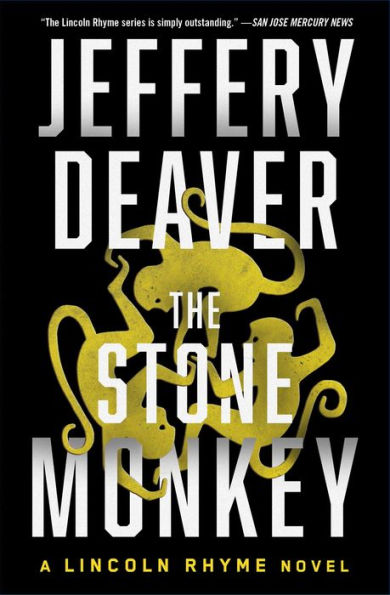
Forensics expert Lincoln Rhyme and his protégée Amelia Sachs have been recruited by the FBI to capture “the Ghost,” a homicidal immigrant smuggler. But when they corner him aboard a cargo ship, the bust goes disastrously wrong and the Ghost escapes. Now, the killer must eliminate the only witnesses—two families who jumped ship and vanished into New York City’s Chinatown. Against a ruthless adversary, Rhyme and Sachs race to find the families before the Ghost can silence them. . . .
The Stone Monkey begins with a mass murder at sea, as the Chinese freighter Fuzhou Dragon sails toward New York, carrying a clandestine cargo of illegal immigrants. When a Coast Guard vessel intercepts the ship just miles off the U.S. mainland, the leader of the immigrants -- a vicious, elusive "human smuggler" known as Ghost -- blows up the ship and escapes on a lifeboat, leaving his charges to die. Against all odds, several of the immigrants survive, make their way to shore, and go to ground in the self-contained society of New York's Chinatown.
Ghost -- who has never been photographed or fingerprinted, and who is determined to eliminate all potential witnesses -- begins the process of tracking the survivors down. At the same time, Lincoln Rhyme, acting on behalf of the FBI, the NYPD, and the INS, leads a desperate, round-the-clock effort to locate the survivors before Ghost does. The two hunters rely on radically different methods. Ghost makes use of Chinatown's violent criminal subculture and employs information gleaned from corrupt government officials. Rhyme, of course, utilizes his forensic expertise, teasing viable clues out of minute traces of physical evidence. The ensuing duel between two equally obsessed opponents dominates this compelling, beautifully detailed narrative.
All of Deaver's traditional virtues -- his endlessly resourceful plotting, his empathetic rendering of a quadriplegic's existence, his authoritative grasp of arcane forensic procedures -- are on full display here. This time out, however, Deaver adds something new to the mix: a convincing portrait of the uneasy relationship between two wildly divergent cultures. A shrewdly constructed blend of the exotic and the familiar, The Stone Monkey offers intelligence, excitement, and visceral thrills -- and reveals a gifted, increasingly ambitious storyteller working at the top of his game. (Bill Sheehan)
They were the vanished, they were the unfortunate.
To the human smugglers -- the snakeheads -- who carted them around the world like pallets of damaged goods, they were ju-jia, piglets.
To the American INS agents who interdicted their ships and arrested and deported them they were undocumenteds.
They were the hopeful. Who were trading homes and family and a thousand years of ancestry for the hard certainty of risky, laborious years ahead of them.
Who had the slimmest of chances to take root in a place where their families could prosper, where freedom and money and contentment were, the story went, as common as sunlight and rain.
They were his fragile cargo.
And now, legs steady against the raging, five-meter-high seas, Captain Sen Zi-jun made his way from the bridge down two decks into the murky hold to deliver the grim message that their weeks of difficult journeying might have been in vain.
It was just before dawn on a Tuesday in August. The stocky captain, whose head was shaved and who sported an elaborate bushy mustache, slipped past the empty containers lashed to the deck of the seventy-two-meter Fuzhou Dragon as camouflage and opened the heavy steel door to the hold. He looked down at the two-dozen people huddled there, in the grim, windowless space. Trash and children's plastic blocks floated in the shallow tide under the cheap cots.
Despite the pitching waves, Captain Sen -- a thirty-year veteran of the seas -- walked down the steep metal steps without using the handrails and strode into the middle of the hold. He checked the carbon dioxide meter and found the levels acceptable though the air was vile with the smell of diesel fuel and humans who'd lived for two weeks in close proximity.
Unlike many of the captains and crew who operated "buckets" -- human smuggling ships -- and who at best ignored or sometimes even beat or raped the passengers, Sen didn't mistreat them. Indeed he believed that he was doing a good thing: transporting these families from difficulty to, if not certain wealth, at least the hope of a happy life in America, Meiguo in Chinese, which means the "Beautiful Country."
On this particular voyage, however, most of the immigrants distrusted him. And why not? They assumed he was in league with the snakehead who'd chartered the Dragon: Kwan Ang, known universally by his nickname, Gui, the Ghost. Tainted by the snakehead's reputation for violence, Captain Sen's efforts to engage the immigrants in conversation had been rebuffed and had yielded only one friend. Chang Jingerzi -- who preferred his Western name of Sam Chang -- was a forty-five-year-old former college professor from a suburb of the huge port city of Fuzhou in southeastern China. He was bringing his entire family to America: his wife, two sons and Chang's widower father.
A half-dozen times on the trip Chang and Sen had sat in the hold, sipped the potent mao-tai that the captain always had in good supply on his ship and talked about life in China and in the United States.
Captain Sen now saw Chang sitting on a cot in a forward corner of the hold. The tall, placid man frowned, a reaction to the look in the captain's eyes. Chang handed his teenage son the book he'd been reading to his family and rose to meet the captain.
Everyone around them fell silent.
"Our radar shows a fast-moving ship on course to intercept us."
Dismay blossomed in the faces of those who'd overheard.
"The Americans?" Chang asked. "Their Coast Guard?"
"I think it must be," the captain answered. "We're in U.S. waters."
Sen looked at the frightened faces of the immigrants around him. Like most shiploads of illegals that Sen had transported, these people -- many of them strangers before they'd met -- had formed a close bond of friendship. And they now gripped hands or whispered among themselves, some seeking, some offering reassurance. The captain's eyes settled on a woman holding an eighteen-month-old girl in her arms. Her mother -- whose face was scarred from a beating at a reeducation camp -- lowered her head and began to cry.
"What can we do?" Chang asked, troubled.
Captain Sen knew he was a vocal dissident in China and had been desperate to flee the country. If he was deported by U.S. Immigration he'd probably end up in one of the infamous jails in western China as a political prisoner.
"We're not far from the drop-off spot. We're running at full speed. It may be possible to get close enough to put you ashore in rafts."
"No, no," Chang said. "In these waves? We'd all die."
"There's a natural harbor I'm steering for. It should be calm enough for you to board the rafts. At the beach there'll be trucks to take you to New York."
"And what about you?" Chang asked.
"I'll head back into the storm. By the time it's safe for them to board you'll be on highways of gold, heading toward the city of diamonds....Now tell everyone to get their belongings together. But only the most important things. Your money, your pictures. Leave everything else. It will be a race to the shore. Stay below until the Ghost or I tell you to come up top."
Captain Sen hurried up the steep ladder, on his way to the bridge. As he climbed he said a brief prayer for their survival to Tian Hou, the goddess of sailors, then dodged a wall of gray water that vaulted the side of the ship.
On the bridge he found the Ghost standing over the radar unit, staring into the rubber glare shade. The man stood completely still, bracing himself against the rolling of the sea.
Some snakeheads dressed as if they were wealthy Cantonese gangsters from a John Woo film but the Ghost always wore the standard outfit of most Chinese men -- simple slacks and short-sleeved shirts. He was muscular but diminutive, clean-shaven, hair longer than a typical businessman's but never styled with cream or spray.
"They will intercept us in fifteen minutes," the snakehead said. Even now, facing interdiction and arrest, he seemed as lethargic as a ticket seller in a rural long-distance bus station.
"Fifteen?" the captain replied. "Impossible. How many knots are they making?"
Sen walked to the chart table, the centerpiece of all ocean-crossing vessels. On it sat a U.S. Defense Mapping Agency nautical chart of the area. He had to judge the two ships' relative positions from this and from the radar; because of the risk of being traced, the Dragon's global positioning system and her EPIRB emergency beacon and Global Maritime Distress and Safety System were disconnected.
"I think it will be at least forty minutes," the captain said.
"No, I timed the distance they've traveled since we spotted them."
Captain Sen glanced at the crewman piloting the Fuzhou Dragon, sweating as he gripped the wheel in his struggle to keep the Turk's head knot of twine, tied around a spoke, straight up, indicating that the rudder was aligned with the hull. The throttles were full forward. If the Ghost was right in his assessment of when the cutter would intercept them they would not be able to make the protected harbor in time. At best they could get within a half mile of the nearby rocky shore -- close enough to launch the rafts but subjecting them to merciless pounding by the tempestuous seas.
The Ghost asked the captain, "What sort of weapons will they have?"
"Don't you know?"
"I've never been interdicted," the Ghost replied. "Tell me."
Ships under Sen's command had been stopped and boarded twice before -- fortunately on legitimate voyages, not when he was running immigrants for snakeheads. But the experience had been harrowing. A dozen armed Coast Guard sailors had streamed onto the vessel while another one, on the deck of the cutter, had trained a two-barreled machine gun on him and his crew. There'd been a small cannon too.
He now told the Ghost what they might expect.
The Ghost nodded. "We need to consider our options."
"What options?" Captain Sen now asked. "You're not thinking of fighting them, are you? No. I won't allow it."
But the snakehead didn't answer. He remained braced at the radar stand, staring at the screen.
The man seemed placid but, Sen supposed, he must've been enraged. No snakehead he'd ever worked with had taken so many precautions to avoid capture and detection as the Ghost on this voyage. The two-dozen immigrants had met in an abandoned warehouse outside of Fuzhou and waited there for two days, under the watch of a partner of the Ghost's -- a "little snakehead." The man had then loaded the Chinese onto a chartered Tupolev 154, which had flown to a deserted military airfield near St. Petersburg in Russia. There they'd climbed into a shipping container, been driven 120 kilometers to the town of Vyborg and boarded the Fuzhou Dragon, which Sen had sailed into the Russian port just the day before. He himself had meticulously filled out the customs documents and manifests -- everything according to the book, so as not to arouse suspicion. The Ghost had joined them at the last minute and the ship had sailed on schedule. Through the Baltic Sea, the North Sea, the English Channel, then the Dragon had crossed the famous starting point of transatlantic voyages in the Celtic Sea -- 490N 70W -- and had begun steaming southwest toward Long Island, New York.
There was not a single thing about the voyage that would arouse the suspicion of the U.S. authorities. "How did the Coast Guard do it?" the captain asked.
"What?" the Ghost responded absently.
"Find us. No one could have. It's impossible."
The Ghost straightened up and pushed outside into the raging wind, calling back, "Who knows? Maybe it was magic."
Copyright © 2002 by Jeffery Deaver
Chapter One
They were the vanished, they were the unfortunate.
To the human smugglers -- the snakeheads -- who carted them around the world like pallets of damaged goods, they were ju-jia, piglets.
To the American INS agents who interdicted their ships and arrested and deported them they were undocumenteds.
They were the hopeful. Who were trading homes and family and a thousand years of ancestry for the hard certainty of risky, laborious years ahead of them.
Who had the slimmest of chances to take root in a place where their families could prosper, where freedom and money and contentment were, the story went, as common as sunlight and rain.
They were his fragile cargo.
And now, legs steady against the raging, five-meter-high seas, Captain Sen Zi-jun made his way from the bridge down two decks into the murky hold to deliver the grim message that their weeks of difficult journeying might have been in vain.
It was just before dawn on a Tuesday in August. The stocky captain, whose head was shaved and who sported an elaborate bushy mustache, slipped past the empty containers lashed to the deck of the seventy-two-meter Fuzhou Dragon as camouflage and opened the heavy steel door to the hold. He looked down at the two-dozen people huddled there, in the grim, windowless space. Trash and children's plastic blocks floated in the shallow tide under the cheap cots.
Despite the pitching waves, Captain Sen -- a thirty-year veteran of the seas -- walked down the steep metal steps without using the handrails and strode into the middle of the hold. He checked the carbon dioxide meter and found the levels acceptable though the air was vile with the smell of diesel fuel and humans who'd lived for two weeks in close proximity.
Unlike many of the captains and crew who operated "buckets" -- human smuggling ships -- and who at best ignored or sometimes even beat or raped the passengers, Sen didn't mistreat them. Indeed he believed that he was doing a good thing: transporting these families from difficulty to, if not certain wealth, at least the hope of a happy life in America, Meiguo in Chinese, which means the "Beautiful Country."
On this particular voyage, however, most of the immigrants distrusted him. And why not? They assumed he was in league with the snakehead who'd chartered the Dragon: Kwan Ang, known universally by his nickname, Gui, the Ghost. Tainted by the snakehead's reputation for violence, Captain Sen's efforts to engage the immigrants in conversation had been rebuffed and had yielded only one friend. Chang Jingerzi -- who preferred his Western name of Sam Chang -- was a forty-five-year-old former college professor from a suburb of the huge port city of Fuzhou in southeastern China. He was bringing his entire family to America: his wife, two sons and Chang's widower father.
A half-dozen times on the trip Chang and Sen had sat in the hold, sipped the potent mao-tai that the captain always had in good supply on his ship and talked about life in China and in the United States.
Captain Sen now saw Chang sitting on a cot in a forward corner of the hold. The tall, placid man frowned, a reaction to the look in the captain's eyes. Chang handed his teenage son the book he'd been reading to his family and rose to meet the captain.
Everyone around them fell silent.
"Our radar shows a fast-moving ship on course to intercept us."
Dismay blossomed in the faces of those who'd overheard.
"The Americans?" Chang asked. "Their Coast Guard?"
"I think it must be," the captain answered. "We're in U.S. waters."
Sen looked at the frightened faces of the immigrants around him. Like most shiploads of illegals that Sen had transported, these people -- many of them strangers before they'd met -- had formed a close bond of friendship. And they now gripped hands or whispered among themselves, some seeking, some offering reassurance. The captain's eyes settled on a woman holding an eighteen-month-old girl in her arms. Her mother -- whose face was scarred from a beating at a reeducation camp -- lowered her head and began to cry.
"What can we do?" Chang asked, troubled.
Captain Sen knew he was a vocal dissident in China and had been desperate to flee the country. If he was deported by U.S. Immigration he'd probably end up in one of the infamous jails in western China as a political prisoner.
"We're not far from the drop-off spot. We're running at full speed. It may be possible to get close enough to put you ashore in rafts."
"No, no," Chang said. "In these waves? We'd all die."
"There's a natural harbor I'm steering for. It should be calm enough for you to board the rafts. At the beach there'll be trucks to take you to New York."
"And what about you?" Chang asked.
"I'll head back into the storm. By the time it's safe for them to board you'll be on highways of gold, heading toward the city of diamonds....Now tell everyone to get their belongings together. But only the most important things. Your money, your pictures. Leave everything else. It will be a race to the shore. Stay below until the Ghost or I tell you to come up top."
Captain Sen hurried up the steep ladder, on his way to the bridge. As he climbed he said a brief prayer for their survival to Tian Hou, the goddess of sailors, then dodged a wall of gray water that vaulted the side of the ship.
On the bridge he found the Ghost standing over the radar unit, staring into the rubber glare shade. The man stood completely still, bracing himself against the rolling of the sea.
Some snakeheads dressed as if they were wealthy Cantonese gangsters from a John Woo film but the Ghost always wore the standard outfit of most Chinese men -- simple slacks and short-sleeved shirts. He was muscular but diminutive, clean-shaven, hair longer than a typical businessman's but never styled with cream or spray.
"They will intercept us in fifteen minutes," the snakehead said. Even now, facing interdiction and arrest, he seemed as lethargic as a ticket seller in a rural long-distance bus station.
"Fifteen?" the captain replied. "Impossible. How many knots are they making?"
Sen walked to the chart table, the centerpiece of all ocean-crossing vessels. On it sat a U.S. Defense Mapping Agency nautical chart of the area. He had to judge the two ships' relative positions from this and from the radar; because of the risk of being traced, the Dragon's global positioning system and her EPIRB emergency beacon and Global Maritime Distress and Safety System were disconnected.
"I think it will be at least forty minutes," the captain said.
"No, I timed the distance they've traveled since we spotted them."
Captain Sen glanced at the crewman piloting the Fuzhou Dragon, sweating as he gripped the wheel in his struggle to keep the Turk's head knot of twine, tied around a spoke, straight up, indicating that the rudder was aligned with the hull. The throttles were full forward. If the Ghost was right in his assessment of when the cutter would intercept them they would not be able to make the protected harbor in time. At best they could get within a half mile of the nearby rocky shore -- close enough to launch the rafts but subjecting them to merciless pounding by the tempestuous seas.
The Ghost asked the captain, "What sort of weapons will they have?"
"Don't you know?"
"I've never been interdicted," the Ghost replied. "Tell me."
Ships under Sen's command had been stopped and boarded twice before -- fortunately on legitimate voyages, not when he was running immigrants for snakeheads. But the experience had been harrowing. A dozen armed Coast Guard sailors had streamed onto the vessel while another one, on the deck of the cutter, had trained a two-barreled machine gun on him and his crew. There'd been a small cannon too.
He now told the Ghost what they might expect.
The Ghost nodded. "We need to consider our options."
"What options?" Captain Sen now asked. "You're not thinking of fighting them, are you? No. I won't allow it."
But the snakehead didn't answer. He remained braced at the radar stand, staring at the screen.
The man seemed placid but, Sen supposed, he must've been enraged. No snakehead he'd ever worked with had taken so many precautions to avoid capture and detection as the Ghost on this voyage. The two-dozen immigrants had met in an abandoned warehouse outside of Fuzhou and waited there for two days, under the watch of a partner of the Ghost's -- a "little snakehead." The man had then loaded the Chinese onto a chartered Tupolev 154, which had flown to a deserted military airfield near St. Petersburg in Russia. There they'd climbed into a shipping container, been driven 120 kilometers to the town of Vyborg and boarded the Fuzhou Dragon, which Sen had sailed into the Russian port just the day before. He himself had meticulously filled out the customs documents and manifests -- everything according to the book, so as not to arouse suspicion. The Ghost had joined them at the last minute and the ship had sailed on schedule. Through the Baltic Sea, the North Sea, the English Channel, then the Dragon had crossed the famous starting point of transatlantic voyages in the Celtic Sea -- 490N 70W -- and had begun steaming southwest toward Long Island, New York.
There was not a single thing about the voyage that would arouse the suspicion of the U.S. authorities. "How did the Coast Guard do it?" the captain asked.
"What?" the Ghost responded absently.
"Find us. No one could have. It's impossible."
The Ghost straightened up and pushed outside into the raging wind, calling back, "Who knows? Maybe it was magic."
Copyright © 2002 by Jeffery Deaver
Well known for his bone-chilling psychological thrillers, Jeffery Deaver brings the two cunning detectives back in the fourth entry in the notorious Lincoln Rhyme series. Although he makes a decent attempt to hook his readers into the story, he yet again fails to deliver.
Returning to thier familiar hometown of the Big Apple are on pursuit of the "Ghost", a ruthless Chinese immigrant smuggler. The book opens with Rhyme and Sachs pursuint the snakehead's (smuggler's) boat of illegal Chinese immigrants. When their attempt to catch him turns into a fiasco, the two begin to realize that it's only a matter of time before he decides to kill the surviving families. Over the next 48 hours, the two detectives, along with the help of a Chinese beat, hunt for the foreign smuggler.
I have to admit that THE STONE MONKEY is another letdown by Deaver, though not as quite as his previous Rhyme novel THE EMPTY CHAIR. What I liked most about this book was the beginning pursuit of the Ghost. But from thereon in, the plot began to fall apart.
Fans are normally use to how Deaver cleverly draws his characters into his novels. From chapter to chapter, it seemed to me that the author went bananas when writing this book, failing to deliver this strenth of his into the book. Another thing I noticed while reading was that Rhyme was barely present throughout the scenes in the book. I felt that I did not feel that cunning, forensic intuition that I use to in the earlier Rhyme novels. As I was reading page after page of the investigation, I kept asking myself "Where did Rhyme go?"
What disappointed me the most while reading THE STONE MONKEY was Deaver's failing attempt to know who the Ghost was. I was aware that he was a killer, indeed, but yet I didn't become aware of either his troubled past nor any of the losses that he has taken during then that have motivated him to commit the acts that he has.
Sad to say, Deaver has yet agian disappointed his fans by failing to deliver the strengths that make his novels enjoyable.
1 out of 1 people found this review helpful.
Was this review helpful? Yes NoThank you for your feedback. Report this reviewThank you, this review has been flagged.auntrosie
Posted October 8, 2011
Jeffery Deaver knows how to keep your interest. I've read almost all the Lincoln Rhyme Series plus other independent novels. I don't like to give away plots, I prefer to let the reader discover this man's amazing ability to keep you spell-bound from start to finish. Illegal Chinese immigrants are being smuggled into the US by a homicidal smuggler. When two families jump ship, he must find them and murder them because they're witness to his devious wrongdoings. He needs to find and eliminate them. Forensics expert Lincoln Rhyme must find the families before the "Ghost" can silence them. A real page-turner!
Was this review helpful? Yes NoThank you for your feedback. Report this reviewThank you, this review has been flagged.Jeffery Deaver has, once again, created a gripping and engrossing tale featuring his hero/heroin team of Lincoln Rhyme and Amelia Sachs. The Stone Monkey, the fourth in the series, finds the master criminalist/crime scene investigator duo diving head first into a seemingly impossible task; working with FBI and Immigration authorities to locate a Chinese freighter out on the ocean, with a cargo of undocumented immigrants, and the human trafficker who is bringing them across. The trafficker, or "Sneakhead", goes by the name Gui, Ghost, and has earned his reputation as both deadly and cunning.
Finding a ship in the midst of a raging ocean with nothing but forensic evidence is difficult, but when the ship sinks before the Coast Guard can arrive, the priorities change from arrest and evidence collection to rescuing the victims while trying to preserve the crime scene; and then to keeping the Ghost from murdering any more of his charges.
Woven into the fabric of the story is a reasonably deep look into the Chinese immigrant community, some cultural tradition, and the inevitable conflict of generational differences. These add a fresh color and intrigue to the telling, and all parties have to broaden their horizons to understand both the predator and the prey.
Adding to the mix of usual characters are the personal demons that Amelia and Lincoln wrestle with. Rhyme is still planning to undergo an experimental surgery that he knows won't reverse his quadriplegic condition, but might give him just a little more feeling and movement; that is, if it doesn't take all he has left. Amelia is as supportive as she can be while worrying about losing her love in the attempt. And, she desperately wants for them to have a child.
I very much enjoy the closeness, respect, and understanding that these two have developed over the course of the series. They operate with unstated anticipation of the other's next question or instruction, knowing just what the other is thinking. The relationships with the supporting characters are, likewise, growing and deepening. When outsiders enter the fine meshing machinery it takes a while for them to become part of the big picture, just as it would be in any team that's worked so closely for so long.
I do wish that Deaver had done just a little more research into the operations and procedures used by US Immigrations, which he erroneously calls INS throughout the book. The publication date is 2003, right on the cusp of the reorganization of the various agencies, but by that date, the enforcement arm of INS had been renamed the Bureau of Immigration and Customs Enforcement, ICE for short. He also stumbles over minor operational errors that few on the outside are aware of (I've worked for ICE as a Detention Officer since 2004), but that could have been discovered without too much trouble.
Those small issues aside, The Stone Monkey is superbly written and the plot twists are familiar and welcome to any fan of Deaver's previous works. He kept my interest throughout the story and kept me guessing all the way to the end.
Another one of Deaver's Lincon Rhymes novels that maintains the suspense throughout the entire book. A good presentation of the intricacies of illegal immigration and the criminals who take advantage of those in need.
Was this review helpful? Yes NoThank you for your feedback. Report this reviewThank you, this review has been flagged.Anonymous
Posted June 22, 2006
this boook is awesome!!!the story sucks you in and makes you a part of the scene. great boook i recccommmend to all
Was this review helpful? Yes NoThank you for your feedback. Report this reviewThank you, this review has been flagged.Anonymous
Posted November 25, 2004
Jeffery Deaver keeps you on the edge of your seat during this book. I've read it twice, and both times I was in total suspense through the whole thing. It's a wonderful book by an author who knows how to keep you guessing.
Was this review helpful? Yes NoThank you for your feedback. Report this reviewThank you, this review has been flagged.Anonymous
Posted October 2, 2004
i REALLY GOT INTO THIS BOOK. i HAVE AN INTEREST IN CHINA AND THIS BOOK JUST SUCKED ME IN AND i COULD HARDLY PUT IT DOWN. I highly recommen this book and most of what I have read by Mr. Deaver
Was this review helpful? Yes NoThank you for your feedback. Report this reviewThank you, this review has been flagged.Anonymous
Posted May 29, 2003
Read this book while flying to London and back from New York. Easily put it down. Book is better than the movie on the flight, but only because the movie wasn't in English. The book is OK, but outcomes were predicitable and the answers came to Lincoln too easily. Seems like he had access to every bit of information in the world. He did not have to work hard enough to get the answers.
Was this review helpful? Yes NoThank you for your feedback. Report this reviewThank you, this review has been flagged.Anonymous
Posted June 1, 2003
Just when you think you have things figured out, there is another curve and you are literally hanging on until the final pages reveal...you find out! rich characters, in-depth storyline.
Was this review helpful? Yes NoThank you for your feedback. Report this reviewThank you, this review has been flagged.Anonymous
Posted February 17, 2003
In a few words, too busy. This author did a much better job with The Bone Collector by creating realism and genuine suspense. The story also missed a great opportunity to develop more culture insight.
Was this review helpful? Yes NoThank you for your feedback. Report this reviewThank you, this review has been flagged.Anonymous
Posted April 23, 2003
I really was able to get lost in STONE MONKEY. This is a must read, Deaver at his best! He will need to work extra hard to top this one.
Was this review helpful? Yes NoThank you for your feedback. Report this reviewThank you, this review has been flagged.Anonymous
Posted March 19, 2003
I read every Rhyme book I can get. Each one is better than the last, but he will really have to excel to top this one. The combination of forensics and culture clash is outstanding. It would be really great if he could back up and write some books about Sonny Li before he comes to America or develop a similar character who lives and maybe has his own series.
Was this review helpful? Yes NoThank you for your feedback. Report this reviewThank you, this review has been flagged.Anonymous
Posted March 3, 2003
The weather in San Francisco was beautiful this weekend. I stayed in to finish this book. Great series.
Was this review helpful? Yes NoThank you for your feedback. Report this reviewThank you, this review has been flagged.Anonymous
Posted December 7, 2002
Another great book by Jeffery>>>>I have read nearly everyone of Jeffery's books>>>>he turned my life around with the Blue Nowhere>>>and the Stone Monkey is a must read, I am in the middle of reading it now, and it is wonderfully distracting....
0 out of 1 people found this review helpful.
Was this review helpful? Yes NoThank you for your feedback. Report this reviewThank you, this review has been flagged.Anonymous
Posted October 31, 2002
This book had so many twists are turns and the forensic detail was awesome. The book leaves you holding on until the last page. If you haven't read any of Deaver's books yet you are missing out on a lot. This will blow you away.
Was this review helpful? Yes NoThank you for your feedback. Report this reviewThank you, this review has been flagged.Anonymous
Posted August 5, 2002
Despite the cover, this novel isn't all about Lincoln Rhyme, but rather -- and refreshingly -- we see his protegee, Amelia Sachs featured. Her past relationship with her father, her present mind set and her possible future with Rhyme are put forth in a whole new light. The reader discovers who Sachs is, what she wants and how her health may demand compromise. That said, inventing a believable super sleuth with Lincoln Rhymes' physical limitations was no small endeavor. Keeping him in the good graces of his fans given his fits of temper and at times grumpy nature is even harder. We do however forgive and understand Rhymes' psychological scarring and focus instead on his strengths; his mind and the considerable body of forensic knowledge stored there. For all of this Mr. Deaver has earned our respect as a skillful craftsman. Also notably developed in this offering is the character of Sonny Li, an engaging Chinese detective whose street smarts and dogged use of shoe leather trump technology on more than one occasion. He jumps from the page, real and likable, many times dominating a scene. Others have outlined the plot, so I'll offer this in closing: For those interested in exploring other cultures, Stone Monkey offers some interesting facts and insightful asides that run the gamut from downright tragic to most amusing. Mr. Deaver's story of 'the Ghost' is compelling, complex and well worth any mystery buff's time ¿ and admiration. A great read.
Was this review helpful? Yes NoThank you for your feedback. Report this reviewThank you, this review has been flagged.Anonymous
Posted May 25, 2002
This is one of his best. I just couldn't put it down. I felt as though I was right there with Sachs as she was walking the grid. It certainly holds you in suspense. I can't wait for his next book.
Was this review helpful? Yes NoThank you for your feedback. Report this reviewThank you, this review has been flagged.Anonymous
Posted May 11, 2002
Like all the other Lincoln Rhyme novels, this one is filled with highly compelling forensic information and lots of thrills and suspense. If you haven't picked it up, I recommend you do so now. This is one of the best thriller novels of the year, thus far. My congratulations to Mr. Deaver for a job well done.
Was this review helpful? Yes NoThank you for your feedback. Report this reviewThank you, this review has been flagged.Anonymous
Posted April 1, 2002
In response to the query about the order of Deaver's Ryme series. Go to bookbrowser.com where you will find lots of mysteries listed in story order.
Was this review helpful? Yes NoThank you for your feedback. Report this reviewThank you, this review has been flagged.Anonymous
Posted March 25, 2002
This is only my second Deaver book, 'The Blue Nowhere' was my first. I can't wait to read the rest of his Lincoln Ryme series. He keeps you guessing until the very end. I love his style.
Was this review helpful? Yes NoThank you for your feedback. Report this reviewThank you, this review has been flagged.
Overview
A heart-pounding case from one of crime fiction’s most acclaimed series proves once again “there is no thriller writer today like Jeffery Deaver” (San Jose Mercury News).
Forensics expert Lincoln Rhyme and his protégée Amelia Sachs have been recruited by the FBI to capture “the Ghost,” a homicidal immigrant smuggler. But when they corner him aboard a cargo ship, the bust goes disastrously wrong and the Ghost escapes. Now, the killer must eliminate the only witnesses—two families who jumped ship and vanished into New York City’s Chinatown. Against a ruthless adversary, Rhyme and Sachs race to find the families before the Ghost can silence them. . . .
...