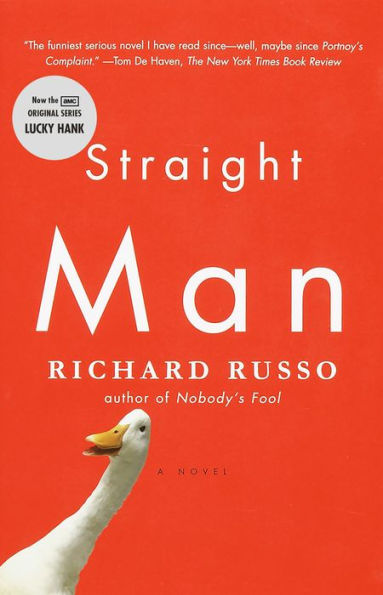
Straight Man

( 37 )

Pick Up in Store

Reserve and pick up in 60 minutes at your local store

Paperback (1 VINTAGE)
$12.98
BN.com price
$15.95 List Price (Save 19%)
Marketplace (New and Used)
from
$0.99
$15.95 List Price (Save 94%)
Usually ships within 1-2 business days
All (258)  
Used (237)  
New (21)  
Close
Sort by
Page 1 of 26
Showing 1 – 10 of 258 (26 pages)
$0.99
(Save 94%)
Seller since 2005

Feedback rating:

(18844)

Condition:

New — never opened or used in original packaging.

Like New — packaging may have been opened. A "Like New" item is suitable to give as a gift.

Very Good — may have minor signs of wear on packaging but item works perfectly and has no damage.

Good — item is in good condition but packaging may have signs of shelf wear/aging or torn packaging. All specific defects should be noted in the Comments section associated with each item.

Acceptable — item is in working order but may show signs of wear such as scratches or torn packaging. All specific defects should be noted in the Comments section associated with each item.

Used — An item that has been opened and may show signs of wear. All specific defects should be noted in the Comments section associated with each item.

Refurbished — A used item that has been renewed or updated and verified to be in proper working condition. Not necessarily completed by the original manufacturer.

Good
1998-06-09 Trade Paperback Good Trade paperback (US). Glued binding. 416 p.

Ships from: Sparks, NV

Usually ships in 1-2 business days

  • Canadian
  • International
  • Standard, 48 States
  • Standard (AK, HI)
  • Express, 48 States
  • Express (AK, HI)
$0.99
(Save 94%)
Seller since 2011

Feedback rating:

(141)

Condition: Acceptable
1998 Paperback Fair The book is clean but may have markings or highlights througout.

Ships from: St Paul, MN

Usually ships in 1-2 business days

  • Canadian
  • International
  • Standard, 48 States
  • Standard (AK, HI)
  • Express, 48 States
  • Express (AK, HI)
$0.99
(Save 94%)
Seller since 2011

Feedback rating:

(141)

Condition: Acceptable
1998 Paperback Fair The book is clean but may have markings or highlights througout.

Ships from: St Paul, MN

Usually ships in 1-2 business days

  • Canadian
  • International
  • Standard, 48 States
  • Standard (AK, HI)
  • Express, 48 States
  • Express (AK, HI)
$0.99
(Save 94%)
Seller since 2011

Feedback rating:

(141)

Condition: Acceptable
1998 Paperback Fair The book is clean but may have markings or highlights througout.

Ships from: St Paul, MN

Usually ships in 1-2 business days

  • Canadian
  • International
  • Standard, 48 States
  • Standard (AK, HI)
  • Express, 48 States
  • Express (AK, HI)
$0.99
(Save 94%)
Seller since 2005

Feedback rating:

(3357)

Condition: Good
reprint Good [ No Hassle 30 Day Returns ] Publisher: Vintage Pub Date: 6/9/1998 Binding: Paperback Pages: 416.

Ships from: College Park, MD

Usually ships in 1-2 business days

  • Canadian
  • International
  • Standard, 48 States
  • Standard (AK, HI)
  • Express, 48 States
  • Express (AK, HI)
$0.99
(Save 94%)
Seller since 2008

Feedback rating:

(2580)

Condition: Very Good
VG- Mild cover wear. Mild aging to clean pages with tight binding.

Ships from: San Jose, CA

Usually ships in 1-2 business days

  • Canadian
  • International
  • Standard, 48 States
  • Standard (AK, HI)
  • Express, 48 States
  • Express (AK, HI)
$0.99
(Save 94%)
Seller since 2007

Feedback rating:

(2536)

Condition: Good
1998 Paperback Good A copy that has been read, but remains in clean condition. All pages are intact, and the cover is intact (including dustcover, if applicable). The spine ... may show signs of wear. Pages can include limited notes and highlighting, and the copy can include "from the library of" labels. Read more Show Less

Ships from: Los Angeles, CA

Usually ships in 1-2 business days

  • Canadian
  • International
  • Standard, 48 States
  • Standard (AK, HI)
  • Express, 48 States
  • Express (AK, HI)
$0.99
(Save 94%)
Seller since 2005

Feedback rating:

(18844)

Condition: Very Good
1998-06-09 Trade Paperback Very Good Trade paperback (US). Glued binding. 416 p.

Ships from: Sparks, NV

Usually ships in 1-2 business days

  • Canadian
  • International
  • Standard, 48 States
  • Standard (AK, HI)
  • Express, 48 States
  • Express (AK, HI)
$0.99
(Save 94%)
Seller since 2005

Feedback rating:

(18844)

Condition: Very Good
1998-06-09 Trade Paperback Very Good Trade paperback (US). Glued binding. 416 p.

Ships from: Sparks, NV

Usually ships in 1-2 business days

  • Canadian
  • International
  • Standard, 48 States
  • Standard (AK, HI)
  • Express, 48 States
  • Express (AK, HI)
$0.99
(Save 94%)
Seller since 2005

Feedback rating:

(18844)

Condition: Good
1998-06-09 Trade Paperback Good Trade paperback (US). Glued binding. 416 p.

Ships from: Sparks, NV

Usually ships in 1-2 business days

  • Canadian
  • International
  • Standard, 48 States
  • Standard (AK, HI)
  • Express, 48 States
  • Express (AK, HI)
Page 1 of 26
Showing 1 – 10 of 258 (26 pages)
Close
Sort by
NOOK Book (eBook)
$11.99
BN.com price

Available on NOOK devices and apps

  • Nook Devices
  • NOOK
  • NOOK Color
  • NOOK Tablet
  • Tablet/Phone
  • NOOK for iPad
  • NOOK for iPhone
  • NOOK for Android
  • NOOK for Android (Tablet)
  • NOOK Kids for iPad
  • PC/Mac
  • NOOK Study
  • NOOK for PC
  • NOOK for Mac

Need a NOOK? Explore Now

Overview

In this uproarious new novel, Richard Russo performs his characteristic high-wire walk between hilarity and heartbreak.  Russo's protagonist is William Henry Devereaux, Jr., the reluctant chairman of the English department of a badly underfunded college in the Pennsylvania rust belt.  Devereaux's reluctance is partly rooted in his character—he is a born anarchist— and partly in the fact that his department is more savagely divided than the Balkans.  

In the course of a single week, Devereaux will have his nose mangled by an angry colleague, imagine his wife is having an affair with his dean, wonder if a curvaceous adjunct is trying to seduce him with peach pits, and threaten to execute a goose on local television.  All this while coming to terms with his philandering father, the dereliction of his youthful promise, and the ominous failure of certain vital body functions.  in short, Straight Man is classic Russo—side-splitting and true-to-life, witty, compassionate, and impossible to put down.

The author of The Risk Pool and Nobody's Fool delivers a brilliant new novel about a professor whose sense of humor is tested by the cosmic joke. Hank Devereaux, Jr., failed novelist, creative writing teacher, and estranged son of one of academe's stars, is a hero whose cynicism must be mitigated by his love for family, friends and, ultimately, knowledge itself.

Editorial Reviews

Joan Smith

Reading Richard Russo's newest novel, Straight Man, you can't help but experience a strong sense of déja vù'. The protagonist is a hapless middle-aged man who's ironic, irreverent, perhaps even brilliant, but lost without the keener emotional insight and wisdom of his beautiful wife. He mediates his relationships not just with his friends and children, but with his very self, as he negotiates the dangers of a week alone, confronting his own mortality.

And what, precisely, are those dangers? A half-dozen women of all ages he is half in love with, who may or may not be willing to sleep with him the moment he is ready to betray his marriage vows. A divorced friend who tends to keep him up drinking and with whom he spends a night in jail for drunk driving. His own perhaps self-destructive inability to avoid provoking other people, especially at the college where he is interim chair of a hilariously combative English department. His blindness to his own feelings and motivations, which leaves him believing that his behavior -- the trajectory of his life, really -- is not exactly his to control. His refusal to take care of himself physically: He ignores everything from a cold to a new inability to pee until they assume the proportions of high crisis.

We have seen something like the story of William Henry Devereaux, Jr. in the novels of Richard Ford, Tom McGuane, Louis B. Jones and Larry McMurtry, to name but a few. Yet Russo's Straight Man -- a departure from his acclaimed upstate New York novels, Nobody's Fool and The Risk Pool -- is so funny, so beautifully written, so fully imagined, it is easy to forgive its familiarity. His narrator's description of life at a mediocre Pennsylvania college is wicked and precise, and easily a metaphor for the mean-spirited insanity of most institutions. There is a wonderful scene in which Devereaux is televised in fake nose and glasses holding a goose from the campus duck pond and threatening to kill a duck a day until the state approves him his budget for the following year, and another of Devereaux inadvertently peeing on himself in his office and climbing into the ceiling (where workers have been removing asbestos) to avoid detection and (while he's at it) to eavesdrop on the departmental meeting at which he is to be impeached.

In their national search for a new chair (stymied by endless bureaucratic inanities), the members of the English department naturally rule out anyone illustrious, because that would invite comparisons to their own work. They bicker over the remaining choices to hilarious effect. No one wants a candidate, in fact, who teaches anything resembling their specialty or who has published anything in their particular genre. And there is, of course, the question of whether they should consider another white male. Devereaux has secretly renamed one young man on the faculty Orshee because he interjects that phrase when anyone uses the masculine pronoun.

Russo is an easy, elegant writer. The book is beautifully plotted, and Russo makes you care about Devereaux and his fate. He also makes you laugh out loud. "Truth be told," Devereaux muses in the prologue, "I'm not an easy man. I can be an entertaining one, though it's been my experience that most people don't want to be entertained. They want to be comforted." Somehow Russo has managed both. -- Salon

From The Critics
Picture this: William Henry (Hank) Devereaux Jr., tenured professor at a second-rank college in Pennsylvania, where he is chairman of the fractious English Department, faces TV cameras wearing a false nose and glasses, brandishing a goose over his head and threatening to kill a duck a day until he gets a budget. It's a vintage Russo scene, and there are others like it in this hilarious, wise and compassionate novel. Pushing 50, Hank is suffering a midlife crisis he will not acknowledge. After his miserable childhood as the son of a chilly mother and a downright icy father--a renowned professor, literary critic and adulterer--Hank has avoided confrontation with his emotions. He jokes about his mediocre job, his lack of self-esteem (his one novel, 20 years ago, got good reviews but didn't sell) and his role as goad and gadfly to his friends and enemies. During the course of the novel, which begins with the burial of one dog and ends with the interment of another, Hank manages to get himself in continuous trouble, in jail, in a ladies room (where he attempts to divest himself of the pants, shoe and sock he has peed in), in the hospital and out of a job. Meanwhile, Russo concocts an inspired send-up of academia's infighting and petty intrigues that ranks with the best of David Lodge, as we follow Hank's progress from perverse mockery to insight and acceptance. Readers who do not laugh uncontrollably during this raucous, witty and touching work are seriously impaired.

Product Details

  • ISBN-13: 9780375701900
  • Publisher: Knopf Doubleday Publishing Group
  • Publication date: 6/28/1998
  • Edition description: 1 VINTAGE
  • Pages: 416
  • Sales rank: 91,215
  • Series: Vintage Contemporaries Series
  • Product dimensions: 5.10 (w) x 8.00 (h) x 0.80 (d)

Meet the Author

Richard Russo
Richard Russo
Known for his sly humor and his touchingly real characters, Richard Russo’s novels about the perennial odd man out are notable for both their sharp turns of phrase and for their nuance. The film version of Nobody's Fool earned him a wider audience, but the Pulitzer in 2001 for Empire Falls ensured a spotlight on his work for years to come.

Biography

Prizewinning author Richard Russo is regarded by many critics as the best writer about small-town America since Sherwood Anderson and Sinclair Lewis. "He doesn't over-sentimentalize [small towns]," said Maureen Corrigan, the book critic for NPR's "Fresh Air." Nor does he belittle the dreams and hardships of his working-class characters. "I come from a blue-collar family myself and I think he gets the class interactions; he just really nails class in his novels," said Corrigan.

When Russo left his own native small town in upstate New York, it was with hopes of becoming a college professor. But during his graduate studies, he began to have second thoughts about the academic life. While finishing up his doctorate, he took a creative writing class; and a new career path opened in front of him.

Russo's first novel set the tone for much of his later work. The story of an ailing industrial town and the interwoven lives of its inhabitants, Mohawk won critical praise for its witty, engaging style. In subsequent books, he has brought us a dazzling cast of characters, mostly working-class men and women who are struggling with the problems of everyday life (poor health, unemployment, mounting bills, failed marriages) in dilapidated, claustrophobic burghs that have -- like their denizens -- seen better days. In 2001, Russo received the Pulitzer Prize for Empire Falls, a brilliant, tragicomic set-piece that explores past and present relationships in a once-thriving Maine town whose textile mill and shirt factory have gone bust.

Russo's vision of America would be bleak, except for the wit and optimism he infuses into his stories. Even when his characters are less than lovable, they are funny, rueful, and unfailingly human. "There's a version of myself that I still see in a kind of alternative universe and it's some small town in upstate New York or someplace like that," Russo said in an interview. That ability to envision himself in the bars and diners of small-town America has served him well. "After the last sentence is read, the reader continues to see Russo's tender, messed-up people coming out of doorways, lurching through life," said the fiction writer Annie Proulx. "And keeps on seeing them because they are as real as we are."

Good To Know

In 1994, Russo's book Nobody's Fool was made into a movie starring Paul Newman and Bruce Willis. Newman also starred in the 1998 movie Twilight, for which Russo wrote the screenplay. Russo now divides his time between writing fiction and writing for the movies.

When he wrote his first books, Russo was employed full-time as a college teacher, and would stop at the local diner between classes to work on his novels. After the success of Nobody's Fool (the book and the movie), he was able to quit teaching -- but he still likes to write in spots such as the Camden Deli. It's "a less lonely way to write," he told USA Today. "I'm less self-conscious when it's not so quiet."

    1. Hometown:
      Gloversville, New York
    1. Date of Birth:
      July 15, 1949
    2. Place of Birth:
      Johnstown, New York
    1. Education:
      B.A., University of Arizona, 1967; Ph.D., University of Arizona, 1979; M.F.A., University of Arizona, 1980

Read an Excerpt

Chapter I

When my nose finally stops bleeding and I've disposed of the bloody paper towels, Teddy Barnes insists on driving me home in his ancient Honda Civic, a car that refuses to die and that Teddy, cheap as he is, refuses to trade in. June, his wife, whose sense of self-worth is not easily tilted, drives a new Saab. "That seat goes back," Teddy says, observing that my knees are practically under my chin.

When we stop at an intersection for oncoming traffic, I run my fingers along the side of the seat, looking for the release. "It does, huh?"

"It's supposed to," he says, sounding academic, helpless.

I know it's supposed to, but I give up trying to make it, preferring the illusion of suffering. I'm not a guilt provoker by nature, but I can play that role. I release a theatrical sigh intended to convey that this is nonsense, that my long legs could be stretched out comfortably beneath the wheel of my own Lincoln, a car as ancient as Teddy's Civic, but built on a scale more suitable to the long-legged William Henry Devereauxs of the world, two of whom, my father and me, remain above ground.

Teddy is an insanely cautious driver, unwilling to goose his little Civic into a left turn in front of oncoming traffic. "The cars are spaced just wrong. I can't help it," he explains when he sees me grinning at him. Teddy's my age, forty-nine, and though his features are more boyish, he too is beginning to show signs of age. Never robust, his chest seems to have become more concave, which emphasizes his small paunch. His hands are delicate, almost feminine, hairless. His skinny legs appear lost in his trousers. It occurs to me as I study him that Teddy would have a hard time starting over-that is, learning how unfamiliar things work, competing, finding a mate. The business of young men. "Why would I have to start over?" he wants to know, a frightened expression deepening the lines around the corners of his eyes.

Apparently, to judge from the way he's looking at me now, I have spoken my thought out loud, though I wasn't aware of doing so. "Don't you ever wish you could?"

"Could what?" he says, his attention diverted. Having spied a break in the oncoming traffic, he takes his foot off the brake and leans forward, his foot poised over but not touching the gas pedal, only to conclude that the gap between the cars isn't as big as he thought, settling back into his seat with a frustrated sigh.

Something about this gesture causes me to wonder if a rumor I've been hearing about Teddy's wife, June-that she's involved with a junior faculty member in our department-just might be true. I haven't given it much credence until now because Teddy and June have such a perfect symbiotic relationship. In the English department they are known as Fred and Ginger for the grace with which they move together, without a hint of passion, toward a single, shared destination. In an atmosphere of distrust and suspicion and retribution, two people working together represent a power base, and no one has understood this sad academic truth better than Teddy and June. It's hard to imagine either of them risking it. On the other hand, it must be hard to be married to a man like Teddy, who's always leaning forward in anticipation, foot poised above the gas pedal, but too cautious to stomp.

We are on Church Street, which parallels the railyard that divides the city of Railton into two dingy, equally unattractive halves. This is the broadest section of the yard, some twenty sets of tracks wide, and most of those tracks are occupied by a rusty boxcar or two. A century ago the entire yard would have been full, the city of Railton itself thriving, its citizens looking forward to a secure future. No longer. On Church Street, where we remain idling in the left-turn lane, there is no longer a single church, though there were once, I'm told, half a dozen. The last of them, a decrepit red brick affair, long condemned and boarded up, was razed last year after some kids broke in and fell through the floor. The large parcel of land it perched on now sits empty. It's the fact that there are so many empty, littered spaces in Railton, like the windblown expanses between the boxcars in the railyard, that challenges hope. Within sight of where we sit waiting to turn onto Pleasant Street, a man named William Cherry, a lifelong Conrail employee, has recently taken his life by lying down on the track in the middle of the night. At first the speculation was that he was one of the men laid off the previous week, but the opposite turned out to be true. He had in fact lust retired with his pension and full benefits. On television his less fortunate neighbors couldn't understand it. He had it made, they said.

When it's safe, when all the oncoming traffic has passed, Teddy turns onto Pleasant, the most unpleasant of Railton streets. Lined on both sides with shabby one- and two-story office fronts, Pleasant Street is too steep to climb in winter when there's snow. Now, in early April, I suspect it may be too steep for Teddy's Civic, which is whirring heroically in its lower gears and going all of fifteen miles an hour. There's a plateau and a traffic light halfway up, and when we stop, I say, "Should I get out and push?"

"It's just cold," Teddy tells me. "Really. We're fine."

No doubt he's right. We will make it. Why this fact should be so discouraging is what I'd like to know. I can't help wondering if William Cherry also feared things would work out if he didn't do something drastic to prevent them.

"I think I can, I think I can, I think I can," I chant, as the light changes and Teddy urges forward the Little Civic That Could. A few months ago I foolishly tried to climb this same hill in a light snow. It was nearly midnight, and I was heading home from the campus and hadn't wanted to go the long way, which added ten minutes. During the long Pennsylvania winters, curbside parking is not allowed at night, so the street had a deserted, ominous feel. Mine was the only car on the five-block incline, and I made it without incident to this very plateau where Teddy and I have now stopped. The office of my insurance agent was on the corner, and I remember wishing he was there to see me do something so reckless in a car he was insuring. When the light changed, my tires spun, then caught, and I labored up the last two blocks. I couldn't have been more than ten yards from the crest of the hill when I felt the tires begin to spin and the rear end to drift. When the car stalled and I realized the brake exerted no meaningful influence, I sat back and became a witness to my own folly. With the engine dead and the snow muffling all other sounds, I found myself in a silent ballet as I slalomed gracefully down the hill, backward as far as the landing where it appeared that I would stop, right in front of my insurance agent's, but then I slipped over the edge and spun down the last three blocks, rebounding off curbs like the cue ball in a game of bumper pool, finally coming to rest at the entrance to the railyard, having suffered a loss of equilibrium but otherwise unscathed. A friend, Bodie Pie, who lives in a second-floor flat near the bottom of the hill and claims to have witnessed my balletic descent, swears she heard me laughing maniacally, but I don't remember that. The only emotion I recall is similar to the one I feel now, with Teddy on this same hill. That is, a certain sense of disappointment about such drama resulting in so little consequence. Teddy is sure we'll make it, and so am I. We have tenure, the two of us.

Once out of town, the rejuvenated Civic rushes along the two-lane blacktop like a cartoon car with a big, loopy smile (I knew I could, I knew I could), the Pennsylvania countryside hurtling by. Most of the trees along the side of the road are budding. Farther back in the deep woods there may still be patches of dirty snow, but spring is definitely in the air, and Teddy has cracked his window to take advantage of it. His thinning hair stirs in the breeze, and I half-expect to see evidence of new leafy growth on his scalp. I know he's been contemplating Rogaine. "You're only taking me home so you can flirt with Lily," I tell him.

This makes Teddy flush. He's had an innocent crush on my wife for over twenty years. If there's such a thing as an innocent crush. If there's such a thing as innocence. Since we built the house in the country, Teddy's had fewer opportunities to see Lily, so he's always on the lookout for an excuse. On those rare Saturday mornings when we still play basketball, he stops by to give me a lift. The court we play on is a few blocks from his house, but he insists the four-mile drive into the country isn't that far out of his way. One drunken night, over a decade ago, he made the mistake of confessing to me his infatuation with Lily. The secret was no sooner out than he tried to extort from me a promise not to reveal it. "If you tell her, so help me . . . ," he kept repeating.

"Don't be an idiot," I assured him. "Of course I'm going to tell her. I'm telling her as soon as I get home."

"What about our friendship?"

"Whose?"

"Ours," he explained. "Yours and mine."

"What about it?" I said. "I'm not the one in love with your wife. Don't talk to me about friendship. I should take you outside."

He grinned at me drunkenly. "You're a pacifist, remember?"

"That doesn't mean I can't threaten you," I told him. "It just means you're not required to take me seriously."

But he was taking me seriously, taking everything seriously. I could tell. "You don't love her as much as you should," he said, real tears in his eyes.

"How would you know?" William Henry Devereaux, Jr., said, dry-eyed.

"You don't," he insisted.

"Would it make you feel better if I promised to ravish her as soon as I get home?"

I mean, the situation was pretty absurd. Two middle-aged men-we were middle-aged even then-sitting in a bar in Railton, Pennsylvania, arguing about how much love was enough, how much more was deserved. The absurdity of it was lost on Teddy, however, and for a second I actually thought he was going to punch me. He had to know I was kidding him, but Teddy belongs to that vast majority who believe that love isn't something you kid about. I don't see how you could not kid about love and still claim to have a sense of humor.

Since that night, I'm the only one who makes reference to Teddy's confession. He's never retracted it, but the incident remains embarrassing. "I wish you had some feelings for June," he says now, smiling ruefully. "We could agree to a reciprocal yearning from afar."

"How old are you?" I ask him.

He's quiet for a moment. "Anyhow," he says finally. "The real reason I wanted to drive you home-"

"Oh, Christ," I say. "Here we go."

I know what's coming. For the last few months rumors have been running rampant about an impending purge at the university, one that would reach into the tenured ranks. If such a thing were to happen, virtually everyone in the English department would be vulnerable to dismissal. The news is reportedly being broken to department chairs individually in their year-end conferences with the campus executive officer. According to which rumors you listen to, the chairs are being either asked or required to draw up lists of faculty in their departments who might be considered expendable. Seniority is reportedly not a criterion.

"All right," I tell Teddy. "Give it to me. Who have you been talking to now?"

"Arnie Drenker over in Psychology."

"And you believe Arnie Drenker?" I ask. "He's certifiable."

"He swears he was ordered to make a list."

When I don't immediately respond to this, he takes his eyes off the road for a microsecond to look over at me. My right nostril, which has now swollen to the point where I can see it clearly in my peripheral vision, throbs under his scrutiny. "Why do you refuse to take the situation seriously?"

"Because it's April, Teddy," I explain. This is an old discussion. April is the month of heightened paranoia for academics, not that their normal paranoia is insufficient to ruin a perfectly fine day in any season. But April is always the worst. Whatever dirt will be done to us is always planned in April, then executed over the summer, when we are dispersed. September is always too late to remedy the reduced merit raises, the slashed travel fund, the doubled price of the parking sticker that allows us to park in the Modern Languages lot. Rumors about severe budget cuts that will affect faculty have been rampant every April for the past five years, although this year's have been particularly persistent and virulent. Still, the fact is that every year the legislature has threatened deep cuts in higher education. And every year a high-powered education task force is sent to the capitol to lobby the legislature for increased spending. Every year accusations are leveled, editorials written. Every year the threatened budget cuts are implemented, then at the last fiscal moment money is found and the budget-most of it-restored. And every year I conclude what William of Occam (that first, great modern William, a William for his time and ours, all the William we will ever need, who gave to us his magnificent razor by which to gauge simple truth, who was exiled and relinquished his life that our academic sins might be forgiven) would have concluded-that there will be no faculty purge this year, just as there was none last year, just as there will be none next year. What there will probably be next year is more belt tightening, more denied sabbaticals, an extension of the hiring freeze, a reduced photocopy budget. What there will certainly be next year is another April, and another round of rumors.

Teddy steals another quick glance at me. "Do you have any idea what your colleagues are saying?"

"No," I say, then, "yes. I mean, I know my colleagues, so I can imagine what they're saying."

"They're saying your dismissing the rumors is pretty suspicious. They're wondering if you've made up a list."

Reading Group Guide

William Henry Devereaux, Jr., spiritually suited to playing left field but forced by a bad hamstring to try first base, is the unlikely chairman of the English department at West Central Pennsylvania University. Over the course of a single convoluted week, he threatens to execute a duck, has his nose slashed by a feminist poet, discovers that his secretary writes better fiction than he does, suspects his wife of having an affair with his dean, and finally confronts his philandering elderly father, the one-time king of American Literary Theory, at an abandoned amusement park.

Such is the canvas of Richard Russo's Straight Man, a novel of surpassing wit, poignancy, and insight. As he established in his previous books -- Mohawk, The Risk Pool, and Nobody's Fool -- Russo is unique among contemporary authors for his ability to flawlessly capture the soul of the wise guy and the heart of a difficult parent. In Hank Devereaux, Russo has created a hero whose humor and identification with the absurd are mitigated only by his love for his family, friends, and, ultimately, knowledge itself.

Unforgettable, compassionate, and laugh-out-loud funny, Straight Man cements Richard Russo's reputation as one of the master storytellers of our time.


From the Hardcover edition.
Customer Reviews
Average Rating 4.5
( 37 )

Rating Distribution

  • ( 21 )
  • ( 10 )
  • ( 4 )
  • ( 2 )
  • ( 0 )
If you've bought this product, tell the world how you liked it.
Write a Review
See All Sort by: Showing 1 – 20 of 37 Customer Reviews
  • Anonymous

    Posted August 5, 2003

    hilarious

    This is one of my all time favorite books. It is dry, witty, and extremely well-written. I found myself laughing uncontrollably at its artful humor. You cannot help but love each character - as is the case in most of Russo's books.

    2 out of 2 people found this review helpful.

    Was this review helpful? Yes  No   Report this review
  • Anonymous

    Posted June 10, 2003

    Great Read

    I thought this book was better than Empire Falls. I found myself laughing out loud several times, and I couldn't put it down. I was sorry to have it end!

    1 out of 1 people found this review helpful.

    Was this review helpful? Yes  No   Report this review
  • Anonymous

    Posted October 6, 2002

    Exceeded recommendations

    With all due respect to the Pulitzer people, I think this is better even than Empire Falls -- and I loved EF immensely. Straight Man is hysterical, warm, gripping and intelligent from the first page to the last. The constant wit and sarcastic edge make "Hank" Russo's best lead character ever. Anyone who has ever taught, or has aspirations to write a book, will not be able to put this book down until they are done with it. This book hasn't gotten the hype of others, but I would call it my best read of the year, by far.

    1 out of 1 people found this review helpful.

    Was this review helpful? Yes  No   Report this review
  • Anonymous

    Posted December 16, 1999

    Laugh out loud funny

    You don't have to be in academia to appreciate this sly take on life at a mediocre liberal arts college. The unexpected twists and turns and the outrageous and crisp dialogue make this book so funny I was literally laughing out loud while reading it, whether alone on my couch or on a crowded bus. Highly recommended.

    1 out of 1 people found this review helpful.

    Was this review helpful? Yes  No   Report this review
  • Anonymous

    Posted October 26, 2011

    Seriously impaired

    I am apparently among the "seriously impaired" to which Publishers Weekly refers in their review. I found the characters in the book more pathetic than funny. I will give Russo credit for his ability to write, but this book was not worth the time it took to read. I not only did not "laugh uproariously" but rarely chuckled throughout. The situations and characters were more slapstick than realistic. I persevered in reading out of affection for my daughter-in-law who recommended it, but I found myself wanting to put the book down very frequently and only picked it up again out of the vain hope that it would finally redeem itself. It did not.

    Was this review helpful? Yes  No   Report this review
  • Posted May 5, 2010

    Funny yet Serious - and Seriously Funny

    Russo's "Straight Man" is clearly written by a man who can write. The reading itself was a pleasure. The story was amusing, if at times slow, and was a wonderful combination of funny and serious. There was nothing silly, over the top, or shocking about the humor in Russo's work. The main character is endearing and honest and the supporting characters are equally entertaining - and for the most served only in appropriately sized portions; the most over-the-top characters make brief appearances, so it's nice to see them again later, rather than repetitive or irritating.

    A great read for anyone who has had zany professors (as many of them are), enjoys reading, and can handle a long read - the length is my only criticism, but I only felt that the book was too long for about 5 chapters in the middle. Once the story picked up again, I was glad to have more to read ahead.

    Was this review helpful? Yes  No   Report this review
  • Posted May 2, 2010

    Delightful Humor

    This book is hands down one the best reads of my post-high school career. It is my opinon that Richard Russo is a quick-witted, sarcastic, and dry author, wich makes makes for a great book that is exceptionally hilarious. After a while i found myself rooting for the antagonist in story becasue i couldn't help but to fall in love with ALL characters. Its seems that Russo used some personal expeirence in his writing wich helped me connect to the characters to better understand their point of view. In other words, this book was real, as in the personalities put into the characters & structure of this story.

    Was this review helpful? Yes  No   Report this review
  • Posted July 25, 2009

    I Also Recommend:

    Too Real To Be True

    With hard economic times on hitting higher education, this book was almost too real to be true. Each character could be on any given campus across the nation. The personal and professional story line for the main character was so likeable and believeable. Great book for any liberal arts department personnel.

    Was this review helpful? Yes  No   Report this review
  • Anonymous

    Posted July 17, 2009

    funny

    ALl I can say is this is one of the funniest books I've EVER read.

    Was this review helpful? Yes  No   Report this review
  • Anonymous

    Posted September 19, 2008

    Russo's best!

    One of my favorite books! I work in academia - this had me laughing in acknowledgement and recognition. Well done!

    Was this review helpful? Yes  No   Report this review
  • Anonymous

    Posted August 1, 2008

    Classic character

    i have a good sense of humor, i like it all, raunchy stuff stupid stuff and this book has it all

    Was this review helpful? Yes  No   Report this review
  • Anonymous

    Posted October 27, 2004

    Pathos & Comedy

    This book had me laughing out loud...with its combination of characters and Hank's thoughts and fantasies. A book about relationships in our jobs and families well worth the read.

    Was this review helpful? Yes  No   Report this review
  • Anonymous

    Posted February 17, 2004

    funny and well written

    The writing is so crisp and believable I recognized all the characters. I laughed out loud a number of times reading this on a 12 hour plane ride. I am not a professor and am not a literature student, but the book author brought me into that world. Alternating between introspective and simply hilarious it was a great story. I am reading Empire Falls starting today.

    Was this review helpful? Yes  No   Report this review
  • Anonymous

    Posted December 30, 2003

    Fun to read

    Fun book with interesting characters that touch on the problems of academia but don't get into the heart of the problems facing modern universities but funny in its satire of college life

    Was this review helpful? Yes  No   Report this review
  • Anonymous

    Posted November 9, 2003

    A DAY IN THE LIFE OF A PROFESSOR

    Funny,great characters,observant and just fun to read.....if you ever been to college or a life in academia an interesting look into life at a university.

    Was this review helpful? Yes  No   Report this review
  • Anonymous

    Posted October 14, 2003

    erudite but boring

    I asked myself throughout the book 'Why am I reading this?' Is it uplifting? Is it humorous? Is it informative? I found the characters uninteresting and the humour was too cynical for my taste. And it didn't teach me anything about life or the world. I'm part of a reading group and we all had similar problems with it. Just another book about dysfunctional university life. Tone reminded me of 'Emperor of Ocean Park'

    0 out of 2 people found this review helpful.

    Was this review helpful? Yes  No   Report this review
  • Anonymous

    Posted January 27, 2003

    disappointing book from an intelligent writer

    Russo knows how to write, but this book is mostly episodic, and lacks the complexity (in both characters and story), depth, and dramatic arc that make a really good, enduring novel. It's also not as funny as I'd expected it to be -- granted, some of the humor is very good, but at other times it's just stale. (A middle-aged man having trouble peeing has been done to death...) It also seems that he had either an incompetent editor or no editor at all -- tiny flaws and fissures appear throughout the book that any good editor should have caught (unnecessary repetition and overexplanations being the main ones), and that mar the writing. Finally, the use of present tense is not successful -- present tense works in a short story, but it's awfully difficult to sustain it and keep it interesting in a novel, and in this case the author doesn't pull it off. Too bad, because I do think Russo is a good writer. But I kept wanting to put this book down -- and, having read it, I'm now less than enthusiastic about reading _Empire Falls_. For really good academic satire, read David Lodge's _Small World_.

    0 out of 2 people found this review helpful.

    Was this review helpful? Yes  No   Report this review
  • Anonymous

    Posted January 7, 2003

    Ducks & Ducts

    One of the funniest books I've read! A college professor, bogged down in administrative trivia, trying to teach a class of students who aren't that interested! Don't have to be a college professor to enjoy this one; the laughs are long and frequent as you turn the pages. Russo nails his characters to perfection.

    Was this review helpful? Yes  No   Report this review
  • Anonymous

    Posted December 21, 2000

    Gallows Humor for Academics

    Having first studied and then worked in an English department, this book struck me as both directly funny and sad funny. Some of it hit so close to the mark I was a bit hesitant to suggest it to academics I know; it might give them ideas. Still, a delightful book that provides smirks, chuckles, and some all-out belly laughs.

    Was this review helpful? Yes  No   Report this review
  • Anonymous

    Posted October 15, 2000

    Book, Audio are both great

    For every Academic. Bought the (condensed) audio, loved it, bought the book, loved it. Buying another copy of the audio in fear that mine will wear out, because most of my College have borrowed it.

    Was this review helpful? Yes  No   Report this review
See All Sort by: Showing 1 – 20 of 37 Customer Reviews

If you find inappropriate content, please report it to Barnes & Noble
Why is this product inappropriate?
Comments (optional)
500 character limit