
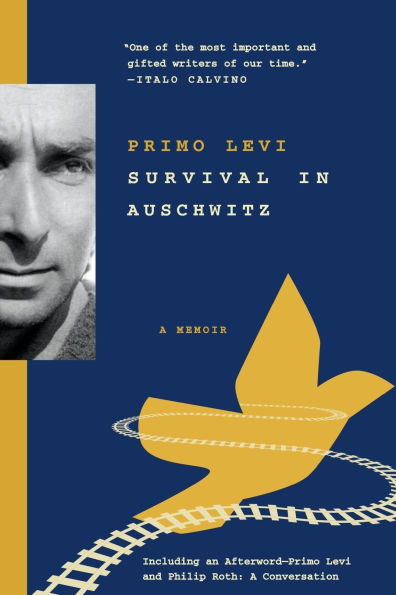
In 1943, Primo Levi, a twenty-five-year-old chemist and “Italian citizen of Jewish race,” was arrested by Italian fascists and deported from his native Turin to Auschwitz. Survival in Auschwitz is Levi’s classic account of his ten months in the German death camp, a harrowing story of systematic cruelty and miraculous endurance. Remarkable for its simplicity, restraint, compassion, and even wit, Survival in Auschwitz remains a lasting testament to the indestructibility of the human spirit. Included in this new edition is an illuminating conversation between Philip Roth and Primo Levi never before published in book form.
In 1943, Primo Levi, a twenty-five-year-old chemist and “Italian citizen of Jewish race,” was arrested by Italian fascists and deported from his native Turin to Auschwitz. Survival in Auschwitz is Levi’s classic account of his ten months in the German death camp, a harrowing story of systematic cruelty and miraculous endurance. Remarkable for its simplicity, restraint, compassion, and even wit, Survival in Auschwitz remains a lasting testament to the indestructibility of the human spirit. Included in this new edition is an illuminating conversation between Philip Roth and Primo Levi never before published in book form.

Paperback(Reprint)
-
SHIP THIS ITEMIn stock. Ships in 1-2 days.PICK UP IN STORE
Your local store may have stock of this item.
Available within 2 business hours
Related collections and offers
Overview
In 1943, Primo Levi, a twenty-five-year-old chemist and “Italian citizen of Jewish race,” was arrested by Italian fascists and deported from his native Turin to Auschwitz. Survival in Auschwitz is Levi’s classic account of his ten months in the German death camp, a harrowing story of systematic cruelty and miraculous endurance. Remarkable for its simplicity, restraint, compassion, and even wit, Survival in Auschwitz remains a lasting testament to the indestructibility of the human spirit. Included in this new edition is an illuminating conversation between Philip Roth and Primo Levi never before published in book form.

Product Details
| ISBN-13: | 9780684826806 |
|---|---|
| Publisher: | Simon & Schuster |
| Publication date: | 09/01/1995 |
| Edition description: | Reprint |
| Pages: | 192 |
| Product dimensions: | 5.50(w) x 8.25(h) x 0.60(d) |
About the Author
Read an Excerpt
Chapter 1
The Journey
I was captured by the Fascist Militia on 13 December 1943. I was twenty-four, with little wisdom, no experience and a decided tendency — encouraged by the life of segregation forced on me for the previous four years by the racial laws — to live in an unrealistic world of my own, a world inhabited by civilized Cartesian phantoms, by sincere male and bloodless female friendships. I cultivated a moderate and abstract sense of rebellion.
It had been by no means easy to flee into the mountains and to help set up what, both in my opinion and in that of friends little more experienced than myself, should have become a partisan band affiliated with the Resistance movement Justice and Liberty. Contacts, arms, money and the experience needed to acquire them were all missing. We lacked capable men, and instead we were swamped by a deluge of outcasts, in good or bad faith, who came from the plain in search of a non-existent military or political organization, of arms, or merely of protection, a hiding place, a fire, a pair of shoes.
At that time I had not yet been taught the doctrine I was later to learn so hurriedly in the Lager: that man is bound to pursue his own ends by all possible means, while he who errs but once pays dearly. So that I can only consider the following sequence of events justified. Three Fascist Militia companies, which had set out in the night to surprise a much more powerful and dangerous band than ours, broke into our refuge one spectral snowy dawn and took me down to the valley as a suspect person.
During the interrogations that followed, I preferred to admit my status of 'Italian citizen of Jewish race'. I felt that otherwise I would be unable to justify my presence in places too secluded even for an evacuee; while I believed (wrongly as was subsequently seen) that the admission of my political activity would have meant torture and certain death. As a Jew, I was sent to Fossoli, near Modena, where a vast detention camp, originally meant for English and American prisoners-of-war, collected all the numerous categories of people not approved of by the new-born Fascist Republic.
At the moment of my arrival, that is, at the end of January 1944, there were about one hundred and fifty Italian Jews in the camp, but within a few weeks their number rose to over six hundred. For the most part they consisted of entire families captured by the Fascists or Nazis through their imprudence or following secret accusations. A few had given themselves up spontaneously, reduced to desperation by the vagabond life, or because they lacked the means to survive, or to avoid separation from a captured relation, or even — absurdly — 'to be in conformity with the law'. There were also about a hundred Jugoslavian military internees and a few other foreigners who were politically suspect.
The arrival of a squad of German SS men should have made even the optimists doubtful; but we still managed to interpret the novelty in various ways without drawing the most obvious conclusions. Thus, despite everything, the announcement of the deportation caught us all unawares.
On 20 February, the Germans had inspected the camp with care and had publicly and loudly upbraided the Italian commissar for the defective organization of the kitchen service and for the scarce amount of wood distribution for heating; they even said that an infirmary would soon be opened. But on the morning of the 21st we learned that on the following day the Jews would be leaving. All the Jews, without exception. Even the children, even the old, even the ill. Our destination? Nobody knew. We should be prepared for a fortnight of travel. For every person missing at the roll-call, ten would be shot.
Only a minority of ingenuous and deluded souls continued to hope; we others had often spoken with the Polish and Croat refugees and we knew what departure meant.
For people condemned to death, tradition prescribes an austere ceremony, calculated to emphasize that all passions and anger have died down, and that the act of justice represents only a sad duty towards society which moves even the executioner to pity for the victim. Thus the condemned man is shielded from all external cares, he is granted solitude and, should he want it, spiritual comfort; in short, care is taken that he should feel around him neither hatred nor arbitrariness, only necessity and justice, and by means of punishment, pardon.
But to us this was not granted, for we were many and time was short. And in any case, what had we to repent, for what crime did we need pardon? The Italian commissar accordingly decreed that all services should continue to function until the final notice: the kitchens remained open, the corvées for cleaning worked as usual, and even the teachers of the little school gave lessons until the evening, as on other days. But that evening the children were given no homework.
And night came, and it was such a night that one knew that human eyes would not witness it and survive. Everyone felt this: not one of the guards, neither Italian nor German, had the courage to come and see what men do when they know they have to die.
All took leave from life in the manner which most suited them. Some praying, some deliberately drunk, others lustfully intoxicated for the last time. But the mothers stayed up to prepare the food for the journey with tender care, and washed their children and packed the luggage; and at dawn the barbed wire was full of children's washing hung out in the wind to dry. Nor did they forget the diapers, the toys, the cushions and the hundred other small things which mothers remember and which children always need. Would you not do the same? If you and your child were going to be killed tomorrow, would you not give him to eat today?
In hut 6A old Gattegno lived with his wife and numerous children and grandchildren and his sons- and daughters-in-law. All the men were carpenters, they had come from Tripoli after many long journeys, and had always carried with them the tools of their trade, their kitchen utensils and their accordions and violins to play and dance to after the day's work. They were happy and pious folk. Their women were the first to silently and rapidly finish the preparations for the journey in order to have time for mourning. When all was ready, the food cooked, the bundles tied together, they unloosened their hair, took off their shoes, placed the Yahrzeit candles on the ground and lit them according to the customs of their fathers, and sat on the bare soil in a circle for the lamentations, praying and weeping all the night. We collected in a group in front of their door, and we experienced within ourselves a grief that was new for us, the ancient grief of the people that has no land, the grief without hope of the exodus which is renewed every century.
Dawn came on us like a betrayer; it seemed as though the new sun rose as an ally of our enemies to assist in our destruction. The different emotions that overcame us, of resignation, of futile rebellion, of religious abandon, of fear, of despair, now joined together after a sleepless night in a collective, uncontrolled panic. The time for meditation, the time for decision was over, and all reason dissolved into a tumult, across which flashed the happy memories of our homes, still so near in time and space, as painful as the thrusts of a sword.
Many things were then said and done among us; but of these it is better that there remain no memory.
With the absurd precision to which we later had to accustom ourselves, the Germans held the roll-call. At the end the officer asked 'Wieviel Stück?' The corporal saluted smartly and replied that there were six hundred and fifty 'pieces' and that all was in order. They then loaded us on to the buses and took us to the station of Carpi. Here the train was waiting for us, with our escort for the journey. Here we received the first blows: and it was so new and senseless that we felt no pain, neither in body nor in spirit. Only a profound amazement: how can one hit a man without anger?
There were twelve goods wagons for six hundred and fifty men; in mine we were only forty-five, but it was a small wagon. Here then, before our very eyes, under our very feet, was one of those notorious transport trains, those which never return, and of which, shuddering and always a little incredulous, we had so often heard speak. Exactly like this, detail for detail: goods wagons closed from the outside, with men, women and children pressed together without pity, like cheap merchandise, for a journey towards nothingness, a journey down there, towards the bottom. This time it is us who are inside.
Sooner or later in life everyone discovers that perfect happiness is unrealizable, but there are few who pause to consider the antithesis: that perfect unhappiness is equally unattainable. The obstacles preventing the realization of both these extreme states are of the same nature: they derive from our human condition which is opposed to everything infinite. Our ever-insufficient knowledge of the future opposes it: and this is called, in the one instance, hope, and in the other, uncertainty of the following day. The certainty of death opposes it: for it places a limit on every joy, but also on every grief. The inevitable material cares oppose it: for as they poison every lasting happiness, they equally assiduously distract us from our misfortunes and make our consciousness of them intermittent and hence supportable.
It was the very discomfort, the blows, the cold, the thirst that kept us aloft in the void of bottomless despair, both during the journey and after. It was not the will to live, nor a conscious resignation; for few are the men capable of such resolution, and we were but a common sample of humanity.
The doors had been closed at once, but the train did not move until evening. We had learnt of our destination with relief. Auschwitz: a name without significance for us at that time, but it at least implied some place on this earth.
The train travelled slowly, with long, unnerving halts. Through the slit we saw the tall pale cliffs of the Adige Valley and the names of the last Italian cities disappear behind us. We passed the Brenner at midday of the second day and everyone stood up, but no one said a word. The thought of the return journey stuck in my heart, and I cruelly pictured to myself the inhuman joy of that other journey, with doors open, no one wanting to flee, and the first Italian names...and I looked around and wondered how many, among that poor human dust, would be struck by fate. Among the forty-five people in my wagon only four saw their homes again; and it was by far the most fortunate wagon.
We suffered from thirst and cold; at every stop we clamoured for water, or even a handful of snow, but we were rarely heard; the soldiers of the escort drove off anybody who tried to approach the convoy. Two young mothers, nursing their children, groaned night and day, begging for water. Our state of nervous tension made the hunger, exhaustion and lack of sleep seem less of a torment. But the hours of darkness were nightmares without end.
There are few men who know how to go to their deaths with dignity, and often they are not those whom one would expect. Few know how to remain silent and respect the silence of others. Our restless sleep was often interrupted by noisy and futile disputes, by curses, by kicks and blows blindly delivered to ward off some encroaching and inevitable contact. Then someone would light a candle, and its mournful flicker would reveal an obscure agitation, a human mass, extended across the floor, confused and continuous, sluggish and aching, rising here and there in sudden convulsions and immediately collapsing again in exhaustion.
Through the slit, known and unknown names of Austrian cities, Salzburg, Vienna, then Czech, finally Polish names. On the evening of the fourth day the cold became intense: the train ran through interminable black pine forests, climbing perceptibly. The snow was high. It must have been a branch line as the stations were small and almost deserted. During the halts, no one tried any more to communicate with the outside world: we felt ourselves by now 'on the other side'. There was a long halt in open country. The train started up with extreme slowness, and the convoy stopped for the last time, in the dead of night, in the middle of a dark silent plain.
On both sides of the track rows of red and white lights appeared as far as the eye could see; but there was none of that confusion of sounds which betrays inhabited places even from a distance. By the wretched light of the last candle, with the rhythm of the wheels, with every human sound now silenced, we awaited what was to happen.
Next to me, crushed against me for the whole journey, there had been a woman. We had known each other for many years, and the misfortune had struck us together, but we knew little of each other. Now, in the hour of decision, we said to each other things that are never said among the living. We said farewell and it was short; everybody said farewell to life through his neighbour. We had no more fear.
The climax came suddenly. The door opened with a crash, and the dark echoed with outlandish orders in that curt, barbaric barking of Germans in command which seems to give vent to a millennial anger. A vast platform appeared before us, lit up by reflectors. A little beyond it, a row of lorries. Then everything was silent again. Someone translated: we had to climb down with our luggage and deposit it alongside the train. In a moment the platform was swarming with shadows. But we were afraid to break that silence: everyone busied himself with his luggage, searched for someone else, oiled to somebody, but timidly, in a whisper.
A dozen SS men stood around, legs akimbo, with an indifferent air. At a certain moment they moved among us, and in a subdued tone of voice, with faces of stone, began to interrogate us rapidly, one by one, in bad Italian. They did not interrogate everybody, only a few: 'How old? Healthy or ill?' And on the basis of the reply they pointed in two different directions.
Everything was as silent as an aquarium, or as in certain dream sequences. We had expected something more apocalyptic: they seemed simple police agents. It was disconcerting and disarming. Someone dared to ask for his luggage: they replied, 'luggage afterwards'. Someone else did not want to leave his wife: they said, 'together again afterwards'. Many mothers did not want to be separated from their children: they said 'good, good, stay with child'. They behaved with the calm assurance of people doing their normal duty of every day. But Renzo stayed an instant too long to say good-bye to Francesca, his fiancée, and with a single blow they knocked him to the ground. It was their everyday duty.
In less than ten minutes all the fit men had been collected together in a group. What happened to the others, to the women, to the children, to the old men, we could establish neither then nor later: the night swallowed them up, purely and simply. Today, however, we know that in that rapid and summary choice each one of us had been judged capable or not of working usefully for the Reich; we know that of our convoy no more than ninety-six men and twenty-nine women entered the respective camps of Monowitz-Buna and Birkenau, and that of all the others, more than five hundred in number, not one was living two days later. We also know that not even this tenuous priciple of discrimination between fit and unfit was always followed, and that later the simpler method was often adopted of merely opening both the doors of the wagon without warning or instructions to the new arrivals. Those who by chance climbed down on one side of the convoy entered the camp; the others went to the gas chamber.
This is the reason why three-year-old Emilia died: the historical necessity of killing the children of Jews was self-demonstrative to the Germans. Emilia, daughter of Aldo Levi of Milan, was a curious, ambitious, cheerful, intelligent child; her parents had succeeded in washing her during the journey in the packed car in a tub with tepid water which the degenerate German engineer had allowed them to draw from the engine that was dragging us all to death.
Thus, in an instant, our women, our parents, our children disappeared. We saw them for a short while as an obscure mass at the other end of the platform; then we saw nothing more.
Instead, two groups of strange individuals emerged into the light of the lamps. They walked in squads, in rows of three, with an odd, embarrassed step, head dangling in front, arms rigid. On their heads they wore comic berets and were all dressed in long striped overcoats, which even by night and from a distance looked filthy and in rags. They walked in a large circle around us, never drawing near, and in silence began to busy themselves with our luggage and to climb in and out of the empty wagons.
We looked at each other without a word. It was all incomprehensible and mad, but one thing we had understood. This was the metamorphosis that awaited us. Tomorrow we would be like them.
Without knowing how I found myself loaded on to a lorry with thirty others; the lorry sped into the night at full speed. It was covered and we could not see outside, but by the shaking we could tell that the road had many curves and bumps. Are we unguarded? Throw ourselves down? It is too late, too late, we are all 'down'. In any case we are soon aware that we are not without guard. He is a strange guard, a German soldier bristling with arms. We do not see him because of the thick darkness, but we feel the hard contact every time that a lurch of the lorry throws us all in a heap. At a certain point he switches on a pocket torch and instead of shouting threats of damnation at us, he asks us courteously, one by one, in German and in pidgin language, if we have any money or watches to give him, seeing that they will not be useful to us any more. This is no order, no regulation: it is obvious that it is a small private initiative of our Charon. The matter stirs us to anger and laughter and brings relief.
"A Conversation with Primo Levi by Philip Roth" copyright © 1986 Philip Roth
Table of Contents
ContentsAuthor's Preface
The Journey
On the Bottom
Initiation
Ka-Be
Our Nights
The Work
A Good Day
This Side of Good and Evil
The Drowned and the Saved
Chemical Examination
The Can to of Ulysses
The Events of the Summer
October 1944
Kraus
Die drei Leute vom Labor
The Last One
The Story of Ten Days
A Conversation with Primo Levi by Philip Roth
What People are Saying About This
Italo Calvino One of the most important and gifted writers of our time.
David Caute, New Statesman Survival in Auschwitz is a stark prose poem on the deepest sufferings of man told without self-pity, but with a muted passion and intensity, an occasional cry of anguish, which makes it one of the most remarkable documents I have ever read.
Meredith Tax, The Village Voice More than anything else I've read or seen, Levi's books helped me not only to grasp the reality of genocide but to figure out what it means for people like me who grew up sheltered from the storm.
The Times Literary Supplement (London) Survival in Auschwitz has the inevitability of the true work of art.