
This book addresses synchronization in networks of coupled systems. It illustrates the main aspects of the phenomenon through concise theoretical results and code, allowing readers to reproduce them and encouraging readers to pursue their own experimentation.
The book begins by introducing the mathematical representation of nonlinear circuits and the code for their simulation. This is followed by a brief account of the concept of the complex network, which describes the main aspects of complex networks and the main model types, with a particular focus on the code used to study and reproduce the models.
The focus then shifts to the process through which independent nonlinear circuits that follow different trajectories without coupling share some properties of their motion: synchronization. The authors present the main techniques for studying synchronization in complex networks, including the major measures, the stability properties and control techniques. The book then moves on to advanced topics in synchronization of complex networks by examining forms of synchronization in which not all the units share the same trajectory, namely chimera states, clustering synchronization, and relay and remote synchronization. Simple codes for experimentation with these topics and control methods are also provided. In closing, the book addresses the problem of synchronization in time-varying networks.
This book addresses synchronization in networks of coupled systems. It illustrates the main aspects of the phenomenon through concise theoretical results and code, allowing readers to reproduce them and encouraging readers to pursue their own experimentation.
The book begins by introducing the mathematical representation of nonlinear circuits and the code for their simulation. This is followed by a brief account of the concept of the complex network, which describes the main aspects of complex networks and the main model types, with a particular focus on the code used to study and reproduce the models.
The focus then shifts to the process through which independent nonlinear circuits that follow different trajectories without coupling share some properties of their motion: synchronization. The authors present the main techniques for studying synchronization in complex networks, including the major measures, the stability properties and control techniques. The book then moves on to advanced topics in synchronization of complex networks by examining forms of synchronization in which not all the units share the same trajectory, namely chimera states, clustering synchronization, and relay and remote synchronization. Simple codes for experimentation with these topics and control methods are also provided. In closing, the book addresses the problem of synchronization in time-varying networks.

Synchronization in Networks of Nonlinear Circuits: Essential Topics with MATLAB® Code
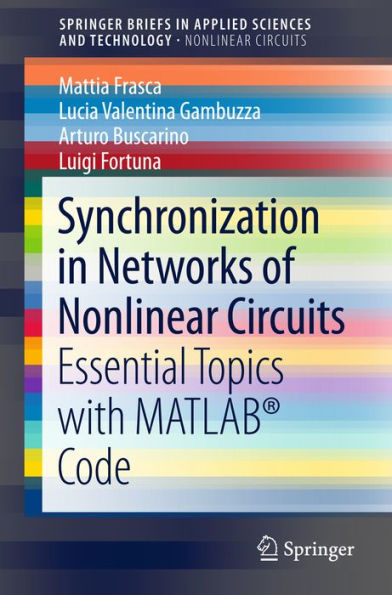
Synchronization in Networks of Nonlinear Circuits: Essential Topics with MATLAB® Code

Product Details
| ISBN-13: | 9783319759579 |
|---|---|
| Publisher: | Springer-Verlag New York, LLC |
| Publication date: | 03/10/2018 |
| Series: | SpringerBriefs in Applied Sciences and Technology |
| Sold by: | Barnes & Noble |
| Format: | eBook |
| File size: | 5 MB |