
 .
.For the first four months of 1942, U.S., Filipino, and Japanese soldiers fought what was America's first major land battle of World War II, the battle for the tiny Philippine peninsula of Bataan. It ended with the surrender of 76,000 Filipinos and Americans, the single largest defeat in American military history.
The defeat, though, was only the beginning, as Michael and Elizabeth M. Norman make dramatically clear in this powerfully original book. From then until the Japanese surrendered in August 1945, the prisoners of war suffered an ordeal of unparalleled cruelty and savagery: forty-one months of captivity, starvation rations, dehydration, hard labor, deadly disease, and torture—far from the machinations of General Douglas MacArthur.
The Normans bring to the story remarkable feats of reportage and literary empathy. Their protagonist, Ben Steele, is a figure out of Hemingway: a young cowboy turned sketch artist from Montana who joined the army to see the world. Juxtaposed against Steele's story and the sobering tale of the Death March and its aftermath is the story of a number of Japanese soldiers.
For the first four months of 1942, U.S., Filipino, and Japanese soldiers fought what was America's first major land battle of World War II, the battle for the tiny Philippine peninsula of Bataan. It ended with the surrender of 76,000 Filipinos and Americans, the single largest defeat in American military history.
The defeat, though, was only the beginning, as Michael and Elizabeth M. Norman make dramatically clear in this powerfully original book. From then until the Japanese surrendered in August 1945, the prisoners of war suffered an ordeal of unparalleled cruelty and savagery: forty-one months of captivity, starvation rations, dehydration, hard labor, deadly disease, and torture—far from the machinations of General Douglas MacArthur.
The Normans bring to the story remarkable feats of reportage and literary empathy. Their protagonist, Ben Steele, is a figure out of Hemingway: a young cowboy turned sketch artist from Montana who joined the army to see the world. Juxtaposed against Steele's story and the sobering tale of the Death March and its aftermath is the story of a number of Japanese soldiers.

Tears in the Darkness: The Story of the Bataan Death March and Its Aftermath
496

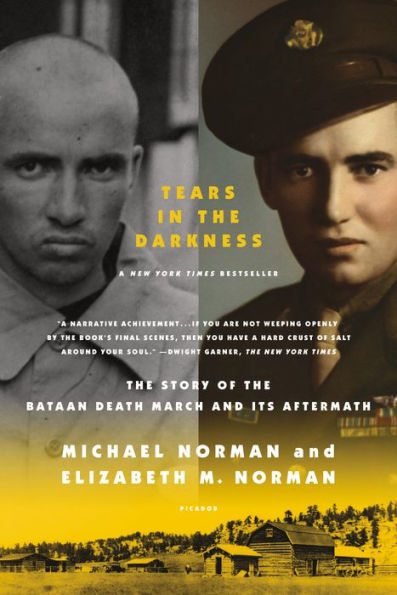
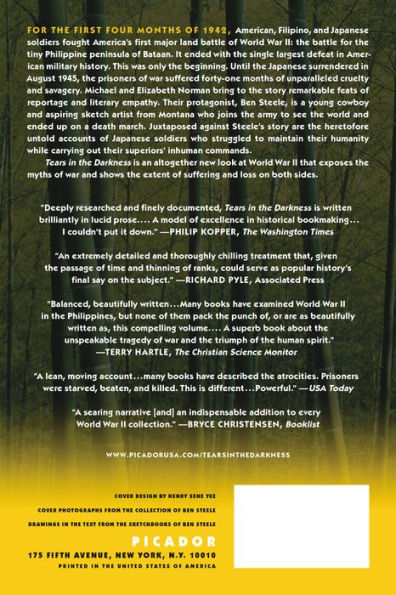
Tears in the Darkness: The Story of the Bataan Death March and Its Aftermath
496Paperback(First Edition)
-
SHIP THIS ITEMIn stock. Ships in 1-2 days.PICK UP IN STORE
Your local store may have stock of this item.
Available within 2 business hours
Related collections and offers
Overview
For the first four months of 1942, U.S., Filipino, and Japanese soldiers fought what was America's first major land battle of World War II, the battle for the tiny Philippine peninsula of Bataan. It ended with the surrender of 76,000 Filipinos and Americans, the single largest defeat in American military history.
The defeat, though, was only the beginning, as Michael and Elizabeth M. Norman make dramatically clear in this powerfully original book. From then until the Japanese surrendered in August 1945, the prisoners of war suffered an ordeal of unparalleled cruelty and savagery: forty-one months of captivity, starvation rations, dehydration, hard labor, deadly disease, and torture—far from the machinations of General Douglas MacArthur.
The Normans bring to the story remarkable feats of reportage and literary empathy. Their protagonist, Ben Steele, is a figure out of Hemingway: a young cowboy turned sketch artist from Montana who joined the army to see the world. Juxtaposed against Steele's story and the sobering tale of the Death March and its aftermath is the story of a number of Japanese soldiers.

Product Details
| ISBN-13: | 9780312429706 |
|---|---|
| Publisher: | Picador |
| Publication date: | 03/02/2010 |
| Edition description: | First Edition |
| Pages: | 496 |
| Product dimensions: | 8.26(w) x 5.56(h) x 0.82(d) |
About the Author
Elizabeth M. Norman, the author of two books about war, teaches at New York University’s Steinhardt School of Education.
Read an Excerpt
Chapter One
He enlisted on the advice of his mother, Bess.
In the late summer of 1940, Ben Steele was working as a camp tender at a large sheep outfit east of town. It was hard, sometimes filthy work, but the freedom of it made him happy—on his own every day, riding a horse or driving a rig between the far-flung camps of the sheepherders, delivering mail and supplies, sleeping in the open, wrapped in an oilcloth, staring up at a big sky dark with bright stars.
One weekend that summer Ben Steele’s mother and father drove out from Billings to visit. His mother had an idea. He’d been a ranch hand most of his life, she said. He was twenty-two now, grown up. Maybe it was time to consider something else. She’d heard on the radio that President Franklin D. Roosevelt had just signed a law creating the first peacetime military draft. The inaugural call-up, she said, was scheduled for late October.1
"You know, I’ve been thinking," she went on. "You really ought to get in before they draft you. Maybe if you do, you could, you know, do what you want in the army?"
He wasn’t sure he wanted to wear a uniform, but since he usually took his mother’s advice to heart, he tucked her suggestion away, and a while later, over a smoky campfire perhaps or riding the green hills and valleys, he remembered something; the boys he knew from Billings who had enlisted in the army were usually sent west for training to the golden valleys of California.
He thought, "Going to California—that sounds good. A little adventure." And on a nice warm day in mid-September, he borrowed a car, went into town, ambled over to the Stapleton Building on Twenty-eighth Street and into the recruiting station there, where he found a sergeant sitting at a desk.
"I want to go into the army," he announced.
"Well now," the recruiter said, looking up at the lean ranch hand standing in front of him, "we have the Army and we have the Army Air Corps, which one you want?"
Ben Steele knew nothing about soldiering, but some years earlier a couple of fellows up at the Billings Municipal Airport got themselves a Ford Tri-Motor (a propeller under each wing and one on the nose) and for a dollar a head started taking people for a ride. It wasn’t much of a ride—the plane took off from atop the rimrocks, circled the Yellowstone Valley below, and a few minutes later landed to pick up another load of wide-eyed locals. But that short hop stirred something in Ben Steele.
"The Air Corps?" he said. "That sounds real good. Give me that!"
A few weeks later, on October 9, 1940, a month shy of his twenty-third birthday, Ben Steele stood in a line of enlistees at the United States Courthouse in Missoula, Montana, raised his right hand, and repeated one of the republic’s oldest oaths: "I do solemnly swear that I will support and defend the Constitution of the United States against all enemies, foreign or domestic . . . So help me God."
LIKE EVERYONE ELSE, like every American who read the newspapers, listened to the radio, went to the movies, and watched newsreels, Private Ben Steele of the United States Army Air Corps was convinced his enemies would be German. Japan was a threat, all right—that fall, in fact, America cut its shipments of scrap steel and iron to Japan—but Germany, threatening all Europe, was the menace of the moment.2
The Germans had invaded Poland, Denmark, Norway, Belgium, the Netherlands, and France. By the time Ben Steele arrived at the induction station in Missoula in the fall of 1940, the German Luftwaffe had been bombing Great Britain for three months.
Reading about all this in the Billings Gazette or listening to it on KGHL radio, the most popular station in that part of the West, most Montanans wanted no part of the trouble overseas. Like the rest of America, they were focused on finding jobs and recovering from the Great Depression, not crossing swords with the saber-rattling Germans. In a national opinion poll conducted the week Ben Steele enlisted, 83 percent of the those surveyed said they did not want to send American troops overseas.3
Young men looking for a job or a little adventure don’t pay much attention to opinion polls. The army was offering a paycheck, plus "three hots and a cot" and perhaps a chance to travel. Since they had no feel for the killing and dying in Europe, no sense at all of facing Panzer tanks and Stuka dive-bombers, the ranch hands, soda jerks, delivery boys, and railroad workers on their way to training camp with Ben Steele were full of brio and eager for action.
"If war’s gonna come, I wanna be in it," Ben Steele thought. "Hell, I want to be over there where it’s happening."
Saturday, October 4,1941, San Francisco
Blue sky, bright sun, seventy-two degrees, a good day to set sail for paradise.
On a pier off the Embarcadero, the men of the 19th Bombardment Group, United States Army Air Corps, waited in long queues to board the United States Army transport General Willard A. Holbrook, a lumbering troopship used to ferry men and matériel to American bases overseas. In the ranks on the wharf, moving slowly toward the gangway, was Benjamin Charles Steele, serial number 190-18-989, a newly minted private. He had been in uniform nearly a year now, and he liked the life of a soldier. The army had given him just what he wanted, a chance to cross the mountains and see the Golden Land.
California wasn’t as golden as he’d imagined, but he liked it well enough. Training camp was a dusty tent city on the dry brown flats at March Field near Riverside. The boys from the cities and suburbs thought these accommodations "kinda primitive," but the men who had been ranch-raised looked around and saw luxury: tents with wooden floors and gas stoves, hot showers nearby, latrines that weren’t buzzing with flies, and a mess hall that served seconds if a man wasn’t sated.
Air Corps basic training was short, just six weeks, long enough for men who would be working as airplane mechanics, gunners, ground crews, and supernumeraries. They attended classes on military courtesy and discipline. They reviewed army rules and regulations. They endured hours of close-order drill and the ritual of forced marches.
These little walks, as Ben Steele thought of them, were too much for many of the men. After one eight-mile hike the road was lined with recruits doubled over, gasping for breath and grousing about their training. Ben Steele had never heard such bellyaching.
"Holy Christ!" he said, to no one in particular. "Eight miles is nothing. Back home I’d walk that far before breakfast."
"Oh yeah?" one of the malcontents came back. "Where the hell did you come from?"
"I’m from Montana," Ben Steele said.
THE ARMY sent him to New Mexico after basic training and assigned him to the 7th Matériel Squadron, 19th Bombardment Group, Kirtland Field, Albuquerque. As soon as he was settled, he made inquiries about buying a horse.
A local stockman wanted fifty bucks for an old plug named Blaze. Not much of a horse, nothing like the spirited animals he was used to, but he missed riding, so he went to a finance company, borrowed the money (agreeing to pay five dollars a week against the balance), and made a deal with a nearby rancher to pasture his mount. His father shipped him a saddle, and every weekend Ben Steele rode out among the cactus and scrub grass. It was hot, sandy country but he didn’t care— he was on a horse, and a horse reminded him of home.
The Air Corps made him a dispatcher, tracking flights, and after a month or two of this work he got it in his head that he wanted to be a pilot. Never much of a student, he found a math professor at the University of New Mexico to tutor him privately in the algebra and geometry that he would need to pass the exam to become a cadet. He studied for several months and was about to take the test when word came down that the 19th Bombardment Group was being sent overseas.
"You can’t ship me out," he told his commanding officer. "I’m fixing to take the cadet exam."
"Oh yeah, we can," the squadron commander said. "The whole out-fit’s goin’."
October 3, 1941
Dearest Mother and Family,
Thought would drop you a few more lines before departing the U.S. Am sailing tomorrow afternoon ...We don’t know for sure how long we will have to stay in foreign service but hope it isn’t too long, but it may be alright... Will write you every chance I get so you will know about where I am at... Just heard we were going to the Philippines, but that is just a rumor not certain. Can’t believe a thing you hear around here... Don’t worry about anything, because everything is O.K. Will write as soon as I can make connections. It is possible we will stop at some port along the way, and if we do will send you a line.
Lots of Love to you all
Bud.
AMERICA REMEMBERS the attacks on its bases in the Pacific in 1941 as acts of treachery, but to label them "sneak" attacks is more propaganda than plain truth. For more than twenty years, a standing committee of admirals and generals in Washington had been planning against just such an attack. They looked at Japan as America’s chief antagonist in the Pacific, and they knew well the value of surprise and Japan’s history of success with this tactic. The military planners were sure that when war came, it would begin "with a sudden, surprise attack." They did not know exactly where or precisely when, but they were convinced that the Philippines, just eighteen hundred air miles from Japan and sitting directly between it and the oil- and mineral-rich Indonesian archipelago in the southwest Pacific, would top Japan’s list of targets. So in the early fall of 1941, with war consuming Europe and with the Japanese Army on the march in Asia, American war planners—more in an attempt to deter an attack than defend against it—began to rush cannon, tanks, airplanes, and men to the Philippine Islands. The men of the 19th Bombardment Group, United States Army Air Corps, were part of that consignment.4
The Holbrook set sail on the evening tide that October 4. In the ship’s galley cooks had prepared a greasy ragout of pork, and as the men passed through the mess line, stewards slopped the dinner on their trays. Later that night the wind picked up, the waves began to swell and the Holbrook began to pitch and roll, and it wasn’t long before all that greasy pork began to reappear. Soon the crappers were clogged and the sinks were overflowing.
October 10, 1941
Dearest Mother and Family,
Have been sitting out on the deck this morning watching flying fish. They are about six inches long and sail through the air like a bird...The water has been sort of rough all the way... The ship is bobbing up and down and from one side to the other till I can’t even sit still. Am sitting here on the deck and writing on my knee. Hope you can read this.
AFTER HAWAII, the sailing was easy, flat water most of the way and light tropical breezes. Most men spent mornings topside, watching the water or staring at the horizon, absorbed by the vast vista of the sea. Some played cards on the hatch covers or spread out their towels and baked in the afternoon sun. In the evenings Quentin Pershing Devore of eastern Colorado came topside to listen to his Hallicrafter shortwave radio. One evening a dark-haired fellow with a friendly face eased over and sat down next to him.
"I’m Ben Steele," he said, holding out his hand.
"I’m Pershing Devore."
"What do you get on that thing?" the fellow asked.
"I get the news, sometimes I get music," Devore said.
Devore too had grown up outdoors, working the land and livestock in the rye- and wheat-farming country of Yuma County, a day’s drive or so from the Nebraska border. He considered himself "a plain boy with no frills," and that’s how this fellow from Billings struck him, too, "real plain."
"Where did you get that name, Pershing?" Ben Steele asked.
"Well, my name is Quentin Pershing Devore, but they call me Pershing."
"That’s too complicated," Ben Steele said. "I’m just going to call you Q.P."5
October 18, 1941
Dearest Mother, Dad + Family,
Met a new friend. He likes hunting and fishing about as well as I do. We get together and talk over old times. It sort of makes me feel at home...
They talked for hours, about farming and ranching and cattle and sheep, about the "hard-up" life on a Colorado farm and the hardscrabble days on a Montana homestead. Ben Steele often turned the conversation to horses—cow ponies, broncs and quarter horses, chestnuts, Appaloosas and bays.
Q.P. thought, "This guy is crazy about horses."
They talked about war as well. Their convoy was flanked by destroyer escorts, and at night the ship was blacked out, a shadow on the sea.
A week and a half out of Hawaii, their company commander called them together. They were going to the Philippines "to fight a war," he said.
Thursday, October 23,1941, Pier 7, Manila, Philippines
Assembled on deck, the thirteen hundred soldiers of the 19th Bombardment Group were preparing to greet paradise. Down the pier a line of trucks was waiting to take them north to their billets at Clark Field, a lattice of sand-and-turf runways laid out on a hot, dry plain fifty miles northwest of Manila. As the young Americans made their way down the gangways and ladders to the queue of open trucks, they were wide-eyed with wonder and delight.
October 24, 1941
Was sure glad to get off the boat after being on it for so long. We were as dirty as a bunch of hogs when we landed.
It is sure interesting around here... The natives are as thick as bees... and live in little bamboo shacks...Drive little horses about the size of a good sized dog, hitched to a little cart. Some have oxen [carabao] hitched to old wooden wheeled carts, sure is interesting to watch them . . . They are always trying to sell us something. They are running from one barracks to the other trying to get a job making our beds, and shining our shoes...Would hate to think I was so lazy I couldn’t make my own bed. We have to have mosquito nets over our beds at night so we can sleep. The mosquitoes here are like humming birds...
Don’t worry about me because I never felt better in my life, and am having a swell time. So please don’t worry. This will be one of the greatest experiences of my life.
FOR DECADES the Philippines had been a backwater post, a collecting pool for those on the way up, young officers eager to get their tickets punched for promotion, and those on the way out—the deadwood, the drunks, the disappointed who had been passed over for rank and were now holed up in a quiet billet, waiting to put in their papers and take a last parade.
It was a gorgeous backwater. Manila was known as "the Pearl of the Orient," and parts of the city, especially the precincts where Americans and Europeans lived and worked, looked like arboretums. Along the boulevards, the trees were trimmed and ringed with pink hydrangeas, and white butterfly orchids grew in the coconut husks.
The duty was easy too, inspections and formations for the most part, then at noon, the workday ended and the enlisted men would head for the beaches and ball fields and brothels of the nearest barrio where they would "shack up" with their "brown-skinned squaws," their Filipina concubines. Life had its annoyances, of course—the soaking summer monsoons, the suffocating heat of the hot season, the incessant insects, the choking dust—but for less than a dollar, a trooper could buy enough Ginebra gin and San Miguel beer to drink himself senseless.
The officers lived like aristocracy. They played polo, tennis, and golf, then made for their private preserve, Manila’s fabled Army and Navy Club, a three-acre toft and croft along the east shore of Manila Bay that looked like a beaux arts mansion set on a waterfront green of palms, flame trees, and bougainvillea. The club hosted dinners and soirees, women and their escorts dancing under the stars and toasting one another over centerpieces of yellow trumpet flowers and white Cadena de Amor. First, and above all, however, the Army and Navy Club was a men’s club, and the men of the Philippine garrison and Asiatic Fleet liked to drink.
Almost every officer in the islands bellied up to the club’s long polished bar—pilots, tankers, artillerymen, chasseurs, submariners, marines—but none more frequently than the gentlemen of the 31st Infantry, the only "all-American" army regiment in the islands.
We are boys from the Thirty-first
We are not so very meek
We never wash behind our ears And seldom wash our feet.
Oh we’re below the scum of the earth
And we’re always looking for booze
Now we’re the boys from the Thirty-first And who in the hell are youse!6
That was garrison life.
Then—it seemed to happen so fast—those unhurried mornings, sultry afternoons, and sybaritic nights were interrupted by an irritating interloper: the Japanese.
Nippon had been on the march in Asia. In 1931 the Imperial Army occupied Manchuria; in 1937 that same army, reinforced, moved south to invade northern China; in 1940 Japan pushed into lower Asia and stationed troops in upper Indochina. To the Roosevelt administration, the Japanese now appeared ready to move against the Dutch East Indies, islands and archipelagoes rich with tin, rubber, oil. Convinced that America would soon be fighting in Europe, the president wanted to avoid a two-front war, and he decided to impose economic sanctions on Japan, hoping to get them to pull back, perhaps even declare a cease-fire in China. He withheld the carrot, then in the early winter of 1940 he started to show them the stick.
America’s military planners began marshaling reinforcements for the Philippines. They knew they could never make the islands a redoubt— Japan, with millions of men under arms, could easily overwhelm any garrison—but, as the thinking went, the new defenses, especially a new long-range B-17 bomber, might deter the Japanese, make them reconsider the cost of attacking the Philippines. If not, then the presence of
reinforcements might at least make them pause long enough for the garrison to ready itself to receive the blow.
In the late spring 1941, the wives and children of American servicemen were ordered to evacuate the islands and sail for home. In July the president recalled General Douglas MacArthur from retirement (he had been serving as a military adviser to the Philippine Commonwealth government since 1935) and named him commander of United States Army Forces in the Far East. The same month the Commonwealth government mobilized the tens of thousands of reservists that made up the Philippine Army. In September, American troop ships and freighters began to arrive regularly at Pier 7. By the end of November, the U.S. Army garrison had been increased to nearly 31,000 troops (19,000 Americans, 12,000 Philippine Scouts), triple its original strength. Almost immediately thereafter MacArthur ordered beach defenses dug and manned by the Philippine Army at the most likely landing spots on the main island of Luzon.
November 9, 1941
Dearest Mother, Dad and Family:
...Well I suppose you have been reading the head lines about the U.S .and Japan, but don’t get excited. Can just see you running around worrying yourself sick. Of course we don’t hear much about it. I think we are safe .We get some of the news and there is a lot we don’t get.
The workday was longer now as men and machinery moved north and south from the piers and warehouses of Manila. Days carried the din of hammering and sawing, nights the rumble and whine of trucks on the roads. The polo fields were often empty, the tennis courts quiet. Some evenings the bar girls at Cavite’s Dreamland Cabaret ("Call us ballerinas, please!" the taxi dancers insisted) toured the dance floor alone or in one another’s arms.
And yet there was still an air of assurance in the islands, a sense that the latest alarm or clarion call would pass without incident and paradise would soon be paradise again. Intelligence reports about Japanese troop movements arrived daily at headquarters, but the majority of officers under MacArthur’s command had convinced themselves "it would be absolutely impossible for the Japanese to attack the Philippine Islands successfully!" Japan, they reasoned "had everything to lose by going to war and nothing to gain."7
So they went about preparing for war with little sense of urgency or imminence. And this strange stupor, this "weakness," as Colonel Ernest
B. Miller, a tank commander from Brainard Minnesota, saw it, led to "things left undone," so many things that even in the end, "with the black clouds of war directly overhead, it was well nigh impossible to quicken the tempo" of the work.8
And why should they? General MacArthur had told his officers that intelligence reports on "the existing alignment and movement of Japanese troops" had convinced him that if Japan, in fact, attacked, it would not do so until the spring of 1942, April at the earliest. Many of his subordinates disagreed, but there was no arguing with the general. The enemy, he insisted, wasn’t coming till spring.9
Japan wasn’t much of an enemy either, or so the Americans believed. For more than a century whites in Asia had looked on the tawny "locals" as less than human. They thought the Japanese "monkey men"—short, slight, bucktoothed, "slant-eyed sons of bitches" who "couldn’t see straight," even through their horn-rimmed glasses, because, as everyone knew, "their eyeballs didn’t open up to the proper diameter." An enemy who could not see straight could not shoot straight, could not keep his planes on course or drop his bombs on target. The war wouldn’t last three weeks, they told one another. "We’ll knock the living shit out of them.10
Even at General MacArthur’s headquarters, where war planning should have sent up a din, "men went about their work as usual." On the evening of December 5, for example, MacArthur’s clerk, Paul Rogers, settled himself in a seat at the Manila Symphony and enjoyed a program of Mozart.11
And it didn’t take long for the young enlistees and reservists fresh from the States to assume that same attitude of indifference. To be sure, there were a few who went against the tide, officers who’d come to the islands "to soldier," as they put it, professionals who now bridled at being part of "a military force afflicted" with "siesta-itis," but their complaints were lost in the laughter around the bar and the sighs coming out of the seraglios.12
Monday, December 8,1941(December 7across the International Dateline), Manila, Philippines
Frank Hewlett, a United Press wire service reporter, got the cable from a colleague in Hawaii around 2:00 a.m. local time. Stunned and looking for official confirmation, Hewlett quickly called the office of Admiral Thomas C. Hart, commander of the Asiatic Fleet. At Fleet Headquarters in Manila, a duty officer answered the phone. Hewlett read him the cable: "Flash! Pearl Harbor under aerial attack."
What did he mean, under attack? The man at Fleet HQ thought Hewlett was goading him. He was tired and in no mood for another "Jap joke."
"Tell your Pearl Harbor correspondent to go back to bed and sleep it off," he told Hewlett, then hung up.13
At the same time, across Manila Bay at the Cavite Naval Base, Seaman Second Class Frank Bigelow, a tall, lean message clerk from Pleasant Lake, North Dakota, stumbled aboard the submarine tender USS Canopus tied up at a wharf. Bigelow had been out drinking and "catting around" with the local amourettes at one of many brothels in nearby Cavite City. Now, "about half drunk," he crawled up into his bunk and was just about to drift off when another sailor came running into the compartment.14
"They’re bombing Pearl Harbor!" the man shouted. "They’re bombing Pearl Harbor!"
Bigelow didn’t believe him and turned his face to the bulkhead to sleep.
The first public word of the attack came over KZRH commercial radio sometime after 2:30 a.m. A short while later, MacArthur and Admiral Hart alerted their commands, but the officers, for the most part, did not tell the men in the ranks until they awoke for breakfast.
North of Cavite and Manila, some fifty miles up the dusty main highway, was Fort Stotsenberg, an army base adjacent to Clark Field. At the nurses’ quarters near the fort hospital, the women had just settled themselves down in the mess to their fruit, eggs, rolls, and coffee when someone reached up and switched on a radio and the familiar staccato of announcer Don Bell started to issue from the box.
"Hey, listen to that!" one of the women said. "They’re having a war in Hawaii. And here we are in the Philippines, and we’re going to be left out of it.&34;15
Less than two miles away, on a road just east of Clark Field, Corporal Zoeth Skinner of Portland, Oregon, part of a five-man crew in a half-track, a kind of tank without a top, was parked in the sun at the side of the highway. The tank battalions had a complement of half-tracks to cover their flanks and scout their points, and for several days the battalions had been on "maneuvers" near the field. In fact they had been deployed to protect the airplanes, but the crews thought they were on another pointless exercise. Then their platoon commander rolled up on a motorcycle.
"Hey, fellas!" He was excited. "The war’s started. They’ve bombed Pearl Harbor!"
Then he roared off.
"Aw, that’s just part of the maneuvers," one of the men said.16
West of the road, across acres of bamboo and sugarcane, sat airplane hangars and barracks for the ground crews at Clark Field, among them the men of the 19th Bombardment Group. At morning chow an officer had climbed up on a chair and announced: "We’ve been attacked by the Japanese at Pearl Harbor, but there is no word yet on the extent of the damage."
Maybe "it wasn’t all that bad," Ben Steele thought. Then, throughout the morning each new report brought a few more details: battleships had been hit, sunk, or badly disabled; casualties were rumored to be high; there was talk that the country’s formidable Pacific Fleet had been hard hit, perhaps crippled.
The men at Clark Field could "hardly believe" what they were hearing. They had not expected war to "start so soon" or the enemy to sally that far from home.
It just didn’t seem real. Shocking, perhaps, but not real, a war without pain or pounding fear, far away, five thousand miles to the east. So the men at Clark Field went to work. The flight crews reported to the flight line, the armorers to the armory, the pilots to their planes. And they waited. They waited and watched the sky. Seven o’clock, seven thirty, still nothing.
They were also waiting for word to strike back. Air Corps commanders in the Philippines knew from intelligence reports that Japanese Army and Navy bombers would likely come at them from Japanese bases on Formosa, five hundred miles due north. And Major General Lewis
H. Brereton, the commander of the Far East Air Force, and his staff had been prepared since November 27 (the day Washington warned all commanders in the Pacific that it believed Japan was ready to go to war) to bomb the Formosan airfields or the harbor at Takao, the likely place the Japanese would gather an invasion force.
To his staff, Brereton was "a square-rigged, stout-hulled believer in action." Earlier that morning, after he had learned of the attack on Pearl Harbor, he had rushed to MacArthur’s headquarters at One Calle Victoria in Manila and asked permission to arm and launch the nineteen new B-17 bombers of the 19th Bombardment Group standing by at Clark Field.17
MacArthur’s chief of staff, Major General Richard Sutherland, told Brereton to wait for MacArthur’s approval. Brereton went back to Air Corps headquarters at Nielson Field and sat. And sat. At seven fifteen he could sit no more and returned to headquarters. Again Sutherland told the Air Corps commander, wait.
AT CLARK FIELD, Ben Steele and his Air Corps comrades wanted to hit the Japanese on Formosa before the Japanese came at them. Most of all they wanted to get their bombers and fighters off the ground, where they were the most exposed and vulnerable.
Word had come down that the Air Corps planes at Hickam Field in Hawaii had been parked wingtip to wingtip, an easy target for Japanese bombardiers. Enraged by the folly at Hickam, the Air Corps chief in Washington, Major General Henry H. Arnold, had called General Brereton in the Philippines and warned him not to make the same mistake at Clark.
Sometime between 8:00 and 9:00 a.m., Major David R. Gibbs, the acting bomb-group commander at Clark, was handed an alert: enemy planes had been spotted over Lingayen Gulf northwest of Clark Field, headed toward Manila. Fearing Clark might be their target, Gibbs immediately ordered the squadrons of bombers into the air, but without bombs. MacArthur still had not given his permission to arm the planes for an attack on Formosa, so the bomber pilots were told to cruise high overhead.
At last, around 11:00 a.m., MacArthur authorized a reconnaissance flight over Formosa to be followed by bombing missions later that afternoon, and the bombers from Clark were immediately recalled to arm them for the mission. The squadrons of pursuit fighters that had been flying protective cover over Manila and other parts of Luzon that morning were also brought down to refuel. By 11:30 most American warplanes in the Philippines were on the ground, being serviced and readied to take off again.
After the crews and pilots at Clark Field finished this work, they went to lunch in shifts. Some of the aircraft were properly protected behind revetments, others dispersed, but many, too many, were parked in neat rows in the open on their ready lines, noses to the runway. From above they looked like toys on a large lawn, silver toys perfectly outlined against the greensward of Luzon’s wide central plain.18
December 8,1941,11:00a.m., 19,000feet somewhere over the South China Sea in the cockpit of an Imperial Navy A6M2 Zero fighter
It was not a lonely impulse of delight that had sent Saburo-Sakai aloft to make tumult in the clouds. It was duty, a sense of obligation born of both politics and myth.
The myth begins in heaven before the world was the world. Looking down one day, the celestial kami (gods) created a new domain: the Eight Great Islands at the Center Of The World, a misty land of emerald hills and jade valleys known to moderns as Dai Nippon, great Japan.
The rest of the earth, so the Shinto myth goes, was mere matter, seafoam and mud, but Nippon, the issue of the gods, was sacred soil, superior to all other lands, the aegis of Amaterasu, the goddess of the sun.
Amaterasu sent her grandson, Ninigi no Mikoto, to consolidate her domain, then she named her great-great-grandson, Jimmu Tenno, to rule there. By heavenly charge he became "emperor," the first of Amat-erasu’s earthly line. Grateful for the appointment, Jimmu Tenno made his "illustrious" foremother a promise: he and his semidivine seed would extend the rule of heaven "to embrace" the entire earth. Hakko-ichi-u, "the world under one roof," they called it, the plan of a people blessed by heaven and ruled by the descendants of the goddess of the sun.19
The myth of Amaterasu instilled in the Japanese an unfaltering feeling of uniqueness, Yamato-damashi, "the spirit of being Japanese." The feeling, more powerful than any sense of self, stirred every Nipponjin, especially Japan’s fighting men, men like Petty Officer First Class Saburo Sakai.
The twenty-five-year-old Imperial Navy fighter pilot, flying south with a squadron of Mitsubishi Zeros on the late morning of December 8, 1941, marveled at his luck. It was a perfect day for an attack, bright sun, clear sky.20
Just before 11:30 a.m., Sakai looked down and saw "the Philippine Islands hove into view, a deep green against the rich blue of the ocean." Then "the coastline slipped beneath" him, "beautiful and peaceful. 21
It was the opening hours of what the Japanese would call "the Greater East Asian War" or "the Great Pacific War." The Japanese had marshaled four armies and fleets to strike American, British, and Dutch targets in the central and southwest Pacific, as far south and west as Malaya and as far east as Hawaii—a battle zone shaped like an immense fan some four thousand miles long and seven thousand miles wide with Tokyo as its pivot. The fan covered a large slice of the globe, all the way from Burma west to Hawaii, six major meridians of time into the heart of the vast Pacific.
Saburo Sakai, stick in his right hand, throttle in his left, was part of this great effort, the effort to bring the world under one roof and, myth and religion aside, to take the territory and resources Japan claimed were hers by right and necessity. A holy war and a fight for survival rolled into one and draped with a cloak called honor.
The atavists in the army, and there were many of them, liked to use history and an old injury to advance their agendas and aims. They looked back a century, to July 8, 1853, when the ambitious Commodore Matthew C. Perry sailed into Edo (Tokyo) harbor with four black-hulled warships and orders from the president of the United States to open Japan, a closed and feudal society, to the West. Those black ships and Perry’s implied threats shamed the Japanese, and to recover their honor and preserve their independence, they moved quickly to make themselves modern.
In the four decades that followed, they cast aside the feudal shogunate, the moribund military autocracy that had governed Japan since the twelfth century, and replaced it with a constitutional monarchy. Then, with help from the French, British, and Prussians, they created a modern, Western-style army and navy. They also set up new industries, built transportation networks, and established a national system of public schools. But in their rush to strengthen their emerald domain and safeguard their precious sovereignty, the parvenus who were racing to embrace the present also held hard to the past, for at heart they were traditionalists, aristocrats, many of them, who did not want Japan to lose its soul—that deep sense of divine origin and the ancient impulse to loyalty and sacrifice that they believed held their society together. They borrowed from the West, these reformers of the Meiji Restoration, as that great change came to be called, borrowed some of the West’s social science and many of its machines and fashions, but their aim always was to keep Japan Japanese. "Eastern ethics, Western science," was the adage of the day, though Eastern ethics apparently included the West’s inclination for empire and the notion that a strong arm was needed to acquire it.
After the turn of the twentieth century, Japan found itself in conflict with Russia over concessions in Korea, just across the Sea of Japan and strategically important to the Japanese. Most military observers of the day predicted that the Russians would swiftly overwhelm the force Japan sent against them, "The Eagles had . . . already fixed their talons on the carcass," wrote one British officer. Nippon, however, struck fast, and its troops, as fierce as any the West had ever seen, defeated the mighty Russians at Port Arthur.22
In just fifty years Japan had transformed itself from a feudal overlordship into a modern military and industrial state, and now it was ready to share in the swag and booty of empire, to grab territory and force concessions in China and domains south, just as the Europeans had been doing in the Pacific since Magellan’s famous sorties in the first decades of the sixteenth century.23
Japanese diplomats, pressed to defend their country’s aggression, claimed necessity. Japan had suffered a series of recessions, and by 1929, the year of widespread financial collapse, the economy was faltering. Ultranationalists in government, aided by right-wing army officers, pressed for a military solution. And by 1937, the army had provoked so many military "incidents" on the Asian mainland that they got what they wanted—a full-scale war. By the end of 1938 the Japanese had more than a million troops fighting in China.
Alarmed, America began an economic war of nerves with the Japanese. Using embargoes of vital materials such as scrap iron, machine parts, and aircraft, America hoped to force Japan to pull back from China. When nothing worked, President Roosevelt in July 1941 froze all Japanese assets in the United States, in effect creating an embargo of the commodity Japan needed most—crude oil. And since America was Japan’s chief source of oil, the boycott left the Imperial Army and Navy in a crisis.
The Japanese decided to take what they needed, and what they needed was in the hands of the British and the Dutch. War planners in Tokyo knew well that by striking the East Indies they would provoke Europe’s ally, the United States, into a fight. They also knew that they could not defeat the industry-rich Americans; the United States with its vast resources and its capacity to manufacture whatever war matériel it needed would eventually wear them down. Japan’s only chance was to win as much as they could as quickly as they could, then sue for peace and the status quo. Keep the Americans off balance for six months, seize the mineral-rich colonies in the southwest Pacific, then set up a ring of defenses to protect their gains.
SURPRISE WAS ESSENTIAL. Surprise had helped Hideyoshi in Korea in 1592 and had carried the day against the Russians at Port Arthur in 1904. Officers of the Imperial Japanese Army and Navy also knew well the words of the Kendo master Miyamoto Musashi: "You win in battles with timing . . . the timing of cunning ...a timing which the enemy does not expect." Surprise leaves an enemy low, outwitted, taciturn. America "will be utterly crushed with one blow," an Imperial Navy admiral told the commanders of the Pearl Harbor task force at a briefing before the battle. "It is planned to shift the balance of power and thereby confuse the enemy at the outset and deprive him of his fighting spirit.24
But a surprise attack, a modern coup de main, demanded careful planning, constant practice, strict secrecy, a willingness to sacrifice, and a lot of luck.25
The Japanese have seven gods of good fortune, and on December 8, 1941, these seven kami were with them. The attack on Hawaii left much of the Pacific Fleet burning or at the bottom of Pearl Harbor. The surprise sorties against the other targets in the Pacific were stunning victories as well. Still, of all the units on the attack that day, the force with the most luck was the 11th Air Fleet, Saburo Sakai and his fellow pilots in the fighters and bombers that had soared into the air from bases on Formosa to bomb Clark Field in the Philippines.
The battle plan had originally called for the Formosa squadrons to take off at 2:30 a.m., which would have put them over the target just after first light, roughly the same moment that the Pearl Harbor attack force, some five thousand miles to the east, was diving on Honolulu’s airfields and on the battleships of the American Pacific Fleet. But a rare and very unseasonal "thick pea-soup fog" rolled in from the Straits of Formosa that morning. And standing on the tarmac in their flight suits, Saburo Sakai and his comrades could not see more than five yards in front of them.
Through the fog came a voice from the loudspeakers on the control tower: "Takeoff is delayed indefinitely," and with that announcement, every pilot instantly understood that the element of surprise had been lost, for surely the Americans at Clark Field and at the other U.S. bases in the Philippines would have heard of the attack at Pearl Harbor and would be prepared for them, or perhaps the enemy was on its way to attack Formosa and the Japanese airfields there.26
Sakai and his fellow pilots, cupping their hands to their ears and listening for the sounds of American bombers overhead, waited for the fog to lift. Five o’clock, six o’clock, seven o’clock. At last the fog gave way to mist, mist to blue sky, and by eight forty-five, all squadrons were headed south.
The attack was now six hours behind schedule and Sakai was sure "after the long delay . . . [the enemy] would be awaiting us in great strength."
Just after noon the formation of fifty-three bombers and forty-five Zeros came roaring in from the South China Sea and the Zambales mountains. Below them, on the plains of Pampanga Province, was Clark Field, the main air base of the United States Army Forces in the Far East, General Douglas MacArthur’s army in the Philippines. When Sakai looked down, he saw "some sixty enemy bombers and fighters neatly parked along the airfield runways ...squatted there like sitting ducks.27
The Japanese airman was astonished. Why, he wondered, weren’t the Americans in the air, "waiting for us?"
The bombers made their passes first. To Sakai, whose squadron of fighters was circling above, protecting the bombers, the attack on Clark Field looked "perfect." He watched from his cockpit as "long strings of bombs tumbled from the bays" of the bombers "and dropped toward the targets." When they hit, "the entire air base seemed to [rise] into the air with the explosions. Pieces of airplanes, hangars, and other ground installations scattered wildly. Great fires erupted and smoke boiled upward.28
Now the Zeros took their turn. They "circled down to 13,000 feet . . . still without enemy opposition." Then, with his two wingmen in tow, Sakai nosed over, "pushed the stick forward and dove at a steep angle for the ground." He picked out two American B-17s sitting on the runway unscathed by the explosions and "poured a fusillade of bullets into the big bombers."
Later, safely back on Formosa, the Japanese pilots were elated. "Now," said one, "we have dealt a spectacular blow!" But, overall, they were surprised by their success and "bewildered" by their luck. They told their debriefing officers that they had "found the enemy’s planes lined up on the target fields as if in peacetime." It was almost "as if the enemy did not know that war had started.&34;29
THE AMERICAN PILOTS and ground crews were eating their lunch when they heard the drone of planes overhead. Some of them rushed outside and looked up.
A few, veteran pilots mostly, knew immediately it was the enemy, but many on the ground, the uninitiated and unknowing, mistook the formations for "friendlies." The planes, flying in giant V formations, were perfect in their spacing, their precision, their unerring course, "beautiful," some men thought, and stirring against the vault of powder blue.30
Then they began to see something strange, something that seemed to be floating beneath the giant Vs: small strips of silver glinting in the sun like tiny pieces of tin foil, "sparkles," Ben Steele thought. And all at once, they knew—bombs. Suddenly the air raid klaxon began its urgent warnings: Eah— Eah— Eah—
"Japanese!" Ben Steele heard someone yell. "Take cover!"
At roughly 12:15 p.m., the first of some forty-two tons of incendiary and fragmentation bombs started to fall toward the field. Some of the men simply stood there and stared, transfixed by the Vs and the silver sparkles falling from the sky.31
Then the base erupted. A line of explosions advanced across the field, then another line, and another. Each bomb held roughly a hundred pounds of explosive in its warhead, enough TNT to bring down a building, blow up an airplane, blast a hole in a runway twelve feet wide, and turn a flesh-and-blood human being into a spray of red. The men on the south side of the field watched the explosions approach—five hundred yards, three hundred, one hundred ...a burst of blinding white, a sharp, painful crack! followed by an enormous rip, a tearing of the air, then, finally, a deep shudder in the ground, the earth set atremble.
A bomb blast is lethal science, fluid mechanics meant to maim. First, the shock wave, a surge of air that hits a man like a wall of wind, hits him so hard his cerebrum starts to shake concussively in his skull, swelling at first, then hemorrhaging, rivulets of blood running from his nose and ears, vomit from his mouth. An instant after the shock wave passes, the atmosphere turns hot and dense, high pressure sucking the low pressure from every recess around it, from a man’s lungs and ears and eye sockets, leaving him gasping for breath and fighting the feeling his pupils are being pulled from their sockets. Finally, fluid mechanics turns to terminal ballistics as the blast blows apart the bomb’s casing, sending hundreds of jagged fragments—pieces of white-hot shrapnel, some no bigger than a pebble, others as big as a brick—slicing into anything in their path.
Q. P. Devore was hit right away.
He had spent the morning sorting armory supplies and at mess call had met his friend Ben Steele for lunch. He ate quickly that afternoon; the fellas in the control tower had invited him up for a look, so he climbed the stairs to the cupola on top of the first hangar to chew the fat with the operations boys and take in the view. All at once a voice came over an intercom: "Enemy bombers overhead." Devore laughed. Another false alarm. "Hey fellas, I’m going to step out on the stairs for a look," he said, and he began to descend from the cupola, down the stairs that hugged the outside of the hangar. When he heard the drone of engines, he stopped and looked up. He was halfway down the stairs when he heard the loudest noise he’d ever heard, and just like that, his world went blank.
When he came to, he was on the ground, lying among a litter of empty gasoline drums at the bottom of the stairs. His body ached, his head was thick and heavy. And he kept hearing a voice, faint at first, as if it were far away.
"Help . . . help."
As his head cleared, the voice grew louder.
"Help me! Please! Somebody help me!"
Devore rolled over and saw a man he knew, a lieutenant from his unit. He blinked and looked again. The man was wobbling, struggling to stand, to get up on the one leg he had left.
A truck stopped nearby and the driver rushed over to the two men. "Let’s get this officer to the hospital at Stotsenberg," he said, and Devore helped him load the lieutenant in the pickup, then jumped in the back.
At Stotsenberg hospital the wounded from Clark Field were everywhere, filling the wards, the halls, the concrete porch in back. When Q. P. Devore arrived with the mangled lieutenant, orderlies were putting men on blankets on the front lawn, and a nurse pressed Devore into service as a litter bearer, unloading truckloads of hobbled, bleeding, unconscious men. He hefted and hauled, stretcher after stretcher, until a nurse stopped him and said, "Hey, what’s the story with you?"
"I’m okay," Devore said.
"Really? Take a look."
His coveralls were soaked with blood and riddled with tiny holes. "Oh," he thought, "I didn’t even feel it."
Now and then a nurse, doctor, or patient would wander over to a window or the front door and look toward Clark Field, less than two miles away. The base was burning—airplanes, hangars, huts, barracks, trucks, and fuel tanks, even the fields of cogon grass were ablaze—and giant twisters of black and gray smoke and clouds of ocher dust were rising high over the runways. Soon the sky, the great blue dome above the central plain, was dark with carbon and ash.
Then they heard gunfire from that direction, the stabbing tchat-tchat-tchat of machine guns and airplane cannon. The Japanese Zeros had come down from the clouds to rake and strafe what the bombers had left.
The attack was over in less than an hour, but all afternoon and into the evening, trucks and cars carted the casualties up the road to Stotsenberg.
The injured, when they could talk, described brimstone scenes and stygian slaughter: bombs falling in trenches, dismembering and decapitating those caught cowering there; orange fireballs of gasoline and oil rimmed with a cockscomb of thick black smoke; pilots trying to take off, shot in their seats or trapped in their flaming cockpits; an airfield that looked like an airplane junkyard, the runways and aprons littered with pieces of wings, tails, and fuselage, and the riddled wrecks of bombers and fighters still smoking. Finally, amid all, derelict corpses and other detritus of war—an arm, a leg, a helmet with holes in it.
When the Zeros came down to finish the attack, they came in low, often just thirty feet off the ground, flying through the smoke and fire left by the bombs, shooting their rounds and tracers into planes and buildings, emplacements and men. Some of the wounded swore they could see the faces of the Japanese pilots and shot at them with their rifles and sidearms, sometimes sighting on the big red circles on the Zero’s fuselage and wings, those "goddamn red meatballs" and "big fried eggs," the hinomaru of Amaterasu, "the circle of the sun."32
In the operating room at Stotsenberg the wounded were taken four and five at a time, laid out on wooden doors set on crates and boxes. Helen Cassiani, a surgical nurse from Bridgewater, Massachusetts, had "never seen such carnage."
"Oh Lord!" she said to herself, "this is a madhouse."
In truth it was more like a knacker’s yard, with stretchers of flayed flesh and splintered bone "all over the lawn, the porch, the hallways, anywhere you looked." Outside was better than inside, where the smell of suffering—the stench of blackened flesh and the reek of green bile and vomit—collected in the still air of the corridors and wards. Most of all, the overpowering smell of blood, sweet with a hint of musk, so much that it made Cassie, as they called Helen, think of her family’s chicken farm and the way the barn smelled on days when the birds were being slaughtered.33
Some of the wounded shrieked and howled, but overall the scene was strangely quiet. Cassie noticed that most of the wounded were "shuddering from the deathly cold that comes from shock" or were so numb with morphine they kept their pain to themselves. Now and then a man with a crushed or dangling limb would summon a nurse to come close, and he would whisper a question: Was he going to lose his hand, his foot, his arm, his leg? Don’t worry, Cassie would tell them; the doctor would do what he could. In the end, of course, the doctor would amputate. There was no time, no equipment, no way to reconnect what had been torn loose and left hanging or rebuild what had been blasted into shards of bone and bloody bits of flesh. So they would shoot up the man with more morphine and clamp off the wound’s arteries and veins, and a surgeon would take a scalpel and pare down the muscle, pare it down to the bone, then the room would fill with the sound of sawing.34
Q. P. Devore had been lucky. The shrapnel had bounced off a rib instead of slicing into him. His legs had been peppered with fragments too, but looking at the litters queued up for surgery, he considered himself almost unscathed. Medics cleaned his wounds and gave him new coveralls and, in the afternoon, sent him back to Clark Field.
He was tired and sore when he wandered into the barracks, and there, waiting for him, was his good friend Ben Steele. Each man had prepared himself for the death of the other. And now, sitting side by side in a barracks full of bullet holes, bullet holes even in the blankets, each counted himself twice lucky, once for his own sweet life, once for the life of his friend.
"And what happened to you?" Q.P. asked.
"After lunch I went on back to the hangar area," Ben said. "Bunch of us were walkin’ about fifty yards from a trench when we hear this high drone, and we look up. They dropped so damn many bombs the sides of the trenches were caving in, you know? Then the fighters came in, just coming in right out of the smoke. Hell, I was shooting at them
with my forty-five. Really, right at point-blank range."35
The conversation carried them outside, over to the wreckage of the hangar and control tower stairs where Q.P. had been hit. Ben told Q.P. that after the attack he had run to the tower to look for him, but all he found was a jumble of gasoline drums under the stairs, and—he reached into his pocket—this wristwatch, which he held out to show him.
Q.P. looked, looked again. "Hey, that’s mine!" he said. "That’s my watch. I didn’t even know I’d lost it."
The two stood there, looking around them. The base was a wasteland of debris and burning junk. Gone were most of the barracks, offices, hangars, repair shops, fuel and ammo dumps, chow halls, and the base communications shack. In the gray half-light of evening, the two runways had so many craters that the field looked like a moonscape. Seventeen of the nineteen B-17 bombers and most of the American pursuit planes had been destroyed or heavily damaged. MacArthur’s Far East Air Force was now a line of wrecks smoldering in the sun.
"They really demolished this place," Ben Steele said. "They got everything."
The graves registration unit was still busy past sundown collecting the dead. More than 250 men had been wounded and some 100 killed, roughly 10 percent of the force manning the base.36
Many had fought well—pilots taxiing down the runway under fire, antiaircraft crews staying at their guns as fighter planes bore down on them, soldiers rushing into burning buildings to save buddies or retrieve valuable gear—but surprise strikes deep. And a large number of men, green privates bewildered by the bombs and veteran corporals and sergeants who had left their courage in a warm bed or in a bottle, were finished. At dark they simply abandoned their posts and fled into the woods and hills and barrios.37
The barracks were almost empty, just Ben Steele, Q.P., and a few others. Where the hell had everyone gone? they wondered. One of the officers said that sentries along the shoreline had spotted "troop transports" up north in the South China Sea, "an invasion force." Invasion? How were they going to stop an invasion now, without an air force? Another man was sure he could hear the sound of tanks in the distance, but whose tanks?
Q.P. was in rough shape. He told Ben he was so sore he could barely stand. Most of all, his nerves were shot; he was sure the barracks would be hit again and he wanted to get out of there.
"That bombing put the fear of God in me," Q.P. whispered to his friend. "I’m afraid."
Ben Steele helped his buddy outside and across the airfield and into the relative safety of the woods. He bedded him down on a rush of cogon grass, and for two nights he ferried food to him and kept him company until he was ready to fall asleep.
Excerpted from Tears in the Darkness by Michael Norman and Elizabeth M. Norman.
Copyright © 2009 by Michael Norman and Elizabeth M. Norman
Published in 2009 by Farrar, Straus and Giroux, LLC.
All rights reserved. This work is protected under copyright laws and reproduction is strictly prohibited. Permission to reproduce the material in any manner or medium must be secured from the Publisher.