
eBook
Available on Compatible NOOK devices, the free NOOK App and in My Digital Library.
Related collections and offers
Overview
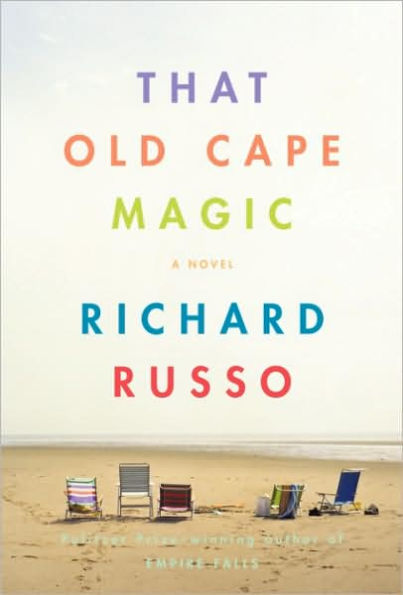
By turns hilarious, rueful, and uplifting, That Old Cape Magic is a profoundly involving novel about marriage, family, and all the other ties that bind.

Product Details
| ISBN-13: | 9780307273307 |
|---|---|
| Publisher: | Knopf Doubleday Publishing Group |
| Publication date: | 08/04/2009 |
| Sold by: | Random House |
| Format: | eBook |
| Pages: | 272 |
| Sales rank: | 292,116 |
| File size: | 3 MB |
About the Author

Hometown:
Gloversville, New YorkDate of Birth:
July 15, 1949Place of Birth:
Johnstown, New YorkEducation:
B.A., University of Arizona, 1967; Ph.D., University of Arizona, 1979; M.F.A., University of Arizona, 1980Read an Excerpt
IA Finer PlaceThough the digital clock on the bedside table in his hotel room read 5:17, Jack Griffin, suddenly wide awake, knew he wouldn’t be able to get back to sleep. He’d allowed himself to drift off too early the night before. On the heels of wakefulness came an unpleasant realization, that what he hadn’t wanted to admit yesterday, even to himself, was now all too clear in the solitary, predawn dark. He should have swallowed his petulance and waited the extra day for Joy.It had been their long- established habit to flee the campus as soon as Griffin taught his last class. Usually, they hopped on the Freedom Trail (his term for I- 95), drove to New York and treated themselves by checking into a good hotel. During the day he would evaluate his small mountain of student portfolios while Joy shopped or otherwise amused herself, and then, evenings, they’d catch up on movies and go to good restaurants. The whole thing reminded him of the early years of their marriage back in L.A. It cost a small fortune, but there was something about spending money they didn’t really have that made him optimistic about more coming in—which was how it had worked in L.A.—and it got him through the portfolios.This year Kelsey’s Cape Cod wedding had royally screwed up their plans, making New York impractical, though he’d been willing to substitute Boston. But Joy, assuming that thanks to the wedding all the usual bets were off, had messed things up further by schedulingmeetings on the day after his last class. “Just go,” she said when he expressed his annoyance at the way things were working out. “Have a boys’ night out in Boston and I’ll meet you on the Cape.” He’d squinted at this proposal. Didn’t you need more than one to have a boys’ night out? Or had Joy meant it to be singular, one boy celebrating his boyness? Was that how she’d understoodthe phrase all her life, as singular? Joy’s relationship to the English language was not without glitches. She was forever mixing metaphors, claiming that something was “a tough line to hoe.” Row to hoe? Line to walk? Her sisters, Jane and June, were even worse,and when corrected all three would narrow their eyes dangerously and identically. If they’d had a family motto, it would have been You Know Perfectly Well What I Mean.In any event his wife’s suggestion that he go on without her had seemed less than sincere, which was why he decided to call her bluff. “All right,” he said, “that’s what I’ll do,” expecting her to say, Fine, if it means that much to you, I’ll reschedule the meetings. But she hadn’t said that, even when she saw him packing his bag, and so he’d discovered a truth that other men probably knew already— that once you’d packed a bag in front of a woman there was no possibility of unpacking, or of not going and taking the damn bag with you.Worse, Joy, who preferred to watch movies on DVD rather than in a theater, as they were meant to be seen, had given him a list of films he was forbidden to see without her, and of course these were the only ones worth seeing. He’d spent an hour looking through the restaurant guides provided by the hotel, but couldn’t decide on one, or even on what kind of food he wanted. Griffin had no trouble making these sorts of decisions when she was around, but for some reason, when he had only himself to please, he often couldn’t make up his mind. He told himself this was just the result of being married for thirty years, that part of the decision- making process was imagining what his wife would enjoy. Okay, but more and more he found himself stalled, in the middle of whatever room he happened to be standing in, and he realized that this had been, of course, his father’s classic pose. In the end Griffin had ordered room service and watched a crappy made- for- TV movie, the kind he and Tommy, his old partner, had been reduced to writing that last year or two in L.A. before he’d gotten his teaching gig and moved back East with Joy and their daughter, Laura. He’d fallen asleep before the first commercial, confident he could predict not only the movie’s outcome but also half its dialogue.In order not to dwell on yesterday’s mistakes, he decided to put today in motion by calling down to the bell captain for his car. Twenty minutes later, dressed and showered, he’d checked out of his Back Bay hotel. The whole of Boston fit neatly into the rectangle of his rearview mirror, and by the time the Sagamore Bridge, one of two that spanned the Cape Cod Canal, hove into view, the sky was silver in the east, and he felt the last remnants of yesterday’s prevarications begin to lift like the patchy fog he’d been in and out of since leaving the city. The Sagamore arched dramatically upward in the middle, helping to pull the sun over the horizon, and though the air was far too cool, Griffin pulled off onto the shoulder of the road and put the convertible’s top down, feeling truly off the reservation for the first time since leaving home in Connecticut. There was something vaguely thrilling about not being where his wife thought he was. She liked to know what people were up to, and not just him. She called Laura most mornings, her brain still lazy with sleep, to ask “So . . . what’s on the agenda for you today?” She also phoned both of her sisters several times a week and knew that June was having her hair done tomorrow morning and that Jane had put on five new pounds and was starting a diet. She even knew what new folly her idiot twin brothers, Jared and Jason, were engaged in. To Griffin, an only child, such behavior was well over the line that separated the merely inexplicable from the truly perverse.Zipping along Route 6, Griffin realized he was humming “That Old Black Magic,” the song his parents had sung ironically—both university English professors, that’s how they did most things— every time they crossed the Sagamore, substituting Cape for black. When he was growing up, they’d spent part of every summer on the Cape. He could always tell what kind of year it had been, moneywise, by when and where they stayed. One particularly prosperous year they’d rented a small house in Chatham for the month of August. Another year, when faculty salaries were frozen, all they could afford was Sandwich in June. His parents had been less wed to each other than to a shared sense of grievance over being exiled eleven months of every year to the “Mid- fucking- west,” a phrase they didn’t say so much as spit. They had good academic careers, though perhaps not the stellar ones that might have been predicted, given their Ivy League pedigree. Both had grown up in the Rust Belt of western New York State, his mother in suburban Rochester, his father in Buffalo, the children of lower- middle- class, white- collar parents. At Cornell, where they’d both gone on scholarship, they’d met not only each other but also the kind of friends who’d invited them home for holidays in Wellesley and Westchester and for summer vacations in the Hamptons or on the Cape. They told their parents they could earn more money there, which was true, but in fact they’d have done anything to avoid returning to their parents’ depressing upstate homes. At Yale, where they did their graduate work, they came to believe they were destined for research positions at one of the other Ivys, at least until the market for academics headed south and they had to take what they could get—the pickings even slimmer for a couple—and that turned out to be a huge state university in Indiana.Betrayed. That was how they felt. Why go to Cornell, to Yale, if Indiana was your reward? But they’d had little choice but to hunker down and make the best of their wretched timing, so they dove into teaching and research and committee work, hoping to bolster their vitae so that when the academic winds changed they’d be ready. They feared the Princeton and Dartmouth ships had probably sailed for good, but that still left the Swarthmores and Vassars of the world as safe if not terribly exciting havens. This much, at least, was surely their due. And before going up for promotion and tenure (or “promotion and tether,” in their parlance) in the Midfucking-west, they’d each had opportunities—she at Amherst, he at Bowdoin—but never together. So they stayed put in their jobs and their marriage, each terrified, Griffin now suspected, that the other, unshackled, would succeed and escape to the kind of academic post (an endowed chair!) that would complete the misery of the one left behind. To make their unhappy circumstances more tolerable, they had affairs and pretended to be deeply wounded when these came to light. His father had been a genuine serial adulterer, whereas his mother simply refused to lag behind in this or anything else.Of course all of this was adult understanding. As a boy, the reluctant witness to his parents’ myriad quarrels and recriminations, Griffin had imagined that he must be the one keeping them together. It was his mother who eventually disabused him of this bizarre notion. At his and Joy’s wedding reception, actually. But by then they had finally divorced—even spite, apparently, was not eternal—and she’d narrowly won the race to remarry. In an ecumenical mood, she ventured outside the English department for her second husband, a philosopher named Bart, whom she’d quickly dubbed “Bartleby.” At the reception, half in her cups, she’d assured Griffin, “Good heavens, no, it wasn’t you. What kept us together was ‘That Old Cape Magic.’ Remember how we used to sing it every year on the Sagamore?” She then turned to Bartleby. “One glorious month, each summer,” she explained. “Sun. Sand. Water. Gin. Followed by eleven months of misery.” Then back to Griffin. “But that’s about par for most marriages, I think you’ll find.” The I think you’ll find, he understood, was of course meant to suggest that in her view, his own marital arithmetic was likely to be much the same. For a moment it seemed as if Bartleby might offer an observation of his own, but he apparently preferred not to, though he did sigh meaningfully. Griffin was about to respond when his father reappeared with Claudia, his former graduate student and new wife. They’d disappearedbriefly after the ceremony, to quarrel or make love, he had no idea. “I swear to God,” his mother said, “if he buys that child a house on the Cape—and I do mean anywhere on the Cape—I may have to murder him.” Her face brightened at a pleasant thought. “You might actually prove useful,” she told Bartleby, then turned back to Griffin. “Your stepfather collects locked- room murder mysteries. Death by curare, that sort of thing. You can figure something out, can’t you? Just make sure I’m in full view of everyone in the drawing room when the fat cow hits the deck, writhing in excruciating pain.” She knew perfectly well, of course, that Griffin’s father didn’t have the money to buy Claudia (who was more zaftig than fat) or anyone else a house on the Cape, of course. She’d made sure of that by beggaring him in the divorce settlement, but the possibility— what of, that he might purchase a winning Lotto ticket?—still clearly worried her.To Griffin, now fifty- five, roughly the same age his parents had been when he and Joy married, the Cape place- names were stillmagical: Falmouth, Woods Hole, Barnstable, Dennis, Orleans, Harwich. They made a boy of him again and put him in the backseat ofhis parents’ car, where he’d spent much of his boyhood, unbelted, resting his arms on the front seat, trying to hear what they, who never made any attempt to include him in their conversations, were talking about. It wasn’t so much that he was interested in their front- seat conversations as aware that decisions that impacted him were being made up there, and if privy to these hatching plans he might offer an opinion. Unfortunately, the fact that his chin was resting on the seat back seemed to preclude this. Most of what he overheard wasn’t really worth the effort anyway. “Wellfleet,” his mother might say, studying the road atlas. “Why haven’t we ever tried Wellfleet?” By the time Griffin was a high school freshman, which marked the last of their Cape vacations, they’d rented just about everywhere. Each summer, when they handed over the keys at the end of their stay, the rental agent always asked if they wanted to book it for next year, but they always said no, which made Griffin wonder if the perfect spot they were searching for really existed. Perhaps, he concluded, just looking was sufficient in and of itself.While he roamed the beach unattended, full of youthful energy and freedom, his parents spent sunny afternoons lying on the sand with their “guilty pleasures,” books they’d have been embarrassed to admit to their colleagues they’d ever heard of. They were on vacation, they claimed, not just from the Mid- fucking- west but also from the literary canon they’d sworn to uphold. His mother’s taste ran to dark, disturbing thrillers and cynical spy novels. “That,” she would say, turning the book’s last page with evident satisfaction, “was truly twisted.” His father alternated between literary pornography and P. G. Wodehouse, enjoying both thoroughly, as if Naked Lunch and Bertie Wooster Sees It Through were intended as companion pieces. The only thing they both read—indeed, studied as intently as each year’s Modern Language Association job listings—was the real- estate guide. Unwilling to give the other a first look, they always picked up two copies as soon as they arrived and wrote their names on the covers so they’d know which was which and whose fault it was if one got lost. A house here was part of their longrange, two- part plan to escape the Mid- fucking- west. First they would find real jobs back East, where they’d locate a suitable apartment to rent. This would allow them to save money for a house on the Cape, where they’d spend summers and holidays and the occasional long weekend, until of course they retired—early if they could swing it—and lived on there full- time, reading and writing op- eds and, who knew, maybe even trying their hand at a novel.A single day was usually all it took for each of them to plow through the hundreds of listings in the fat real- estate guide and place each into one of two categories—Can’t Afford It or Wouldn’t Have It As a Gift—before tossing the booklet aside in disgust, because everything was more expensive this year than last. But the very next day his father would set Jeeves aside and take another look. “Page twenty- seven,” he’d say, and Griffin’s mother would set down her Ripley and rummage for her copy in the beach bag. “Bear with me, now,” he’d continue. Or, “Some things would have to go right”—meaning a big merit raise or a new university- press book contract—“but . . .” And then he’d explain why a couple of the listings they’d quickly dismissed the day before just maybe could be made to work. Later in the month, on a rainy day, they’d go so far as to look at a house or two at the low end of the Can’t Afford It category, but the realtors always intuited at a glance that Griffin’s parents were just tire kickers. The house they wanted was located in a future only they could see. For people who dealt largely in dreams, his father was fond of observing, realtors were a surprisingly unromantic bunch, like card counters in a Vegas casino.The drive back to the Mid- fucking- west was always brutal, his parents barely speaking to each other, as if suddenly recalling last year’s infidelities, or maybe contemplating whom they’d settle for this year. Sex, if you went by Griffin’s parents, definitely took abackseat to real estate on the passion gauge.
Reading Group Guide
The questions, discussion topics, and reading list that follow are intended to enhance your reading group's discussion of That Old Cape Magic, Richard Russo's rueful story of a marriage, and of all the other ties that bind.
1. What does Jack Griffin want?
2. In reference to his parents' ongoing but fruitless search for a Cape Cod beach house, Griffin muses, “Perhaps . . . just looking was sufficient in and of itself” (page 9). Is looking enough? Which characters prove or disprove this point of view?
3. One page 16, Griffin points out to his mother that she and his father used to sing “That Old Cape Magic” on the Sagamore Bridge, “as if happiness were a place.” Is it possible for happiness to be a place? Can a place save a relationship?
4. Griffin poses a question to himself: “Why was he more resentful of Harve and Jill, who really wanted to understand how he made his living, than his own parents, who had never, to his knowledge, seen a single film he had anything to do with” (page 49)? Griffin doesn't admit to an answer, but what do you think the answer is?
5. In “The Summer of the Brownings,” young Griffin refuses to spend his last night on the Cape with Peter, even though the decision only serves to hurt everyone. Can you point to other incidents in which Griffin exercises his perverse desire to hurt himself and others?
6. Why is Griffin so apprehensive of commitment? What is he afraid of losing?
7. Griffin notes that “his wife's natural inclination was toward contentment” (page 105). What is Griffin's natural inclination?
8. Is Griffin afraid of being happy? Is being the happy the same as “settling”?
9. How has Griffin's cynicism caused him to misinterpret the intentions of those around him?
10. Why does it take so long for Griffin to dispose of his parents' remains?
11. Why does Griffin feel the need to carry on internal conversations with his mother?
12. How does Griffin's relationship with his parents lead to the dissolution of his marriage to Joy?
13. Why does Griffin insist on staying in L.A., away from Joy?
14. Griffin uneasily considers the parallels between Joy's attachment to himself and Tommy and Laura's attachment to Andy and Sunny. How do these similar triangles play out?
15. This book dances around the concept of responsibility: filial responsibility, marital responsibility, and personal responsibility, to name a few. What do Russo's characters feel about responsibility?
(For a complete list of available reading group guides, and to sign up for the Reading Group Center enewsletter, visit www.readinggroupcenter.com)
Introduction
The questions, discussion topics, and reading list that follow are intended to enhance your reading group's discussion of That Old Cape Magic, Richard Russo's rueful story of a marriage, and of all the other ties that bind.
Related Subjects
Customer Reviews
Explore More Items