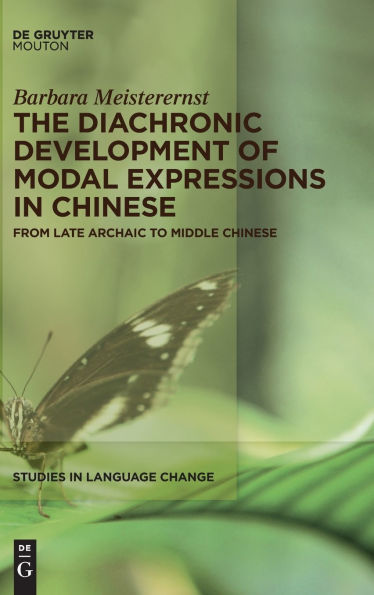
The Diachronic Development of Modal Expressions in Chinese: From Late Archaic to Middle Chinese
The present study is the first to apply a syntactic approach to the grammaticalization of Chinese modals, based on hypotheses on cross-linguistic diachronic developments of modals from lexical to functional categories as upward movement on a functional spine. The temporal framework of the study covers Late Archaic and Middle Chinese. Early Middle Chinese is a crucial turning point for the development of Chinese from a more synthetic to a more analytic language. This change is attributed e.g. to the loss of a former morphology, which also affects the modal system. Against this background, the negative cycle of Chinese, the relevance of polarity contexts, and the development of a new system of deontic, epistemic and future markers are analyzed.

In addition to a comprehensive analysis of the syntactic processes involved in the diachronic changes of the Chinese modal system, the study also provides a comparison with the syntax of grammaticalization of the thoroughly discussed Germanic modals. This constitutes a broad basis for further analyses of the changes in the Chinese language during its long written history, but also for cross-linguistic studies on the syntax of grammaticalization and on linguistic universals.
1142971096
The Diachronic Development of Modal Expressions in Chinese: From Late Archaic to Middle Chinese
The present study is the first to apply a syntactic approach to the grammaticalization of Chinese modals, based on hypotheses on cross-linguistic diachronic developments of modals from lexical to functional categories as upward movement on a functional spine. The temporal framework of the study covers Late Archaic and Middle Chinese. Early Middle Chinese is a crucial turning point for the development of Chinese from a more synthetic to a more analytic language. This change is attributed e.g. to the loss of a former morphology, which also affects the modal system. Against this background, the negative cycle of Chinese, the relevance of polarity contexts, and the development of a new system of deontic, epistemic and future markers are analyzed.

In addition to a comprehensive analysis of the syntactic processes involved in the diachronic changes of the Chinese modal system, the study also provides a comparison with the syntax of grammaticalization of the thoroughly discussed Germanic modals. This constitutes a broad basis for further analyses of the changes in the Chinese language during its long written history, but also for cross-linguistic studies on the syntax of grammaticalization and on linguistic universals.

140.99 Out Of Stock
The Diachronic Development of Modal Expressions in Chinese: From Late Archaic to Middle Chinese

The Diachronic Development of Modal Expressions in Chinese: From Late Archaic to Middle Chinese

by Barbara Meisterernst
The Diachronic Development of Modal Expressions in Chinese: From Late Archaic to Middle Chinese

The Diachronic Development of Modal Expressions in Chinese: From Late Archaic to Middle Chinese

by Barbara Meisterernst

Hardcover

$140.99 
  • SHIP THIS ITEM
    Temporarily Out of Stock Online
  • PICK UP IN STORE

    Your local store may have stock of this item.

Related collections and offers


Overview

The present study is the first to apply a syntactic approach to the grammaticalization of Chinese modals, based on hypotheses on cross-linguistic diachronic developments of modals from lexical to functional categories as upward movement on a functional spine. The temporal framework of the study covers Late Archaic and Middle Chinese. Early Middle Chinese is a crucial turning point for the development of Chinese from a more synthetic to a more analytic language. This change is attributed e.g. to the loss of a former morphology, which also affects the modal system. Against this background, the negative cycle of Chinese, the relevance of polarity contexts, and the development of a new system of deontic, epistemic and future markers are analyzed.

In addition to a comprehensive analysis of the syntactic processes involved in the diachronic changes of the Chinese modal system, the study also provides a comparison with the syntax of grammaticalization of the thoroughly discussed Germanic modals. This constitutes a broad basis for further analyses of the changes in the Chinese language during its long written history, but also for cross-linguistic studies on the syntax of grammaticalization and on linguistic universals.


Product Details

ISBN-13: 9783110737783
Publisher: De Gruyter
Publication date: 11/18/2024
Series: Studies in Language Change [SLC] , #18
Pages: 385
Product dimensions: 6.10(w) x 9.06(h) x (d)
Age Range: 18 Years

About the Author

Barbara Meisterernst, National Tsing Hua University, Hsinchu, Taiwan, and University of Stuttgart.
From the B&N Reads Blog

Customer Reviews