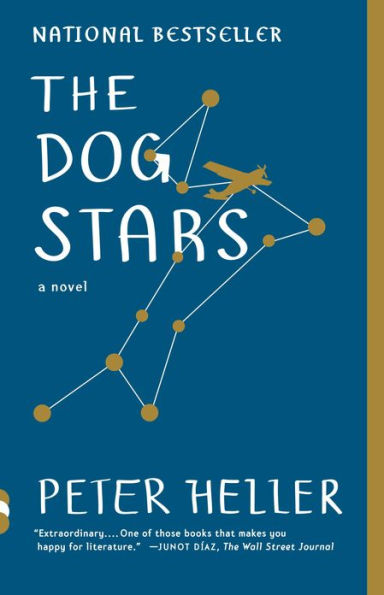
From the Publisher
“The Dog Stars creates a delicate balance between post-civilization wish fulfillment and the deep human need for connection. . . . Heller writes like a kind of latter-day Hemingway or McCarthy. . . . Our current uncertainties can’t hold a candle to nuclear war or a devastating plague, but in the end, the remedy for our fears remains the same: love and connection.” —Clay Evans, Boulder Daily Camera
“Heller sculpts a unique and compelling story [and] an intricate hero who inspires a risky break from complacency in a quest for happiness that can’t be planned but must be forged. . . . [Heller’s] best work yet, combining his keen eye for details and his energetic writing with a gift for introspective storytelling.” —Jason Blevins, The Denver Post
“[The Dog Stars] gripped me—it’s the real deal. Heller’s voice is extraordinary and his narrator’s toughness seems to hide a beautiful and aching restlessness. One of those books that makes you happy for literature.” —Junot Díaz, Wall Street Journal
“A novel about no less than isolation, humanity, empathy, and need.” —The Christian Science Monitor
“Lyrical . . . This is a beautiful, haunting and hopeful book written with a poetic sparseness that makes your breath catch and your heart ache.” —Carole O’Brien, Aspen Daily News Online
“Heller has created a heartbreakingly moving love story with The Dog Stars, one of this year’s greatest literary surprises. . . . A poetic and stellar story of what can happen to men and women when their world begins to die. It’s an ode to what we’ve lost so far, and how we risk losing everything. Grade: A+” —John J. Kelly, Cincinnati City Beat
“Vivacious . . . Heller’s writing is powerful and elegant even when in the vernacular, and polished to a high degree. The narrator’s voice comes through in all his sadness. The story as far as it goes is relatively believable, swiftly paced and engrossing.” —Michel Basilières, The Star
“Beautifully narrated . . . a book that will surprise you. . . . Hig is a charmer, a man of his word with a wicked sense of humor and an acute sense of survival. His eyes are open to the world as only a poet’s can be, observing and absorbing any beauty left in the aftermath of the world’s tragedy. . . . The author shocks readers with unexpected bursts of action-packed scenes that keep the book moving at a suspenseful pace, without compromising the literary style. Heller has written a rare novel that combines readability with high-style prose, while making each compliment the other. The result is a book that rests easily on shelves with Dean Koontz, Jack London or Hemingway. The prose in this novel is anything but conventional. It often is painfully beautiful as the story lapses into arching poetic verse when High is pushed to the very depths of despair, yet still he retains hope. The Dog Stars illustrates the strength of bonds that can be formed between men, the fierce companionship between man and dog, and the inner-struggle of a survivor's guilt with gut-wrenching clarity. Heller’s sensitivity to nature and descriptive detail brings about an appreciation that will make readers pause, if only for a moment, to reflect on the majesty of their own natural surroundings. It’s a tale of humanity after Doomsday, from an author who’s not afraid to step out of his comfort zone.” —Mindy Sansoucie, The Missourian
“What [Hig] encounters along the way brings to the fore primal instincts and essential desires. The action is swift, pinpointing old struggles with little ado: Companionship is what we long for, memory is what confounds us, sex is what agitates the caldron of all we are. The narrative has the urgency and rhythm of Morse code. An amalgam of long and short utterances, it goes far in conveying the near-isolation of an alert mind. . . . In the end, the stronghold grows. Whether that has larger implications for the future of humanity is irrelevant. Scarcity leads to the discovery of new pleasures. To a re-evaluation of what matters. To a sense of home. Giving one’s dog a place among the constellations in the company of a lover amounts to all of the above.” —Rudy Mesicek, The Salt Lake Tribune
“Fresh . . . quiet, meditative . . . it’s the people [Hig] meets when he least expects to who change everything, proving a truth we know from our everyday nonfictional lives: Even when it seems like all the humans in the world are only out for themselves, there are always those few who prove you absolutely wrong—in the most surprising of ways.” —Leigh Newman, Oprah.com
"A stupendous debut, Heller's voice is both haunted and irresistible. A post-apocalyptic novel with so much emotional truth it reads like a memoir from the future. About a worn-out pilot, his beloved Cessna, his copilot dog and our endless longing for connection—even in a world undone." —Junot Diaz
“When Hig takes his plane into the wilderness surrounding the airport, The Dog Stars can feel less like a 21st-century apocalypse and more like a 19th-century frontier narrative (albeit one in which many, many species have become extinct). There are echoes of Grizzly Adams or Jeremiah Johnson in scenes where Heller lingers on the details of how the water in a flowing stream changes color as the sun moves across the sky, or making a fire from fallen twigs on a bed of dry moss. Modern technology finds its way back into the story, but we’re so far inside Hig’s head that it feels like one more element in the dreamlike landscape. Though it is punctuated by intensely violent outbursts, once these recede into the background, Heller’s novel can approach moments of quiet, poetic beauty.” —Ron Hogan, Dallas News
“An elegy for a lost world turns suddenly into a paean to new possibilities. In The Dog Stars, Peter Heller serves up an insightful account of physical, mental, and spiritual survival unfolded in dramatic and often lyrical prose . . . in which unexpected hope persistently flickers amid darkness.” —Alan Cheuse, The Boston Globe
“Hig sees animals in the stars, beauty in trees and love in his memories—and so will you. The story is at times brutal but the language is often poetic. This is a deeply felt story about things we all crave: connection, love and survival in an unforgiving world.” —Ronni Mott, Jackson Free Press
“[A] terrific debut novel . . . Recalling the bleakness of Cormac McCarthy and the trout-praising beauty of David James Duncan, The Dog Stars makes a compelling case that the wild world will survive the apocalypse just fine; it’s the humans who will have the heavy lifting.” —Bruce Barcott, Outside Magazine
“Suspenseful, full of action and hope, and a love story. . . . The book is one you’ll not soon forget.” — Kay Dyer, The Oklahoman
“Heller’s writing gives you a heartbreaking jolt, like a sudden wakening from a dream.” —Moira Macdonald, The Seattle Times
“What separates Heller's book from other End of Days stories is that it doesn't rely on the thematic fail-safes to tell the story—The Dog Stars is quite simply the story of what it's like to be alone. What it feels like to not know more than one or two other people for a decade. What it's like to love those people while fearing them, all the time knowing that survival sometimes means you have to shoot first.” —Melody Datz, The Stranger
“Heller crafts a richly emotional perspective on how humans choose to respond when confronted with calamity. . . . [T]here’s a singular voice at work here in Hig’s halting first-person narration that turns his mind into a battleground between two choices of handling apocalypse: self-preserving fear, or risky humanity. At times funny, at times thrilling, at times simply heartbreaking and always rich with a love of nature, The Dog Stars finds a peculiar poetry in deciding that there’s really no such thing as the end of the world—just a series of decisions about how we live in whatever world we’ve got.” —Scott Renshaw, Salt Lake City Weekly
“The Dog Stars by Peter Heller is a heavenly book, a stellar achievement by a debut novelist that manages to combine sparkling prose with truly memorable, shining, characters. It contains constellations of grand images and ideas, gleams with vitality, and sparkles with wit. And for a story of this ilk, it is also—a rarity—radiant with hope. Despite the many terrible events threatening to engulf our heroes, The Dog Stars never falls into the black hole of hopelessness common in many post-apocalyptic fictions. . . . Luminous with bright ideas . . . The Dog Stars is the story of Hig’s conversation with his faith, with his humanity, with his former life. By turns moving, articulate and, exciting, it is also one of those stories that remains with the reader long after the book is closed. It contains all of the lyricism of Cormac McCarthy at his best—Hig fights for ‘things that have no use anymore except as a bulwark against oblivion. Against the darkness of total loss.’ And he reaches for the stars. For the constellations of his memory. He looks up and not down.” —A. J. Kirby, New York Journal of Books
“With its soulful hero, macabre villains, tender love story and action scenes staggered at perfectly spaced intervals, [The Dog Stars] unfolds with the vigor of the film it will undoubtedly become. But it also succeeds as a dark, poetic and funny novel in its own right. . . . That [Hig’s] story is not in the end depressing may be the most disturbing part of this novel. In fact, at times, the destruction of civilization seems to have given Hig the chance to live more richly in the present, to feel grace more acutely, to sleep outdoors and gaze up at the stars in his purged, rejuvenated universe. It is frightening to face up to the apocalypse. It’s perhaps even more frightening when we get past that and start seeing its upside.” —Jennifer Reese, NPR
“A stunning, hope-riddled end-of-the-world story . . . bound to become a classic.” —Emily Temple, Flavorwire
“The Dog Stars is a post-apocalyptic adventure novel with the soul of haiku. . . . Heller is a well-known adventure writer, and his knowledge of and sensitivity to nature and outdoor pursuits come through here with precision and power. . . . A novel that gets under the skin of what it means to survive unbearable loss.” —Margaret Quamme, The Columbus Dispatch
“A heart-wrenching and richly written story about loss and survival—and, more important, about learning to love again. . . . The Dog Stars is a love story, but not just in the typical sense. It’s an ode to friendship between two men, a story of the strong bond between a human and a dog, and a reminder of what is worth living for.”—Michele Filgate, Minneapolis Star Tribune
“By putting us in the worst of all possible times, literature can allow us to experience the best side of humankind, where instead of giving up, we struggle desperately in the ruins for love, connection and hope. And that brings us to Peter Heller’s ravishing doomsday novel, The Dog Stars. . . . An indelible core of kindness beats like a heart within [Hig]. . . . The supreme pleasure of this book is the lovely writing. Hig talks to himself, and to us, in a kind of syncopated rhythm that’s as intimate as a conversation, with pauses and clipped words. . . . In the midst of all the devastation, Heller shows us the stunning beauty of the natural world. . . . The pages of The Dog Stars are damp with grief for what is lost and can never be recovered. But there are moments of unexpected happiness, of real human interaction, infused with love and hope, like the twinkling of a star we might wish upon, which makes this end-of-the-world novel more like a rapturous beginning. . . . Remarkable.”—Caroline Leavitt, San Francisco Chronicle
“Magical and life-affirming.” —Eric Brown, The Guardian
“Terrific . . . With echoes of Moby Dick, The Dog Stars . . . brings Melville’s broad, contemplative exploration of good and evil to his story; he tells it in the spare, often disjunctive, language of Beckett. Heller’s vision, however, is not as dark as that of his literary antecedents. . . . With startling lyricism, Heller’s accomplished first novel rises above the inherent darkness of a world stripped bare by disease, climate change and violence” —Bruce Jacobs, Shelf Awareness
“Alternates between elegiac reflection, lyrical nature writing, and intense, high-caliber action.” —NPR
“The critically acclaimed book of the summer.” —Philadelphia Magazine
“The Dog Stars is a compelling debut from author Peter Heller, which decisively strikes at the ever-arching desire to know what makes us human. . . . Gruff, tormented and inspirational, Heller has the astonishing ability to make you laugh, cringe and feel ridiculously vulnerable throughout the novel that will have you rereading certain passages with a hard lump in the pit of your stomach. One of the most powerful reads in years.” —Playboy
“After an award-winning career as an adventure writer and NPR contributor, Heller has written a stunning debut novel. In spare, poetic prose, he portrays a soaring spirit of hope that triumphs over heartbreak, trauma, and insurmountable struggles. A timely must-read.” —Library Journal
“Richly evocative yet streamlined journal entries propel the high-stakes plot while simultaneously illuminating Hig’s nuanced states of mind as isolation and constant vigilance exact their toll, along with his sorrow for the dying world . . . Heller’s surprising and irresistible blend of suspense, romance, social insight, and humor creates a cunning form of cognitive dissonance neatly pegged by Hig as an ‘apocalyptic parody of Norman Rockwell’—a novel, that is, of spiky pleasure and signal resonance.” —Donna Seaman, Booklist (starred)
“In the tradition of postapocalyptic literary fiction such as Cormac McCarthy’s The Road and Jim Crace’s The Pesthouse, this hypervisceral first novel by adventure writer Heller (Kook) takes place nine years after a superflu has killed off much of mankind. . . . With its evocative descriptions of hunting, fishing, and flying, this novel, perhaps the world’s most poetic survival guide, reads as if Billy Collins had novelized one of George Romero’s zombie flicks. From start to finish, Heller carries the reader aloft on graceful prose, intense action, and deeply felt emotion.” —Publishers Weekly
“Leave it to Peter Heller to imagine a post-apocalyptic world that contains as much loveliness as it does devastation. His likable hero, Hig, flies around what was once Colorado in his 1956 Cessna, chasing all the same things we chase in these pre-annihilation days: love, friendship, the solace of the natural world, the chance to perform some small kindness, and a good dog for a co-pilot. The Dog Stars is a wholly compelling and deeply engaging debut.” —Pam Houston, author of Contents May Have Shifted
“Take the sensibility of Hemingway. Or James Dickey. Place it in a world where a flu mutation has wiped out ninety-nine percent of the population. Add in a heartbroken man with a fishing rod, some guns, a small plane. Don't forget the dog. Now imagine this man retains more hope than might be wise in such a battered and brutal time. More trust. More hunger for love—more capacity for it, too. That's what Peter Heller has given us in his beautifully written first novel. The Dog Stars is a gripping tale of one man's fight for survival against impossibly long odds. A man who has lost nearly everything but his soul. And what's so moving about Heller's book is that he shows us how sometimes a big soul is the only thing a man needs: the keystone, the center pillar, the hunk of masonry upon which all else will rise or fall.” —Scott Smith, author of A Simple Plan and The Ruins
“Heller is a masterful storyteller and The Dog Stars is a beautiful tribute to the resilience of nature and the relentless human drive to find meaning and deep connections with life and the living. In this chillingly realistic post-apocalyptic setting, readers will root for Heller's characters and be moved by their toughness as well as their tenderness.” —Julianna Baggott, author of Pure
“The Dog Stars is a giant of a novel that goes about its profound business with what looks alarmingly like ease. For all those who thought Cormac McCarthy's The Road the last word on the post-apocalyptic world—think again. Peter Heller has dark and glittering news from the future, and delivers it in prose that stops you like a wolf in the snow. Make time and space for this savage, tender, brilliant book.” —Glen Duncan, author of The Last Werewolf and Talulla Rising