
"This refreshingly original tour of the ancient world’s lesser-known locales challenges readers to imagine familiar stories from the other side for a change. … By highlighting how cultural partisans of the past shaped how history was told, Rees aims to help readers see beyond the stereotyping that bluntly divided the ancient world into tidy categories such as civilized and uncivilized, citizen and barbarian. His book is a reminder that while neatly defined narratives may seem appealing, the truth is rarely so straightforward."— Michael Patrick Brady Wall Street Journal
"This is the book for expanding your ancient history horizon. Owen Rees skillfully brings little-known places filled with amazing ancient history away from the periphery and into the spotlight."— Tristan Hughes, host of The Ancients podcast
"[A]n illuminating history of the marginalized cultures of the ancient world. … Lively and propulsive, this brings obscure corners of the ancient world to life."— Publishers Weekly
"Good ancient history off the beaten path."— Kirkus Reviews
"A true tour of horizons, the ancients’ and our own. . . . Fascinating questions arise: When is a border a boundary? When is a site a city? And when are people ‘classics’?"— Josephine Quinn, author of How the World Made the West
"A blast of fresh air, presenting a perspective on cultural history that is breathtaking in its scope. . . . An indispensable guide to our shared past."— Jane Draycott, author of Cleopatra’s Daughter
"In this pathbreaking and vital book, Owen Rees opens new perspectives on ancient history . . . to reveal surprising connections, from Hadrian’s Wall and the Scythian steppes to Africa’s Rift Valley, the Khyber Pass, and Southeast Asia."— Adrienne Mayor, author of The Amazons
"This is a powerful and wide-ranging account of life at the edges of the known world. . . . Rees takes us on a journey of discovery that never fails to be engaging."— Helen King, author of Immaculate Forms
"Fascinating. An interesting, and unique, exploration of aspects and areas at the periphery or edge of the 'traditional' ancient world which are often omitted or overlooked by the standard histories. From Lake Turkana and Megiddo to Aksum and Taxila, this is a volume well worth your time and attention!"— Eric Cline, author of 1177 B.C.
"A transformative portrayal of the ancient world, seen not from its centre but its margins. … Essential reading for anyone who wants to understand how the city-states and empires of the ancient Mediterranean fit into a global history."— Catherine Fletcher, author of The Roads to Rome
When Ovid was exiled from Rome to a border town on the Black Sea, he despaired at his bleak and barbarous new surroundings. Like many Greeks and Romans, Ovid thought the outer reaches of his world was where civilization ceased to exist. Our own fascination with the Greek and Roman world has for centuries followed this perspective, shrouding cultures at the far reaches of their influence in myth. But what was it like to live on the edges of these empires, on the boundaries of the known world?
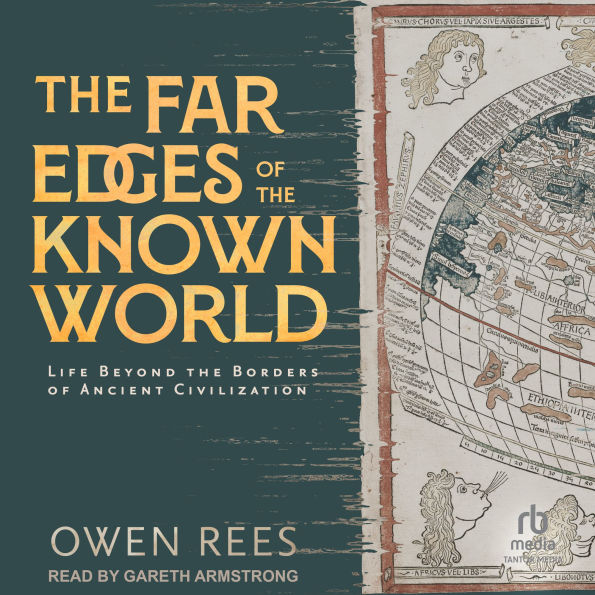
In The Far Edges of the Known World, ancient historian Owen Rees draws on archaeological excavations to reveal these so-called borders as thriving multicultural spaces. This is where the boundaries of "civilized" and "barbarian" began to dissipate; where traditional rules didn't always apply; where different cultures intermarried; and where nomadic tribes built their own cities. Rees journeys from the sandy caravan routes of Morocco to the freezing winters of the northern Black Sea, from the Red River valley of Vietnam to the rain-lashed forts south of Hadrian's Wall. Rees introduces us to the everyday people who called the borderlands home. As Rees shows, exchanges of trends, ideas, even religious practices were happening all over the world.
The Far Edges of the Known World offers us a vibrant new lens to see and understand the ancient world.
1146855268
In The Far Edges of the Known World, ancient historian Owen Rees draws on archaeological excavations to reveal these so-called borders as thriving multicultural spaces. This is where the boundaries of "civilized" and "barbarian" began to dissipate; where traditional rules didn't always apply; where different cultures intermarried; and where nomadic tribes built their own cities. Rees journeys from the sandy caravan routes of Morocco to the freezing winters of the northern Black Sea, from the Red River valley of Vietnam to the rain-lashed forts south of Hadrian's Wall. Rees introduces us to the everyday people who called the borderlands home. As Rees shows, exchanges of trends, ideas, even religious practices were happening all over the world.
The Far Edges of the Known World offers us a vibrant new lens to see and understand the ancient world.
The Far Edges of the Known World: Life Beyond the Borders of Ancient Civilization
When Ovid was exiled from Rome to a border town on the Black Sea, he despaired at his bleak and barbarous new surroundings. Like many Greeks and Romans, Ovid thought the outer reaches of his world was where civilization ceased to exist. Our own fascination with the Greek and Roman world has for centuries followed this perspective, shrouding cultures at the far reaches of their influence in myth. But what was it like to live on the edges of these empires, on the boundaries of the known world?
In The Far Edges of the Known World, ancient historian Owen Rees draws on archaeological excavations to reveal these so-called borders as thriving multicultural spaces. This is where the boundaries of "civilized" and "barbarian" began to dissipate; where traditional rules didn't always apply; where different cultures intermarried; and where nomadic tribes built their own cities. Rees journeys from the sandy caravan routes of Morocco to the freezing winters of the northern Black Sea, from the Red River valley of Vietnam to the rain-lashed forts south of Hadrian's Wall. Rees introduces us to the everyday people who called the borderlands home. As Rees shows, exchanges of trends, ideas, even religious practices were happening all over the world.
The Far Edges of the Known World offers us a vibrant new lens to see and understand the ancient world.
In The Far Edges of the Known World, ancient historian Owen Rees draws on archaeological excavations to reveal these so-called borders as thriving multicultural spaces. This is where the boundaries of "civilized" and "barbarian" began to dissipate; where traditional rules didn't always apply; where different cultures intermarried; and where nomadic tribes built their own cities. Rees journeys from the sandy caravan routes of Morocco to the freezing winters of the northern Black Sea, from the Red River valley of Vietnam to the rain-lashed forts south of Hadrian's Wall. Rees introduces us to the everyday people who called the borderlands home. As Rees shows, exchanges of trends, ideas, even religious practices were happening all over the world.
The Far Edges of the Known World offers us a vibrant new lens to see and understand the ancient world.
19.99
In Stock
5
1


The Far Edges of the Known World: Life Beyond the Borders of Ancient Civilization
The Far Edges of the Known World: Life Beyond the Borders of Ancient Civilization
FREE
with a B&N Audiobooks Subscription
Or Pay
$19.99
19.99
In Stock

Editorial Reviews
Product Details
| BN ID: | 2940195261030 |
|---|---|
| Publisher: | Tantor Audio |
| Publication date: | 09/30/2025 |
| Edition description: | Unabridged |
Videos

From the B&N Reads Blog